


Winter Coat Buying Guide for Black Friday 2026: How to Read Fill Power, Fill Weight, Wool Content and Waterproof Ratings
How to read a winter coat spec before Black Friday 2026: fill power vs fill weight, wool fibre labels and waterproof ratings, explained with sources.
 Mehul AgarwalFounder & CEO
Last updated: October 2026
Quick answer: On a down coat, fill power (for example 650 or 800) tells you the quality of the down, but fill weight (the ounces or grams of down inside) tells you how warm it is, so you need both numbers. On a wool coat, read the fibre label for the percentage of wool in the shell and whether the lining is insulating. On anything sold as waterproof, look for a hydrostatic head of at least 10,000mm. If a Black Friday listing hides these numbers, ask for them or skip it.
Black Friday falls on 27 November 2026, the day after US Thanksgiving, and winter coats are one of the categories people most often wait to buy on sale. Two puffers can look identical in photos and be completely different in warmth, and "wool coat" can mean mostly wool or mostly polyester. The numbers that settle it are on the spec sheet or the label. This guide explains what each one means, which ones brands are required to show, and how to compare them.
For a broader look at fabric quality online, see our Black Friday guide to judging clothing quality. This piece goes deep on coats.
Start with your winter, not the spec sheet
Before comparing coats, be clear about which problem you are solving, because the right numbers change with it:
- Dry cold (clear, below freezing): insulation matters most. Down or a thick wool coat both work.
- Wet cold (rain, sleet, slush around freezing): water protection matters as much as insulation. A waterproof shell, or treated down or synthetic fill under a water-resistant face fabric, will serve you better than untreated down.
- Standing still (school runs, bus stops, outdoor markets): you lose heat faster than when walking, so size up the insulation and think about length. A coat that covers your hips keeps more of you warm.
- Walking or cycling commutes: you will overheat in a very warm coat. A lighter insulated jacket you can open, layered over a knit, is often better.
Down coats: fill power is quality, fill weight is warmth

Fill power is a lab measure of how much space one ounce of down fills. REI's explainer describes the test: an ounce of down is placed in a cylinder under a lightly weighted disk, and after a minute the volume is recorded in cubic inches. So 650-fill down lofts to about 650 cubic inches per ounce. Higher numbers mean bigger, better down clusters that trap more air for their weight. REI calls 900 fill "about as good as down gets," and outdoor brands commonly use somewhere between 500 and 900.
What fill power does not tell you is how warm the coat is. That depends on how much down is inside, the fill weight. REI gives the example that a 900-fill jacket with 30g of down will not be warmer than a 450-fill jacket with 100g. Switchback Travel's guide puts typical fill weights at around 3 ounces of down for a lightweight jacket and 5 to 6 ounces for a midweight one.
How to use the two numbers together:
- Compare fill weight first when two coats have similar fill power. More down at the same fill power means more warmth.
- Use fill power to judge weight and packability. Higher fill power gives the same warmth with less down, so the coat is lighter and squashes smaller. If you never pack your coat, a well-filled 600 can be the better buy than a thinly filled 800.
- Be suspicious when only fill power is listed. REI notes that few jacket makers report fill weight. If a sale listing shouts "800 fill" but will not say how much down, ask customer service. A brand that knows its product can answer.
- Do not split hairs between close numbers. Fill power depends on the test method. UK maker PHD notes that the standard Lorch test reads about 4 percent lower than the US federal method for the same down, so a 50-point gap between two brands may not be a real difference.
Two other lines worth reading on a down coat's spec sheet:
- Treated or hydrophobic down. Switchback Travel explains that water-repellent treatments help down absorb less water and dry faster, but are "no match for full waterproofing." Useful for damp climates, not a substitute for a rain shell.
- Responsible Down Standard (RDS). Developed by the non-profit Textile Exchange, the RDS covers the welfare of the ducks and geese the down comes from and tracks certified down through the supply chain, according to certification body Intertek. If sourcing matters to you, look for it on the label or product page.
When you get the coat home, our guide to washing a down jacket covers how to keep that loft for years.
Synthetic insulation: what to compare instead
Synthetic fills (polyester insulation sold under various brand names) have no equivalent to fill power, so REI notes you cannot use a fill power number to compare synthetic against down, or one synthetic against another. Instead:
- Look for the insulation weight if the brand gives it (often in grams per square metre), and compare it only within the same brand's range.
- Use it where it shines: synthetic is the usual recommendation for damp climates and for people who want to machine-wash often without worrying about clumping.
Wool coats: how to read the fibre label
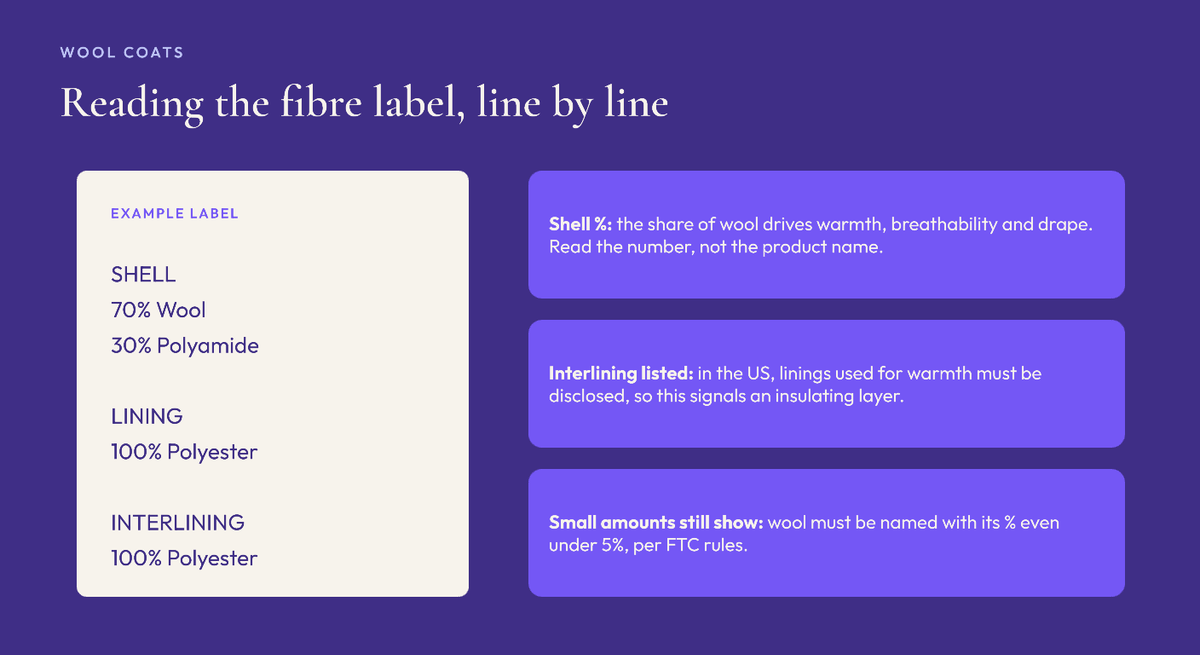
A wool coat's warmth comes from three things: how much wool is in the shell, how dense the fabric is, and what is inside it. The label tells you more than most people realise, especially in the US, where the Federal Trade Commission (FTC) sets the rules under the Wool Products Labeling Act. According to the FTC's business guide to textile and wool labeling:
- Fibre content must be shown by percentage. Look for the wool percentage in the shell, not just the word "wool" in the product name.
- Wool has to be named even in tiny amounts. Most fibres under 5 percent can be lumped together as "other fibers," but wool and recycled wool must be disclosed by name and percentage even below 5 percent. So "wool blend" with 4 percent wool will say so on the label.
- Recycled wool must be labelled as recycled wool. That is not a quality warning in itself; it is just a disclosure.
Want this styled from your own closet?
Elara builds the look from what you own, then lets you try it on.
- Insulating linings and fillings must be listed separately. Linings used only for structure do not need their fibre listed, but linings or fillings used for warmth must be disclosed section by section. A label that lists "Shell: 70% wool, 30% polyamide / Lining: 100% polyester / Interlining: 100% polyester" is telling you the coat has an insulating layer.
- "Cashmere" has a legal definition. Under the FTC rules, fibre can only be called cashmere if it comes from the cashmere goat's undercoat and averages no more than 19 microns in diameter, among other limits. Specialty fibre names like cashmere or alpaca must appear on the required label with a percentage, not only on a hang tag.
- Online listings must say where it was made. For wool products sold online or by catalogue, the FTC requires a clear statement of whether the item was made in the USA, imported, or both.
In the UK and EU, the full fibre composition must also be available before you buy. Our quality guide covers those rules.
What the percentages mean in practice, as general guidance:
- A higher share of wool in the shell generally means a warmer, more breathable coat that resists odour and drapes better.
- A share of nylon or polyamide can add abrasion resistance and is not a red flag on its own.
- If the coat is mostly polyester with a small wool share, it will look like wool in photos but behave more like a synthetic: less breathable and more prone to static. Price it accordingly.
- A wool coat with an insulating interlining can be much warmer than its weight suggests. If you stand still in the cold a lot, look for one.
Waterproof ratings: what the millimetres mean

If you need a coat that keeps out rain or sleet, look for a hydrostatic head rating, quoted in millimetres. It measures how much water pressure a fabric withstands before it leaks. Finisterre's guide to its own ratings gives a useful scale:
- Under 10,000mm: water-resistant, fine for drizzle and short commutes.
- 10,000mm: the minimum Finisterre calls rainproof; handles moderate showers.
- 15,000mm: suited to most hiking and longer periods of heavy rain.
- 20,000mm: for prolonged heavy downpours and mountain use.
Finisterre also notes that higher waterproof ratings usually come with slightly lower breathability, so a city commuter rarely needs 20,000mm. The durable water repellent (DWR) finish that makes rain bead up wears off with dirt and use, and Finisterre recommends cleaning with a technical wash and reapplying it to keep the coat performing.
Your Black Friday coat checklist
Before you add a coat to your basket this November:
- Get the numbers. For down: fill power and fill weight. For wool: the full fibre breakdown of shell, lining and interlining. For rain: the hydrostatic head in mm.
- Check the length and the hood. Hip-length or longer for standing still; a hood that fits over a hat if you will not carry an umbrella.
- Check the return window and who pays return shipping. Some sales shorten returns. A coat is worth trying on at home before the window closes.
- Try it on over your thickest knit. Reach forward and raise your arms: sleeves should still cover your wrists, and the back should not ride up.
FAQ
What fill power is good for a winter coat?
For everyday city wear, 600 to 700 fill is plenty if the coat has enough down inside. Higher fill power mainly makes the coat lighter and more packable for the same warmth. Always check fill weight too, because a well-filled 600 can be warmer than a thinly filled 800.
Is 800 fill power warmer than 600?
Not necessarily. Fill power measures the quality and loft of the down, not the warmth of the coat. Warmth depends on fill weight, the amount of down inside. Compare both numbers.
How much wool should a good wool coat have?
There is no legal minimum, so read the label. As general guidance, a higher wool share in the shell gives better warmth and breathability, and a small share of nylon for durability is fine. A coat that is mostly polyester with a little wool will behave more like a synthetic.
What waterproof rating do I need for a city coat?
For rain and sleet on a commute, 10,000mm is a sensible minimum. Below that the fabric is usually water-resistant rather than waterproof. Higher ratings matter more for long hikes in heavy rain.
What does RDS mean on a down coat?
RDS is the Responsible Down Standard, developed by Textile Exchange. It certifies animal welfare practices for the birds the down comes from and tracks certified down through the supply chain.
Is down or synthetic better for wet weather?
Synthetic insulation, or down with a water-repellent treatment under a waterproof shell, is the safer choice for wet cold. Untreated down loses loft when it gets wet.
Build your coat around what you already wear
The right coat also has to work with the rest of your winter wardrobe: your knits, your boots and the colours you wear most. Elara, an AI personal stylist app, lets you photograph your wardrobe into a digital closet, spot the gaps before a sale, and see which coat colours and lengths pair with the most of what you own. Try Elara free before Black Friday.
Your stylist, in your pocket
Stop reading about outfits. Start wearing them.
Elara knows your closet, shops every store and gets you dressed for any occasion.


