


How to Check a Silk Saree Is Real Before You Buy: Silk Mark, Zari and Weave Checks for Diwali and Wedding Season 2026
How to check a silk saree is real before Diwali 2026: what the Silk Mark label proves, how to grade zari, weave clues and what to ask sellers online.
 Mehul AgarwalFounder & CEO
Last updated: October 2026
Quick answer: To check that a silk saree is real before you pay, look for the Silk Mark label (a hologram with a unique number, issued only to authorised sellers under a Central Silk Board scheme), then check the zari separately, because pure silk can still carry imitation zari. Ask the seller in writing what the zari is, check the weave at the border join, and save the burn test for a loose thread, never the saree itself.
Diwali falls on Sunday, 8 November 2026, and the wedding season runs on from it into February, so October and November are when a lot of families buy their most expensive sarees of the year. A Kanjivaram or Banarasi can cost as much as a piece of gold jewellery, yet most buyers check a gold hallmark far more carefully than a silk label. This guide gives you the same kind of checklist for silk: what each label proves, what it does not, and the questions that separate an honest listing from a vague one.
If you are also buying gold this season, our Dhanteras gold hallmark guide covers the jewellery side.
What "real silk" actually means on a saree
A silk saree has two separate things to verify, and they are often confused:
- The fabric. Pure silk is a natural protein fibre made by silkworms (mulberry, tussar, eri or muga). "Art silk" is not silk at all; it is a manufactured fibre, usually viscose or polyester, made to imitate silk's sheen.
- The zari. The metallic thread in the border and pallu has its own grades, from pure zari with real silver and gold to imitation zari with no precious metal at all.
A saree can be 100 percent pure silk and still use imitation zari, and that is not fraud as long as the seller says so. The problem is when a listing says "pure silk zari saree" and leaves you to assume the zari is pure too. Keep the two checks apart and you will ask much better questions.
Check 1: The Silk Mark label and what it proves
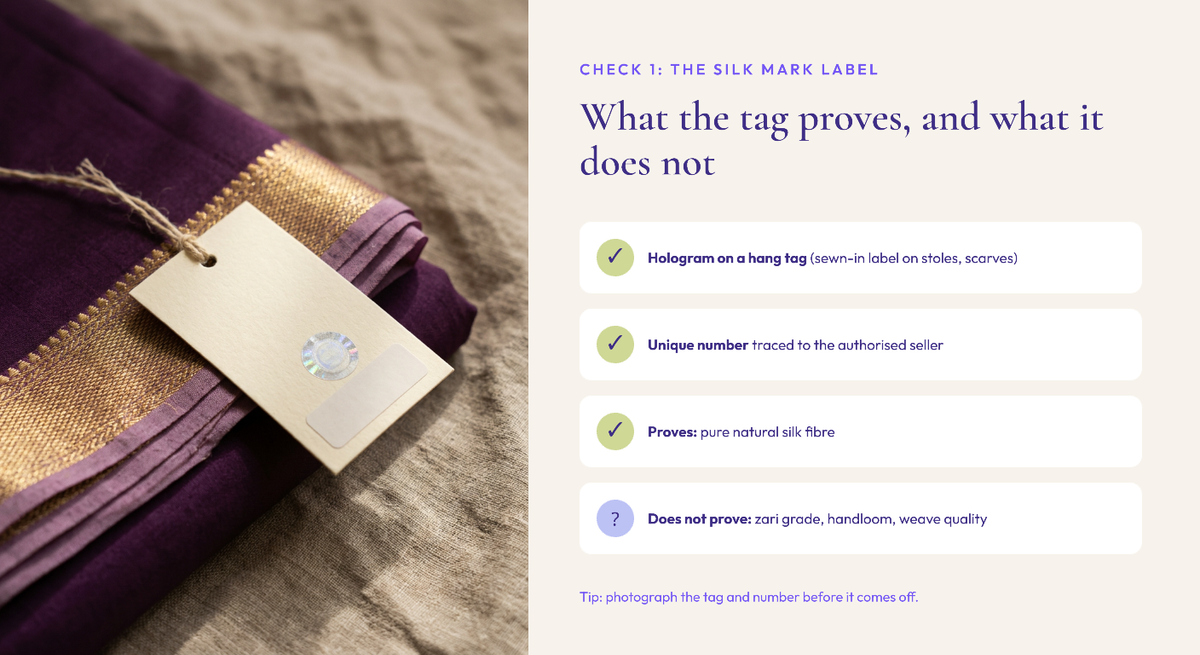
Silk Mark is a quality assurance label for pure silk. According to Amazon India's 2020 announcement of its agreement with the scheme, it is an initiative of the Central Silk Board, Ministry of Textiles, Government of India, and is run by the Silk Mark Organisation of India (SMOI), a registered society based in Bengaluru. Fibre2Fashion's history of the scheme dates its launch to June 2004.
What the label gives you:
- A hologram on a hang tag. For sarees and garments, the label is a paper hang tag carrying a high-security hologram. Smaller items such as stoles and scarves may use a sewn-in label instead.
- A unique serial number. Each hologram's number is tied to the Authorised User (the seller or weaver licensed to use it) and the period of use, so the product can be traced back to who labelled it.
- Fibre purity, not quality. The label assures that the product is pure natural silk. It does not grade the weave, confirm handloom versus powerloom, or say anything about the zari.
What to do with it:
- Photograph the tag before the shop removes it or before you cut it off at home. If anything later looks wrong, the number is your link back to the seller.
- When buying online, ask the seller to send a close photo of the Silk Mark tag on the actual saree you will receive, not a stock image.
- Treat a missing tag as a reason to ask questions, not as automatic proof of a fake. Chennai retailer RMKV notes that some small master weavers do not carry the Silk Mark tag even when the silk is pure. In that case lean harder on the other checks below and on the seller's written description.
Check 2: The zari, graded by what is inside it

Zari is where most of the price, and most of the confusion, sits. Retailers that sell all grades describe them in broadly the same way:
- Pure (real) zari. Aza Fashions describes it as a silk thread wrapped in silver and then electroplated with gold. Kanchipuram retailer Salammal Silks notes that pure zari carries precious-metal value, so it has some resale value depending on metal prices, the amount of zari and the saree's condition.
- Tested zari and imitation zari. These use a cheaper core, often copper with a thin silver coating, or a metallised plastic film (lurex). Salammal lists trade names such as Silk Fast, German Silver and Half Fine in this group and says they have no precious-metal value.
- "1G" and "2G" zari. These labels sound like gold grades but are not a standard. Salammal says the gold in 2G is too small to give meaningful resale value, and that "1G" can be used for tested or imitation zari. Do not assume gold content from the name.
How to check zari in a shop:
- Look at the core. RMKV suggests gently scratching a loose zari end, usually near the end of the pallu. A red silk core suggests real zari; a white or plastic-looking core suggests tested or synthetic zari.
- Rub it lightly. Aza Fashions notes that if gentle rubbing exposes a red, green or plastic-like base, the zari is likely not real. Real zari keeps its colour.
- Feel the weight and look at the glow. Real zari adds noticeable weight and has a soft, warm sheen rather than a mirror-bright one.
- Ask the resale question. Salammal's own advice is to ask the seller directly whether the zari will fetch any value if you sell it later. An honest seller can answer that in one sentence. Get the answer on the bill.
Imitation zari is not a bad choice. It is lighter, cheaper and often tarnishes more slowly. The point is to pay the right price for what you are getting.
Want this styled from your own closet?
Elara builds the look from what you own, then lets you try it on.
Check 3: Weave clues at the border and pallu
For a Kanjivaram, the most useful weave check is the korvai join, where the contrast border meets the body. RMKV explains that the border and body are woven separately and then interlocked by hand, which leaves a slightly jagged, zig-zag line where the colours meet. A perfectly straight join, or a border that looks printed on, points to a powerloom imitation.
Other quick checks that work on most handwoven silks:
- Turn it over. On a handwoven brocade, the reverse often shows floats of thread behind the motifs. A print shows the design faintly on the back or not at all.
- Look for tiny irregularities. Fibre2Fashion's guide to the scheme points out that handwoven silk shows small irregularities and thread joins, while machine-made imitations look uniform.
- Ask for the weight. A heavy Kanjivaram should feel substantial, and reputable sellers can tell you its weight. Write it down and compare it with the saree you receive.
Kanchipuram silk is also a registered Geographical Indication of Tamil Nadu, as noted on Vikaspedia, the Government of India's knowledge portal. The GI protects the name, but a shop label saying "Kanchipuram" is not a certificate by itself, so the label and weave checks still matter.
Check 4: The burn test, and when not to use it
The burn test is the oldest home check, and it is genuinely informative, but it destroys whatever you burn. Use it only on a loose thread, a fall or blouse offcut, or a sample, never on the saree itself, and never on a new or costly piece without a shop's guidance (Aza Fashions gives the same warning).
What to look for, holding a single thread with tweezers over a sink:
- Pure silk smells like burning hair and leaves a crumbly ash, according to RMKV.
- Synthetics such as polyester melt rather than burn to ash and give off a chemical smell, leaving a hard bead.
- Real zari smells of burning metal and leaves ash, while plastic-based imitation zari melts, per Aza Fashions.
Buying online: questions to send before you pay

Online, you cannot rub zari or feel the weight, so the seller's written answers become your evidence. Send these before ordering and keep the replies:
- Is the body 100 percent pure silk, and which silk (mulberry, tussar)?
- Is there a Silk Mark tag on this exact piece? Please share a photo showing the hologram and number.
- Is the zari pure, tested or imitation? Will it have resale value?
- Is it handloom or powerloom?
- What does it weigh?
- What is your return or exchange policy if the saree does not match the description?
Vague answers ("premium silk", "rich zari", "best quality") are a signal to slow down. Specific answers, even ones that say "tested zari", are a good sign: that seller is telling you what you are paying for.
After you buy: protect the investment
A real silk and zari saree lasts decades if it is stored well. Keep the Silk Mark tag and the bill together in an envelope with a photo of the saree. Before you put it away after Diwali, follow our guide on how to clean and store silk sarees so the zari does not tarnish and the folds do not crack before wedding season.
FAQ
Does every pure silk saree have a Silk Mark?
No. Silk Mark labels are available only to authorised users, and some small weavers and shops are not part of the scheme. The tag is strong evidence of pure silk, but its absence is a reason to check further, not proof of a fake.
Does Silk Mark certify the zari or that a saree is handloom?
No. Silk Mark assures that the product is pure natural silk. Zari type and handloom status need to be confirmed separately with the seller, ideally in writing on the bill.
Is tested zari a fake?
Tested zari is a legitimate, cheaper grade with no precious-metal value. It is only a problem when it is sold or priced as pure zari. Ask the seller to name the zari grade before you buy.
How can I tell real zari at home?
Look at a loose end of the zari: a red silk core suggests real zari, while a white or plastic-like core suggests tested or synthetic zari. Real zari also feels heavier and has a softer glow. Only burn a loose thread, never the saree.
Is art silk the same as pure silk?
No. Art silk is a manufactured fibre, usually viscose or polyester, designed to look like silk. It can be a sensible budget choice, but it should be priced and labelled as art silk.
What should I keep after buying an expensive silk saree?
Keep the Silk Mark tag (or a clear photo of its hologram and number), the bill listing the silk and zari type, and a photo of the saree. These help with any exchange, and with resale if the zari is pure.
Plan which saree goes to which function
Once your festive and wedding silks are home, the next question is what to wear them with and to which event. Elara, an AI personal stylist app, lets you photograph your sarees into a digital closet, plan looks on a calendar across Diwali and every wedding function, and see blouse, jewellery and layering options from what you already own. Try Elara free before your next festive shopping trip.
Your stylist, in your pocket
Stop reading about outfits. Start wearing them.
Elara knows your closet, shops every store and gets you dressed for any occasion.


