


Winter Boots Buying Guide for Black Friday 2026: What Insulation Grams, Waterproof Membranes and Lug Depth Actually Mean
How to choose winter boots this Black Friday: what 200g and 400g insulation means, waterproof vs water-resistant, which soles grip ice, and how to test the fit.
 Mehul AgarwalFounder & CEO

Last updated: October 2026
Quick answer: Buy winter boots for how much you will be standing still, not just for how cold it gets. Around 200 grams of insulation suits active days and commutes; 400 grams or more suits standing around outdoors in serious cold. Insist on a waterproof membrane, not just a water-resistant coating. Match the sole to the ground: deep lugs (REI suggests more than 4 mm) for snow, flatter, grippier rubber for icy pavements. Try boots on with the socks you will actually wear and leave room to wiggle your toes, because a tight boot is a cold boot.
Black Friday falls on 27 November 2026, and for many people in the US, Canada, the UK and Europe it is when the winter boot gets bought. The trouble is that product pages are full of numbers that sound precise and are easy to misread: 200g, 400g, "rated to -25°F", waterproof, water-resistant, lug depth. This guide explains what each one means, where the sources disagree, and how to pick the right pair for the way you actually spend winter. It draws on buying advice from REI, the boot makers Rocky Boots and KEEN, and the long-running outdoor gear site Section Hiker.
Start with how you will use them

The single biggest factor in whether your feet stay warm is not the boot. It is what you are doing. Section Hiker notes that temperature figures assume brisk walking, not standing still, and Rocky Boots' insulation guide is organised by activity level for the same reason: a moving body makes heat, a still one does not.
So before you look at any specification, decide which of these describes most of your winter:
- Walking commute, errands, city pavements: you move most of the time and come indoors often. You need waterproofing and grip more than heavy insulation.
- Standing still outside: Christmas markets, children's sports, bus stops, outdoor events. You need more insulation than you think.
- Deep snow, shovelling, rural winters: height matters as much as warmth, so snow does not get in over the top.
- Winter hiking or snowshoeing: you generate a lot of heat, so too much insulation becomes a sweat problem. REI recommends a more supportive midsole, a tall ankle collar and aggressive lugs for this.
What insulation grams actually mean
Most insulated boots list a number like 200g or 400g, usually for a synthetic insulation such as Thinsulate or Primaloft. According to Rocky Boots, the figure is the weight of the insulating material, and it is not a temperature rating. Section Hiker, quoting a commenter, adds that the number refers to the insulation's weight per square metre of fabric, which is why it can be far higher than the amount actually inside one boot.
How the grams map to use, according to the sources:
- 200g: REI says that for active use, "200 grams should suffice." KEEN describes 200g as suited to cold conditions. Section Hiker reports 200g boots working comfortably at around 20 to 30°F (about -7 to -1°C) while walking.
- 400g: KEEN suggests 400g for very cold conditions. REI points to boots with more than about 400 grams for subzero temperatures.
- 600g to 1,000g and above: Rocky Boots' guide places these at low to moderate activity in cold to really cold conditions, which is why heavily insulated boots are common for hunting and other long stretches of standing still.
Two honest caveats. First, the sources disagree on how much difference the grams make. Section Hiker says a 400g boot traps roughly twice the body heat of a 200g boot, while Rocky Boots says plainly that a 400g boot is not twice as warm. The safe reading is that more grams means warmer, within the same brand and style, but not in a neat straight line. Second, Rocky Boots states that "providing specific temperatures for each insulation weight is not possible," and Section Hiker notes there is no lab test that measures boot warmth. Treat any "comfort rated to" figure as the maker's guide, not a standard you can compare across brands.
Why too much insulation can make your feet colder
It sounds backwards, but REI warns that too much insulation can make you sweat, and that moisture can leave your toes numb once you stop moving. KEEN gives the same advice for high-intensity activities: a lower rating may help prevent overheating.
That is why one very warm boot is not the answer for everyone. If you walk briskly to work, a 400g boot plus heavy socks can leave you with damp, cold feet by the time you sit at your desk. If you stand at a market for two hours, a 200g boot may not be enough. Pick for your coldest common use, then adjust with socks.
Waterproof is not the same as water-resistant
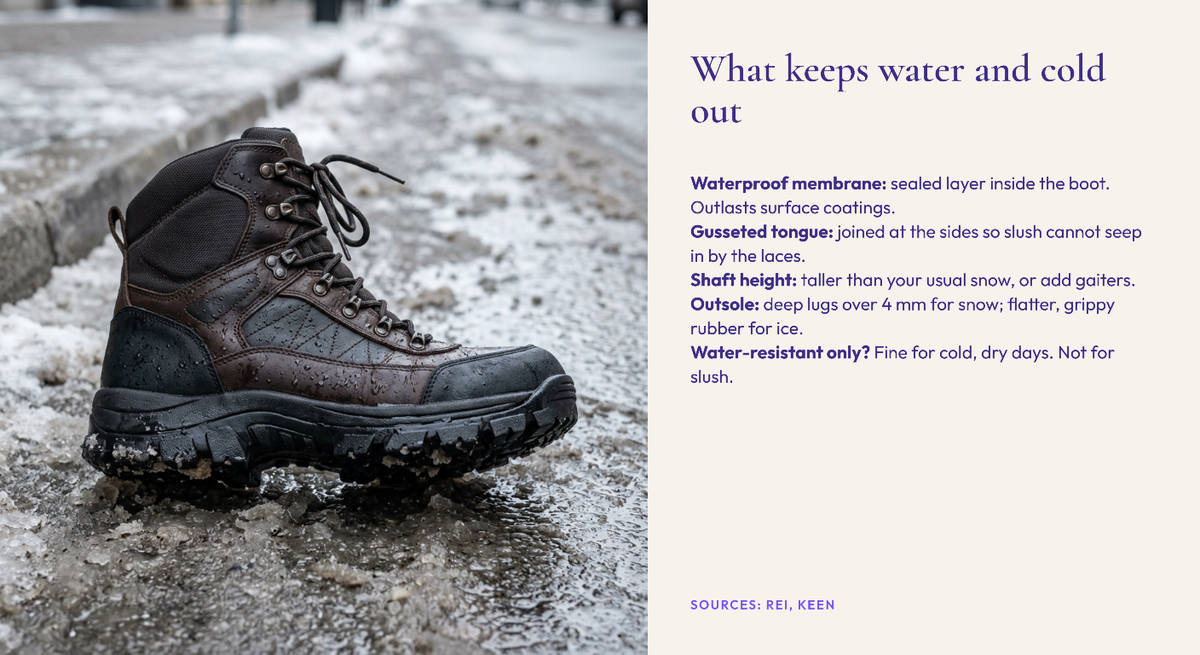
REI is direct: "A true winter boot needs to be waterproof." Wet feet get cold fast, and slush gets into anything that is not sealed. What to look for:
- A waterproof membrane, such as Gore-Tex or a brand's own equivalent. KEEN notes that a membrane also helps block cold air from getting in, and that some waterproof coatings wear off over time, so a membrane tends to last longer than a surface treatment.
- Read the fine print on what is waterproof. REI points out that features like laces are not waterproof. Look for a gusseted tongue (attached at the sides) on lace-up boots, so water cannot seep in around the laces.
- Height for your snow. REI suggests choosing the taller version of a boot for snowy areas and adding gaiters for deep snow. A waterproof boot that is shorter than the snow is not waterproof in practice.
"Water-resistant" usually means a treated leather or fabric that sheds light rain and dry snow. That is fine for a cold, dry city. It is not enough for slush.
Grip: match the sole to the ground

Slipping is the winter hazard people forget to shop for. REI's guidance distinguishes between two kinds of ground:

Want this styled from your own closet?
Elara builds the look from what you own, then lets you try it on.
- Snow and mud: look for deep, angular lugs of more than 4 mm for maximum grip.
- Icy pavements and driveways: shallower lugs work better on large, flat surfaces.
- Special rubber compounds: REI notes that some outsoles are infused with fabric, silica or fiberglass to add friction on slick surfaces. These are worth looking for if your winter is more ice than snow.
KEEN also recommends an aggressive tread or lug sole for traction on snow and ice. In practice, city commuters on icy pavements should pay most attention to the rubber, and anyone walking through fresh snow should pay most attention to lug depth.
Fit: the cheapest way to warmer feet

A boot that fits badly will be cold however much insulation it has. The common threads across the sources:
- Try them on with your winter socks. KEEN says to try boots on with the same socks you plan to wear. Rocky Boots recommends merino wool socks, and notes that heavier socks can be paired with lighter insulation.
- Leave room to wiggle your toes. Section Hiker stresses that boots should not be too tight, and notes that toe warmers need internal space too.
- Check the size advice for that model. REI's own reviews flag that some popular winter boots run small and that many buyers size up a half or full size to fit heavier socks. Read the reviews for the exact boot before you order.
- Do not wear winter boots on warm days. KEEN advises lighter, breathable footwear instead.
Buying online during Black Friday? Order early enough to try them at home with your socks, walk around indoors, and return them if they pinch. Our guide to Black Friday 2026 clothing returns rights explains what you are entitled to in the US, UK and EU before you pay.
A five-question checklist before you buy
- How long will I stand still in them? More standing, more grams.
- Is it fully waterproof, with a membrane? Not just a coating, and with a gusseted tongue if it laces.
- Is it tall enough for my snow? Or will I need gaiters?
- Does the sole suit my ground? Deep lugs for snow, grippy compound for ice.
- Does it fit with my winter socks, with toe room? If not, size up or try another model.
Pair your boots with the rest of your winter layers. If you are also buying a coat, our winter coat buying guide explains fill power, wool content and waterproof ratings in the same way.
FAQ
How many grams of insulation do I need in winter boots?
For active use and commuting, about 200 grams is usually enough, according to REI. For standing still in very cold or subzero conditions, look at 400 grams or more. Rocky Boots' guide places 600 to 1,000 grams and above at low activity in really cold conditions.
Is a 400g boot twice as warm as a 200g boot?
Not exactly. Sources disagree: Section Hiker says a 400g boot traps about twice the body heat, while Rocky Boots says it is not twice as warm. More grams is warmer within the same style, but not in a straight line.
Can I trust a boot's temperature rating?
Use it as a rough guide from that maker only. Rocky Boots says specific temperatures for each insulation weight are not possible, and Section Hiker notes there is no lab test for boot warmth. Ratings also assume you are walking, not standing.
What is the difference between waterproof and water-resistant boots?
Waterproof boots use a sealed membrane that keeps water out in slush and wet snow. Water-resistant boots have a treated surface that sheds light moisture but will eventually let water in. REI says a true winter boot needs to be waterproof.
Should I size up for winter boots?
Often, if you wear thick socks. Try them on with your winter socks and make sure you can wiggle your toes. REI's reviews show some models run small, so check the advice for the exact boot.
What sole is best for icy sidewalks?
REI says shallower lugs work better on large, flat icy surfaces, and that outsoles infused with materials like silica or fiberglass add friction. Deep lugs are better for snow and mud.
Build your winter outfits around them
The right boots change what you can wear all season, from a commute to a Christmas market. If you want help putting together winter outfits around the boots and coats you already own, try Elara: add your wardrobe to your digital closet, tell the AI stylist the weather and the plan, and it will suggest complete looks for the day.
Your stylist, in your pocket
Stop reading about outfits. Start wearing them.
Elara knows your closet, shops every store and gets you dressed for any occasion.


