


Dhanteras 2026 Gold Buying Guide: How to Read a BIS Hallmark and Verify the HUID
Buying gold on Dhanteras 2026? Learn to read the BIS hallmark, verify the HUID in the BIS CARE app, decode 22K916 and check your bill before you pay.
 Mehul AgarwalFounder & CEO
Last updated: October 2026
Quick answer: Before you pay for gold jewellery this Dhanteras (Friday, 6 November 2026), look for three marks on the piece: the BIS standard mark, a purity mark such as 22K916, and a six-character HUID code. Type that HUID into the "Verify HUID" feature of the government's BIS CARE app before you pay. It should show the same jeweller, item type and purity you are being sold. If any of the three marks is missing, or the app shows something different, do not buy.
Dhanteras opens the five days of Diwali, and it is traditionally an auspicious day for buying metal, whether that is a gold chain, a pair of jhumkas, a silver coin or a new steel utensil. That makes it one of the busiest days of the year at jewellery counters, which is exactly when buyers rush and skip the checks that take two minutes. This guide walks you through those checks: what the hallmark actually says, how to verify it on your phone at the counter, what to ask about the bill, and how to choose a piece you will wear all wedding season rather than lock away.
When is Dhanteras 2026?
According to Drik Panchang, Dhanteras falls on Friday, 6 November 2026, with the New Delhi puja muhurat in the evening, roughly 6:02 PM to 7:57 PM. HinduTone's state-wise festival calendar gives the same date for India, with Diwali and Lakshmi Puja on Sunday, 8 November and Bhai Dooj on Wednesday, 11 November.
Two caveats. Drik Panchang notes that the Dhanteras date can differ by a day between India and the US, because the Trayodashi tithi is calculated for local sunrise and sunset. And regional calendars sometimes shift a festival by a day. If the exact muhurat matters to your family, check the panchang for your own city, or ask the family elder or priest who usually guides the puja.
What a BIS hallmark on gold actually tells you

Hallmarking is India's official certification of how much pure gold is in a piece. It is done by independent Assaying and Hallmarking Centres (AHCs) recognised by the Bureau of Indian Standards (BIS), not by the jeweller. According to a Ministry of Consumer Affairs release (PIB, March 2023), hallmarking of gold jewellery became mandatory from 23 June 2021, and since 1 April 2023 selling hallmarked gold jewellery or artefacts without a HUID is prohibited.
Since July 2021, a hallmark has three parts:
- The BIS standard mark. A small triangular mark showing the piece was tested under the BIS scheme.
- The purity mark. The carat followed by the fineness in parts per thousand. 22K916 means 22 carat, 91.6% gold. 18K750 means 18 carat, 75% gold.
- The HUID. A six-character alphanumeric code, unique to that one piece, generated by the BIS system after testing and laser-marked on the jewellery.
Before July 2021, hallmarks had four marks, including the AHC's mark and the jeweller's mark, and no HUID. The PIB release confirms that jewellery hallmarked under the older system remains valid, so do not panic if your mother's 2019 bangles lack a HUID.
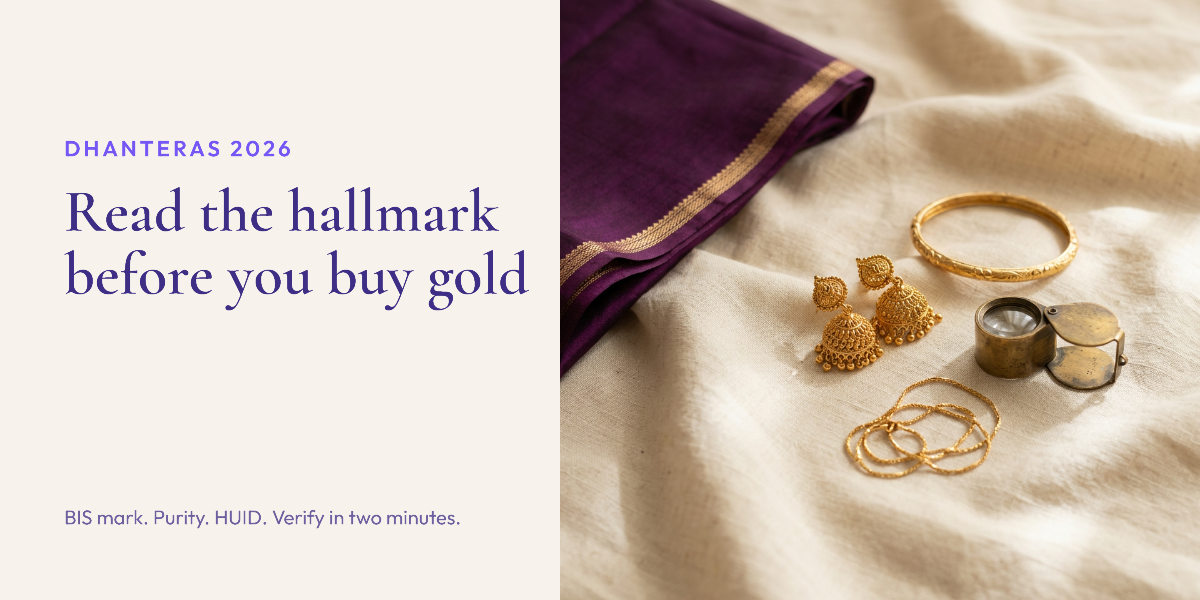
The marks are tiny, often on the clasp, the inside of a bangle, or the back of an earring. Ask the jeweller for a loupe (a jeweller's magnifier). Any good counter will have one, and asking for it signals that you know what you are looking for.
How to verify a HUID in the BIS CARE app (two minutes at the counter)
BIS runs a free app called BIS CARE on Android and iOS. Its "Verify HUID" feature is the single most useful thing you can do at the counter.
- Step 1. Install BIS CARE before you leave home. Counters are crowded and mobile data is patchy inside some markets.
- Step 2. Ask the jeweller to show you the HUID on the piece under the loupe, and read it out yourself.
- Step 3. In the app, open "Verify HUID" and enter the six characters.
- Step 4. Check what comes back. According to the PIB release, the app shows the jeweller's name and registration number, the type of article, its purity, and the hallmarking centre that tested it.
- Step 5. Match it to what is in front of you. A HUID that comes back as a "ring" when you are holding a necklace, a different purity from the one stamped, or a different jeweller's name, is a reason to walk away.
- Step 6. Make sure the HUID is printed on your bill for each hallmarked item, so your purchase is traceable later.
A practical tip: photograph the hallmark under the loupe and the app result for each piece. If you ever sell, exchange or insure the jewellery, you have the record ready.
Purity grades decoded: which carat for which piece

The BIS standard for gold jewellery, IS 1417, lists the grades that can be hallmarked. BIS's own explainer names 14, 18, 20, 22, 23 and 24 carat, with example marks such as 22K916, 18K750 and 14K585. In July 2025, Indian Jeweller reported that the mandate was extended to include 9 carat gold, a lower-priced option at 37.5% gold.
Which should you buy? This is where the hallmark meets your wardrobe.
- 22K (916) is the traditional choice for bridal and heirloom pieces: chains, bangles, temple-style necklaces and coins. It has the deep yellow colour that pairs with silk sarees and rich festive colours.
- 18K (750) is what many jewellers recommend for stone-set and everyday pieces, because a lower-carat alloy is generally harder and holds stones more securely. Its slightly paler tone also sits well with western wear and pastel lehengas.
- 14K (585) and 9K (375) cost less per gram and are often used in lightweight daily wear. Just remember you are paying for less gold.
None of these is a "better" grade. The right one depends on how often you will wear the piece and with what.
The bill: what to ask before you pay

The hallmark tells you about purity. The bill tells you whether the price is fair. Ask for an itemised invoice that shows, for each piece:
Want this styled from your own closet?
Elara builds the look from what you own, then lets you try it on.
- The gold rate per gram used, for that carat, on that day.
- Gross weight and net gold weight. In stone-set or kundan pieces, the stones add weight. You should not pay the gold rate on stone weight, so ask for the two weights to be shown separately.
- Making charges, stated as a percentage or a flat amount per gram, so you can compare across shops.
- Stone charges, listed separately, with any certificate for diamonds or precious stones.
- Taxes, shown as a separate line rather than folded into one total.
- The HUID and purity for each hallmarked article.
Compare making charges, not just the gold rate. Two shops can quote the same rate for 22K and still end up thousands of rupees apart once making charges are added.
Silver for Dhanteras: what is (and is not) hallmarked
Many families buy silver on Dhanteras: coins, a small lamp, anklets or utensils. Silver works differently from gold. According to GJEPC's Solitaire magazine and a PTI report carried by The Week, BIS introduced HUID-based hallmarking for silver from 1 September 2025 on a voluntary basis, with HUID required on silver articles that are hallmarked under the scheme.
In practice, that means:
- Silver is not required to be hallmarked, so plenty of honest silver is sold without a hallmark.
- If a seller says a silver piece is BIS hallmarked, it should carry the BIS mark, a purity grade such as 925, and a HUID you can check in BIS CARE.
- Ask what the purity is, and get it written on the bill either way.
Already bought gold, or unsure about old pieces?
Two consumer protections are worth knowing.
You can get any gold jewellery tested. BIS allows consumers to have hallmarked or unhallmarked gold jewellery tested at any BIS-recognised AHC. When the scheme was announced in March 2022, BIS set the charge at Rs 200 for up to four articles, as reported by PTI via FashionNetwork. Fees can change, so confirm with the centre. The test report is useful if you plan to sell or exchange old jewellery.
You are entitled to compensation if hallmarked purity is short. The PIB release explains that under section 49 of the BIS Rules, 2018, if a hallmarked article is found to be of lower purity than marked, the buyer is entitled to compensation of twice the difference in value for the shortfall, plus testing charges. Keep your bill and the HUID record.
Buy jewellery you will actually wear this season
Dhanteras gold is often bought as savings first and jewellery second. That is a valid choice. But if you are buying something to wear, think about the next three months, which in many families means Diwali, Bhai Dooj and wedding season.
- Start from your outfits, not the display case. Look at the sarees, lehengas and kurtas you already plan to wear for Diwali and the weddings ahead. A long rani haar suits a deep neckline or a saree; a choker needs a higher neckline or bare collarbones.
- Pick one hero piece and one bridge piece. A statement necklace or jhumkas for big functions, plus something lighter (studs, a fine chain, a slim kada) that bridges festive and everyday wear.
- Match the gold tone to your palette. If your festive wardrobe leans toward pastels and ivory, the softer tone of 18K can look more cohesive than the deep yellow of 22K. Our festive and wedding colour guide goes deeper on pairings.
- Plan re-wears. One good set can carry several functions if you change the outfit around it. Our guide to re-wearing one lehenga, saree or sherwani across functions works the same way for jewellery.
FAQ
What is a HUID number on gold jewellery?
A HUID (Hallmark Unique Identification) is a six-character alphanumeric code laser-marked on each hallmarked gold article. It is generated by the BIS system after the piece is tested at a recognised hallmarking centre, and it lets you trace that one article in the BIS CARE app.
How do I check if gold is real on Dhanteras?
Check for the three marks (BIS mark, purity such as 22K916, and HUID), then enter the HUID in the "Verify HUID" feature of the BIS CARE app. Confirm the jeweller, item type and purity match what you are buying, and make sure the HUID is on your bill.
Is old gold jewellery without HUID still valid?
Yes. According to the Ministry of Consumer Affairs, jewellery hallmarked under the older four-mark system remains valid. Since 1 April 2023, it is jewellers who cannot sell hallmarked gold without a HUID.
Is silver hallmarking mandatory in India?
No. BIS introduced HUID-based silver hallmarking from 1 September 2025 on a voluntary basis. If a seller says a silver item is hallmarked, it should carry a purity grade and a HUID you can verify.
What does 22K916 mean?
22K916 is the purity mark for 22 carat gold, meaning 916 parts per thousand, or 91.6% pure gold. 18K750 means 75% gold and 14K585 means 58.5% gold.
What is the Dhanteras 2026 date?
Dhanteras is on Friday, 6 November 2026 in India, according to Drik Panchang and HinduTone. The US date can differ by a day, so check the panchang for your city.
Plan the looks around your Dhanteras buy
Once the piece is home, the fun part is wearing it. In Elara, you can add your festive outfits to your digital closet, then describe your new piece to the AI stylist and ask which of your sarees, lehengas or kurtas it works with for Diwali night, Bhai Dooj and each wedding function on your calendar. Try Elara free for 14 days and walk into the season knowing exactly what you will wear with it.
Your stylist, in your pocket
Stop reading about outfits. Start wearing them.
Elara knows your closet, shops every store and gets you dressed for any occasion.


