
How to Wash a Down Jacket Without Ruining It: A Step-by-Step Guide for Puffer Season
How to wash a down jacket at home without flattening it: detergent, cycle, rinse and the low-heat drying method, based on Arc'teryx and Patagonia care advice.
 Mehul AgarwalFounder & CEO
Last updated: October 2026
Quick answer: You can machine wash most down jackets at home. Check the care label, close the zips, use a down-specific detergent (regular detergent can strip the down's natural oils), wash on a gentle cycle in a front-loader if you can, and rinse twice. The drying is what matters most: tumble dry on low heat with two clean tennis balls or dryer balls, and expect it to take several cycles. Stop only when there are no damp clumps left, because down that is put away damp can clump and smell. Wash only when it is dirty, losing loft or clumping, not on a schedule.
Puffer season is here. As temperatures drop through late October and November, down jackets come out of storage, and many of them come out flatter and grubbier than they went in. A wash done well restores loft and warmth. A wash done badly leaves you with a jacket of hard lumps and empty baffles.
This guide pulls together care instructions from Arc'teryx and Patagonia, which both make down jackets and publish detailed care guides, plus advice from outdoor retailers REI, MEC and evo. Where they disagree (on water temperature, for one), we say so, so you can decide based on your own jacket's label. If you are wearing your puffer to a market or on a winter trip, our guide to what to wear to a Christmas market covers what goes underneath it.
Before you wash: read the label and decide if it needs it
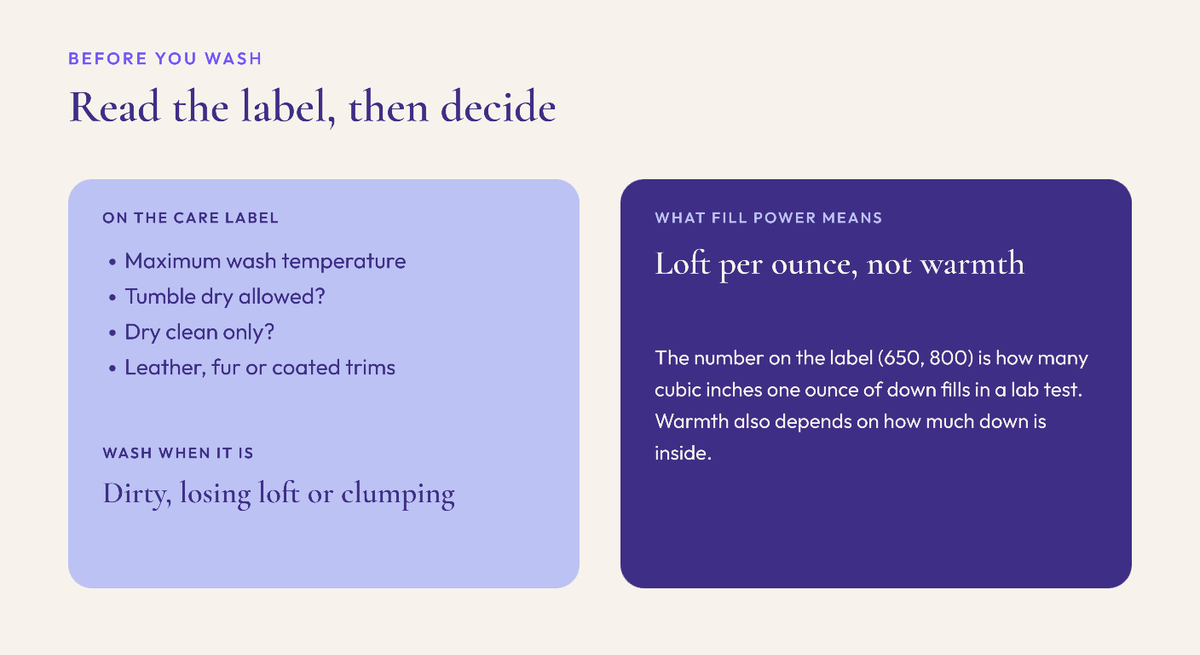
Start with the care label. It overrides any general guide, including this one. Look for the wash temperature, whether tumble drying is allowed, and whether the jacket is marked dry clean only. Patagonia notes that it "doesn't make anything that requires dry cleaning," but other brands do, especially for fashion puffers with leather trims, fur trims or coated fabrics.
Wash only when it needs it. Arc'teryx advises washing down "whenever it is dirty, losing loft or clumping," and warns against "unnecessary washing." Signs it is time: the jacket looks flat even after a shake, the collar and cuffs are visibly grubby, or it smells after a few wears.
Understand what you are protecting. Down insulates by lofting, trapping air between its clusters. REI explains that fill power, the number often printed on the label (for example 650 or 800), comes from a lab test measuring how many cubic inches one ounce of down fills. Higher numbers mean down that lofts more for its weight. REI is careful to note that fill power alone "does not tell you how warm a jacket" will be, because the amount of down matters too. Either way, the goal of washing is to clean the down without crushing or stripping it, so it can loft fully again.
How to wash a down jacket, step by step
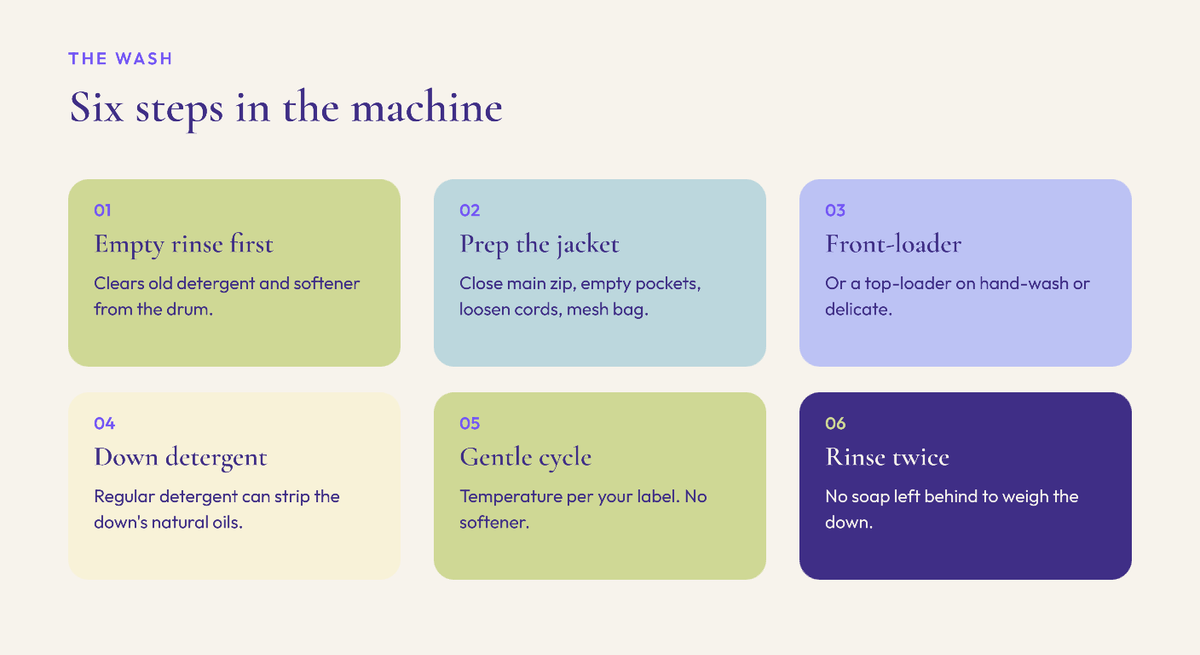
This sequence combines Arc'teryx's and Patagonia's published instructions:
- Run an empty rinse first. Arc'teryx suggests running an empty rinse cycle to clear detergent or softener residue left in the machine from previous loads.
- Prepare the jacket. Close the main zip, open the pocket zips (and empty them), release drawcord tension, and fasten any Velcro so it does not snag the shell. Arc'teryx also recommends a mesh laundry bag.
- Use a front-loader if you can. Patagonia says a front-loading machine is "preferred," though a top-loader "will work just fine on a hand-wash or delicate setting." If your top-loader has a central agitator, that gentler setting matters even more.
- Use a down-specific detergent. Both brands are firm on this. Patagonia warns that traditional detergent can "strip down of its natural oils," and Arc'teryx says non-down detergents can damage them. Down-specific washes are made for exactly this job.
- Choose a gentle cycle. Arc'teryx recommends a permanent press or gentle cycle.
- Rinse twice. Arc'teryx calls for a double rinse so no soap or residue is left in the down. Leftover soap can stop down from lofting fully.
- Skip fabric softener. Patagonia says it does not recommend fabric conditioners or softeners on its products. Softener coats fibres, which is the opposite of what you want for down.
When the cycle finishes, the jacket will look alarmingly flat and heavy. That is normal. Wet down collapses into clumps, and drying is what brings it back.
Drying: the step that makes or breaks it
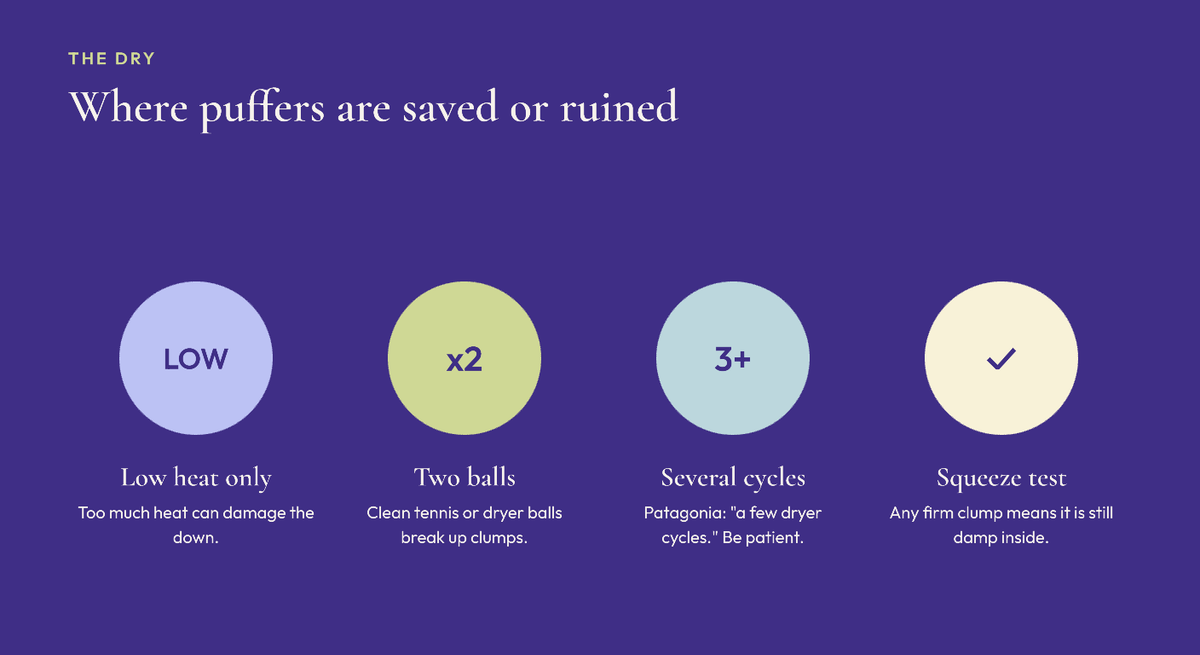
Most down jackets that come out ruined were washed fine and dried badly. The care guides agree on the core method:
- Tumble dry on low heat. Arc'teryx recommends low heat on a permanent press cycle, and MEC says the same. Outdoor retailer evo warns that "too much heat can damage the down insulation," so resist turning it up to speed things along.
- Add two clean tennis balls or dryer balls. Patagonia and Arc'teryx both recommend two, to break up clumps and redistribute the down. Patagonia suggests a large heavy cotton bath towel as an alternative. If you use tennis balls, make sure they are clean and the dye will not transfer to a pale jacket.
- Expect several cycles. Patagonia says plainly that "it will take a few dryer cycles to be completely dry and lump-free" and advises you to "be patient."
- Turn and check between cycles. Arc'teryx suggests turning the garment inside out periodically during drying. Between cycles, pull the jacket out and squeeze each baffle. If you feel a firm clump, it is still damp inside.
- Do not stop early. A jacket that feels dry on the outside can still hold moisture in the down. Put away damp, down can clump and develop a musty smell. Finish with a final cycle after you think it is done.

Want this styled from your own closet?
Elara builds the look from what you own, then lets you try it on.
If you have no dryer, you can air dry flat in a warm, ventilated room, but it will take much longer, and you will need to break up the clumps by hand every few hours. Patagonia notes that machine drying gives better loft than line drying.
Where the guides disagree: water temperature
Not every source gives the same temperature, which is a good reminder that your label wins:
- Arc'teryx recommends medium heat, 40°C (104°F).
- MEC suggests a gentle cycle with cold water.
- evo, the outdoor retailer, suggests "warm, not hot or cold, water."
- Patagonia's down care page does not specify a temperature, only a down-specific detergent and a gentle or delicate setting.
In practice, if your label says 30°C or cold, use that. If it allows 40°C and the jacket is grimy (collar and cuffs especially), the warmer wash will clean more effectively. Never go hotter than the label allows.
Common mistakes to avoid
- Using regular detergent or fabric softener, which can strip or coat the down so it does not loft.
- Using a normal cycle in a top-loader, instead of the hand-wash or delicate setting Patagonia recommends.
- Skipping the second rinse, which leaves residue that weighs the down down.
- Drying on high heat to save time.
- Air drying in a heap, which lets the down set in clumps.
- Putting it away before it is fully dry.
- Washing too often. Spot clean grubby cuffs and collars between full washes instead.
Storing it at the end of winter
When the season ends, wash the jacket first (stains and body oils are harder to remove after months in storage), make sure it is completely dry, then store it loose.
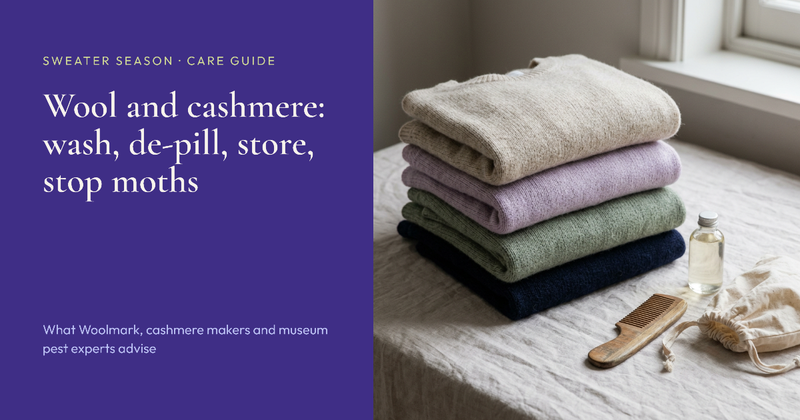
MEC recommends hanging a down jacket on a wide hanger in a cool, dry place, or, if you are short on space, folding it loosely and keeping it on a shelf or in a breathable bag. Following that advice means not leaving it squashed in a stuff sack or vacuum bag for months, so the down can keep its loft. For the knitwear going into storage at the same time, our wool and cashmere care guide covers washing and moth prevention.
FAQ
Can you put a down jacket in the washing machine?
Usually, yes. Check the care label first. Most down jackets can be machine washed on a gentle cycle with a down-specific detergent, ideally in a front-loading machine. Patagonia says a top-loader works on a hand-wash or delicate setting.
Why use tennis balls when drying a down jacket?
Wet down clumps together. Two clean tennis balls or dryer balls bounce around in the drum and break up those clumps so the down redistributes evenly through the baffles. Patagonia also suggests a heavy cotton bath towel as an alternative.
How long does a down jacket take to dry?
Longer than you expect. Patagonia says it takes "a few dryer cycles" to be completely dry and lump-free. Keep going on low heat until there are no damp clumps when you squeeze each baffle.
How often should I wash a down jacket?
Only when it needs it. Arc'teryx recommends washing when the jacket is dirty, losing loft or clumping, and warns against unnecessary washing. Spot clean the collar and cuffs between full washes.
Can I use regular detergent on a down jacket?
It is best not to. Patagonia and Arc'teryx both say regular detergents can strip the natural oils from down. Use a down-specific detergent, and skip fabric softener.
My down jacket is still flat after washing. What went wrong?
Usually one of three things: it is not fully dry, there is detergent residue left in the down, or it needs more tumbling. Run another low-heat cycle with dryer balls. If it stays flat, rinse it again with no detergent and dry it fully.
Elara can help you get more wear from the coat you already have. Add your outerwear to your digital closet, and ask the AI stylist to build cold-weather outfits around your puffer for work, weekends and travel, so you can see whether you actually need a new coat this year. Try Elara and plan your winter wardrobe around what you own.
Your stylist, in your pocket
Stop reading about outfits. Start wearing them.
Elara knows your closet, shops every store and gets you dressed for any occasion.