
How to Care for Wool and Cashmere Sweaters: Wash, De-Pill, Store and Stop Moths
How to wash wool and cashmere sweaters without shrinking them, remove pilling, store knits between seasons and stop clothes moths, with expert sources.
 Mehul AgarwalFounder & CEO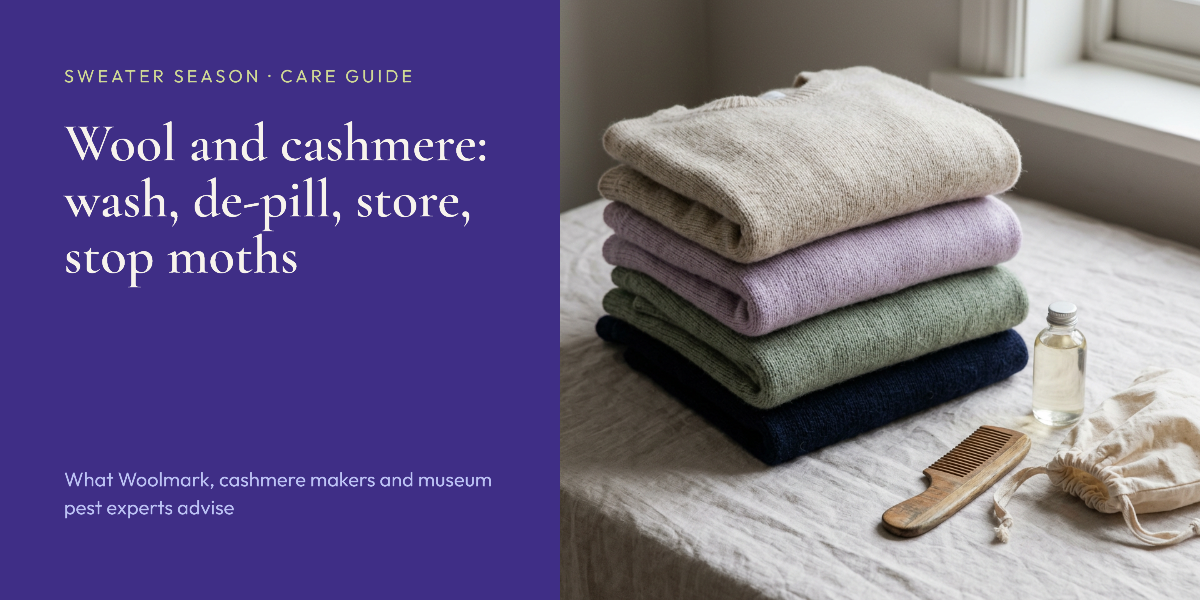
Last updated: October 2026
Quick answer: Wash wool and cashmere sweaters rarely (air them between wears instead), use cool to lukewarm water around 30°C with a wool or neutral detergent, never wring, and dry them flat away from heat. Remove pills with a sweater comb or fabric shaver. Before you store knits, wash them first, because clothes moth larvae target soiled fabric, then fold them into sealed containers. If you find moth damage, the Natural History Museum and English Heritage both recommend freezing the item in a sealed bag.
Sweater season starts in earnest this month. British Summer Time ends on Sunday, 25 October 2026, and daylight saving time ends in most of the US on Sunday, 1 November 2026. Darker evenings mean knitwear comes out of storage, and this is the moment most damage happens: a felted sweater from one wrong wash cycle, pills on the elbows within a month, or small holes from moths that hatched over summer.
This guide pulls together advice from the Woolmark Company (the wool industry's standards body), cashmere makers Johnstons of Elgin and N.Peal, and pest specialists at the Natural History Museum, English Heritage, UC Integrated Pest Management and the University of Kentucky. If you are building a cold-weather wardrobe, our fall capsule wardrobe checklist shows which knits are worth the investment.
Why wool shrinks: the one thing to understand
Wool fibres are covered in tiny overlapping scales. Woolmark explains that with heat and moisture these scales lift, and with "mechanical agitation" they "start to lock onto the scales of other fibres." That is felting, and Woolmark is blunt about it: "This process is irreversible."
So every care rule below is really about controlling three things at once: heat, moisture and agitation. Remove any one of them and wool is surprisingly forgiving. Combine all three, as a hot wash followed by a tumble dryer does, and a sweater can shrink noticeably in a single cycle.
Some wool is treated to resist this. Woolmark describes "Superwash" as an industry term for wool given a shrink-resist treatment, most commonly a process that smooths the scales and adds a thin resin layer. If your care label allows machine washing, the yarn has often been treated. If it says hand wash, believe it.
How to wash a wool or cashmere sweater
First, wash less. Woolmark suggests airing wool by laying it flat for an hour to release odours, and resting a garment for 24 hours between wears. Johnstons of Elgin recommends washing cashmere every three to four wears.
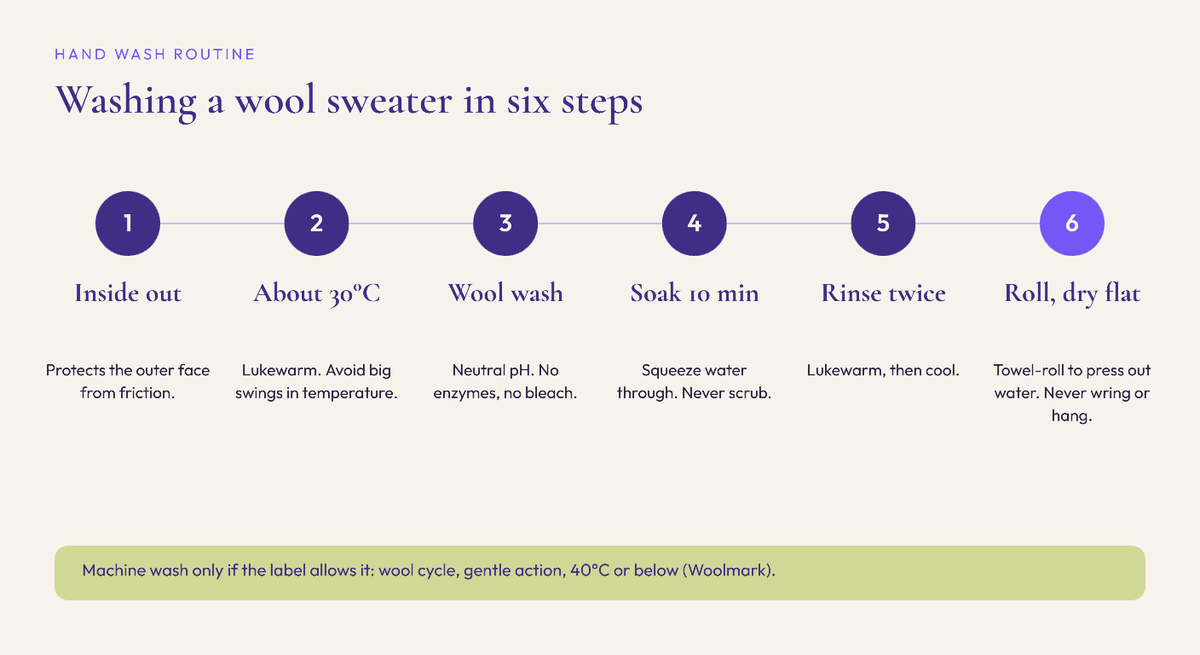
Hand washing, step by step
- Turn it inside out. This protects the outer face from friction.
- Use lukewarm water, about 30°C. Woolmark's guidance for hand-wash knits is lukewarm water around 30°C. Johnstons of Elgin warns water "too hot or too cold can cause shrinkage or distortion," so avoid big temperature swings between wash and rinse.
- Use a wool or neutral detergent. Woolmark says mild or neutral detergents "have a relatively neutral pH," and advises avoiding "bio" detergents with enzymes and never using bleach, "either chlorine or oxygen based."
- Soak, do not scrub. Woolmark suggests a soak of about 10 minutes, gently squeezing the water through rather than rubbing.
- Rinse twice. Rinse in lukewarm water, then once more in cool water.
- Never wring. Roll the sweater in a towel and press to remove water.
Machine washing, only if the label says so
Woolmark says a garment labelled as machine washable "can safely be machine washed… multiple times, without shrinkage" on a wool cycle, usually gentle action at 40°C. If your machine has no wool setting, use a cold or delicates cycle. N.Peal advises washing cashmere "no higher than 30 degrees" in a laundry bag with a low or short spin.
Drying: always flat
"Always flat dry wool sweaters or other knitwear if possible," says Woolmark. Hanging a wet sweater or pegging it on a line stretches it out of shape. Lay it on a dry towel, ease it back to its original shape, and keep it away from radiators and direct sun. Only tumble dry if the label explicitly allows it, and then on a low-heat wool setting.
Read the care symbols
The GINETEX care symbols tell you exactly what a knit can take. A hand in a washtub means hand wash at a maximum of 40°C, with no rubbing or wringing. A number in the tub is the maximum temperature. One bar underneath means a mild cycle; two bars mean very mild. A square with a horizontal line means dry flat, and a crossed-out circle in a square means do not tumble dry.
How to remove pilling (and slow it down)
Pilling is not necessarily a sign of a bad sweater. N.Peal says outright that it does not mean poor quality. Woolmark explains that "pilling is caused by rubbing during wear," which is why it shows up first at the elbows, underarms and sides where your arms brush your body.
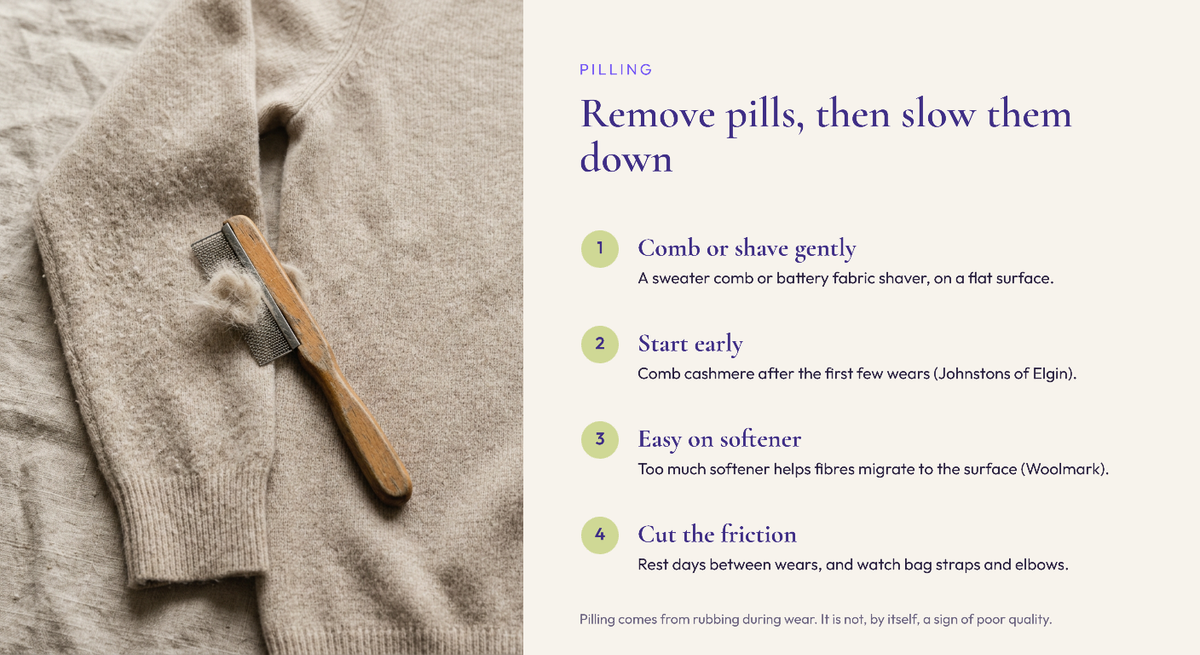
- Remove pills gently. Woolmark suggests picking off a few by hand, using a comb "very gently and carefully," or a battery-powered de-piller or fabric shaver, which it calls "very effective." N.Peal recommends laying the sweater flat and combing lightly.
- Comb early. Johnstons of Elgin suggests using a cashmere comb "after the first few wears," when loose fibres are working their way out.
- Go easy on softener. Woolmark's sweater care guide notes that too much fabric softener, and abrasion in washing or tumble drying, can help fibres migrate to the surface, where they form pills.
Want this styled from your own closet?
Elara builds the look from what you own, then lets you try it on.
- Reduce friction. Wear a smooth layer under a cross-body bag strap, and give the sweater rest days.
Clothes moths: what actually works
This is the part most care guides get wrong. Here is what the pest specialists say.
Know your enemy
The Natural History Museum identifies two main clothes moths in homes: the webbing clothes moth (Tineola bisselliella) and the case-bearing clothes moth (Tinea pellionella). English Heritage notes the webbing moth is now the most common and has seen "a very large increase in numbers in recent years."
Crucially, the Natural History Museum says "it is the immature larvae, rather than the adult moths, that cause the damage." The larvae feed on keratin, the protein in wool, cashmere, silk and fur. They prefer "low light levels and dirty fabrics." English Heritage adds that textiles soiled with food or sweat are "preferentially attacked," and that moths "hate disturbance."
Prevention, in order of what helps most
- Clean before you store. The University of Kentucky explains: "Cleaning kills any eggs or larvae that may be present, and removes perspiration odors that tend to attract pests." Never put a worn sweater away for the season.
- Seal it. University of Kentucky entomologists recommend airtight containers, and English Heritage advises sealed bags or lidded boxes. Make sure knits are completely dry first.
- Disturb your wardrobe. Take out, shake and refold stored knits every few weeks. Larvae thrive in hidden, undisturbed spots; UC IPM notes damage often appears under collars and cuffs.
- Use traps to monitor, not to cure. English Heritage points out that pheromone traps attract only males, so "traps will not control an infestation." They are useful for telling you moths are present.
- Do not rely on cedar. UC IPM says cedar can kill small larvae but not large ones and loses its effect after a few years, and the University of Kentucky calls cedar chests "seldom effective." Treat cedar and lavender as a pleasant extra, not protection.
If you find holes: freeze it
The Natural History Museum says "freezing to -20°C for a week" kills all life stages. English Heritage, which looks after historic textile collections, is more cautious: seal items in plastic bags, expose them to -18°C "for at least two weeks," and then leave them in the bag for at least 24 hours after removing them from the freezer to prevent condensation. Most home freezers are set to around -18°C, so the English Heritage method is the practical one to follow at home.
How to store knitwear between seasons
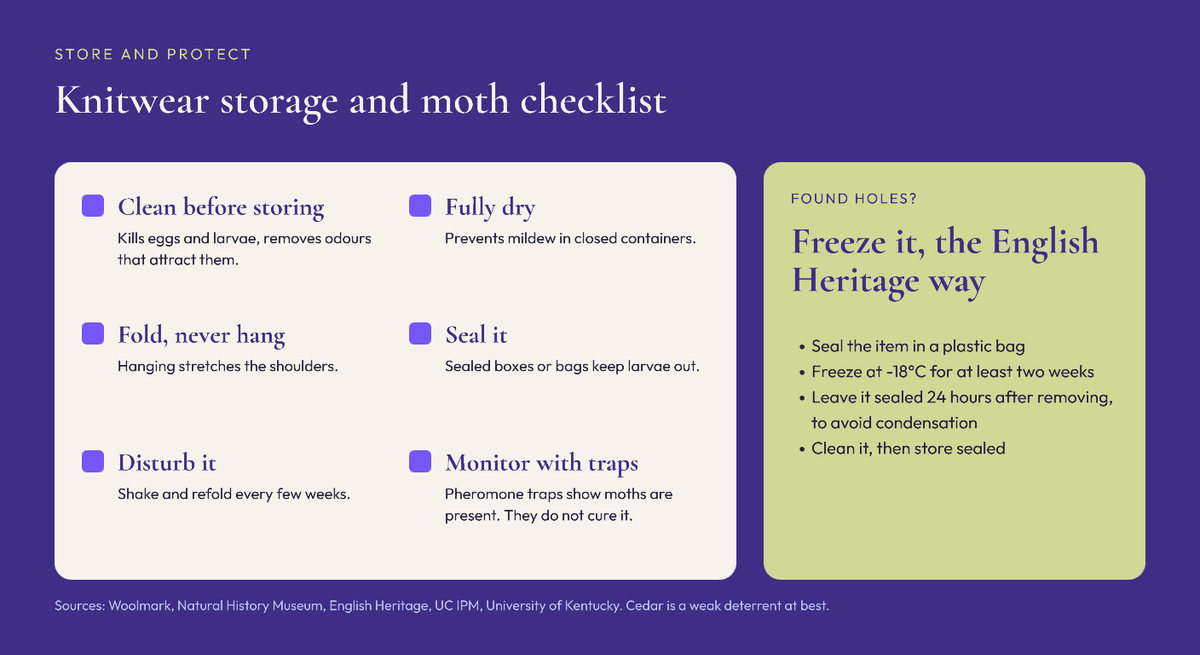
- Fold, never hang. Woolmark's guidance is that "sweaters should be stored flat in a folded manner, rather than storing on a hanger," because hanging stretches the shoulders. Johnstons of Elgin says the same for cashmere.
- Store clean and fully dry. This matters for moths and for mildew.
- Choose your container deliberately. Woolmark and N.Peal prefer breathable cotton bags in a cool, dark place, and Woolmark warns that vacuum bags can trap moisture. Pest specialists prefer sealed containers for moth protection. A sensible middle ground: clean, bone-dry knits in sealed boxes or bags, checked every few weeks.
- Keep heavy knits at the bottom. Stacking heavy pieces on fine ones can flatten them.
FAQ
How often should you wash a wool sweater?
Less often than you think. Woolmark recommends airing wool between wears and resting it for a day, and Johnstons of Elgin suggests washing cashmere every three to four wears.
Can you put a wool sweater in the washing machine?
Only if the care label allows it. Woolmark says machine-washable wool can go on a wool cycle, usually gentle action at 40°C. Hand-wash-only knits can felt in a normal cycle.
How do you fix a pilled sweater?
Lay it flat and use a sweater comb gently, or a battery-powered fabric shaver. Woolmark calls de-pillers "very effective." Combing early, after the first few wears, helps.
Does cedar stop clothes moths?
Not reliably. UC IPM says cedar can kill small larvae but not large ones and loses effect over time, and University of Kentucky entomologists call cedar chests "seldom effective." Cleaning and sealed storage matter more.
How long do you freeze clothes to kill moths?
English Heritage advises sealing items in plastic bags and freezing at -18°C for at least two weeks, then leaving them sealed for 24 hours after removal to avoid condensation.
Why did my wool sweater shrink?
Heat, moisture and agitation together cause wool's surface scales to lock together, a process called felting. Woolmark says it is irreversible, so prevention is the only fix.
Get more wear from the knits you already own. Elara is an AI personal stylist built around your wardrobe. Add your sweaters to your digital closet and Elara suggests outfits for the weather and your plans, so a cashmere crew gets worn often and given rest days in between. Pair it with our guide to styling a sweater vest, then try Elara free.
Your stylist, in your pocket
Stop reading about outfits. Start wearing them.
Elara knows your closet, shops every store and gets you dressed for any occasion.