
What to Wear to a Christmas Market 2026: How to Stay Warm Standing Still
What to wear to a Christmas market in 2026: a layering system for standing in the cold, warm footwear, outfit formulas and this year's opening dates.
 Mehul AgarwalFounder & CEO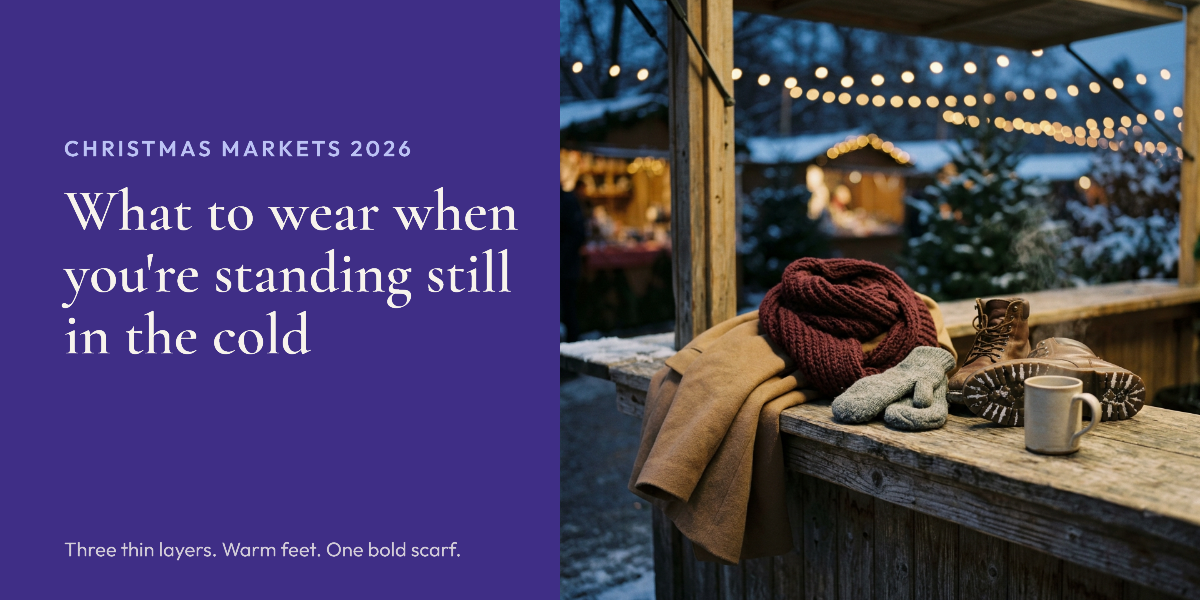
Last updated: October 2026
Quick answer: Dress for standing still, not walking. A Christmas market means two or three hours of slow shuffling between stalls in the evening cold, so build three thin layers (a wool or synthetic base, a knit mid-layer, a coat that covers your hips), then spend most of your effort on your feet, hands and neck: insulated boots with grip and room for a wool sock, mittens or lined gloves, and a big scarf. Skip cotton next to the skin, carry a small cross-body bag, and choose one warm colour near your face for photos under string lights.
Christmas market season starts earlier than most people expect. Vienna's market on Rathausplatz opens on 13 November 2026, according to the city's official tourism site, Wien.info. London's Hyde Park Winter Wonderland opens on 19 November. Nuremberg's Christkindlesmarkt, one of the best known in Germany, runs from 27 November to 24 December, according to the City of Nuremberg's official market notice.
The challenge with dressing for a market is that it is not like a walk or a commute. You move slowly, stop often, hold a hot drink in one hand, and stay out after dark. Clothes that keep you warm on a brisk walk can leave you cold within an hour of standing around. This guide explains why, then gives you a layering system, outfit formulas for different kinds of visit, and a short packing list for a market city break. For general cold-weather outfits, our guide to what to wear in 40 degree weather is a good companion.
2026 dates for the big markets

Confirm dates before you book, because listings sometimes disagree. Here is what official and established sources say as of October 2026:
- Vienna, Rathausplatz: 13 November to 26 December 2026, daily 10am to 10pm (Wien.info).
- Vienna, Schönbrunn Palace: 6 November 2026 to 6 January 2027 (Wien.info).
- London, Hyde Park Winter Wonderland: 19 November 2026 to 3 January 2027, closed on Christmas Day (official Winter Wonderland site).
- Nuremberg, Christkindlesmarkt: 27 November to 24 December 2026, 10am to 9pm, closing at 2pm on Christmas Eve (City of Nuremberg).
- Strasbourg: listings disagree on the opening day. Some give Thursday 26 November and others Friday 27 November 2026, both closing on 24 December. The city's official Christmas site, noel.strasbourg.eu, publishes the programme each autumn, so check it before you travel.
Why markets feel colder than the forecast
Three things work against you at a market, and knowing them tells you where to spend your layers.
You are barely moving. When you walk briskly, your body produces a lot of heat. Shuffling between stalls produces very little, so the outfit that felt fine on the walk from the station starts to feel thin after 30 minutes. Outdoor retailers frame their advice the same way: REI's base layer guide, for example, sorts its picks by how active you will be.
Your extremities get the worst of it. Standing on cold stone or cobbles draws heat from your feet, and holding a mug or a phone keeps one hand out of your pocket. Most of the discomfort people describe after a market visit is cold feet and hands, not a cold torso.
It gets dark early, and the temperature drops with it. Markets are at their best in the evening, which is also the coldest part of the visit. Dress for the temperature at 8pm, not at 3pm.
The layering system for standing still
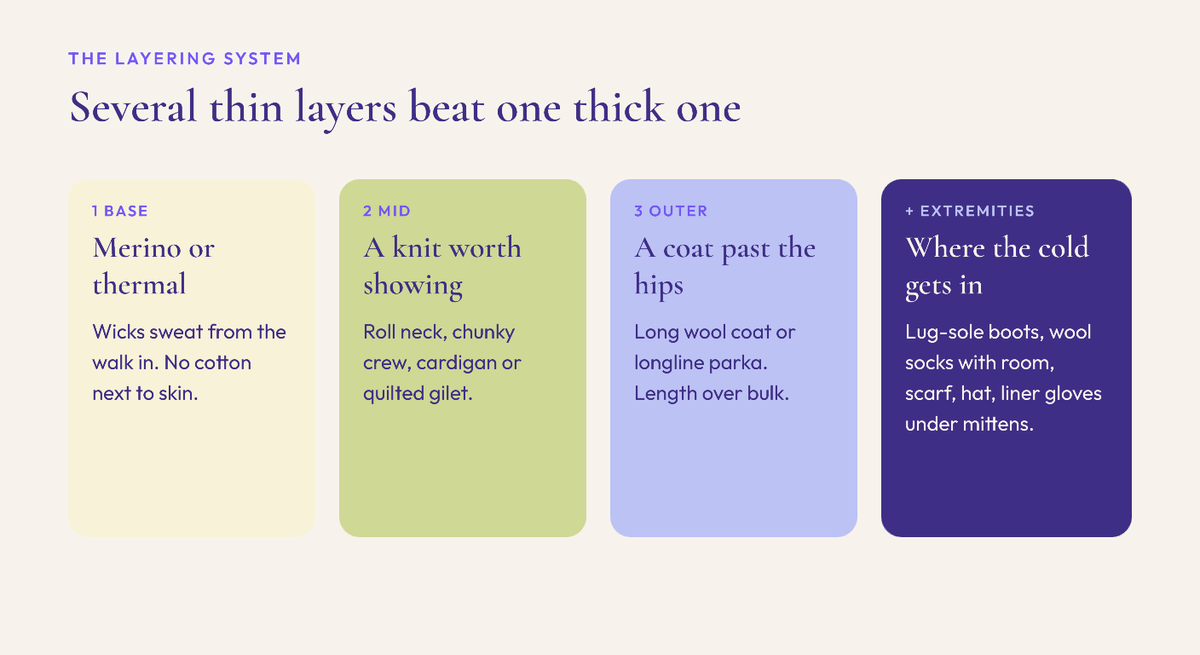
The NHS advice for cold weather is simple: wear several thin layers rather than one thick layer, because the layers trap warm air between them. For a market, that means three layers, plus accessories.
Base layer: no cotton. REI advises avoiding cotton next to the skin "because cotton doesn't efficiently wick away moisture," and notes it dries slowly and insulates poorly. If you get warm on the walk in, a cotton T-shirt holds that sweat and then chills you once you stop. Merino wool, which REI describes as "soft, breathable, moisture wicking and naturally odor resistant," is the best option for most people. A fine merino long-sleeve or a thin thermal top fits under almost anything. Synthetic base layers dry faster than wool, according to REI, so they suit people who run hot.
Mid-layer: a knit that looks good on its own. This is the layer people will see when you step into a warm café or a crowded tent, so make it the style piece: a chunky lambswool crewneck, a cashmere roll neck, a cardigan you can open, or a fleece-lined overshirt. A roll neck doubles as neck insulation, which means you can wear a lighter scarf.
Outer layer: length matters more than bulk. Choose a coat that covers your hips or reaches mid-thigh. A long wool coat, a quilted or down parka, or a padded longline jacket keeps your lower back and seat warm, which a cropped puffer does not. If rain is likely, a water-resistant shell or a coat with a treated finish matters more than extra padding.
Accessories do most of the work. A big wool scarf you can wrap twice, a hat that covers your ears, and mittens or lined gloves. Mittens are generally warmer, because your fingers share warmth, but gloves with touchscreen fingertips are easier when you are paying at stalls and taking photos. A practical compromise is thin touchscreen liner gloves under mittens you can pull off.
Feet first: boots, socks and the ground
If you only upgrade one thing, make it your footwear. You will spend hours on stone, cobbles or packed ground that may be wet or icy.
- Choose insulated or lined boots with a grippy rubber sole. Smooth leather soles slip on wet cobbles. A lug sole gives you traction without needing hiking boots.
- Leave room for a thicker sock. A wool or wool-blend sock adds warmth, but only if your boot is not squeezing it. Tight boots press out the insulating air. Try boots on with the socks you plan to wear.
- Add an insole if your boots are thin. A wool or felt insole between your foot and the sole helps when you are standing on cold ground.
Want this styled from your own closet?
Elara builds the look from what you own, then lets you try it on.
- Skip fashion trainers and thin-soled ankle boots for evening visits. They look good in photos and feel terrible by hour two.
Three outfit formulas that work
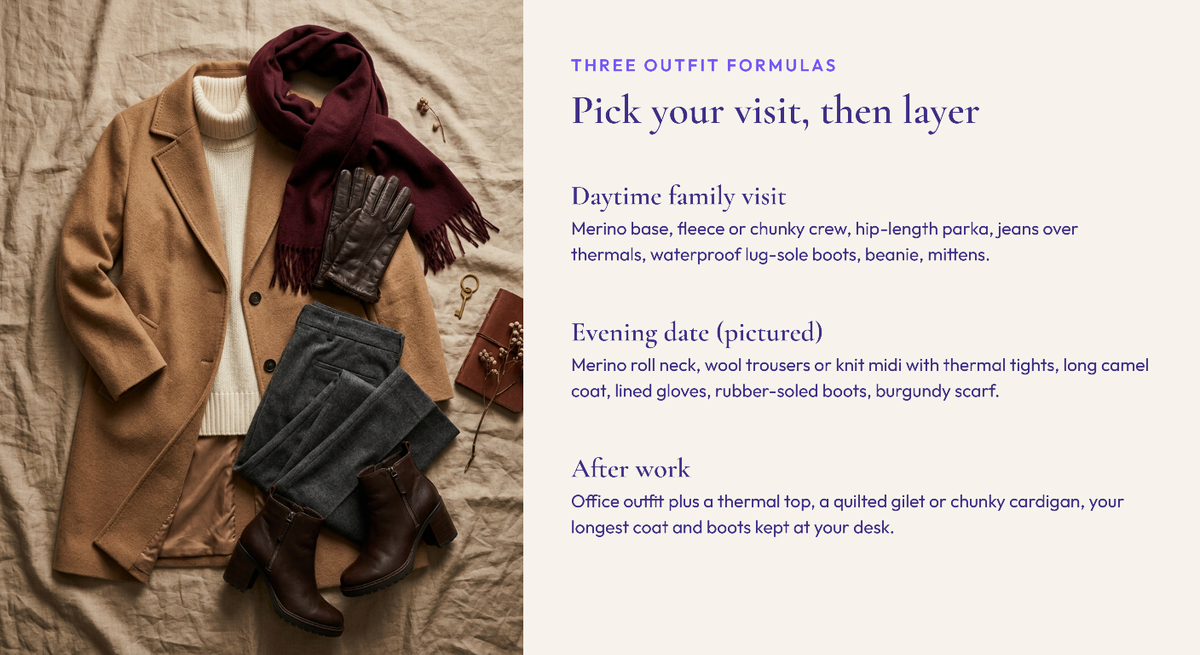
Use these as starting points and swap in pieces you already own.
The daytime family visit
Merino base, a fleece or a chunky crew-neck jumper, a quilted parka that covers the hips, straight-leg jeans with thermal leggings underneath, waterproof lug-sole boots, a beanie and mittens on a cord if you have small children with you. Bring a cross-body bag so your hands are free.
The evening date
Fine merino roll neck, wool trousers or a knit midi skirt with opaque thermal tights, a long camel or charcoal wool coat, lined leather gloves, a heeled boot with a rubber sole, and a scarf in a rich colour like burgundy, forest green or deep plum near your face. Those shades look warm under yellow string lights and hide the inevitable drop of mulled wine.
After work with colleagues
Keep your office layers and add on top: a thermal top under your shirt, a chunky cardigan or a quilted gilet over it, your longest coat, and a pair of boots you keep at your desk. A gilet is the most underrated piece here, because it warms your core without adding bulk to your sleeves.
Bags, cups and other practical details
- Carry a small cross-body bag. You will want both hands for food and drink, and crowds make backpacks awkward. Some venues have rules too: Hyde Park Winter Wonderland only allows handbags or small rucksacks no larger than A4, searches all bags at the gate, and has no left luggage on site.
- Wear pockets you can reach. Coat pockets with a zip or a flap stop phones and cards falling out when you bend over a stall.
- Know the cup system. Many German and Austrian markets serve drinks in a ceramic mug with a deposit that you get back when you return it. Keep a few coins handy, and keep one glove off and tucked into a pocket rather than balanced on a ledge.
- Protect your knits. Wool and cashmere pick up the smell of grilled food and woodsmoke. Air them overnight rather than washing them straight away; our wool and cashmere care guide explains why washing less is better for knitwear.
Packing for a market city break
For a long weekend in Vienna, Nuremberg or Strasbourg, a carry-on can cover it if you build around layers rather than outfits:
- 2 base layers (one long-sleeve merino, one thermal)
- 2 knit mid-layers in colours that work together
- 1 long coat, worn on the plane
- 1 pair of trousers or jeans, plus thermal leggings
- 1 pair of insulated boots with grip, worn on the plane
- 3 pairs of wool-blend socks
- Scarf, hat, liner gloves and mittens
- A small cross-body bag that folds flat
FAQ
What should I wear to a Christmas market at night?
Plan for the coldest part of the evening. Wear a thin non-cotton base layer, a warm knit, and a coat that covers your hips, then add insulated boots with grip, a thick scarf, a hat and gloves or mittens. Layers you can open are better than one heavy jumper, because tents and cafés can be warm.
Are trainers OK for a Christmas market?
For a short daytime visit on a dry day, yes. For an evening visit, insulated boots with a rubber lug sole are much more comfortable, because you will be standing on cold, often wet stone for hours and thin soles let the cold straight through.
How do I stay stylish but warm at a Christmas market?
Put the style into the pieces people see: the coat, the scarf and the knit. Keep the warmth underneath, with a merino or thermal base layer and thermal tights or leggings. A long wool coat with a rich-coloured scarf looks polished and keeps you warmer than a cropped jacket.
When do Christmas markets open in 2026?
Dates vary by city. Vienna's Rathausplatz market opens on 13 November, Hyde Park Winter Wonderland on 19 November, and Nuremberg's Christkindlesmarkt on 27 November 2026. Strasbourg listings give 26 or 27 November, so check the city's official site before booking.
What bag should I take to Winter Wonderland?
A small handbag or small rucksack no bigger than A4. According to the official site, bags are searched at the gates, larger bags and luggage are discouraged, and there is no left luggage at the event.
Elara can build these outfits from what you already own. Add your coats, knits and boots to your digital closet, tell the AI stylist where you are going and what the forecast says, and it will put together complete looks for the trip, so you only buy the one piece you are actually missing. Try Elara before you pack.
Your stylist, in your pocket
Stop reading about outfits. Start wearing them.
Elara knows your closet, shops every store and gets you dressed for any occasion.