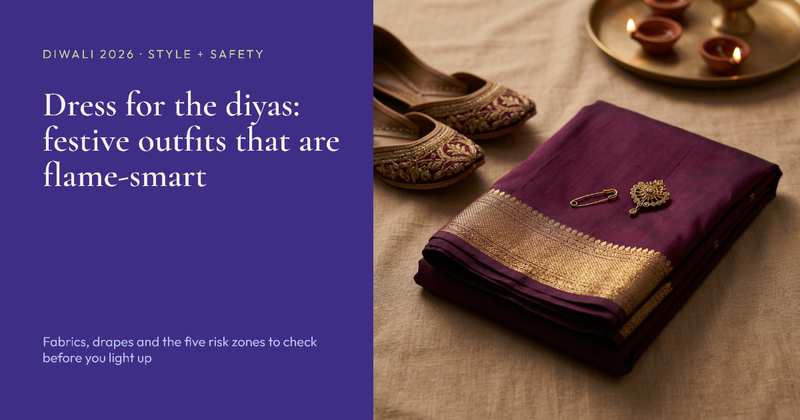


Clocks Go Back 2026: How to Dress to Be Seen on Dark Walks and Commutes
The clocks go back on 25 October (UK) and 1 November (US). How to dress to be seen on dark walks and commutes, using reflective details where they work best.
 Mehul AgarwalFounder & CEO
Last updated: October 2026
Quick answer: When the clocks go back, your walk or cycle home moves into the dark, and dark coats make you hard to see. Use fluorescent or light colours for dusk and dull days, and reflective material once it is dark: the UK Highway Code says reflective materials can be seen by drivers using headlights "up to three times as far away" as non-reflective ones. Put reflective details where you move (ankles, wrists, the backs of your shoes), because research on night-time visibility found drivers recognise people with reflectors on their joints much sooner than people in a reflective vest. A few well-placed pieces can look intentional rather than high-vis.
The clocks go back in the UK at 2am on Sunday, 25 October 2026, according to GOV.UK. In the US, daylight saving time ends on the first Sunday in November, which this year is Sunday, 1 November 2026, at 2am local time, according to the US Naval Observatory (Hawaii and most of Arizona stay on standard time year-round). Either way, the evening school run, the commute home, the after-work run and the last dog walk all shift into darkness almost overnight.
Most autumn and winter wardrobes make this worse. Navy, black, charcoal and dark olive coats are the season's default, and they are close to invisible against a dark road. This guide explains the difference between fluorescent and reflective, why where you put reflective detail matters more than how much you wear, and how to build visibility into clothes you would choose anyway. If you are updating your cold-weather wardrobe at the same time, our guide to caring for wool and cashmere covers the knits coming out of storage this month.
Fluorescent and reflective are not the same thing
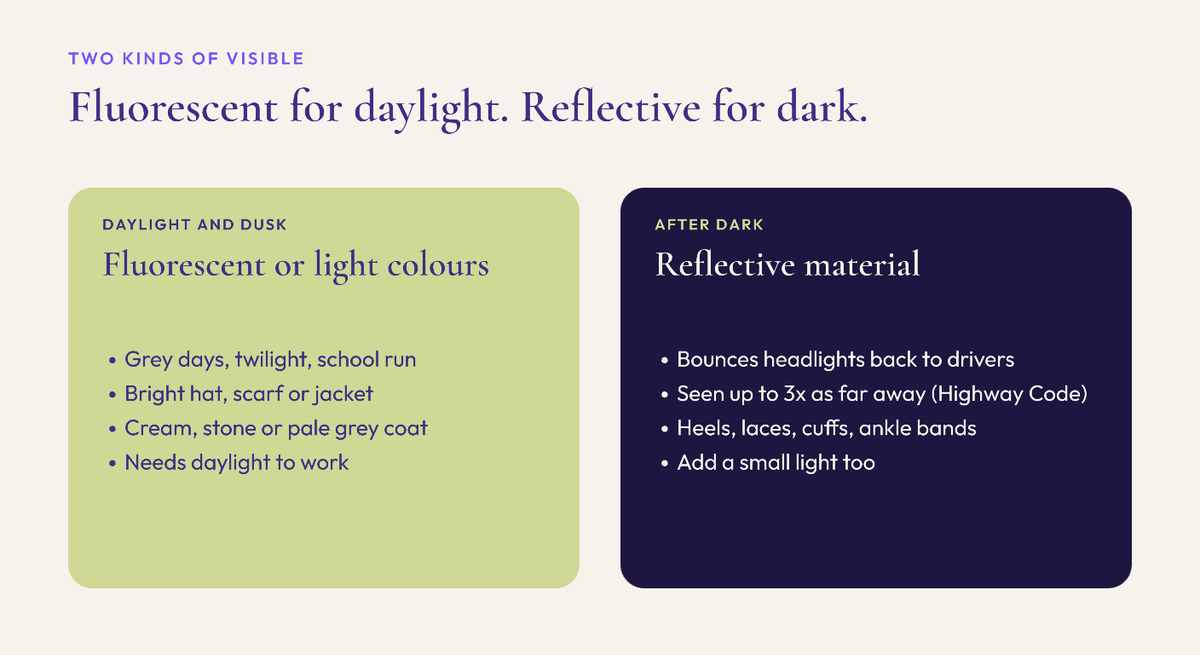
People often use these words interchangeably, but they work in different light, and the Highway Code treats them separately.
Fluorescent colours are for daylight and dusk. Fluorescent fabric (the bright yellow, orange or pink of a cycling jacket) converts light into a more vivid colour, so it stands out on grey, overcast days and at twilight. Rule 3 of the Highway Code tells pedestrians to "wear or carry something light-coloured, bright or fluorescent in poor daylight conditions." Light colours like cream, stone and pale grey also help at dusk, just less dramatically.
Reflective material is for the dark. Retroreflective tape, piping and prints bounce light from headlights back towards the driver. The same rule continues: "When it is dark, use reflective materials (eg armbands, sashes, waistcoats, jackets, footwear)," which "can be seen by drivers using headlights up to three times as far away as non-reflective materials."
The practical upshot: a fluorescent jacket with no reflective trim does far less at 7pm in November than it did at 4pm, and a dark coat with a reflective panel does almost nothing until headlights hit it. For the darker months, you want both, or at least one of each. The US National Highway Traffic Safety Administration gives the same split advice: "Wear bright clothing during the day, and wear reflective materials or use a flashlight at night."
Why placement matters more than quantity
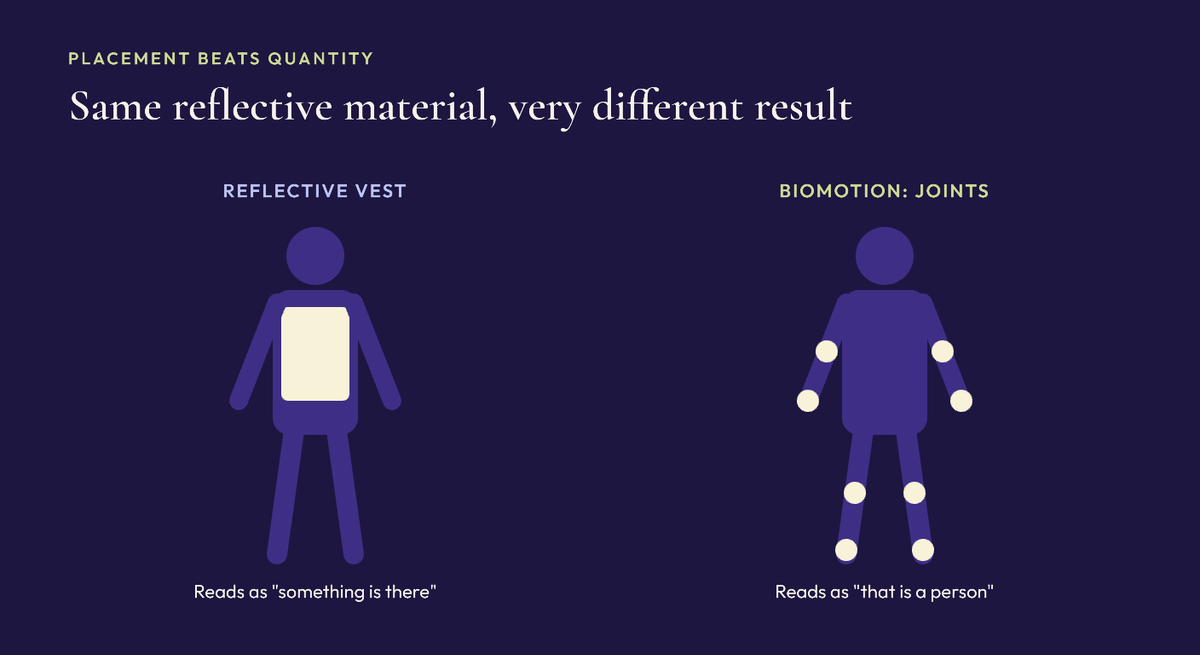
This is the part most people do not know. A long-running line of research led by Joanne Wood and colleagues at Queensland University of Technology tested how drivers recognise pedestrians at night. Participants drove a closed road course at night while pedestrians wore black clothing, a reflective vest, or reflective strips on the wrists, elbows, knees and ankles, a layout researchers call "biological motion" or "biomotion."
The results were consistent: pedestrians with reflectors on their joints were recognised more often and from further away than those in a reflective vest, even when drivers had blurred vision or faced oncoming headlights. In the original 2005 study, published in the journal Human Factors and summarised in a 2021 paper in the International Journal of Fashion Design, Technology and Education, the same amount of reflective material in a biomotion layout was recognised at roughly three times the distance of the vest.
The researchers' explanation is that the human visual system is very good at recognising the pattern of a moving body. A rectangle of reflective material on your chest says "something is there." Points of light at your ankles and wrists moving in a walking rhythm say "that is a person," and drivers react to that sooner.
For your wardrobe, this means:
- Prioritise feet and ankles. Reflective heel tabs on trainers, reflective laces, or reflective ankle bands move constantly as you walk or pedal.
- Then wrists. Reflective cuffs on a jacket, a slap band, or gloves with reflective detail.
- Treat a bag or chest panel as a bonus, not the main event.
For cyclists, the Highway Code's Rule 59 says the same thing in plainer terms: light-coloured or fluorescent clothing helps "in daylight and poor light," while "reflective clothing and/or accessories (belt, arm or ankle bands) can increase your visibility in the dark." It also reminds riders that at night a bike "MUST have white front and red rear lights lit," which clothing does not replace.
Ways to be seen that still look like your style
You do not need a hi-vis vest over your good coat. These options blend into a normal autumn wardrobe:
- Trainers and boots with reflective details. Many running and lifestyle trainers have reflective heel tabs, logos or piping. For your daily walking shoes, this is the single most effective swap, because it puts reflectors where the research says they matter most.
- Reflective-print or reflective-thread outerwear. Some rain jackets and parkas use reflective prints or yarns that look grey or black in daylight and only light up under headlights. Look for "retroreflective" in the product description, and check where the reflective areas are: sleeves and hems beat a single back logo.

Want this styled from your own closet?
Elara builds the look from what you own, then lets you try it on.
- A light-coloured coat. A stone, oatmeal or pale grey coat is easier to see at dusk than black or navy. If you are buying one coat this season and you walk a lot after dark, this is worth weighing.
- Small add-ons for your existing coat. Clip-on reflectors for bag straps, reflective slap bands for wrists or ankles, and reflective zip pulls are cheap and easy to move between coats.
- A bright scarf or beanie. For dusk, a fluorescent or very bright knit hat or scarf adds colour at head height. It is not a substitute for reflective detail after dark, but it helps on grey afternoons.
- Carry a light. NHTSA suggests using a flashlight at night. A small clip-on LED on a bag strap, set to flash, is visible even before headlights reach you.
A pre-commute checklist for darker evenings
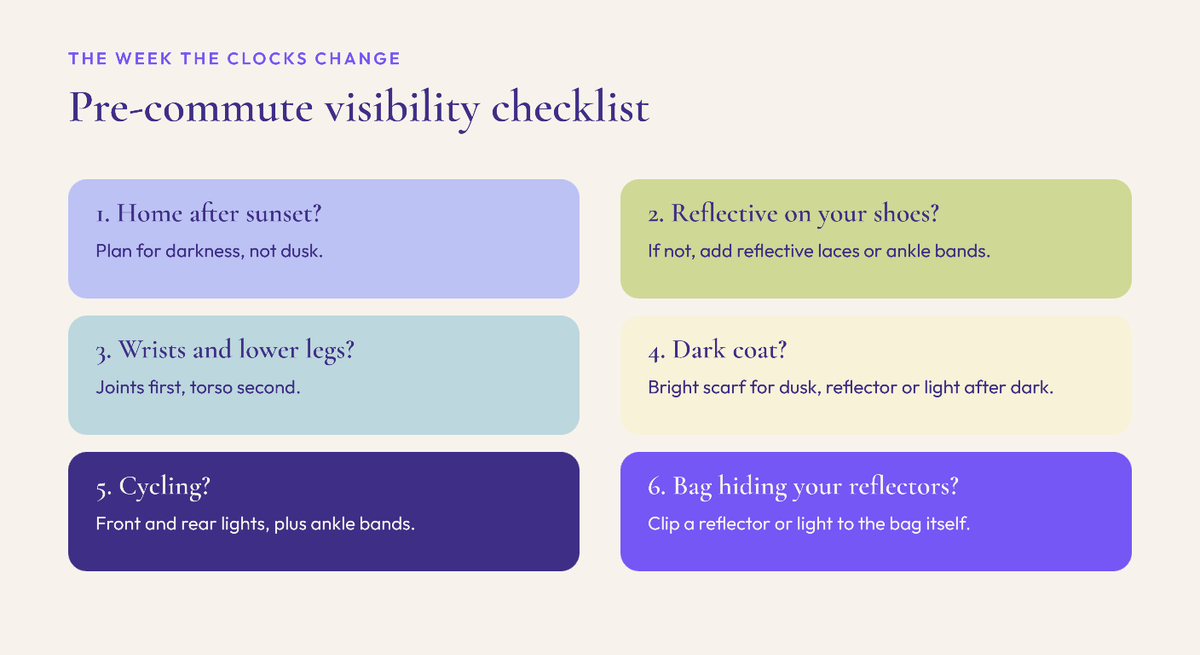
Run through this the week the clocks change, then it becomes habit:
- What time will I head home? If it is after sunset, plan for darkness, not dusk.
- Do my shoes have anything reflective? If not, add reflective laces or ankle bands.
- Is there anything reflective on my wrists or lower legs? Joints first, torso second.
- Is my coat dark? If so, add a light or bright scarf or hat for dusk, and a clip-on reflector or light for after dark.
- Am I cycling? Lights on front and rear are a legal requirement at night in the UK, and reflective ankle bands double as trouser clips.
- Does my bag cover my reflective details? A backpack can hide a reflective back panel completely, so put a reflector on the bag itself.
Runners, dog walkers and children
Runners are the easiest to equip, because a lot of running kit already includes reflective detail. Check that it sits on moving parts: reflective tights with ankle detail, reflective shoe heels and a slap band on one wrist.
Dog walkers often walk the same dark route at the same time every evening. A reflective lead or collar for the dog, plus reflective ankle bands for you, covers both of you at ground level, where headlights hit first.
Children walking home from school or activities benefit from the same approach. Reflective strips on school bags, shoes with reflective heels, and a light-coloured or bright coat or hat give drivers more chances to spot them. Rule 3 of the Highway Code applies to everyone on foot, not just adults.
FAQ
When do the clocks go back in 2026?
In the UK, at 2am on Sunday, 25 October 2026, according to GOV.UK. In the US, daylight saving time ends on the first Sunday in November, which is Sunday, 1 November 2026, at 2am local time. Hawaii and most of Arizona do not observe daylight saving time.
Is fluorescent or reflective clothing better at night?
Reflective. Fluorescent colours stand out in daylight and at dusk, but they need daylight to work. After dark, reflective material bounces headlight beams back to the driver. The Highway Code recommends fluorescent in poor daylight and reflective materials in the dark.
Where should I wear reflective strips?
On parts of your body that move, especially your ankles and wrists. Research by Joanne Wood and colleagues at Queensland University of Technology found drivers recognised pedestrians with reflectors on their joints sooner than those wearing a reflective vest with the same amount of material.
Does a white or light-coloured coat help at night?
It helps at dusk and in lit streets, and it is easier to see than black or navy. On an unlit road at night, though, reflective material is far more visible in headlights, so pair a light coat with reflective details or a small light.
How can I be visible without wearing hi-vis?
Choose shoes with reflective heels or laces, add reflective slap bands at the wrist or ankle, look for outerwear with reflective prints that only show in headlights, and carry a small clip-on light. These look like normal clothing in daylight.
Elara can help you work visibility into what you already wear. Add your coats, shoes and bags to your digital closet, and ask the AI stylist to build commute outfits around the pieces with reflective or light-coloured details, or to point out the one gap worth filling. Try Elara before your first dark walk home.
Your stylist, in your pocket
Stop reading about outfits. Start wearing them.
Elara knows your closet, shops every store and gets you dressed for any occasion.