
Winter Wedding Season 2026: How to Stay Warm in a Saree, Lehenga or Sherwani
How to stay warm at a winter wedding in 2026 without hiding your saree, lehenga or sherwani: hidden thermals, warmer fabrics, GI shawls and smart swaps.
 Mehul AgarwalFounder & CEO
Last updated: October 2026
Quick answer: To stay warm at a North Indian winter wedding without hiding your outfit, layer from the inside out: a thin thermal base under the blouse, kurta or churidar, a warm middle layer that is part of the look (a velvet or brocade blouse, a bandhgala, a sherwani in a heavier fabric), and a statement outer layer such as a pashmina, Kani or Kullu shawl, or a jacket over a saree. Cover ears, hands and feet, which feel the cold first, and plan for the coldest part of the night, which is usually the late pheras.
The 2026 wedding season begins with Dev Uthani (Prabodhini) Ekadashi, which most panchangs place on Friday, 20 November 2026, followed by Tulsi Vivah on 21 November. Some calendars list the Ekadashi on 19 or 21 November depending on the tradition followed, so check with your family priest. Lists of auspicious vivah muhurat dates vary between sources, but 21, 25 and 26 November and 3, 4 and 12 December appear on several of them. Many families then pause weddings during Kharmas, which runs from about 16 December 2026 to 14 January 2027.
That puts a lot of weddings in late November and early December, when evening temperatures in much of North India drop sharply, and many ceremonies happen outdoors, on lawns and terraces, late into the night. This guide is about staying warm without losing the look. For what to wear at each function, see our guest guide to haldi, mehendi, sangeet and the wedding.
How cold does a winter wedding actually get?
Winter evenings in the plains can be colder than people pack for. The India Meteorological Department's climate summary for Jaipur, for example, gives a mean minimum temperature of about 9°C in December and under 8°C in January, which it calls the coldest month. Those are averages: individual nights run colder, and an open lawn at 1am feels colder still.
IMD also has formal definitions worth knowing. Its criteria for a cold wave in the plains start when the minimum temperature is 10°C or below, and a cold wave is declared when the minimum is 4.5 to 6.4°C below normal, or 4°C or lower. If the forecast mentions a cold wave or a "cold day" for the wedding date, plan your layers seriously.
The layering principle, adapted for Indian wedding wear
Outdoor clothing experts use a three-layer system. REI describes it as a base layer that "wicks sweat off your skin," a mid layer that "retains body heat," and an outer layer that blocks wind. NHS guidance on keeping warm makes the same point more simply: wear "several layers of clothes rather than 1 chunky layer."
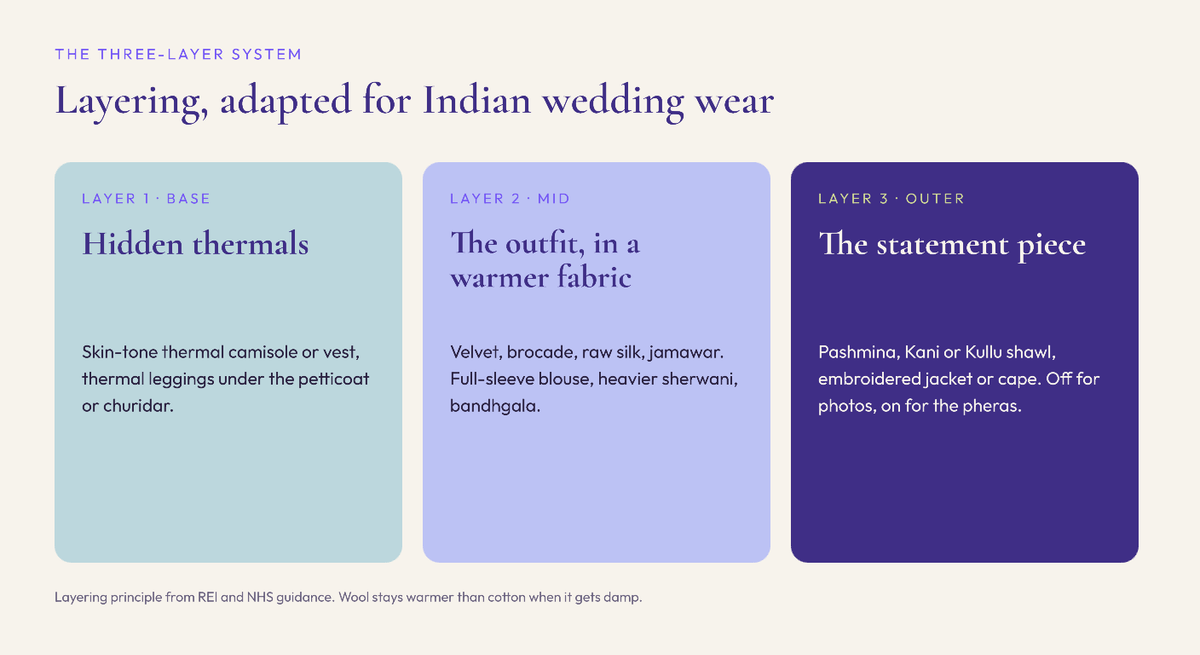
Wedding wear maps onto this neatly, if you plan it:
- Base layer: hidden thermals. A slim thermal camisole or sleeveless thermal under the blouse, thermal leggings under the petticoat or churidar, and a thin thermal vest under a kurta. Choose skin tones and thin fabrics so nothing shows at the neckline or sleeves.
- Mid layer: the outfit itself, in a warmer fabric. Velvet, brocade, raw silk, jamawar and wool-silk weaves trap more warmth than georgette or net. A full-sleeve velvet blouse or a sherwani in heavier brocade is the outfit and the warmth at once.
- Outer layer: the statement piece. A shawl, a cape, an embroidered jacket over a saree, or a bandhgala over a kurta. This is the layer you take off for photos and put back on for the pheras.
One more principle: wool stays warm when it gets a little damp from evening dew or a long night. The Woolmark Company (the wool industry body) says wool can absorb a significant amount of moisture before it feels wet. REI warns that cotton "sponges up water and can chill you."
Warm layers that belong at a wedding: shawls with a story
A good shawl is not a compromise at a wedding. Some of India's finest textiles exist precisely for the cold.
Kashmir Pashmina
Pashmina comes from the fine undercoat of Changthangi goats raised by nomadic herders in the Changthang region of Ladakh, according to the Press Information Bureau. Kashmir Pashmina received a Geographical Indication (GI) tag in 2008, and a testing and certification centre in Srinagar checks genuine pieces. Under the GI criteria, as summarised in government exam-prep sources, the fibre must be 16 microns or finer. If you are buying, ask about GI certification and a lab label rather than relying on the word "pashmina" alone.
Kani shawls
The Kani shawl, also GI-tagged in 2008, is woven on a loom using small wooden sticks called kanis, following a coded pattern called a talim, according to Incredible India. It is a twill tapestry weave, which gives the dense, all-over patterns that make a Kani shawl an outfit in itself. A plain saree or lehenga with a Kani shawl draped over the shoulders is a classic winter wedding look.
Kullu shawls
The Kullu shawl from Himachal Pradesh has been GI-registered since 2005, according to India's GI registry. It is known for bold geometric bands woven at both ends, and is made from local wool and finer fibres including merino, angora and pashmina, according to the Himachal Pradesh state council for science and technology's GI brochure. Its strong patterns pair well with solid-coloured kurta sets and sherwanis.
Saree, lehenga and sherwani: specific warm-weather swaps
Saree
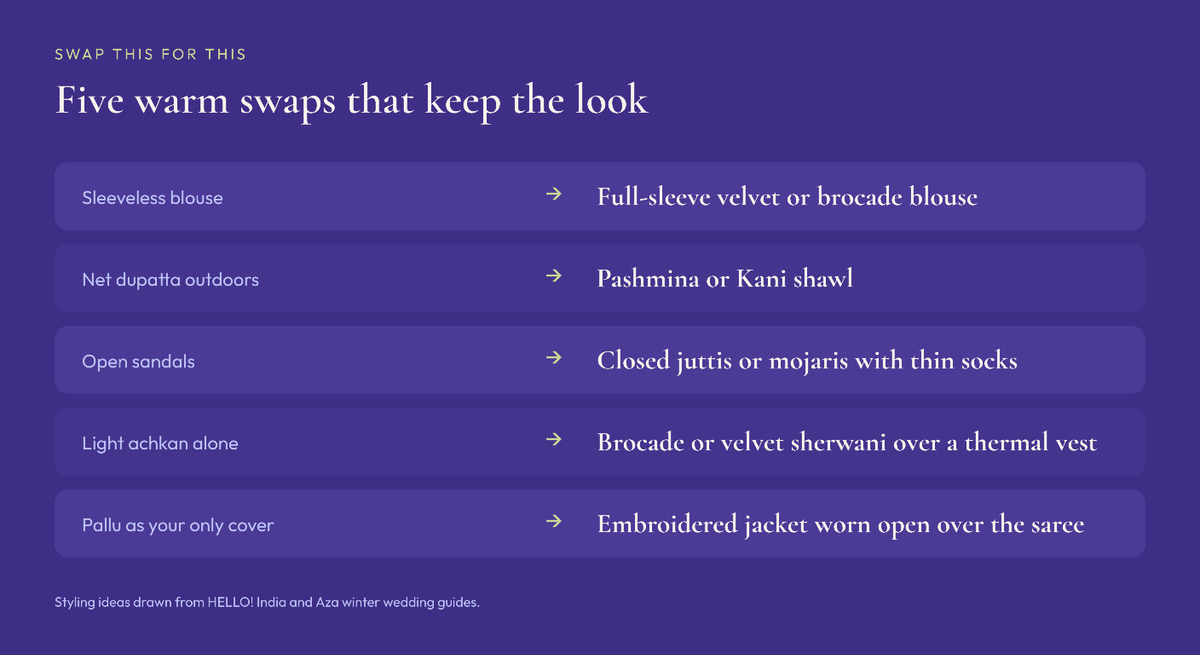
- Swap a sleeveless blouse for a full-sleeve or three-quarter-sleeve blouse in velvet or brocade.
- Try a Gujarati or Rajasthani-style drape, which wraps more fabric around the torso, as HELLO! India's winter wedding guide suggests.
- Replace the pallu-as-only-cover habit with a pashmina or Kani shawl, or a short embroidered jacket worn open over the saree.
- Wear thermal leggings under the petticoat. Nobody will know.
Lehenga
- Choose a velvet, raw silk or brocade lehenga, and a full-sleeve choli.
- Use a pashmina shawl or a heavier dupatta in place of a net dupatta for the outdoor parts of the night, as retailer Aza suggests.

Want this styled from your own closet?
Elara builds the look from what you own, then lets you try it on.
- A long cape or floor-length jacket over the lehenga keeps the silhouette and adds real warmth.
Sherwani and kurta sets
- Sherwanis in brocade, velvet, raw silk or jamawar are naturally warmer, as Aza's guide to sherwanis and achkans notes. An achkan is shorter and lighter, so it needs more help underneath.
- Add a thermal vest and thermal leggings under the churidar.
- For sangeets and receptions, a raw-silk or velvet bandhgala over a kurta works as both outfit and outer layer.
- Drape a shawl or a dushala, a wide woollen shawl with embroidered edges, over the shoulder for the pheras.
Cover the extremities, not just your core
You have probably heard that most body heat escapes through your head. That is a myth. A 2008 BMJ report, as covered by Live Science, found that only around 7 to 10% of body heat is lost through the head, and that heat loss tracks how much skin is exposed. What matters is that your ears, nose, hands and feet are especially sensitive to cold.
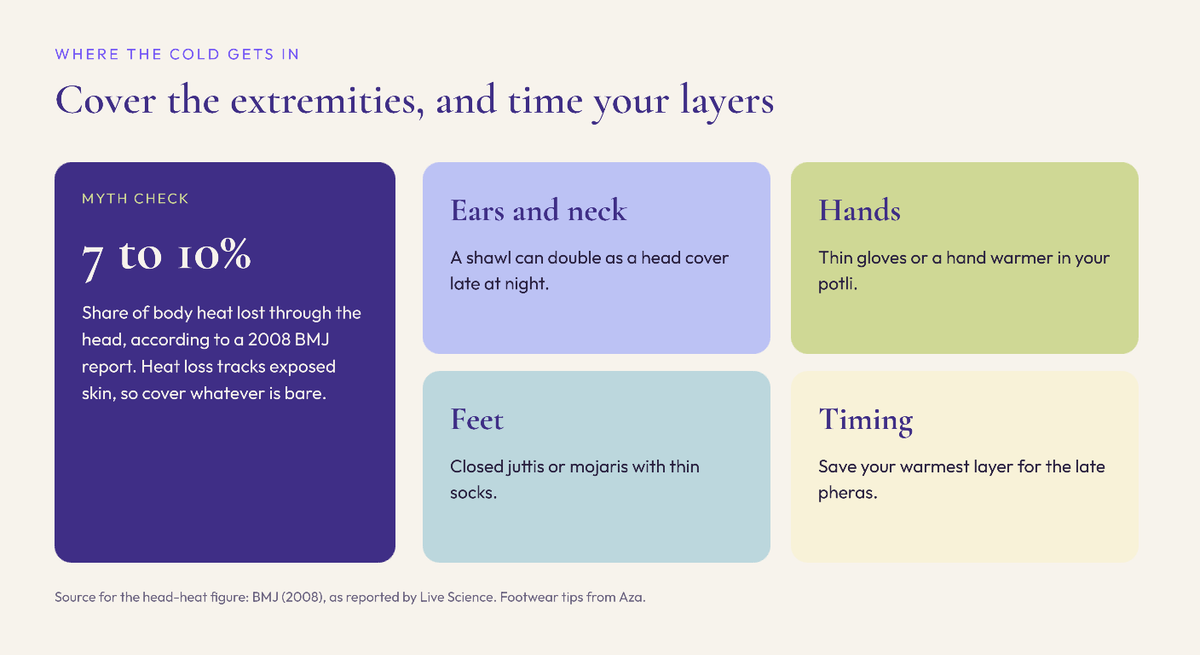
- Feet: wear closed juttis or mojaris with thin socks rather than open sandals, as Aza suggests. Closed embroidered boots also work with lehengas.
- Hands: keep a pair of thin gloves or a hand warmer in your potli for the long wait before the baraat or the pheras.
- Ears and neck: a shawl can double as a head cover when the night gets cold, which also suits ceremonies where heads are covered.
- Timing: the pheras often run late into the night. Keep your warmest layer for then rather than wearing it all evening and overheating indoors.
A winter wedding packing checklist
- Thermal base layers in skin tone (top and leggings).
- One warm statement layer per outfit: shawl, jacket or cape.
- Closed footwear and thin socks.
- Thin gloves or hand warmers.
- Safety pins to secure a shawl over a saree or lehenga.
- A plan to re-wear one shawl across functions. Our guide to re-wearing one wedding outfit at every function shows how.
FAQ
When does the 2026 wedding season start?
Dev Uthani (Prabodhini) Ekadashi falls on 20 November 2026 in most panchangs, with Tulsi Vivah on 21 November. Some traditions observe the Ekadashi on 19 or 21 November. Several vivah muhurat lists include 21, 25 and 26 November and 3, 4 and 12 December 2026.
How can I stay warm in a saree at an outdoor wedding?
Wear a thin thermal under the blouse and thermal leggings under the petticoat, choose a full-sleeve velvet or brocade blouse, and add a pashmina or Kani shawl or an embroidered jacket for the outdoor part of the evening.
What should men wear under a sherwani in winter?
A thin thermal vest and thermal leggings under the churidar. Heavier sherwani fabrics like brocade, velvet and jamawar are warmer than lighter achkans.
How do I know if a pashmina shawl is genuine?
Ask whether it carries Kashmir Pashmina GI certification from the Srinagar testing centre. Under the GI criteria the fibre must be 16 microns or finer.
Do we lose most of our heat through the head?
No. A 2008 BMJ report found only around 7 to 10% of body heat is lost through the head. Cover any exposed skin, especially ears, hands and feet.
When is Kharmas in 2026?
Kharmas (Dhanu) runs from about 16 December 2026 to 14 January 2027, and many families avoid weddings during this period. Exact dates vary slightly between panchangs.
Plan every function's look, with the layers built in. Elara is an AI personal stylist that knows your wardrobe. Add your wedding outfits, shawls and jackets to your digital closet, add each function to your calendar, and Elara suggests complete looks for the occasion and the weather, including what to layer for an outdoor night. Try Elara free.
Your stylist, in your pocket
Stop reading about outfits. Start wearing them.
Elara knows your closet, shops every store and gets you dressed for any occasion.