Black Friday 2026: How to Judge Clothing Quality Online Before You Buy
How to judge clothing quality online before Black Friday 2026: read fibre labels, spot good seams in photos, decode GSM and micron, and check returns.
 Mehul AgarwalFounder & CEO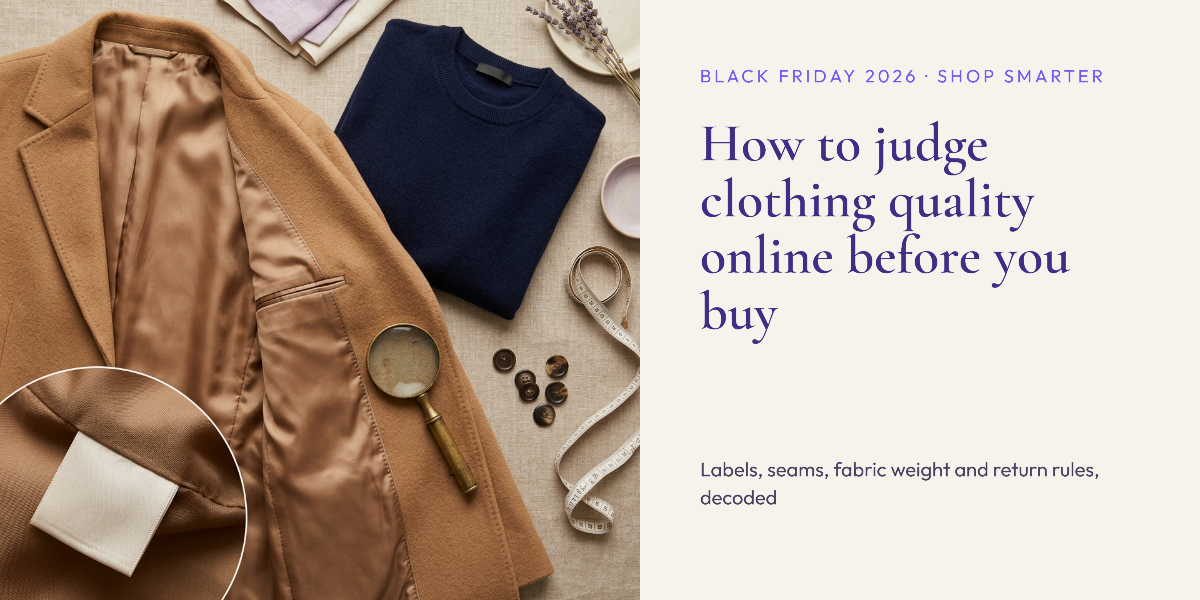
Last updated: October 2026
Quick answer: To judge clothing quality online before Black Friday, read the fibre content (by percentage) before the price, zoom into seams, hems and buttonholes in the product photos, check fabric weight where it is listed, and read the return policy before you check out. In the UK and EU, retailers must show fibre composition before you buy online. In the US, they must show country of origin online, but fibre percentages often only appear on the sewn-in label, so ask or check the size and care section.
Black Friday falls on Friday, 27 November 2026, with Small Business Saturday on 28 November and Cyber Monday on 30 November. Prices drop, but fabric does not get any better because it is discounted. A polyester sweater at 50% off is still a polyester sweater, and a jacket with puckered seams will still look tired by February.
This guide shows you how to read a product page the way a buyer or garment technologist would, using the labelling rules retailers have to follow and the construction checks that university extension programmes have taught for decades. If you already know what you want to buy, pair it with our Black Friday clothing buy list.
Step 1: Read the fibre content before the price
The fibre content tells you more about how a garment will wear, wash and age than almost anything else on the page. Here is what the law actually requires, so you know what to look for and what may be missing.
In the US: origin online, fibre on the label
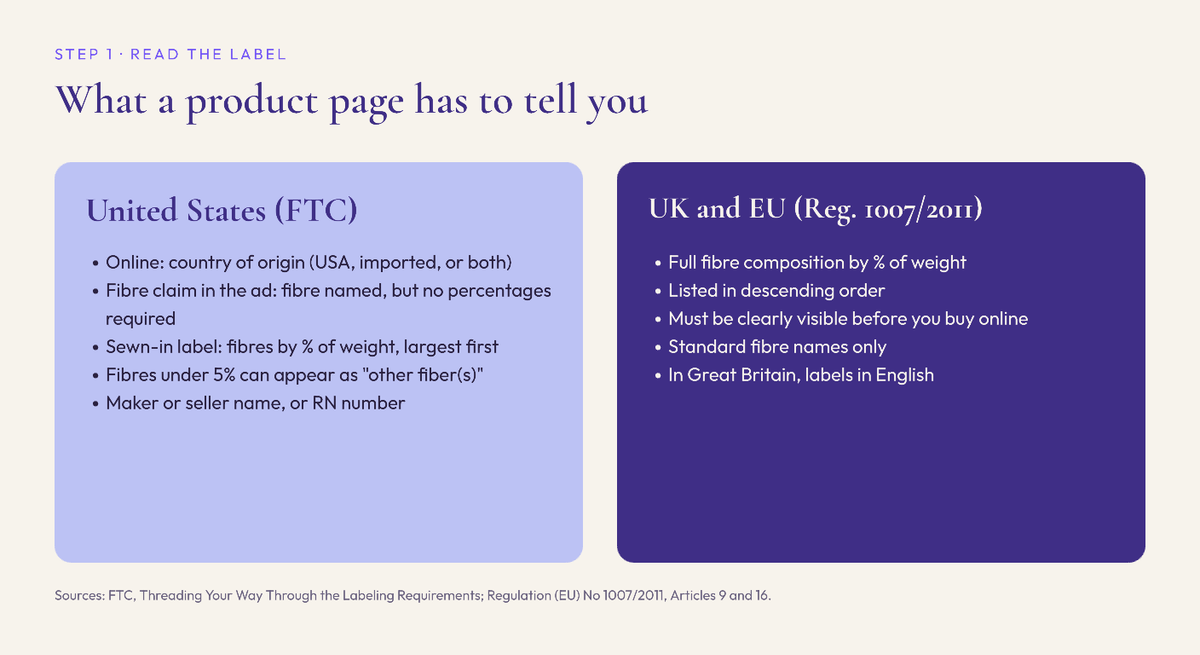
The Federal Trade Commission's guide to the Textile and Wool Acts says most clothing must carry a label listing fibre content, country of origin and the manufacturer or dealer (by name or RN number). Fibres must be listed "in descending order of predominance" by weight, and only fibres making up 5% or more can be named individually; the rest appear as "other fiber(s)."
For online listings, the FTC says retailers "must disclose country of origin information in mail order or internet advertising," described as made in the USA, imported, or both. If an ad makes a claim about a fibre (say, "cashmere sweater"), the fibre information must appear in the ad, though without the percentages. In practice, that means a US product page can say "cashmere blend" without telling you it is 10% cashmere. If the percentage is not shown, check the details tab or ask customer service before you buy.
In the UK and EU: full composition before you pay
The EU Textile Labelling Regulation (No 1007/2011), which the UK retained, requires the name and percentage by weight of all fibres in descending order. Article 16 adds that this information "shall be clearly visible to the consumer before the purchase, including in cases where the purchase is made by electronic means." If a UK or EU product page does not show the full composition, that is a red flag about the retailer, not just the garment.
What the percentages tell you
- A blend name can hide a small share. "Wool blend" or "cashmere blend" can mean almost any percentage. Look for the number.
- Elastane in small amounts is normal. A few percent in jeans or trousers adds stretch and recovery.
- Synthetic knits are not the same as wool. Woolmark notes wool absorbs moisture vapour before it feels wet; polyester and acrylic do not, so a mostly synthetic "winter" sweater can feel clammy indoors.
- Viscose and modal drape beautifully but often need gentler care, so read the care label before you buy.
Step 2: Check the fibre quality signals that brands state
Some retailers go beyond the legal minimum and state fibre grades. These terms are meaningful when they appear, because they describe how fine or long the fibre is.
- Merino micron. The Woolmark Company describes Merino as "generally less than 22 micron," compared with human hair at 50 to 100 microns. A lower number means a finer, softer fibre.
- Super numbers on suiting. Woolmark's fabric training manual lists a scale from Super 80's (under 19.75 micron) to Super 250's (under 11.25 micron). Higher numbers are finer and smoother, but also more delicate, so a mid-range number is often the better buy for a suit you will wear a lot.
- Worsted vs woollen. Woolmark explains that worsted yarns have parallel fibres and finer counts and are used for suiting, while woollen yarns are bulkier and used for jackets and coats. Neither is better; they are built for different jobs.
- Long-staple cotton. According to Textile World, extra-long staple (ELS) cotton has fibres of at least 1 3/8 inches, and Supima cotton averages over 1 7/16 inches. Longer fibres make smoother, stronger yarn. "Supima" is a licensed name, so it is a more specific claim than "premium cotton."
Step 3: Zoom in on construction
You cannot hold the garment, but good product photography and detail shots show more than you might think. Zoom in on the inside of the garment if the retailer shows it, and on close-ups of seams, collars and buttons.
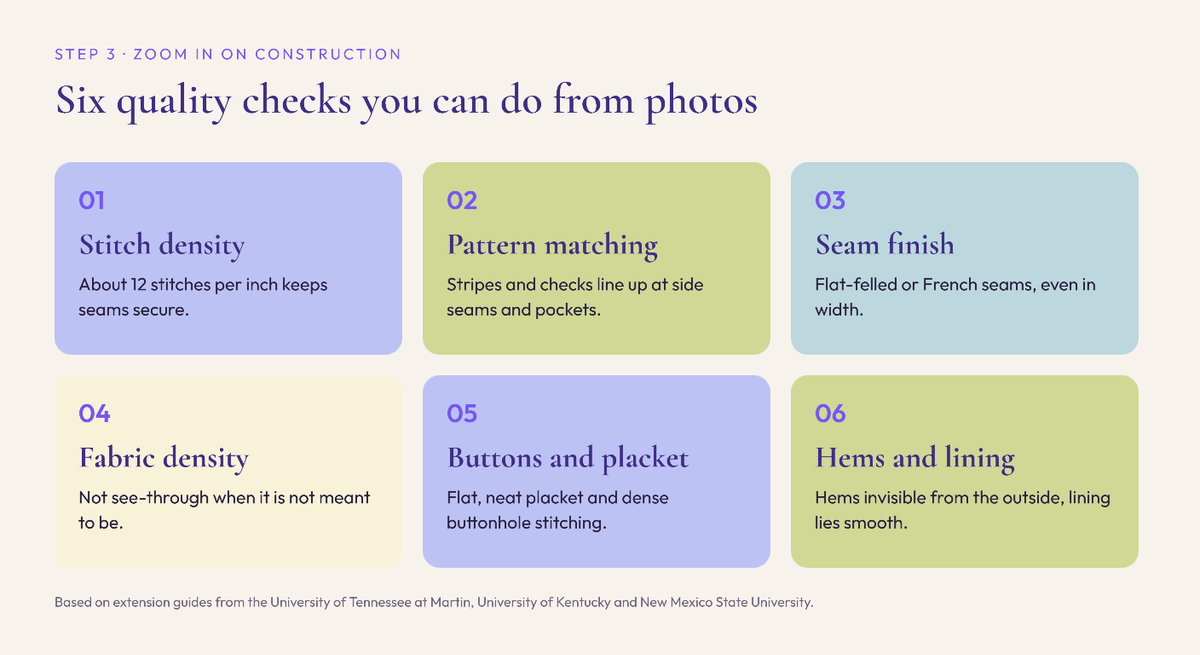
These checks come from university extension guides used to teach clothing quality, including a ready-made garment checklist from the University of Tennessee at Martin and the University of Kentucky's guide to seams.
- Stitch density. UT Martin's checklist asks: "Are the stitches small (about 12 per inch), making the seams secure and sturdy?" Long, loose stitches on a close-up are a warning sign.
- Pattern matching. On stripes, checks and plaids, the same checklist asks whether the design matches at the seams. Look at the side seams, centre front and pocket placement in photos.
- Seam finishes. The University of Kentucky describes flat-felled seams (common on jeans and shirts) as suited to items "requiring strong, durable seams," and French seams, which enclose raw edges, as "strong and durable" for sheer or delicate fabrics. Seams should be "even in width throughout."
Want this styled from your own closet?
Elara builds the look from what you own, then lets you try it on.
- Fabric density. UT Martin suggests checking whether the fabric is "closely woven so you can't see through it when held up to the light." Online, look for photos against a light background or on a model in daylight. If you can see through a shirt that is not meant to be sheer, it is thin.
- Buttons and buttonholes. The UT Martin checklist suggests checking for interfacing down the front where the buttons and buttonholes sit. In photos, a placket that lies flat and neat, dense buttonhole stitching are good signs.
- Linings and hems. New Mexico State University's extension guide says hems and facings should be "inconspicuous from the garment's right side," and a lining should not "cause unsightly wrinkling." On coats and tailored jackets, a smooth, full lining is a good sign.
Step 4: Use fabric weight when it is listed
Some brands, especially for T-shirts, sweatshirts, denim and outerwear, list fabric weight in grams per square metre (GSM) or ounces per square yard. A heavier fabric is not automatically better, but it tells you a lot about opacity, drape and warmth.
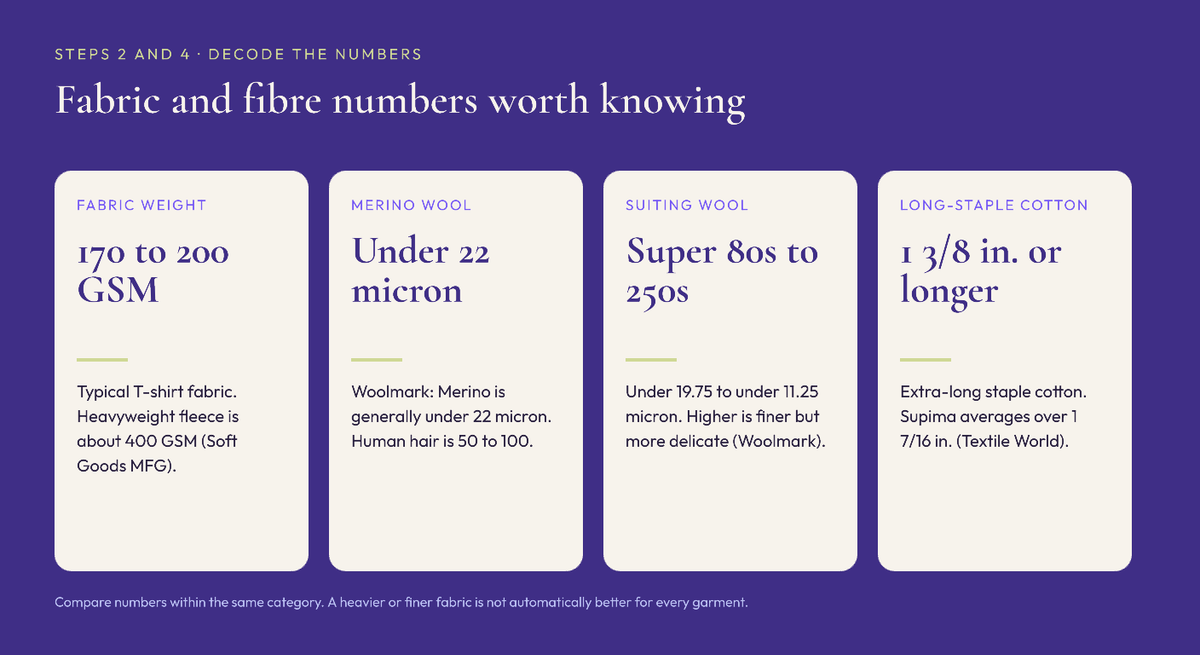
As a rough guide, garment maker Soft Goods MFG puts typical T-shirt fabric at about 5 to 6 oz (around 170 to 200 GSM) and heavyweight fleece at about 12 oz (around 400 GSM). If a "heavyweight tee" is listed at 140 GSM, the description is doing more work than the fabric. Compare weights within the same category rather than across categories: a 200 GSM T-shirt and a 200 GSM wool suiting are very different things.
Step 5: Read the care label and the return policy
Care label. The FTC's Care Labeling Rule requires complete regular care instructions, permanently attached. If a product page shows the care instructions, read them before you buy: a "dry clean only" sweater adds cost every time you wear it. Care symbols follow the GINETEX system internationally (in the US, the ASTM symbols are the approved set). A hand in a washtub means hand wash, a number in the tub is the maximum wash temperature in °C, and bars underneath mean a gentler cycle.
Return policy. In the UK, the Consumer Contracts Regulations give you a 14-day cancellation period for most online purchases, which starts when you place the order and ends 14 days after you receive the goods. Which? explains that you then have another 14 days to send items back, and the retailer must refund you within 14 days of getting them back. In the US, the Better Business Bureau notes that stores are generally not legally required to accept returns unless an item is defective or misrepresented, so the retailer's own policy decides. The FTC advises checking "who pays for return shipping and if there is a restocking fee." Holiday purchases often come with extended windows, but read the dates before you check out.
A two-minute quality check before you buy
- Find the fibre content and note the percentage of the fibre you are paying for.
- Check for country of origin (US) or full composition (UK and EU). If it is missing, ask.
- Zoom into the seams, collar, buttons and hem in at least two photos.
- Look for fabric weight, fibre grade or yarn type, and compare it with similar items.
- Read the care label and decide if you will actually follow it.
- Read the return window, who pays return shipping, and any restocking fee.
- Ask: would I buy this at full price? If the answer is no, the discount is the only thing you like about it.
If you want fewer returns this season, our guide to reducing clothing returns when shopping online covers fit and sizing in more detail.
FAQ
How can I tell if clothing is good quality online?
Check the fibre content percentages, zoom into seams, hems and buttonholes, look for fabric weight or fibre grade where it is listed, and read the care label and return policy. Stitches of about 12 per inch and matched patterns at the seams are classic quality signs.
Do online stores have to show fabric content?
In the UK and EU, yes: fibre composition must be clearly visible before purchase online. In the US, online listings must show country of origin, and fibre information must appear if the ad makes a fibre claim, but without percentages.
What does GSM mean in clothing?
GSM is grams per square metre, a measure of fabric weight. It helps you compare similar items. Typical T-shirt fabric is around 170 to 200 GSM, according to garment maker Soft Goods MFG.
Is a higher Super number always better for suits?
Not always. Higher Super numbers mean finer wool, which is softer and smoother but also more delicate. For a suit you will wear often, a mid-range number is usually more durable.
When is Black Friday 2026?
Black Friday is on Friday, 27 November 2026, Small Business Saturday is on 28 November, and Cyber Monday is on 30 November.
Can I return Black Friday purchases?
In the UK, most online purchases have a 14-day cancellation period after delivery. In the US, returns depend on each retailer's policy, so check the window, return shipping cost and any restocking fee before you buy.
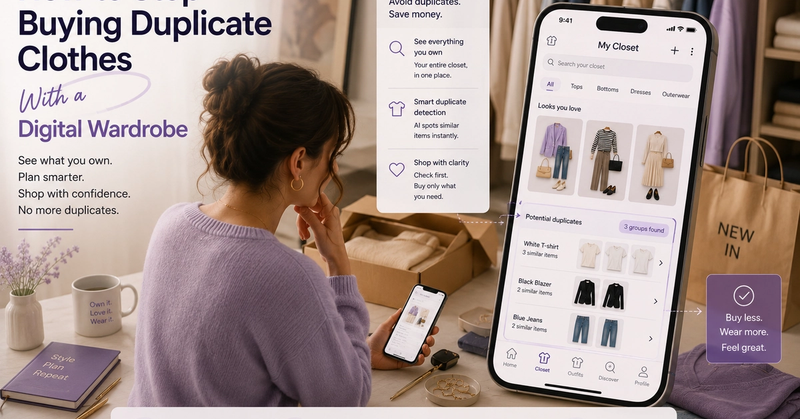
Shop the deals that fit your wardrobe. Elara is an AI personal stylist that knows what is already in your closet. Before you check out this Black Friday, ask Elara whether a piece fills a real gap, what it will pair with, and how many outfits it adds, so the discount goes to clothes you will actually wear. Try Elara free.
Your stylist, in your pocket
Stop reading about outfits. Start wearing them.
Elara knows your closet, shops every store and gets you dressed for any occasion.