Stop Buying Duplicate Clothes: Use a Digital Wardrobe
Stop buying duplicate clothes by digitizing your wardrobe and using AI-driven gap analysis. Learn why secondhand shopping alone doesn't work and how to shop smarter.
 Mehul AgarwalFounder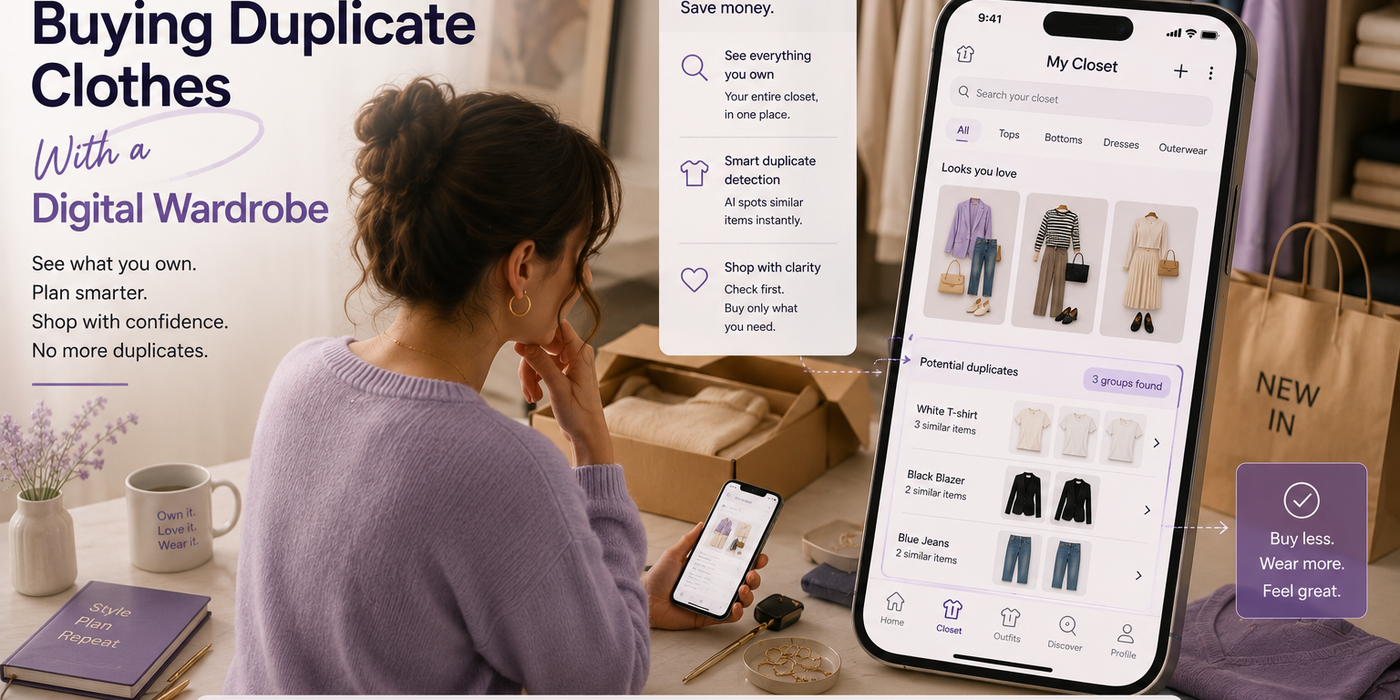
How to Stop Buying Duplicate Clothes With a Digital Wardrobe
Table of Contents
- Key Takeaways
- Introduction: The Secondhand Paradox No One Is Talking About
- The Secondhand Trap: Why Shopping Smarter Isn't Enough
- Why You Keep Buying Duplicates (It's Not What You Think)
- What a Digital Wardrobe Actually Does (And What It Doesn't)
- How AI-Driven Gap Analysis Prevents Duplicate Purchases Before They Happen
- A Practical Framework: Audit Your Wardrobe Before You Shop (Secondhand or New)
- FAQ: Common Questions About Duplicate Purchases and Wardrobe Intelligence
- Conclusion: The Wardrobe-First Approach to Sustainable Style
Key Takeaways
- According to thredUP's 14th Annual Resale Report, 60% of Americans shopped secondhand in 2025 — yet the average American still buys 53–58 new clothing items per year (Population Education)
- The real fix isn't changing where you shop — it's knowing exactly what you own before you shop
- A digital wardrobe functions as a personal inventory check that surfaces duplicates before any purchase decision
- AI-powered tools like Elara analyze your existing wardrobe and flag true gaps versus wants, stopping duplicate buys before they happen
Introduction: The Secondhand Paradox No One Is Talking About
Sixty percent of American shoppers bought secondhand clothing in 2025, according to thredUP's 14th Annual Resale Report. That same year, the average American purchased 53–58 new clothing items, according to Population Education. Hold both numbers in your head at once. Something doesn't add up.
The uncomfortable truth is that secondhand shopping hasn't replaced overconsumption — it's running alongside it. Yale News research found that frequent secondhand buyers simultaneously purchase significant amounts of new clothing, effectively negating the environmental and financial benefits of shopping resale. The "conscious shopper" identity, it turns out, can make the problem worse by creating permission to buy more.
This is the secondhand paradox, and it reframes the entire conversation around duplicate clothes. Buying duplicates isn't a discipline failure or a moral weakness — it's a predictable outcome of a broken system. When you don't know what you own, you can't make good decisions about what to buy next, regardless of whether you're browsing Depop or walking into a department store.
This article unpacks why secondhand shopping alone can't break the cycle, what actually causes duplicate purchases at the behavioral level, and how a digital wardrobe — paired with AI-driven gap analysis — gives you the inventory clarity to stop buying what you already have.
The Secondhand Trap: Why Shopping Smarter Isn't Enough
Resale isn't a niche anymore. thredUP's 14th Annual Resale Report describes the secondhand clothing market as entering "a new era of structural growth" — a characterization that reflects how deeply resale has embedded itself in mainstream shopping behavior. Among younger consumers, the shift is even more pronounced: 58% of Gen Z now explores resale options before buying new, according to the same report. By any measure, secondhand has won cultural legitimacy.
The problem is that winning cultural legitimacy hasn't translated into buying less. Yale News research is direct on this point: frequent secondhand buyers continue to purchase significant quantities of new clothing at the same time, which cancels out the environmental savings they're generating through resale. The math simply doesn't work in favor of the planet — or the wallet — when secondhand is an addition to a shopping habit rather than a replacement for it.
The behavioral economics explanation for this is the "responsible shopper" effect. Buying secondhand activates a sense of virtue — you're keeping something out of landfill, you're not feeding fast fashion, you're being smart with money. That sense of virtue lowers the psychological cost of the next purchase. The cognitive barrier that might otherwise cause you to pause and ask "do I actually need this?" gets bypassed, because you've already done the responsible thing today.
Forbes contributor Pam Danziger has noted a meaningful 2026 shift in how people approach secondhand: consumers are moving away from cheap "dupes" — low-quality replicas of luxury goods — toward authentic secondhand luxury and high-quality resale pieces. That's a genuine quality improvement. A well-made vintage coat is a better purchase than a fast-fashion knockoff by almost any measure. But better quality per item doesn't solve the volume problem. You can fill a closet with excellent secondhand finds and still own three coats you never wear and two nearly identical pairs of dark-wash jeans.
The channel of purchase — new, resale, luxury, fast fashion — is not the variable that determines whether a purchase makes sense. The variable that matters is whether you already own something functionally equivalent, and whether the new item fills a real gap in your wardrobe. That question requires knowing what you own. Most people don't.
Why You Keep Buying Duplicates (It's Not What You Think)
Knowing what you own is harder than it sounds — and that gap between what's in your closet and what you can actually recall in the moment of purchase is precisely where duplicate buying lives.
Three root causes drive most wardrobe duplication, and none of them are about willpower. The first is invisible inventory: the average American buys 53–58 new clothing items per year, according to Population Education, yet most people cannot accurately inventory their own closet without physically standing in front of it. The second is context collapse: shopping happens in a store, on your phone, or at a secondhand market — environments entirely disconnected from the closet where your existing wardrobe sits. The third is the "fresh start" illusion: a new purchase feels like a wardrobe upgrade even when it replicates something you already own.
The scenario plays out constantly. You spot a camel trench coat at a consignment shop — the color is perfect, the price is right, the fit is close enough. You buy it. Six weeks later, clearing out your closet, you find the nearly identical camel trench you bought two winters ago and forgot existed. Neither coat is the problem. The invisible inventory is.
This is a systems problem, not a discipline problem. No amount of shopping restraint fixes the fact that your wardrobe is stored in your home while your purchasing decisions happen everywhere else. The fix isn't trying harder — it's making your inventory visible and queryable at the exact moment you're about to buy something. That's what a digital wardrobe is designed to do.
What a Digital Wardrobe Actually Does (And What It Doesn't)
A digital wardrobe is a cataloged, searchable, photo-based record of every item you own — organized by category, color, occasion, and wear frequency. Think of it as a personal inventory system that travels with you: instead of guessing whether you already own a white linen shirt, you open the app and know in seconds.
Basic closet apps do exactly this, and nothing more. They function as photo catalogs — useful for seeing what you own, but passive by nature. You still have to do the analytical work yourself. An AI-powered digital wardrobe is a different category of tool entirely. It doesn't just store your clothes; it interprets them — tracking which items go unworn for months, identifying patterns in what you actually reach for, and connecting your existing wardrobe to your shopping behavior in real time.
What a digital wardrobe genuinely solves:
- Visible inventory — your entire closet is accessible before any shopping decision, not just when you're standing in front of it
- Underused item surfacing — items worn zero times in six months are flagged, which changes how you evaluate new purchases in the same category
- True gap identification — you can ask "Do I actually need another white shirt?" and get an honest answer based on what you already own, not what you think you own
Want this styled from your own closet?
Elara builds the look from what you own, then lets you try it on.
What a basic digital wardrobe cannot do on its own:
- It cannot tell you whether a potential purchase is functionally equivalent to something you already own — that requires comparative analysis, not just cataloging
- It cannot assess whether a "secondhand bargain" integrates with your existing pieces or will hang unworn for the same reasons your current items do
- It cannot recommend whether to skip a purchase or make it with any confidence — it can only show you what exists, not what the addition would mean
That last limitation is where most closet apps stop. It's also where AI-powered wardrobe intelligence starts.
How AI-Driven Gap Analysis Prevents Duplicate Purchases Before They Happen
Wardrobe gap analysis is the process of cross-referencing a potential purchase against your existing inventory to distinguish a true gap — something you need but don't own — from a perceived gap driven by trend, impulse, or the "fresh start" illusion. AI makes this comparison instant, contextual, and accurate in a way no manual audit realistically can.
The mechanics matter here. When you're considering a purchase, an AI wardrobe system doesn't just check whether you own the same item. It checks whether you own something functionally equivalent: similar silhouette, occasion range, color family, and styling versatility. It then assesses whether the new item integrates with the pieces you already wear regularly, and whether it fills an occasion or style gap that's actually present in your wardrobe — or whether it simply replicates what's already there in a slightly different form.
This is the intelligence layer that sits between your wardrobe and every shopping decision, whether you're browsing Depop or walking through a department store. According to Forbes contributor Pam Danziger, the 2026 trend away from cheap "dupes" toward secondhand luxury reflects a growing consumer appetite for quality over volume — but quality purchases still duplicate if the underlying wardrobe intelligence isn't there.
Elara applies this gap analysis through conversation. A user asks: "I found a secondhand leather jacket I'm thinking about buying — do I actually need it?" Elara cross-references the user's digitized wardrobe, identifies that they already own two outerwear pieces in similar weight and occasion range, and responds with a specific recommendation: skip it, or consider replacing the older of the two existing jackets rather than adding a third. The purchase decision becomes informed rather than impulsive.
The specific Elara features that make this possible:
- Digital Wardrobe Digitization — every owned item is cataloged and searchable, eliminating invisible inventory
- Context-Aware Shopping — potential purchases are evaluated against what you already own before they're surfaced as recommendations
- Wardrobe Integration — shows exactly which existing pieces a new item would pair with, and how many
- Versatility Recommendations — flags single-occasion purchases that are likely to go unworn, the category most prone to duplication
As Danziger wrote in Forbes, resale is becoming "the fashion industry's new value flywheel" — but the consumers who benefit most financially and environmentally are those who combine resale awareness with genuine wardrobe intelligence before they buy.
The gap between knowing resale exists and knowing whether a specific resale item fills a real gap in your wardrobe is exactly where most duplicate purchases happen. AI-driven analysis closes that gap before the purchase, not after.
A Practical Framework: Audit Your Wardrobe Before You Shop (Secondhand or New)
Closing that gap between wardrobe intelligence and purchase decisions doesn't require an app — though having one makes the process significantly faster. This five-step audit works whether you're browsing Depop on your lunch break or walking into a department store.
- Do a category count. Before shopping any category, count how many items you already own in it. How many tops, how many outerwear pieces, how many pairs of dark jeans? Most people genuinely don't know, and that ignorance is where duplicates are born.
- Apply the last-3-wears test. Can you name three recent occasions when you wore something comparable? If you're struggling to recall even two, you likely don't have a gap — you have an underused existing piece.
- Define the occasion gap. Ask specifically: "Is there a real event or context I cannot currently dress for?" Only proceed if the answer is unambiguously yes. Vague dissatisfaction with your wardrobe isn't an occasion gap.
- Run an integration check. Would the potential purchase pair with at least three pieces you already wear regularly? A beautiful standalone item that works with nothing you own is a future duplicate-in-waiting.
- Invoke the 48-hour rule for secondhand. Secondhand urgency — the "it won't be there tomorrow" feeling — is a named cognitive trigger, not a genuine reason to buy immediately. Non-essential resale finds deserve a 48-hour waiting period before purchase.
A digital wardrobe or AI stylist makes steps 1 through 4 instant rather than manual — your category counts, wear history, and integration data are already there. The framework itself, however, is channel-agnostic. Forbes contributor Pam Danziger's analysis of the 2026 shift toward secondhand luxury and high-quality resale confirms that the resale market is maturing — but the logic of buying only what fills a real gap applies equally whether the price tag reads $12 or $120.
FAQ: Common Questions About Duplicate Purchases and Wardrobe Intelligence
Q: How do I know if I already own something "functionally equivalent" to what I'm thinking of buying?
A: Look for three overlaps: similar silhouette (fitted vs. loose), similar occasion (work vs. casual), and similar color family. A camel trench and a tan blazer might look different, but they fill the same occasion gap and pair with the same pieces. If you already have one, the other is likely a duplicate purchase waiting to happen.
Q: Why does the 48-hour rule matter for secondhand shopping specifically?
A: Secondhand items create artificial urgency — the fear that something won't be there tomorrow. That urgency bypasses the same gap-analysis questions you'd ask about a new purchase. The 48-hour waiting period lets you step back and ask whether you actually need it, or whether you're just reacting to scarcity. Most impulse secondhand buys look different after two days.
Q: Can I stop buying duplicate clothes without a digital wardrobe app?
A: Yes, but it's significantly harder. You'd need to manually count what you own, track wear frequency, and physically reference your closet every time you shop — which most people can't do on a lunch break or while browsing online. An app or AI stylist makes the process instant and accurate, but the five-step audit framework works even without one.
Conclusion: The Wardrobe-First Approach to Sustainable Style
Stopping duplicate purchases isn't primarily a shopping channel problem. Yale research confirms that frequent secondhand buyers still accumulate significant amounts of new clothing, negating the environmental and financial benefits they set out to capture. The channel changes; the behavioral loop doesn't — unless wardrobe intelligence changes first.
As resale becomes what Pam Danziger calls "the fashion industry's new value flywheel," the consumers who benefit most are those who pair resale awareness with genuine clarity about what they already own. That combination — not secondhand shopping alone — is what breaks the duplicate cycle.
The two-part solution is straightforward: digitize your wardrobe so your inventory is actually visible, then apply AI-driven gap analysis before every purchase decision, secondhand or new.
If you want to experience what shopping from a position of wardrobe clarity actually feels like, Elara's digital wardrobe is built exactly for that. Explore it at joinelara.com.
Dress better. Shop smarter. Start with what you already have.
Your stylist, in your pocket
Stop reading about outfits. Start wearing them.
Elara knows your closet, shops every store and gets you dressed for any occasion.