
What to Wear to a Gurdwara for Gurpurab 2026: A First-Time Visitor's Guide to Head Coverings, Floor Seating and Layers
What to wear to a gurdwara for Gurpurab 2026: head coverings that stay on, outfits for floor seating, shoes, layers and langar etiquette for first-time guests.
 Mehul AgarwalFounder & CEO
Last updated: October 2026
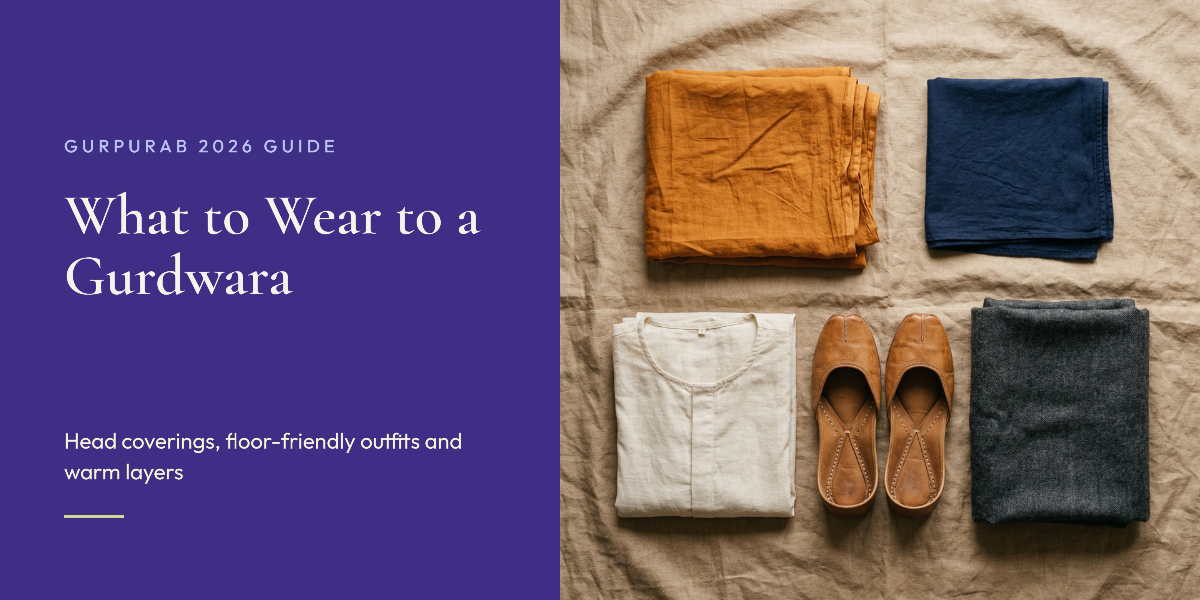
Quick answer: For a gurdwara visit on Gurpurab 2026, wear loose, modest clothes you can sit cross-legged in on the floor (a kurta with salwar, palazzos or straight trousers works well), bring a scarf, dupatta or bandana large enough to cover all of your hair, and choose shoes you can slip off quickly because you will leave them at the entrance. Add a shawl or warm layer for cool late-November mornings, and skip shorts, short skirts and caps, which some gurdwaras say are not allowed.
Guru Nanak Gurpurab, also called Guru Nanak Jayanti or Prakash Purab, marks the birth of Guru Nanak Dev Ji, the first Sikh Guru. Gurdwaras hold kirtan (devotional singing), readings and langar, the free community meal, and many cities see a nagar kirtan procession in the days around it. Visitors of any faith are welcome, and many people visit a gurdwara for the first time on this day.
If that is you, the questions are practical: what covers your hair properly, what you can sit on the floor in for an hour, and what happens to your shoes. This guide answers each one, using the visitor guidance that gurdwaras themselves publish. If you are dressing for a home celebration rather than a gurdwara, our Diwali party guest guide covers hosting etiquette that carries over well.
When is Gurpurab 2026?
The Government of India's list of holidays for central government offices in 2026 gives Guru Nanak's Birthday as Tuesday, 24 November 2026. The date follows the lunar calendar (it is observed on Kartik Purnima, the full moon of the month of Kartik), so it moves every year, and some panchang-based sites list 25 November because of when the full moon tithi begins and ends in different time zones.
Sources also disagree more widely than that. The University of Wisconsin-Madison's interfaith calendar lists Wednesday, 5 November 2026, so not every calendar agrees on the date. Because practice differs between communities and countries, the simplest step is to check your local gurdwara's own announcements for programme timings and any nagar kirtan.
Covering your head: the one rule everywhere
Every gurdwara visitor guide we read starts with the same point. Fremont Gurdwara in California asks visitors to keep their heads covered at all times in both the Darbar (prayer) hall and the Langar hall, and the gurdwara in Tampa, Florida notes that it keeps washed scarves at the main entrance if you forget. The University of Wisconsin-Madison's resource page also notes that it is traditional to cover your hair at Gurpurab celebrations.

Caps, hats and beanies do not count. The Tampa gurdwara lists them among items that are not allowed, along with hoodies. What works:
- A cotton bandana or rumal. Fold it into a triangle, place the long edge across your forehead and knot it at the back of the head, over the point. It is a simple choice for first-time visitors, and it stays put when you bow or sit.
- A dupatta or long, lightweight scarf. Drape it over the crown so it covers the hairline at the front, then wrap one end loosely around the neck or over the shoulder so it does not slip back. Cotton and soft silk-cotton grip better than satin or chiffon, which tend to slide off as soon as you look down.
- A patka or turban, if you already wear one. Nothing more is needed.
The practical test: tilt your head forward and turn side to side in front of a mirror. If the scarf moves, pin it with a small bobby pin at each temple or swap to a less slippery fabric. You will bow on arrival and stand during Ardas (the congregational prayer), so a covering that keeps falling back becomes a distraction.
Clothes you can sit on the floor in
In the Darbar hall, everyone sits on the floor, as Fremont Gurdwara's code of conduct notes, and the Tampa gurdwara asks visitors to sit cross-legged for langar, with chairs and tables kept for elderly and disabled guests. That one fact should drive most of your outfit choices.

What works well:
- Kurta with salwar, churidar or palazzos. The Tampa gurdwara names kurta pajama and salwar kameez as welcome, and they suit floor sitting: the kurta falls over the lap and the trousers have room at the knee.
- Straight or wide-leg trousers with a longer top. Full-length trousers and jeans are acceptable at Tampa, but very skinny or stiff denim gets uncomfortable after a while cross-legged. A top that covers the hips stops it riding up when you lean forward.
- A long, full skirt or an anarkali, if you prefer. Ankle-length and full enough to fold your legs under easily.
What to skip: shorts, short skirts and minis, which Tampa lists as not allowed, and anything you would have to keep adjusting while seated, such as low-rise trousers, short crop tops or tight pencil skirts. Rules differ a little between gurdwaras, and some are more relaxed than others, so modest and comfortable is the safest standard.
About your feet: feet are bare or in socks inside. Fremont Gurdwara asks visitors to remove socks as well as shoes and to wash hands and feet before entering the hall. It also asks that you never point your feet towards the Guru Granth Sahib, so when sitting, fold your legs to the side or cross them rather than stretching them out in front.
Shoes, socks and the cold-floor problem
Shoes come off before you enter the prayer hall, as the Ontario Khalsa Darbar and other gurdwaras state. Gurdwaras usually provide a shoe rack or shoe room at the entrance. Three small choices make this easier:
- Wear slip-on shoes. Loafers, juttis, mules or flat boots with a side zip. Lace-up trainers mean crouching to untie them in a busy entrance on one of the year's most crowded days.
- Check whether socks stay on. Some gurdwaras, like Fremont, ask you to take socks off; others do not mention it. If yours expects bare feet, wear socks you can pull off quickly and pocket.

Want this styled from your own closet?
Elara builds the look from what you own, then lets you try it on.
- Plan for cool floors. Late November mornings in north India and the colder months in the UK, US and Canada can make stone and marble floors cold. Rather than relying on socks, keep warmth in your upper layers: a shawl, a cardigan or a jacket you can keep on in the hall.
Layering for a long, early day
Gurpurab programmes can start early, run for several hours and move between an indoor hall, a langar hall and sometimes an outdoor procession. That means layers you can add or remove without taking anything off over your head (which would disturb your head covering).
A good layering order: a breathable cotton or cotton-blend base (kurta or long top), then a front-opening layer such as a cardigan, Nehru jacket or quilted vest, then a shawl or stole you can wrap around your shoulders or over your knees while seated. A wool or acrylic shawl in a deep colour also hides marks from sitting on a carpeted floor.
If you plan to walk in or watch a nagar kirtan, add comfortable closed shoes for the route and a warmer outer layer, and keep your head covered while you walk with the procession. For more ideas on keeping festive clothes warm, see our guide to staying warm in a saree, lehenga or sherwani.
Langar and karah prashad: dressing for the meal
Langar is served in a separate hall, often with diners seated in rows on the floor, by volunteers known as sevadars. The Tampa gurdwara invites visitors to help serve if they wish, and to eat in the designated langar area. A few clothing details help:
- Sleeves that stay out of the food. Wide bell or trumpet sleeves dip into dal. Three-quarter or fitted sleeves are easier, or push long sleeves up before you sit.
- A dupatta you can control. Throw long ends back over your shoulder or tie them so they do not trail on the floor or into a plate.
- Darker or patterned fabric for the lap. Turmeric-based dishes stain light fabrics quickly when you eat seated on the floor. If something does spill, our festive stain removal guide explains how to treat haldi and ghee marks.
For karah prashad, the sweet offering given after the prayers, the Tampa gurdwara explains that you cup both hands together as the sevadar approaches. This is easier when you are not holding a phone or bag, so keep a small crossbody bag on your shoulder.
What not to bring
The visitor guidance we reviewed is consistent here. Tampa and Fremont both prohibit alcohol, tobacco and drugs anywhere on the premises, Fremont also lists weapons, and Tampa asks visitors not to bring cigarettes or tobacco inside even in a pocket or bag, and not to chew gum. Tampa also asks for phones on silent, airplane mode or off. If you are not sure about anything on the day, the Tampa gurdwara's advice is the best one: ask a sevadar or a member of the sangat (congregation).
A quick Gurpurab outfit checklist
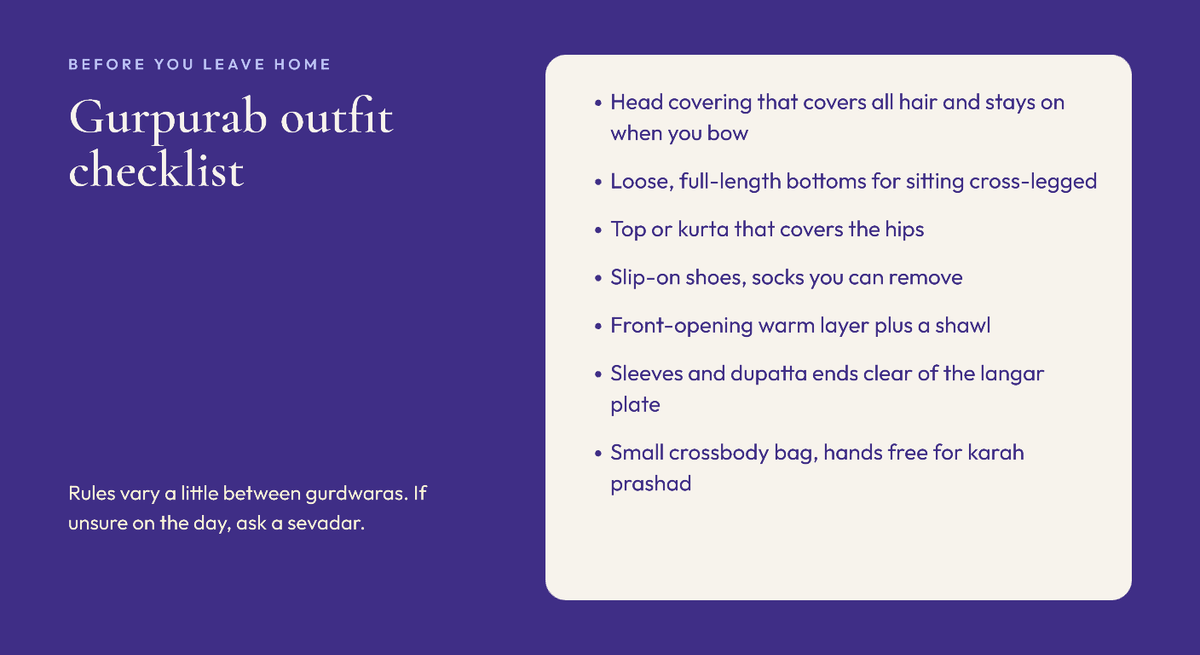
- Head covering that covers all of your hair and stays on when you bow (bandana, dupatta or scarf, not a cap)
- Loose, full-length bottoms you can sit cross-legged in
- A top or kurta that covers the hips and does not ride up when you lean forward
- Slip-on shoes, and socks you can remove if your gurdwara asks
- A front-opening warm layer and a shawl for the hall and the procession
- Sleeves and dupatta ends that will stay out of the langar plate
- A small crossbody bag so both hands are free for karah prashad
FAQ
Can women wear jeans to a gurdwara?
Generally yes. The Tampa gurdwara lists full-length jeans and pants as acceptable for visitors. Choose a relaxed fit with stretch, since you will sit cross-legged on the floor, and pair it with a top that covers the hips.
Do I need to cover my head if I am not Sikh?
Yes. Gurdwaras ask all visitors to cover their hair inside the prayer hall and the langar hall, whatever their faith. Many provide scarves at the entrance, but bringing your own means it fits and stays on.
Can I wear a cap or beanie instead of a scarf?
No. Caps, hats and beanies are not accepted as a head covering; the Tampa gurdwara lists them as not allowed. Use a bandana, rumal, dupatta or scarf instead.
What colour should I wear for Gurpurab?
None of the gurdwara visitor guidance we reviewed sets a required colour. Modest, comfortable clothing and a proper head covering matter far more than any colour choice, so wear what feels festive to you.
Is Gurpurab 2026 on 24 or 25 November?
The Government of India's 2026 holiday list gives 24 November. Some panchang sites list 25 November depending on when the full moon falls locally, and some calendars observe it on a different date, so check with your local gurdwara for programme timings.
Plan festive outfits around the whole season
Gurpurab arrives in a busy stretch, between Diwali, wedding functions and winter gatherings. Elara, an AI personal stylist app, keeps your kurtas, dupattas and shawls in a digital closet and helps you plan which outfit goes to which occasion on its calendar, so you are not repeating yourself or forgetting the one scarf that stays put. Try Elara free and plan your festive weeks in one place.
Your stylist, in your pocket
Stop reading about outfits. Start wearing them.
Elara knows your closet, shops every store and gets you dressed for any occasion.