

Invited to a Diwali Party in 2026? What to Wear and Bring as a Guest
First Diwali party as a guest? What colours and outfits to wear, why your shoes come off, what gift to bring and what to avoid, for 8 November 2026.
 Mehul AgarwalFounder & CEO
Last updated: October 2026
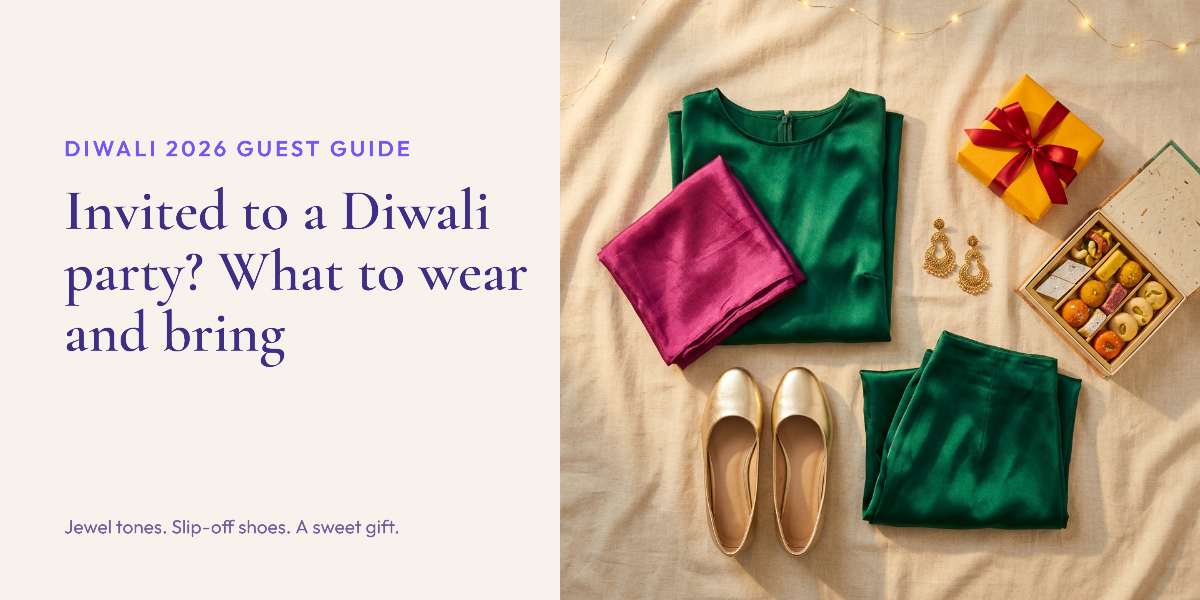
Quick answer: If you are invited to a Diwali party in 2026 (Diwali falls on Sunday, 8 November), dress up and lean into colour: jewel tones, metallics and rich fabrics feel right for a festival of lights, while head-to-toe black or white can look subdued. Wear shoes you can slip off easily, because guests usually remove them in Hindu homes and places of worship. Keep sleeves and hems away from open flames, bring a small gift such as sweets or a plant, and if you visit a gurdwara during the celebrations, cover your head.
Diwali is celebrated far beyond India. Across the US, UK, Canada and Australia, colleagues and neighbours host Diwali dinners and parties, and first-time guests tend to wonder the same things: should I wear Indian clothes, what colours are right, do I take my shoes off, and what do I bring? This guide answers those questions with guidance from cultural and faith-community sources, plus practical styling advice built around what is already in a western wardrobe.
When is Diwali 2026, and why there may be more than one party
According to Drik Panchang and HinduTone's festival calendar, the main day of Diwali (Lakshmi Puja) falls on Sunday, 8 November 2026 in India, within five days of festivities that begin with Dhanteras on 6 November and run to Bhai Dooj on 11 November. Drik Panchang notes that dates can differ by a day between India and North America, so your hosts may celebrate on a slightly different day.
Diwali is also not only a Hindu festival. As a Religion News Service explainer describes, Jains mark it as the anniversary of Mahavira's liberation, and Sikhs celebrate Bandi Chhor Divas, commemorating Guru Hargobind's return to Amritsar after his release from imprisonment. Hindu families themselves mark different stories depending on region. So the gathering you are invited to might be a home puja followed by dinner, a big community event, a party on the nearest weekend, or a visit to a temple or gurdwara. It is fine to ask your host what to expect.
What to wear: colour first

Diwali is the festival of lights, and the mood is celebratory. Hosts usually dress up, so making an effort is a way of showing respect. The easiest way to look right is through colour.
- Go for jewel tones. Emerald, ruby, magenta, sapphire, deep teal and marigold all look at home next to lamps, lights and festive decoration.
- Add one metallic or rich texture. A gold or bronze accessory, a satin skirt, a velvet blazer or a silk scarf brings in the glow without needing new clothes.
- Be careful with all black or all white. Neither is forbidden, but both can look subdued at a festival of light. In many Indian communities white is associated with mourning; the Cultural Atlas, for example, advises against giving white flowers for that reason. If you love black, break it up with a bright scarf, jewellery or a coloured jacket.
- Dress to the host's level. A dinner at someone's home is usually smart and festive; a community gala may be closer to a wedding reception. Ask if you are unsure.
Western-wardrobe outfit formulas
You do not need anything new. These formulas use pieces many people already own.
- Jewel-tone midi dress + gold flats or mules + a light wrap. Simple, festive, and easy to sit on the floor in if seating is informal.
- Silk or satin blouse in a rich colour + wide-leg trousers + statement earrings. Comfortable for a long evening of eating and conversation.
- Velvet or coloured blazer + crisp shirt + dark trousers. For anyone who prefers tailoring; swap the tie for a pocket square in a bright colour.
- Fine knit in a deep colour + tailored trousers + loafers. The smart-casual option for a relaxed home dinner.
Should a guest wear Indian clothes to Diwali?
If your host invites you to, or offers to lend you something, it is generally taken as a warm gesture to accept. FEMA's faith-community guidance on engaging Hindu communities makes a useful point here: traditional dress is usually "a combination of culture and ethnicity, not a religious requirement," and you should not assume anyone is expected to dress traditionally. In other words, Indian clothing is not required of you, and wearing it is not a religious act.
If you do want to wear Indian clothes, a few pointers:
- Start simple. A kurta with straight trousers, or a kurta set, is comfortable and easy to wear well. A saree takes practice to drape and walk in; if you want to try one, ask a friend to help you drape it.
- Ask where to buy or borrow. Your host or friends will often know a local store, or have a piece to lend.
- Keep religious items out of it. Treat sacred symbols as sacred, not as accessories. If you are unsure whether something is decorative or religious, ask or leave it off.
Shoes, flames and floors: the practical part

This is where most first-time guests get caught out.
- Expect to take your shoes off. The Cultural Atlas advises removing shoes before entering someone's home in India, and FEMA's guidance says to remove shoes before entering a Hindu home or temple. Many diaspora households follow the same custom. Wear shoes you can slip off and on without sitting down to unlace them.

Want this styled from your own closet?
Elara builds the look from what you own, then lets you try it on.
- Think about your feet. In November, floors can be cold. Clean, presentable socks or tights are a good idea, and avoid anything with holes.
- Respect where your feet point. The Cultural Atlas notes that feet are considered the least clean part of the body, so avoid pointing the soles of your feet at people or at a shrine, especially if you are seated on the floor.
- Keep fabric away from flames. Diwali means diyas (small oil lamps), candles and often sparklers. Avoid long, loose trailing sleeves, floaty scarves and very flammable synthetic fabrics near open flames. Our guide to Diwali outfit safety around diyas and firecrackers goes into fabric choices in detail.
- Visiting a gurdwara? If the celebrations include a visit to a gurdwara for Bandi Chhor Divas, FEMA's guidance on Sikh communities says men and women must cover their heads and remove their shoes. Many gurdwaras provide head coverings at the door, but bringing a scarf or bandana is easier.
What to bring: gift etiquette

A gift is not required, but a small one is appreciated. The Cultural Atlas lists sweets or something for the host's children as typical choices. Good options:
- A box of Indian sweets (mithai) or good-quality chocolates, nuts or dried fruit.
- A plant, or a candle or set of lights for the festival of light.
- Something for the children, if there are any.
And a few things to avoid or check first, again drawing on the Cultural Atlas:
- Leather goods are best avoided as gifts for Hindu hosts.
- White flowers are associated with funerals and mourning.
- Alcohol only if you know your host drinks. Many Indian families do not.
- Gift wrap in yellow, green or red is considered lucky.
- Hand gifts over with your right hand or both hands, not the left hand alone.
Food is usually central, and much of it may be vegetarian. FEMA's guidance notes that many Hindus eat only vegetarian food, and some avoid onion and garlic, so if you bring food, make it vegetarian and check the ingredients.
A short greeting goes a long way
"Happy Diwali" is always fine. If you want to go a step further, "Shubh Deepavali" is a common greeting. Arrive with a gift, take off your shoes at the door without being asked twice, compliment the decorations and the food, and you will be a welcome guest. If the family holds a puja (prayer) before dinner, it is respectful to stand quietly at the back unless you are invited to join.
FAQ
What should a non-Indian guest wear to a Diwali party?
Festive, colourful clothes. Jewel tones, metallics and rich fabrics work well; a jewel-tone dress, a silk blouse with tailored trousers, or a coloured blazer are all good choices. Indian clothes are welcome if you want to wear them but are not required.
Is it okay to wear black to Diwali?
It is not forbidden, but all black can look subdued at a festival of lights. Break it up with a bright scarf, jewellery or a coloured jacket.
Do you take your shoes off at a Diwali party?
Usually, yes, if it is in a home or place of worship. The Cultural Atlas and FEMA's faith-community guidance both say to remove shoes before entering a Hindu home or temple. Wear shoes you can slip off easily.
What gift should I bring to a Diwali party?
Sweets, dried fruit, chocolates, a plant, or candles and lights are all good choices. Avoid leather gifts and white flowers, and only bring alcohol if you know your host drinks.
When is Diwali 2026?
The main day of Diwali (Lakshmi Puja) is Sunday, 8 November 2026 in India, according to Drik Panchang. Hosts outside India may celebrate on a slightly different day or the nearest weekend.
Do I need to cover my head at a gurdwara during Diwali?
Yes. FEMA's guidance on Sikh communities says both men and women cover their heads and remove their shoes in a gurdwara. Many provide head coverings at the door.
Find your Diwali party outfit in your own closet
Not sure which of your clothes hit the festive note? In Elara, add your wardrobe to your digital closet, tell the AI stylist you are going to a Diwali dinner at a friend's home, and get outfit options built from what you already own, with shoes you can slip off at the door. Try Elara free for 14 days.
Your stylist, in your pocket
Stop reading about outfits. Start wearing them.
Elara knows your closet, shops every store and gets you dressed for any occasion.