
What to Wear to Rann Utsav: Layers for Hot Days and Cold Desert Nights
Rann Utsav 2026-27 runs 1 Nov to 7 Mar in Dhordo. Kutch days hit 30°C and nights near 10°C, so pack sun layers, a warm shawl and closed shoes for the salt.
 Mehul AgarwalFounder & CEO
Last updated: November 2026
Quick answer: Rann Utsav 2026-27 runs from 1 November 2026 to 7 March 2027 at the Tent City in Dhordo, Kutch, according to Outlook Traveller and Travel Trade Journal. Kutch days are warm and nights get cold: on 30 November 2025 Bhuj hit 31°C (88°F), and the next morning Kandla dropped to 10.4°C (51°F), per IMD readings reported by DeshGujarat. Wear breathable cotton or linen with long sleeves, a hat and sunglasses by day, then add a sweater, a light jacket or wool shawl, and a beanie for sunset and full-moon nights on the salt. Closed, washable shoes beat sandals.
Rann Utsav is Gujarat's winter festival on the edge of the White Rann, a salt desert that stretches to the horizon. Most visitors do three very different things in one trip: craft villages and viewpoints in the heat of the day, sunset on the salt, and evenings of folk music and food at the Tent City. Each needs slightly different clothes, and the swing between them is the part people under-pack for. This guide covers the 2026-27 dates and full-moon nights, how warm and cold it actually gets, an outfit for day and one for night, shoes for the salt crust, colours that look good on white, and how to wear Kutchi crafts with respect.
Rann Utsav 2026-27 dates and full-moon nights
The festival season runs 1 November 2026 to 7 March 2027, with the Tent City near Dhordo, about three hours by road from Bhuj, the main gateway.
Travel Trade Journal reports that Evoke Experiences runs the Tent City with Gujarat Tourism, with folk performances, regional food and an on-site haat selling Ajrakh, Bandhani, embroidery, mirror work and Lippan art. Outlook Traveller lists the full-moon windows that most people plan around, plus dark-moon nights for stargazing:
- Full-moon nights: 23 to 25 November, 22 to 24 December, 21 to 23 January and 19 to 21 February.
- Dark-moon nights (best for stars): 9 November, 8 December, 7 January and 6 February.
The White Rann needs an entry permit. The Kutch district administration set up online permits at rannpermit.com, with manual permits at the Bhirandiyara checkpost, according to DeshGujarat. Fees and timings may have changed since that system launched, so check the current rules before you go and carry the ID you used to apply.
How hot and cold it gets (and why the salt matters)
Expect T-shirt afternoons and sweater nights: last season's readings show a 14 to 20°C drop between afternoon and dawn.
IMD readings from last season give a realistic range. On 30 November 2025 Bhuj reached 31.0°C and Kandla 31.2°C; the following morning Bhuj's minimum was 16.8°C and Kandla's 10.4°C. On 20 December 2025 Bhuj recorded 17.9°C at dawn, which IMD noted was 5.5°C above normal, so a typical December night there is closer to 12°C (54°F), per DeshGujarat's IMD summary. Outlook Traveller warns that the Rann "can be surprisingly cold in winter, particularly after sunset, despite the daytime sun."
Two things make it feel more extreme on the salt itself. There is no shade and nothing to block the wind, and a white surface bounces sunlight back up at you, so glare and sunburn come from below as well as above. That is why sunglasses, sunscreen and a hat matter more here than on an ordinary winter trip, and why your neck and the backs of your hands need covering at midday.
The daytime outfit: craft villages, Kala Dungar and Dholavira
By day, dress for sun and dust: loose, breathable, long-sleeved, in natural fibres.
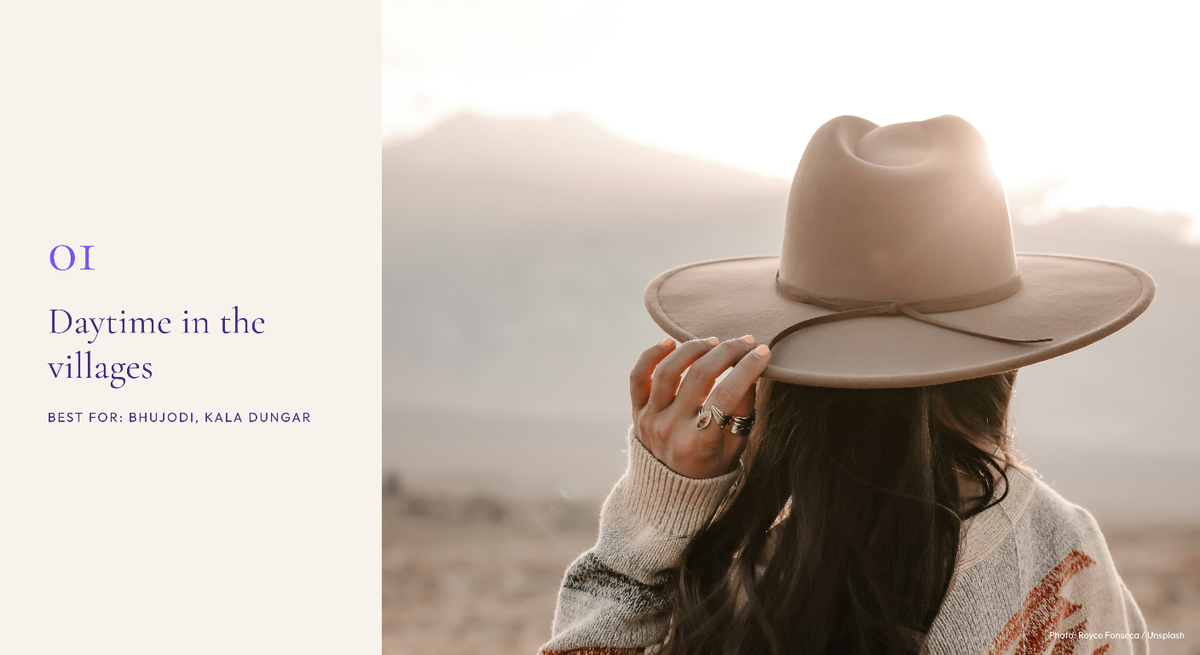
Midday is when you will be in villages watching Ajrakh printing at Ajrakhpur, at the Kala Dungar viewpoint, or on the long drive to Dholavira. A long-sleeved cotton or linen shirt protects your arms without trapping heat, and it reads respectful in villages. Pair it with wide-leg trousers, a cotton kurta and palazzos, or relaxed chinos; all of them breathe and handle dusty steps better than a short skirt or tight jeans.
- For women: a cotton or khadi kurta with straight pants or palazzos, a light cotton dupatta or stole you can pull over your head and shoulders in the sun, and a crossbody bag that keeps your hands free in markets.
- For men: a linen or cotton shirt with sleeves you can roll, chinos or loose cotton trousers, and a cap or wide-brim hat.
- For everyone: sunglasses, a hat with a real brim, and a light layer in your bag. Kala Dungar is the highest point in the region, so it is windier and cooler than the plains below.
The evening outfit: sunset and full-moon nights on the salt
For evenings, think in three layers: a base you wore all day, a warm mid-layer, and something that blocks wind.
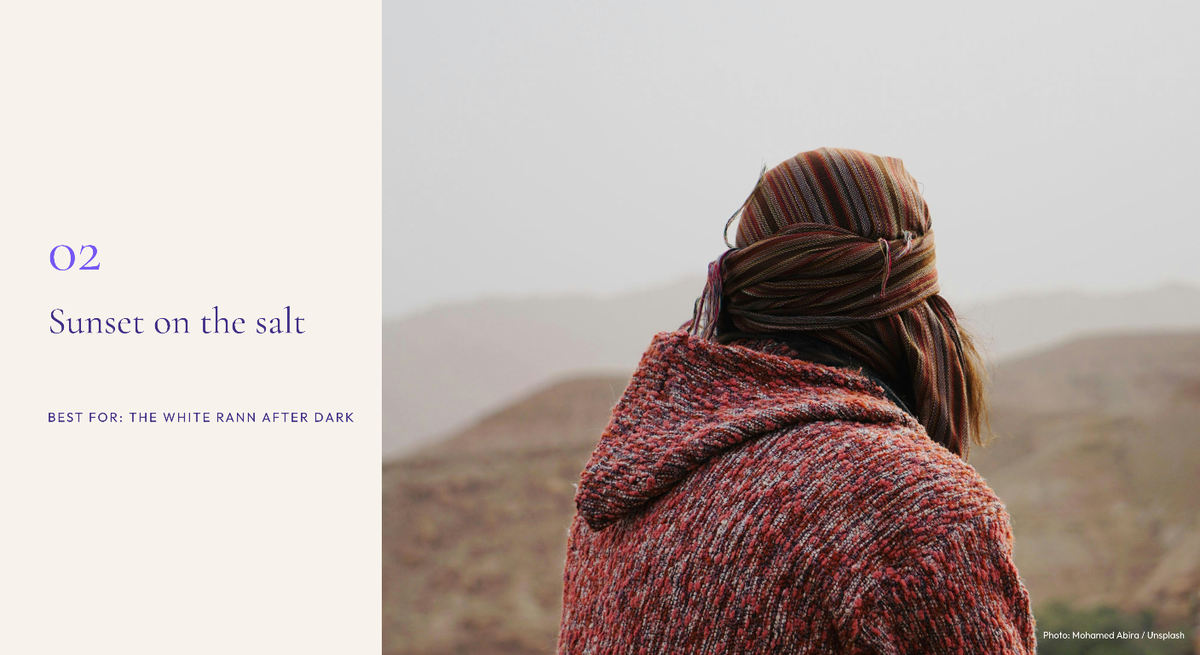
Sunset and moonrise are when most people walk out onto the salt, and you will be standing still, watching and taking photos, while the temperature falls. That combination makes people colder than the number on a weather app suggests. A layering formula that works:
- Base: your daytime T-shirt or kurta.
- Middle: a fine-knit wool or cotton sweater, a fleece, or a cardigan.
- Outer: a light quilted jacket, a packable puffer, or a thick wool shawl wrapped over your shoulders. A shawl doubles as a blanket on a camel cart or at an outdoor performance.
- Extras: a beanie or scarf for your ears and neck, and socks. On full-moon weekends you may be out for hours.
If you are dressed in Indian wear for photos, a shawl over a lehenga or saree keeps the look intact. Our guide on how to drape a shawl over a saree or lehenga shows a few ways to wear one without hiding the outfit.
Shoes for the White Rann
Wear closed shoes you can wipe or wash: canvas sneakers, trail shoes or simple leather walking shoes.
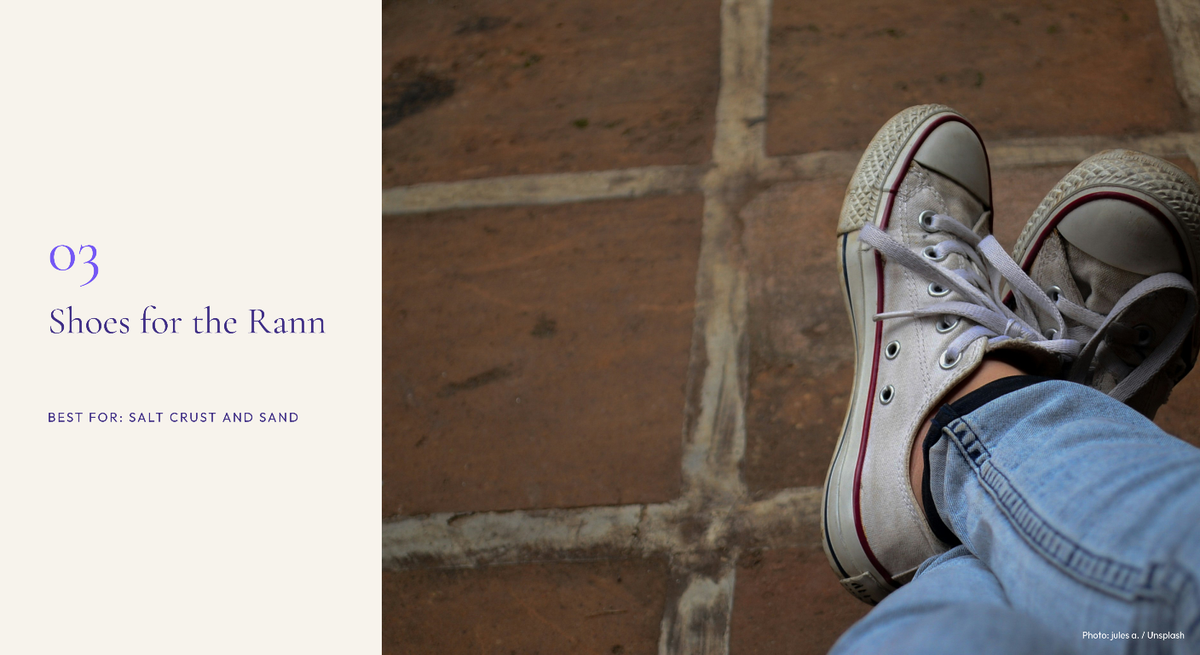
The salt crust is crunchy and uneven, so open sandals let salt and grit in and delicate shoes come back marked. Avoid suede, satin and anything you would hate to see with a white tide line. Outlook Traveller simply recommends comfortable walking shoes, and that holds for the villages too, where lanes are dusty and uneven.
After a day on the salt, knock the shoes together outside, wipe leather with a barely damp cloth and let it air-dry away from heat, and rinse canvas in plain water. Salt left in leather can dry out and mark it, so do this the same evening rather than after you get home.

Want this styled from your own closet?
Elara builds the look from what you own, then lets you try it on.
Colours that look good on white salt
On a white, almost shadowless background, saturated colour photographs best; head-to-toe white tends to disappear.
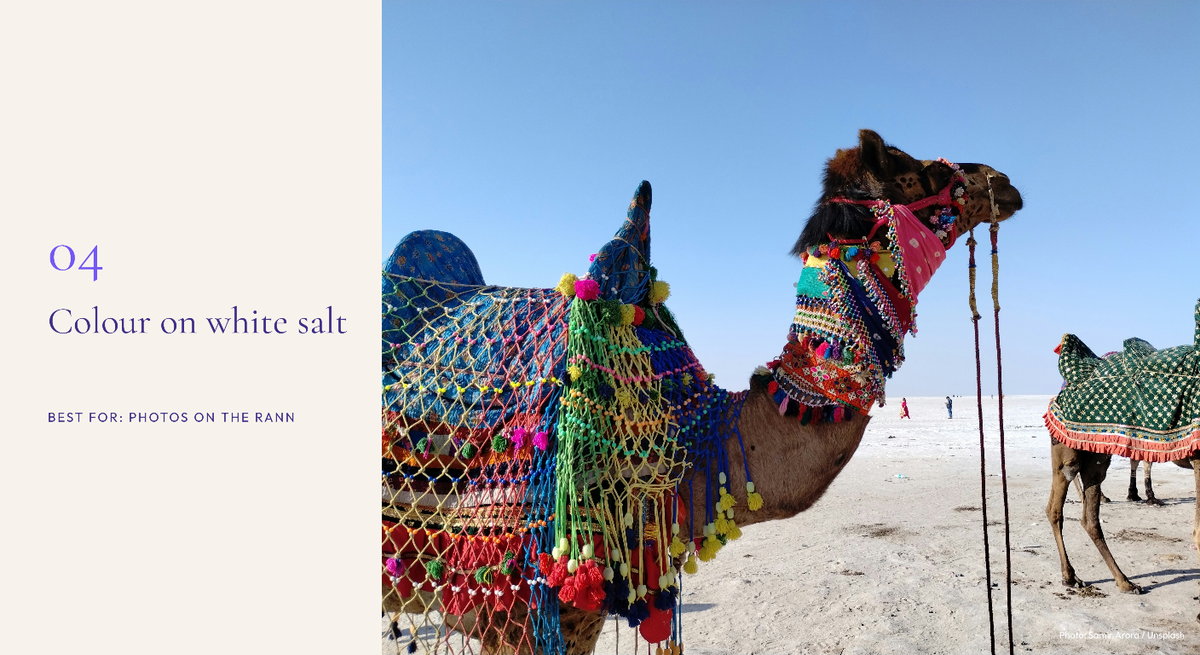
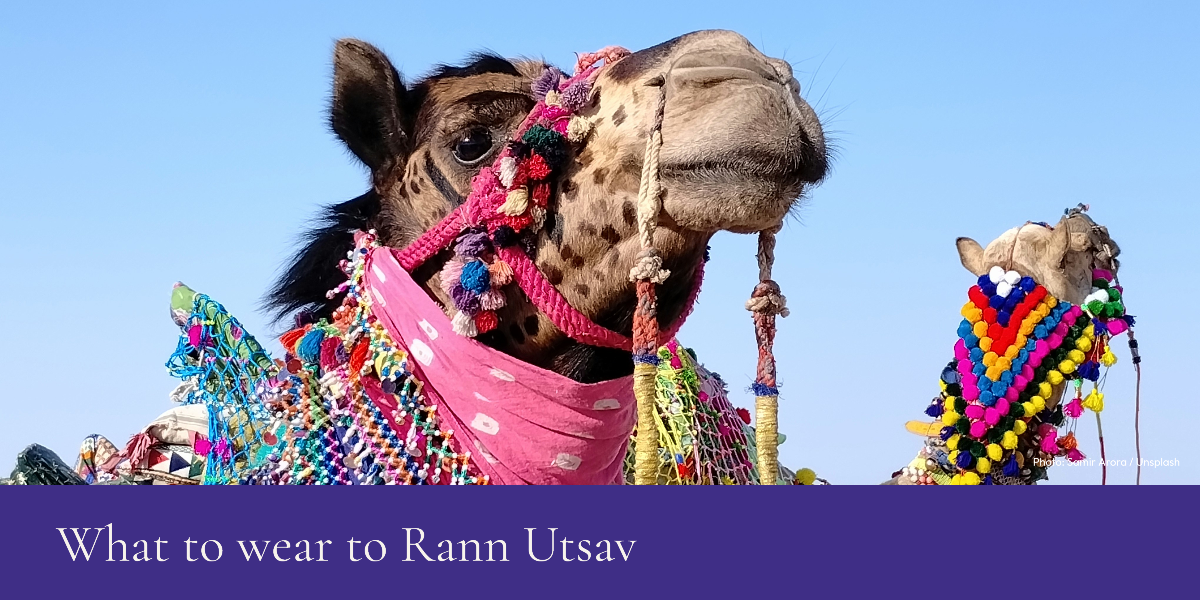
The salt and the sky give you a backdrop of white and blue, which is why the camels' harnesses look so vivid in photos. Borrow that idea: red, deep indigo, mustard, emerald, magenta and rust all stand out. Prints that come from this region, such as Ajrakh's indigo and madder red or Bandhani's tie-dyed dots, look especially at home here.
- For photos: one strong colour on your top half, or a bright stole over a neutral outfit, is enough. Very pale beige and white blend into the salt.
- For sunset: warm colours like rust, red and mustard glow in the low light; cooler blues come into their own after moonrise.
- For practicality: darker trousers hide dust better than cream ones on a long day.
Wearing Kutchi crafts respectfully
Buying and wearing a stole, shirt or sari from Kutch artisans is welcome; the respectful part is how you buy, photograph and wear it.
Kutch's textiles are tied to specific communities. Rabari men and women, for example, wear distinct traditional dress, and their subgroups are recognised by subtle differences in attire, weaving and embroidery, according to the Global InCH journal. Outlook Traveller's responsible-travel advice is to buy directly from artisans where you can and to ask before photographing people or their work.
- Buy at the Tent City haat or in craft villages from the makers, and ask what a pattern means before you choose it.
- Wear crafts as part of your own outfit, such as an Ajrakh stole with jeans or a Bandhani dupatta with a plain kurta, rather than copying a community's full traditional dress as a costume.
- Ask before photographing artisans, performers or anyone in traditional dress, and accept a no.
Rann Utsav packing list
For a two- or three-night stay, this covers day, night and the drive.
- 2 or 3 breathable long-sleeved tops (cotton, linen or khadi)
- 2 pairs of loose trousers, palazzos or chinos
- 1 warm mid-layer (sweater, fleece or cardigan)
- 1 wind-blocking outer layer or a thick wool shawl
- Beanie or scarf, and warm socks for nights
- Closed walking shoes, plus slippers for the tent
- Sunglasses, a brimmed hat, sunscreen and lip balm
- One bright stole or dupatta for photos
- ID for your White Rann permit
If you are heading to Rajasthan's desert fairs too, our Pushkar Fair outfit guide covers a similar warm-day, cool-night climate.
FAQ
What should I wear to Rann Utsav?
Breathable long-sleeved cotton or linen with loose trousers, a hat and sunglasses by day, then a sweater, a light jacket or wool shawl and a beanie for evenings on the salt. Closed walking shoes work for both.
Is it cold at the Rann of Kutch at night?
Yes, in winter. Kutch mornings can fall to the low teens Celsius; IMD recorded 10.4°C at Kandla on 1 December 2025 and noted that 17.9°C at Bhuj on 20 December was 5.5°C above normal. Pack a warm layer for sunset and full-moon nights.
When is the full moon at Rann Utsav 2026?
Outlook Traveller lists the 2026-27 full-moon windows as 23 to 25 November, 22 to 24 December, 21 to 23 January and 19 to 21 February. Book early if you want one of these nights.
What shoes should I wear in the White Rann?
Closed shoes you can wipe or wash, such as canvas sneakers or walking shoes. Avoid suede and open sandals, since the salt crust is uneven and salt marks delicate materials.
Do I need a permit to visit the White Rann?
Yes. Permits are issued online through rannpermit.com and at the Bhirandiyara checkpost. Check the current fee and timings before you travel and carry the ID you applied with.
Plan your Rann outfits before you pack
A desert trip with hot days and cold nights is easier when every layer does two jobs. In Elara, add your clothes to your digital closet, put your Rann Utsav days in the Calendar, and let Daily Outfits suggest a day look and an evening look for each, with Style DNA keeping them true to your taste. Try Elara free and pack exactly what the trip needs.
Your stylist, in your pocket
Stop reading about outfits. Start wearing them.
Elara knows your closet, shops every store and gets you dressed for any occasion.