
What to Wear in 10 Degrees Celsius: Layers and 5 Outfits
At 10°C (50°F), wear a light base, a knit and a jacket or light wool coat. How wind and rain change it, plus 5 outfits for work, weekends, nights out and runs.
 Mehul AgarwalFounder & CEO
Last updated: November 2026
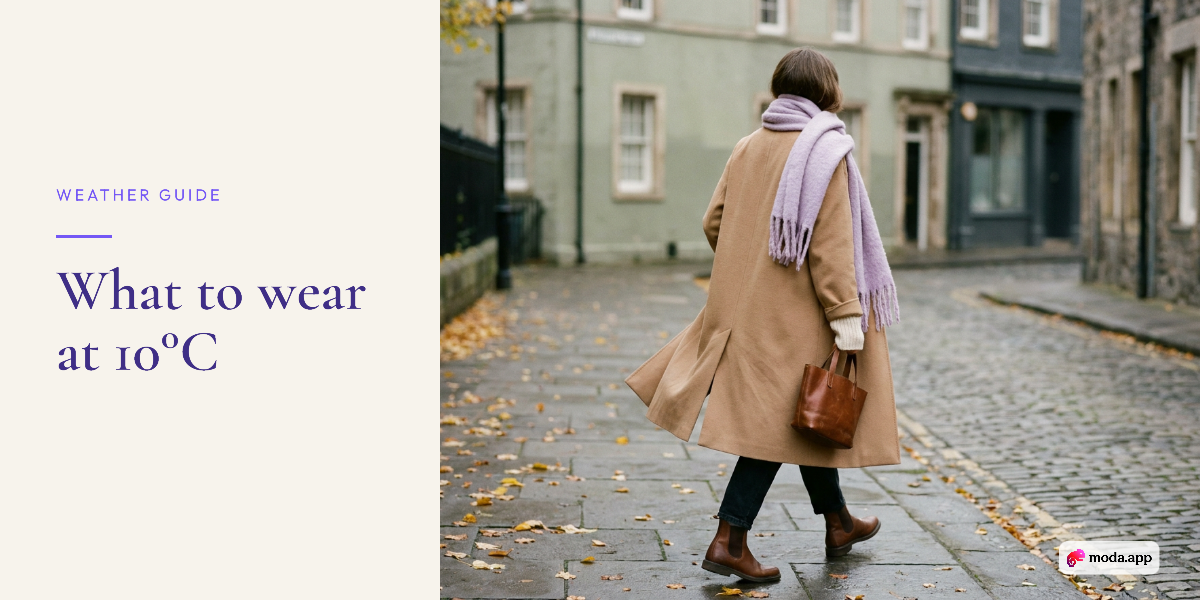
Quick answer: At 10°C (50°F), wear two light layers plus a jacket you can open: a long-sleeve top or shirt, a fine knit or sweatshirt, and a trench, light wool coat, quilted jacket or leather jacket, with long trousers or tights and closed shoes. Skip the winter coat unless it is windy, wet or you will be out after dark. The Met Office says a calm 10°C feels close to 10°C, but a strong wind can make it feel several degrees colder; by the US National Weather Service wind chill formula, a 20 km/h breeze takes it to about 7°C.
10°C is the most in-between number on the forecast. A winter coat feels heavy by lunchtime, yet a T-shirt and denim jacket leave you shivering at the bus stop. It is also common: in London, the Met Office 1991 to 2020 averages for Heathrow put the typical daytime high at 11.5°C in November and 11.7°C in March. Below: why 10°C feels so different day to day, a three-layer formula with the fabric reasons, and five outfits.
If your forecast is colder, our 5°C outfit guide adds the warm coat and accessories; if it is milder, the 15°C guide shows which layer to drop. And if you think in Fahrenheit, 10°C is exactly 50°F, so our 50 degree weather guide covers the same day from the US side.
How cold does 10 degrees Celsius feel?
On a still, dry day, 10°C feels cool but comfortable in a jacket. Three things change that more than the number itself: wind, sun and how the temperature moves through the day.
- Wind: the Met Office explains that moving air removes heat from your body faster than still air. Using the National Weather Service wind chill formula, 10°C feels like about 8.6°C in a 10 km/h breeze, 7.4°C at 20 km/h and 6.6°C at 30 km/h. The NWS only defines wind chill at 10°C (50°F) and below, so this is where wind starts to count.
- Sun and shade: a sunny 10°C afternoon can feel noticeably milder when you stand in the light, and the Met Office notes it feels much colder in the shade or once the sun drops behind cloud. That is why your middle layer should come off easily.
- Rain and damp: wet fabric pulls heat away from you, so a drizzly 10°C day can feel much colder than the forecast suggests. Keeping water off matters more than adding thickness.
- The daily swing: a 10°C high usually means colder mornings and evenings. Heathrow's November averages pair that 11.5°C high with a 5.3°C low, so if you leave at 8am and come home at 7pm, you are dressing for two different temperatures.
Where and when 10°C is typical
10°C is the daytime high of late autumn and early spring in much of Northern Europe, and a night-time temperature in many warmer places. Knowing which kind of 10°C you have tells you how to dress for it.
- London and the UK: according to the Met Office Heathrow averages (1991 to 2020), November and March both have average highs just under 12°C, and October mornings average about 9°C. Here 10°C is a daytime number, often with wind and drizzle.
- Delhi in winter: the India Meteorological Department's 1991 to 2020 normals for Safdarjung give an average minimum of 8.4°C in December, 7.5°C in January and 10.6°C in February, while afternoons average 20 to 24°C. In Delhi, 10°C is a night and early-morning temperature, so the question is really what to carry for an evening wedding, a late dinner or a 7am start.
- Shimla in October: IMD climate tables for Shimla show an average October minimum of about 11°C against a 20°C high, so pack a proper evening layer.
If 10°C is your high, layer for the whole day. If it is your low, dress for the day and carry the warm layer for sunset.
The 10°C layer formula: base, mid, outer
Wear a base layer, a light insulating layer and an outer layer that blocks wind, and make each one easy to remove. REI's layering guide describes the same three jobs: the base moves sweat off your skin, the middle traps body heat and the outer shields you from wind and rain.
- Base: a long-sleeve T-shirt, shirt or thin merino top. Cotton is fine for a desk day, but if you will walk far or sweat, REI calls cotton a no-no in cold weather because it sponges up water and can chill you.
- Mid: a fine merino or lambswool sweater, a cotton-cashmere knit, a cardigan, a sweatshirt or a light fleece. Wool earns its place here: Woolmark's research factsheet says wool can absorb up to 35% of its weight in moisture before it feels wet, and wool fabrics move 25% more moisture away from the skin than polyester. Fleece is warm even when damp, but wind passes straight through it, so it needs a jacket on top.
- Outer: a trench coat, an unlined or lightly lined wool coat, a quilted jacket, a leather or suede jacket, or a waxed or waterproof jacket for rain. If you choose a padded layer, REI notes that down loses insulating efficiency when damp, while synthetic insulation keeps working, which makes a synthetic quilted jacket the safer pick for misty, drizzly 10°C days.
- Bottoms and shoes: full-length trousers, jeans or a skirt with tights; closed shoes such as loafers, trainers or ankle boots. Sandals and cropped trousers with no-show socks leave the skin the wind finds first.
- One accessory: a light wool or cotton scarf is the best value piece at 10°C. It closes the gap at your neck when the wind picks up and folds into a bag when it does not. For more ways to wear one, see our guide to tying a scarf for winter.
When to upgrade the outer layer to a warmer coat: if it is windy, if you will be outside for more than about an hour, or if you will be out after sunset on a day that only peaks at 10°C.
What to wear in 10 degrees Celsius: 5 outfits
All five use the same formula, so pieces swap between them.

Want this styled from your own closet?
Elara builds the look from what you own, then lets you try it on.
1. Commute and office
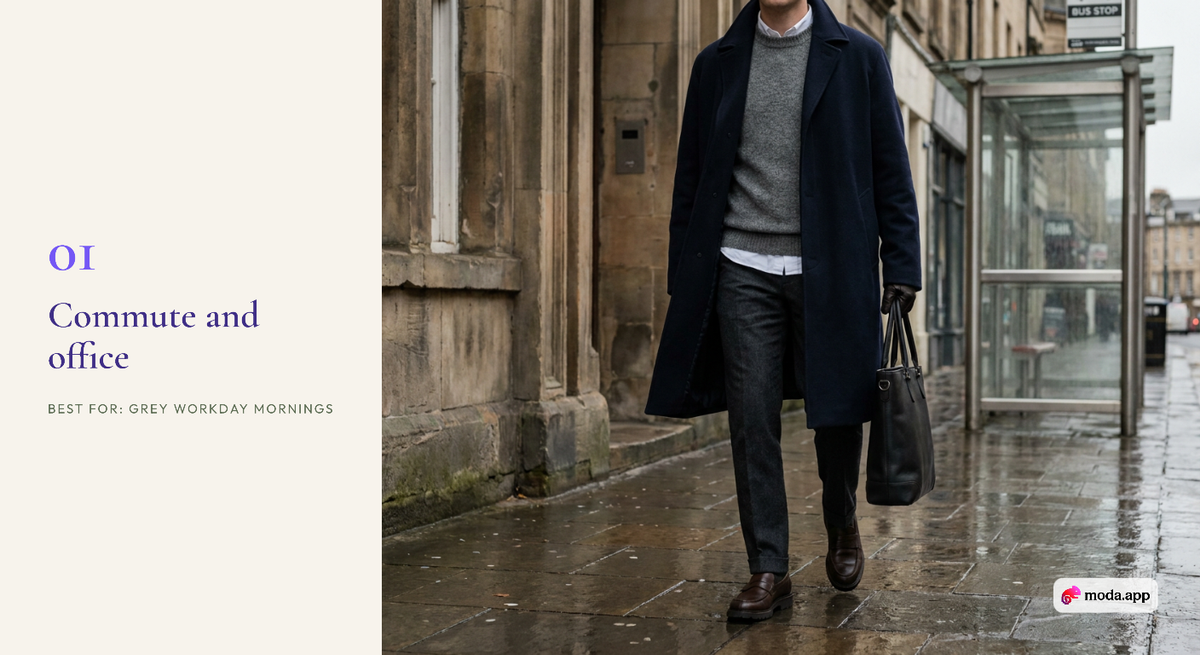
Put the warmth in a coat you can hang up, not a thick sweater you are stuck in at a heated desk.
Try a navy or camel wool overcoat over a fine merino crew-neck and a collared shirt, wool or cotton-drill trousers and leather loafers or Chelsea boots with rubber soles. For a dress or skirt, wear a fine knit over a midi skirt with 40 to 60 denier tights and ankle boots. For Indian office wear, a straight cotton or silk kurta with trousers and a wool Nehru jacket or a long cardigan works for a Delhi winter morning that warms up by noon.
2. Weekend and errands

A sunny 10°C Saturday swings between pleasant in the sun and chilly in the shade. A light quilted jacket is ideal because it is warm for its weight and easy to unzip in a shop or café.
Wear a white T-shirt under a chunky cotton or wool sweater, a quilted liner jacket or a chore jacket, straight jeans, wool-blend socks and trainers. If the sun comes out, the jacket comes off and the knit alone is enough; if it clouds over, zip back up.
3. Evening out

Evenings are the coldest part of a 10°C day, so wear a full-length outer layer over a fine knit, not a thin party jacket.
A belted trench or a long wool coat over a ribbed knit top, a satin or wool midi skirt, sheer or opaque black tights and heeled ankle boots is warm enough for the walk to the restaurant. For trousers, a turtleneck under a blazer with a wool coat on top does the same job. For a Delhi wedding or sangeet on a December night, a pashmina or wool shawl over a saree or lehenga, or a velvet or wool bandhgala over a kurta set, covers the drop after sunset without hiding the outfit.
4. Rainy 10°C
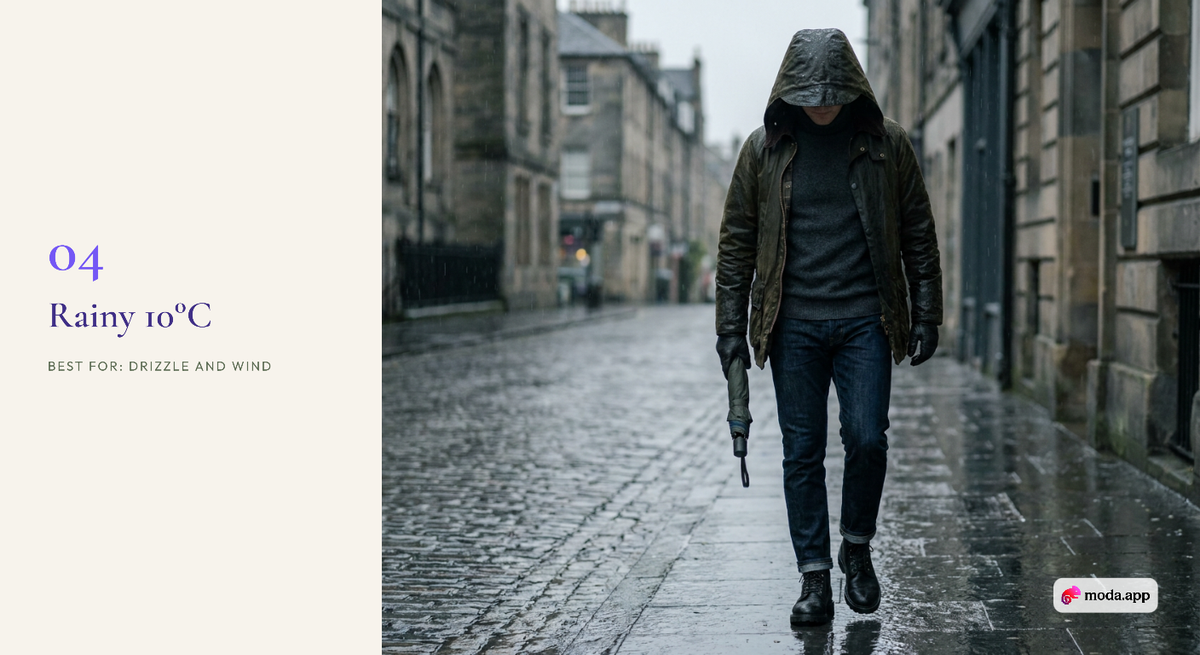
Choose a hooded, water-resistant outer layer and let a wool knit do the warming, because wool keeps you comfortable even if some damp gets through.
Wear a waxed cotton jacket, a waterproof trench or a hooded rain jacket over a wool roll-neck or merino sweater, dark jeans or trousers that will not show splashes, and leather or rubber-soled boots that keep water out. Skip suede and canvas trainers. As REI puts it, a waterproof, breathable shell suits heavy rain; water-resistant is fine for drizzle.
5. Running and active
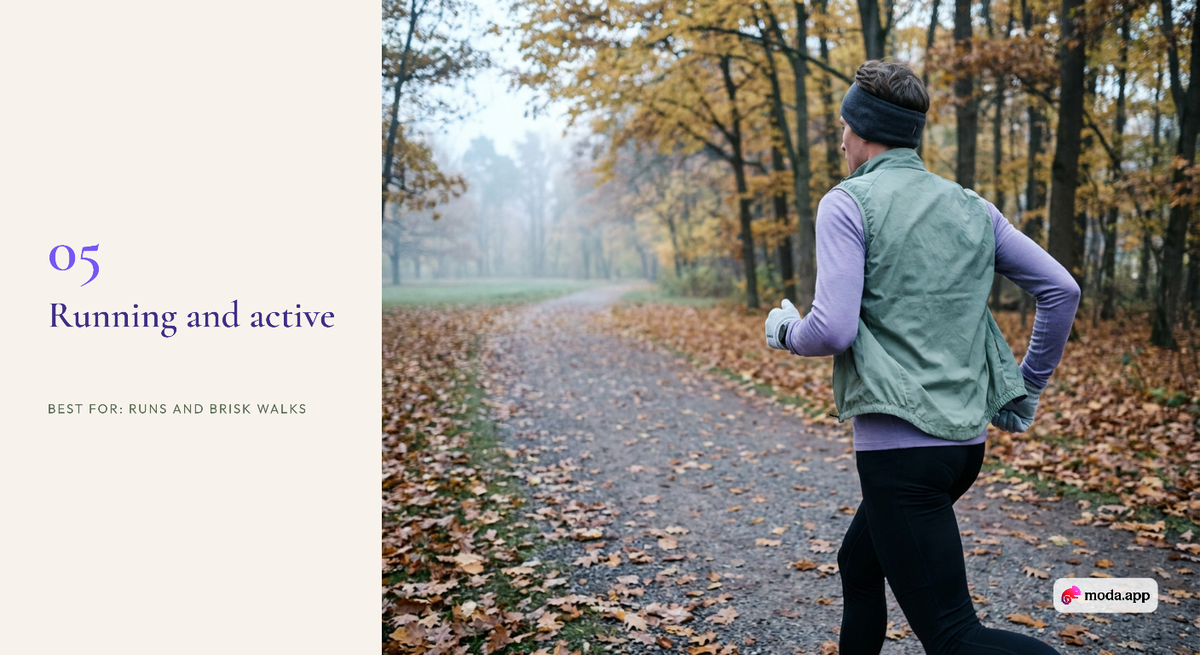
Dress lighter than you think, because you will warm up within minutes. Fleet Feet's running advice is to dress for temperatures 10 to 20°F warmer than the thermometer says, which at 10°C means dressing for roughly 16 to 21°C.
For most runs that means a thin long-sleeve top in merino or a synthetic wicking fabric, or a T-shirt with a light wind vest, plus running tights or shorts, depending on how warm you run. Add thin gloves and a headband for the first kilometre, and tuck them into a pocket once you warm up. For brisk walks or cycling, add a light windproof jacket rather than a thick hoodie.
Common 10°C mistakes to avoid
The usual problem is dressing for one moment of the day instead of all of it.
- Dressing for noon only. A T-shirt and light jacket feel right at 1pm and wrong at 7pm. Check the evening temperature, not just the high.
- A heavy winter coat with nothing underneath. You overheat indoors and then go out cold after taking it off. Two light layers plus a lighter coat give you more control.
- A knit with no wind layer. Wind goes straight through open knits and fleece. Even a trench or denim jacket over the sweater makes a clear difference on a breezy day.
- A cotton hoodie for exercise. It soaks up sweat and stays cold when you stop. Choose wool or a wicking synthetic next to the skin.
FAQ
Is 10 degrees Celsius cold?
10°C (50°F) is cool rather than cold. Most people are comfortable in a long-sleeve top, a light sweater and a jacket. With wind or rain it feels noticeably colder, closer to 6 or 7°C.
What should I wear in 10 degree weather Celsius?
Wear three light layers: a long-sleeve top or shirt, a fine knit or sweatshirt, and a trench, light wool coat or quilted jacket, with long trousers or tights and closed shoes. Add a scarf if it is windy.
Do I need a coat at 10 degrees Celsius?
You need a jacket, but usually not a heavy winter coat. A trench, light wool coat, quilted jacket or leather jacket is enough on a dry day. Upgrade to a warmer coat if it is windy, wet or you will be out late.
Can I wear shorts in 10 degrees Celsius?
For running, yes, many runners wear shorts or tights at 10°C because exercise warms you up fast. For everyday wear, most people find full-length trousers, jeans or a skirt with tights more comfortable.
What should I wear at 10°C at night in Delhi?
Carry a warm layer for after sunset: a wool shawl or pashmina, a Nehru jacket, a bandhgala or a light wool coat. IMD normals put Delhi's December and January nights at about 7.5 to 8.5°C on average.
What is 10 degrees Celsius in Fahrenheit?
10°C is 50°F. If your forecast really says 10°F (about -12°C), see our what to wear in 10 degree Fahrenheit weather guide.
Plan 10°C outfits from your own closet
Elara turns your wardrobe into a digital closet, so you can see which jackets, knits and boots you already own that work on a 10°C day, and get Daily Outfits built from them. Ask the AI styling chat what to wear for a cool morning that turns into a cold evening, and it puts the outfit together from your own pieces. Try Elara before the next in-between day.
Your stylist, in your pocket
Stop reading about outfits. Start wearing them.
Elara knows your closet, shops every store and gets you dressed for any occasion.