
What to Wear in 30 Degrees Celsius: 4 Outfits That Stay Cool
What to wear in 30°C (86°F) weather: breathable fabrics, loose fits, white vs black, UPF sun cover and 4 outfits for work, weekends, evenings and India.
 Mehul AgarwalFounder & CEO
Last updated: November 2026
Quick answer: At 30°C (86°F), wear loose, breathable layers in open-weave cotton or linen: a linen shirt or shirt dress, shorts or wide-leg trousers, and sandals or canvas trainers. If you will be active, a lightweight technical tee moves sweat better than cotton. In strong sun, add a broad-brim hat and a collared, longer-sleeved top: Cancer Council Australia recommends sun protection whenever the UV index is 3 or above, and UPF 50+ fabric for the best protection.
Thirty degrees is warm enough that what you wear changes how you feel within minutes. It is a normal summer afternoon in Sydney or Perth, a winter day in Chennai or Goa, and a heatwave in London. The good news is that dressing for it is less about the right garment and more about three choices: the fabric's weave, how loosely it fits, and how much skin you cover from the sun.
This guide explains each of those with what textile researchers and health bodies actually say, then gives four outfits that work at 30°C. Slightly cooler where you are? See what to wear in 25 degrees Celsius.
What 30°C feels like, and why humidity changes the outfit
At 30°C your body cools mainly by sweating, so your clothes need to let sweat evaporate. In dry heat that happens easily; in humid heat, the air is already full of moisture, sweat lingers, and fabric that soaks it up starts to cling. That is why the same linen shirt feels fine in a dry 30°C afternoon and sticky on a humid one.
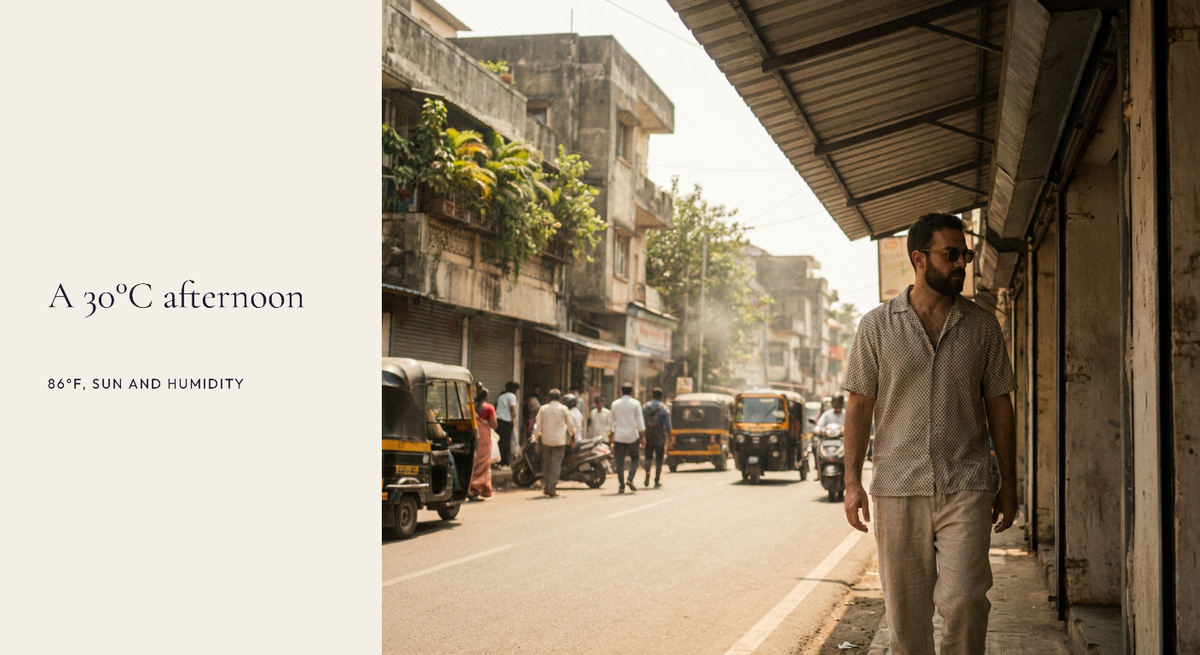
Sun is the other variable. A 30°C day in the shade and a 30°C day in full midday sun are different outfits. The NHS advises staying in the shade "especially between 11am and 3pm" during hot weather, so plan the most exposed part of your day, and your outfit, around that window.
The best fabrics for 30°C weather
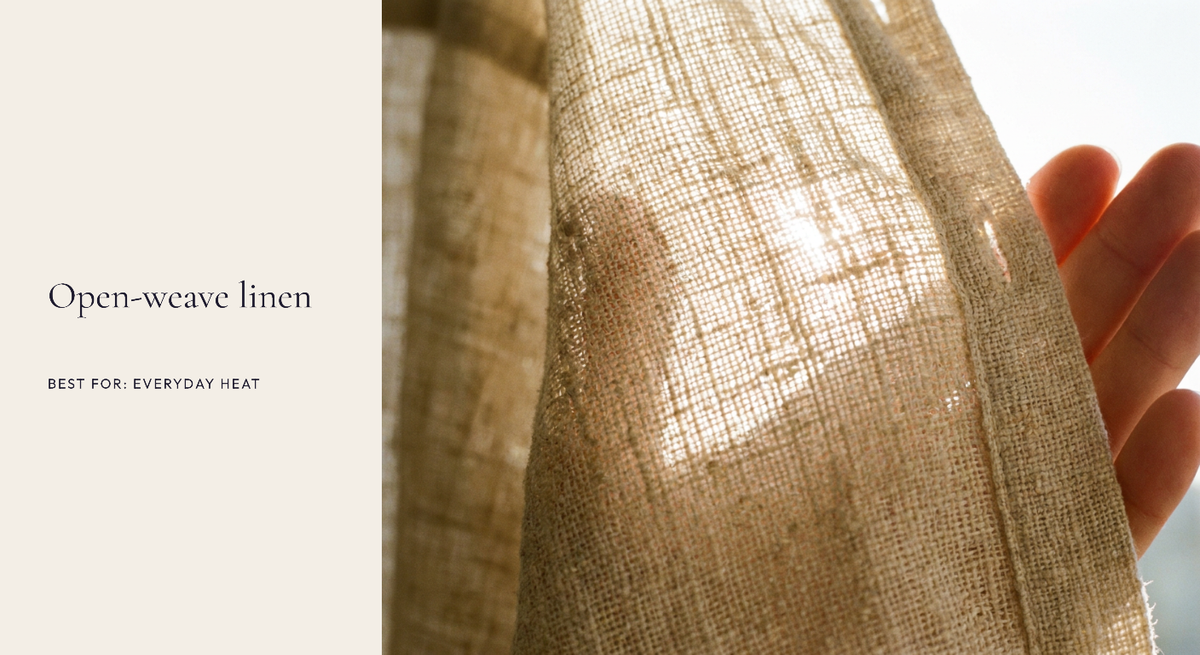
Choose open-weave cotton or linen for everyday wear, and lightweight, porous synthetics for activity. In an AP report on fabrics for extreme heat, Florida State University professor Meredith McQuerry said cellulosic fibres like cotton and linen "tend to be more breathable and comfortable", but added that an open weave matters more than the fibre alone, so a linen label does not guarantee a breathable garment.
Cotton has a limit. The University of Chicago's Po-Chun Hsu told AP that cotton "will work well for a short period" but gets heavy once saturated, while engineered polyester keeps sweat evaporating during exercise. University of Texas professor Jonathan Chen noted that untreated polyester "absorbs very little moisture naturally" and can feel clammy, and that two "100% polyester" garments can perform very differently.
How to use that in a shop:
- Hold it up to the light. If you can see light through the weave, air can move through it too.
- Pick by activity. Cotton and linen for sitting, walking and work; a lightweight technical tee for hiking, sport or a long day on your feet.
- Be wary of "cooling" labels. Hsu warned that some cooling fabrics mainly feel cold to the touch and are "quite unlikely" to have a continuous cooling effect.
Loose or fitted?
Loose for sitting and walking, closer-fitting only for exercise. Loughborough University's George Havenith recommends room for ventilation in hot outdoor conditions, and McQuerry noted that a tighter fit can help sweat evaporate faster during activity, while a looser fit suits sitting or light chores.
In practice: wide-leg trousers over skinny jeans, a boxy shirt over a fitted one, an A-line or shirt dress over a bodycon. Loose garments also stop fabric from sticking to damp skin, which is most of what makes 30°C feel uncomfortable.
Should you wear white or black in the heat?
White is the safer default, but colour matters less than fit and fabric. A 1980 study in Nature found that a Bedouin in the desert gained about the same heat in a black robe as in a white one, because the extra heat the black robe absorbed was carried away before it reached the skin, helped by the loose cut. Hsu told AP that white or highly reflective fabrics can "reduce heat gain by reflecting sunlight."
There is a sun-protection trade-off. Cancer Council Australia says darker colours of the same fabric "will absorb more UV radiation", and the Australian Radiation Protection and Nuclear Safety Agency (ARPANSA) says the same of darker, more heavily dyed fabric. So a loose navy linen shirt can be a good choice in strong sun, while a tight black top is the worst of both.
Sun protection is part of a 30°C outfit
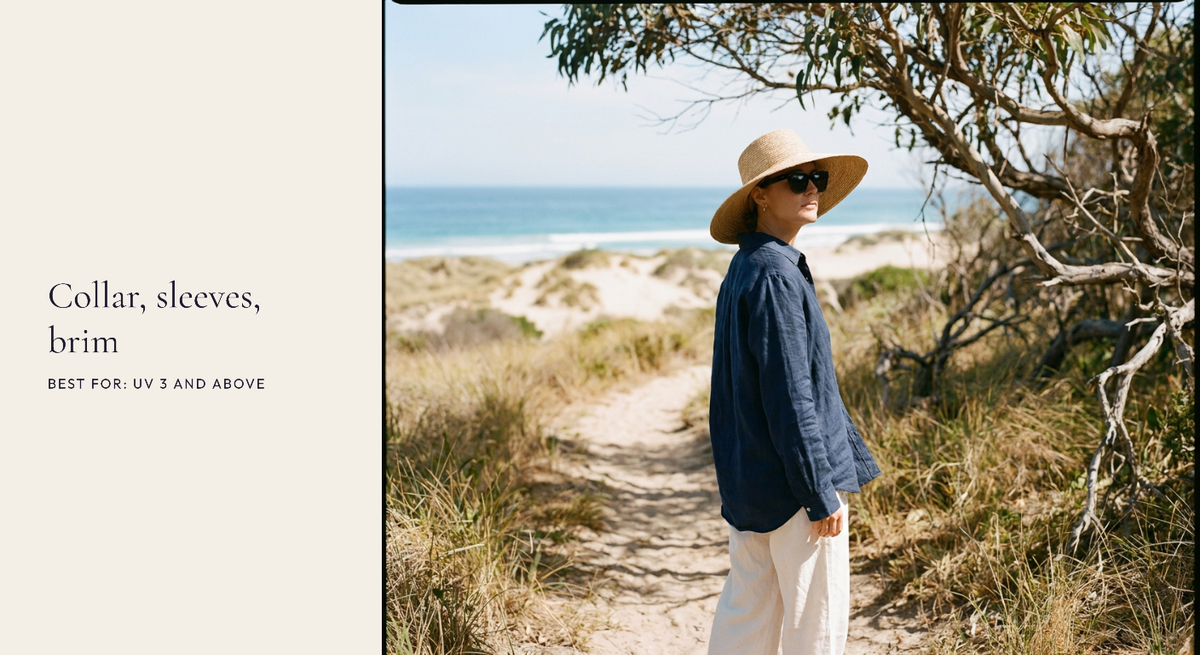
If the UV index is 3 or above, treat your clothes as sun protection. Cancer Council Australia recommends using all five SunSmart steps at UV 3 and above, and says the best tops have "collars, and sleeves of at least three-quarter to full-length", with UPF 50 or 50+ fabric rated "excellent" and blocking about 98% of UV.
- Weave beats thickness. ARPANSA notes that "the tighter the weave, the less space there is between the strands" for UV to pass through.
- Stretch and wear lower protection. ARPANSA says stretching a knit opens gaps and lowers its rating, and that a garment's rating can fall as it fades with washing.
Want this styled from your own closet?
Elara builds the look from what you own, then lets you try it on.
- Wet fabric protects less. Cancer Council Australia notes that most fabrics give less UV protection when wet, so a damp shirt after a swim is not a sun shirt.
- Hat and sunglasses. A broad-brim hat covers your face, ears and neck in one piece.
4 outfits for 30 degrees Celsius
Each outfit uses the same rules: breathable weave, room to move air, and coverage where the sun hits.
1. Office at 30°C
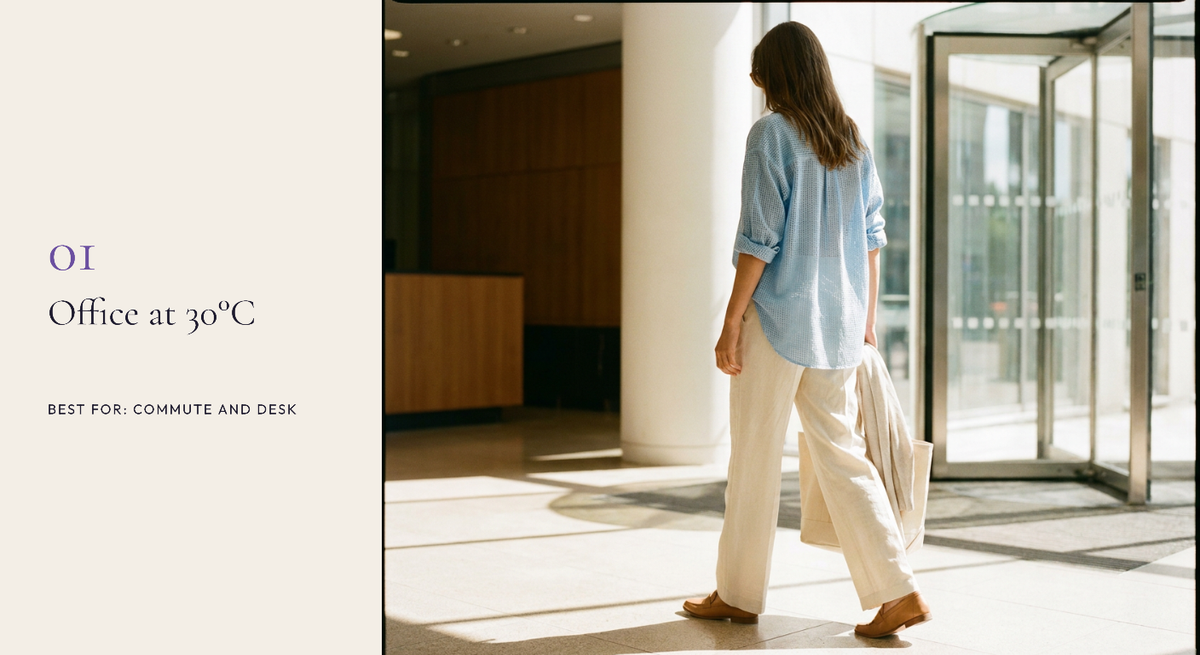
Linen-blend wide-leg trousers or a cotton midi skirt, an open-weave cotton or linen shirt with the sleeves rolled to the forearm, and leather sandals or loafers. Keep a light cotton overshirt or cardigan at your desk for air conditioning. For men, swap in linen-blend chinos and a short-sleeve camp-collar shirt if the office allows it.
2. Weekend errands and markets

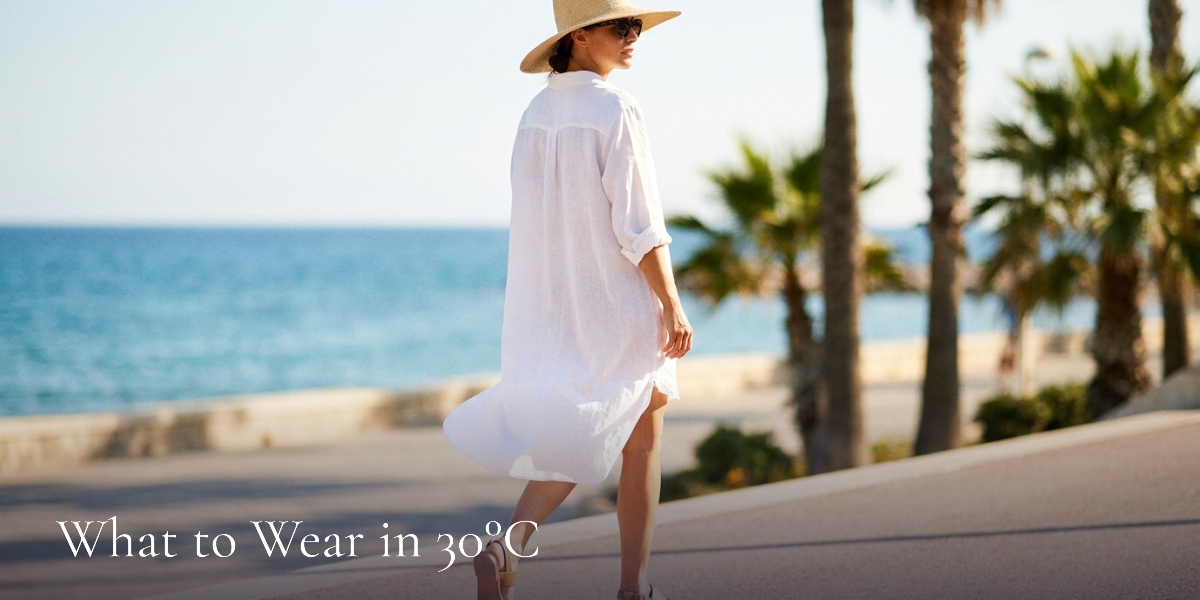
A linen shirt dress, or loose shorts with an oversized linen shirt worn open over a cotton tank, plus a broad-brim hat, sunglasses and sandals with a back strap for walking. The open shirt doubles as sun cover for your shoulders and arms when you step out of the shade.
3. Humid evening out
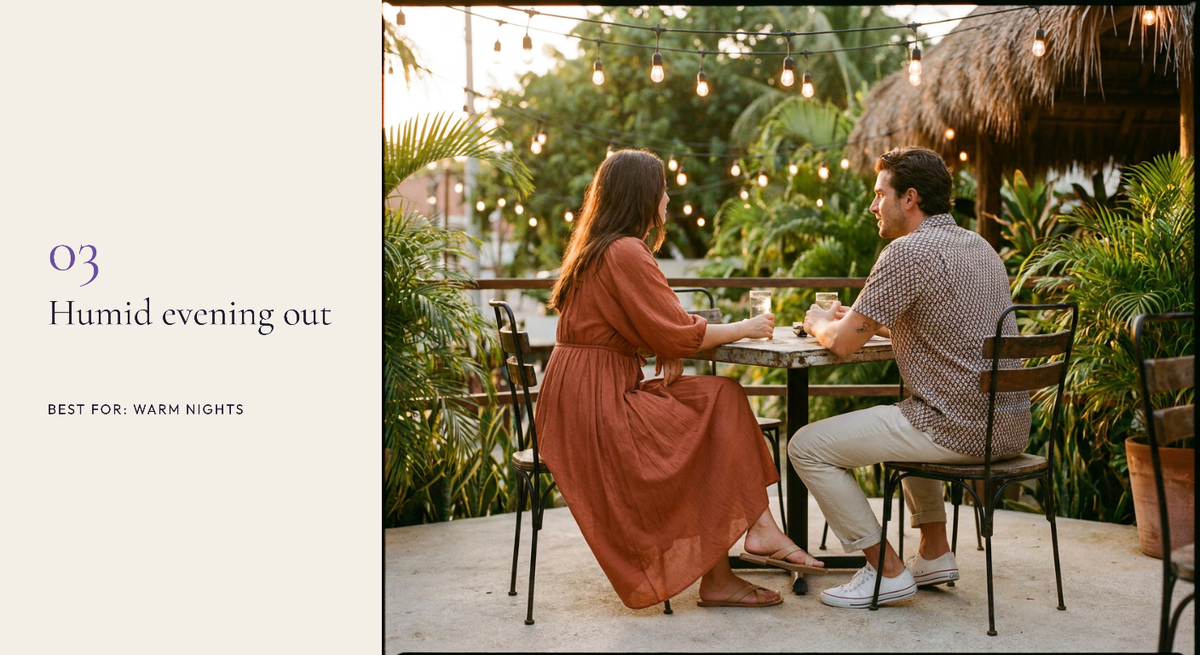
A cotton voile or linen midi dress with flat sandals, or a short-sleeve camp-collar shirt with light chinos and canvas trainers. Evenings stay warm after a 30°C day, so skip the jacket and bring a thin scarf or shawl only if you are heading somewhere air-conditioned.
4. Indian summer or a festival day
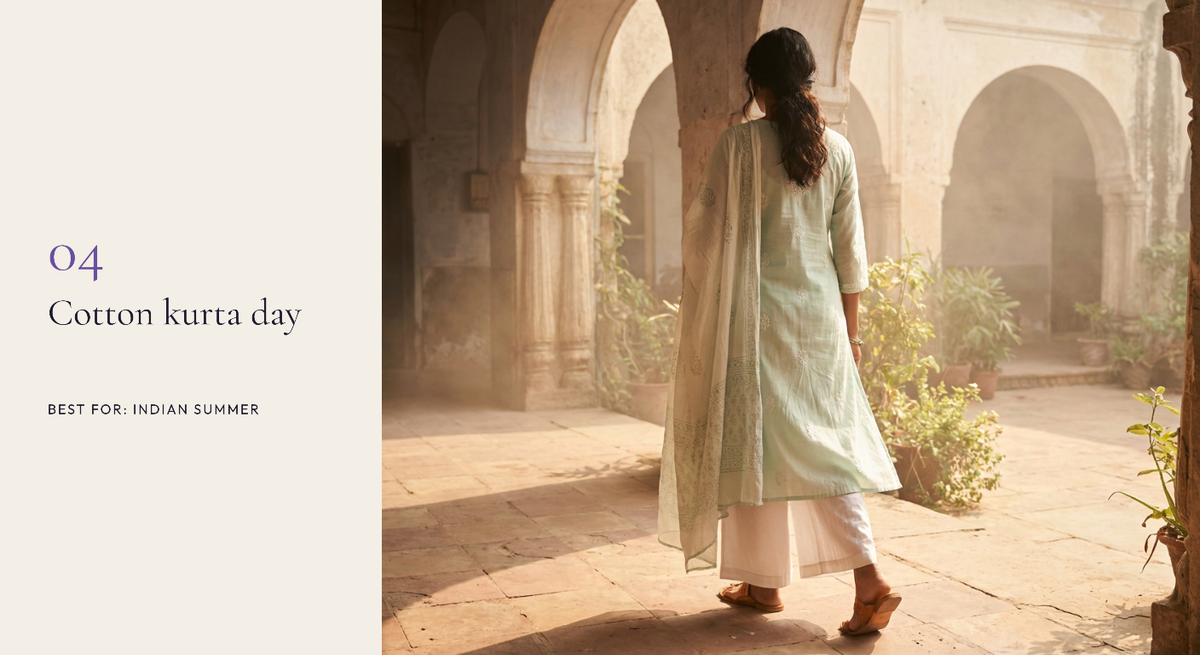
A loose cotton or mulmul kurta with cotton palazzos or straight trousers, or a light cotton saree, plus kolhapuris or juttis. Pale, airy cottons suit daytime; for a family function, choose a deeper colour in the same fabric rather than switching to silk. If you are in Kerala or Goa over winter, our Kerala in December and Goa in December guides cover the local dress codes.
Common mistakes at 30°C
- Skinny jeans and stretch denim. Heavy and close to the skin, they trap heat and sweat.
- Untreated polyester tops. Chen's point about clammy polyester applies most to cheap, smooth polyester blouses and dresses.
- Strappy tops in full sun. Bare shoulders burn quickly; Cancer Council Australia's advice is collars and longer sleeves when the UV is high.
- New shoes. Feet swell in the heat, so wear shoes you already know are comfortable.
FAQ
What should I wear in 30 degree weather?
Loose, breathable clothes in open-weave cotton or linen, such as a linen shirt, a shirt dress, shorts or wide-leg trousers, with sandals or canvas trainers. Add a broad-brim hat and a collared, longer-sleeved top in strong sun.
Is 30 degrees Celsius hot?
Yes. 30°C is 86°F, a hot summer day in most climates and warm enough that fabric, fit and sun protection noticeably change how comfortable you feel.
Can I wear jeans in 30 degrees?
You can, but loose, lightweight denim or linen-blend trousers will feel cooler than skinny or stretch jeans, which sit close to the skin and trap heat.
Is linen or cotton better for hot weather?
Both breathe well. Researchers quoted by AP say the openness of the weave matters more than the fibre, and that cotton can get heavy once soaked with sweat. For activity, a lightweight technical fabric moves sweat better.
Is it better to wear black or white in hot weather?
White reflects more sunlight, but a loose black garment can be nearly as comfortable, according to a 1980 Nature study. Darker colours also block more UV, so a loose dark shirt is a reasonable choice in strong sun.
What is 30 degrees Celsius in Fahrenheit?
30°C equals 86°F.
Dress for the forecast, from your own wardrobe
Hot days make a small wardrobe feel smaller. Elara is an AI personal stylist that knows your closet and the weather, so its Daily Outfits can suggest a 30°C look from clothes you already own, and you can ask the styling chat what to wear for a humid evening or a long day in the sun. Try Elara free.
Sources: AP via NBC: The best fabric for extreme heat, Cancer Council Australia: Sun protective clothing, ARPANSA: Sun protection clothing, NHS: Heatwave, how to cope in hot weather, Shkolnik et al., Nature (1980): Why do Bedouins wear black robes in hot deserts?.
Your stylist, in your pocket
Stop reading about outfits. Start wearing them.
Elara knows your closet, shops every store and gets you dressed for any occasion.