How to Tie a Scarf for Winter 2026: 6 Knots Step by Step, the Warmest Ones and Which Coat Each Suits
How to tie a scarf for winter 2026: six knots step by step, which are warmest, which suit an overcoat or puffer, and what length and fibre to buy.
 Mehul AgarwalFounder & CEO
Last updated: October 2026
Quick answer: For real warmth, tie a Parisian knot or a reverse drape cross: both close the gap at your throat and stay put. For a smart overcoat, use the flatter fake knot or four-in-hand so the scarf sits under your lapels. For a big triangle or blanket scarf, tie a loose front knot. Whatever you tie, start with the right scarf: Gentleman's Gazette recommends at least 180 cm (about 71 inches) long and 30 cm (about 12 inches) wide, because a short scarf cannot hold a secure knot.
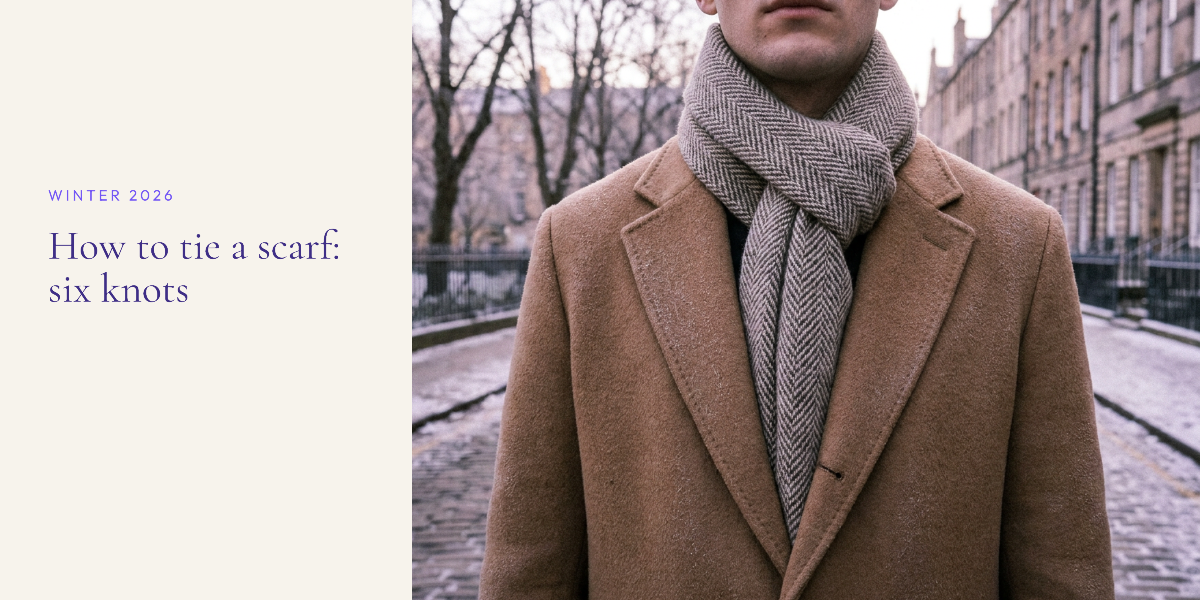
As the cold sets in across much of the northern hemisphere in November, the scarf you pull out of the drawer starts doing real work. Tied well, it closes the open neckline of your coat and keeps the wind off your throat. Tied badly, it slips, gapes or bunches up under your collar. This guide walks through six knots step by step, explains which ones are warmest and which suit which coat, and covers how to pick a scarf that ties properly in the first place.
The knot instructions come from the Canadian menswear retailer Harry Rosen and the scarf maker Tartan Blanket Co., and the sizing and fibre advice from Gentleman's Gazette. All six knots work for anyone; scarves are not gendered.
Start with the right scarf
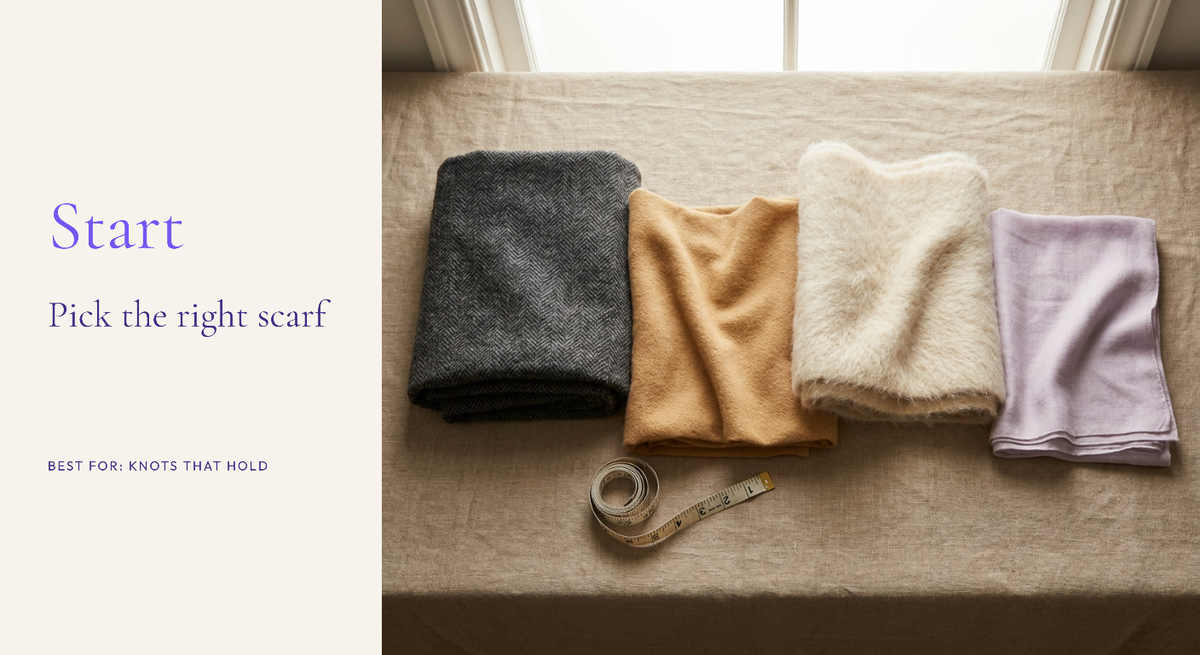
Most knot problems are scarf problems. Gentleman's Gazette puts the ideal length at around 180 cm and the width at no less than 30 cm, and says plainly that "if a scarf is too short, you cannot tie a proper knot that stays secure and looks proportional." Longer is fine if you want more warmth; shorter is not. Harry Rosen's knots likewise assume a medium to long scarf.
Fibre matters as much as size:
- Wool is the classic. The Woolmark Company, the wool industry's own body, says wool's natural crimp traps still air for insulation and that the fibre can absorb a lot of moisture vapour before it feels wet. Heavier wools can feel scratchy against the neck.
- Cashmere is softer and, according to Gentleman's Gazette, "never scratchy against the neck." It also warns that cheap cashmere often uses short fibres that pill quickly.
- Alpaca is the one to know about. Gentleman's Gazette describes it as more insulating than wool or cashmere because the hair fibre is hollow and holds air, and often less expensive than cashmere.
- Silk and silk blends are thinner and suit the in-between weeks, not deep winter.
On pattern, Gentleman's Gazette's rule of thumb is contrast: a patterned scarf, such as herringbone or check, with a plain coat, and a solid scarf with a boldly patterned coat.
Six ways to tie a scarf, step by step
Each knot below lists the steps, then when to use it.
1. The Parisian knot
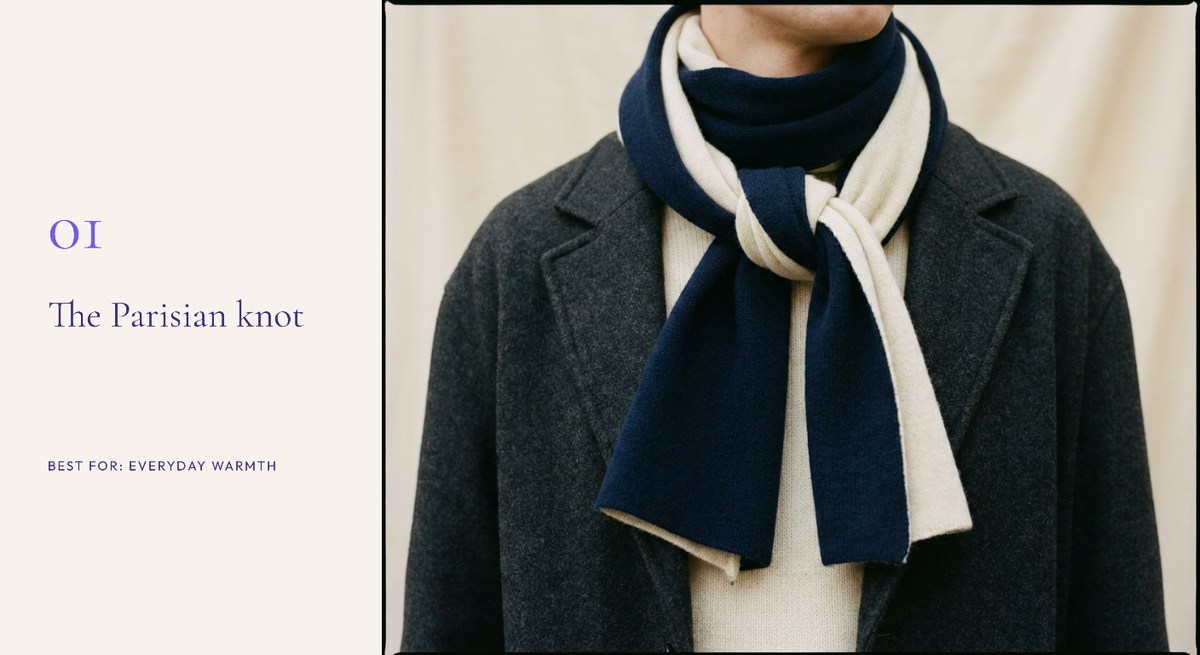
Also called the Chelsea knot or the loop.
- Fold the scarf in half widthways so the two ends meet.
- Fold it again lengthways if it is wide, so it is not too bulky.
- Put it round the back of your neck with the folded loop on one side and the two loose ends on the other.
- Pass both loose ends through the loop and pull them until the knot sits snugly at your throat.
When to use it: everyday warmth. Harry Rosen calls it relatively easy and warm, and the doubled fabric across the front of your neck is why. It works under most coats with a collar you can leave open at the top.
2. The fake knot
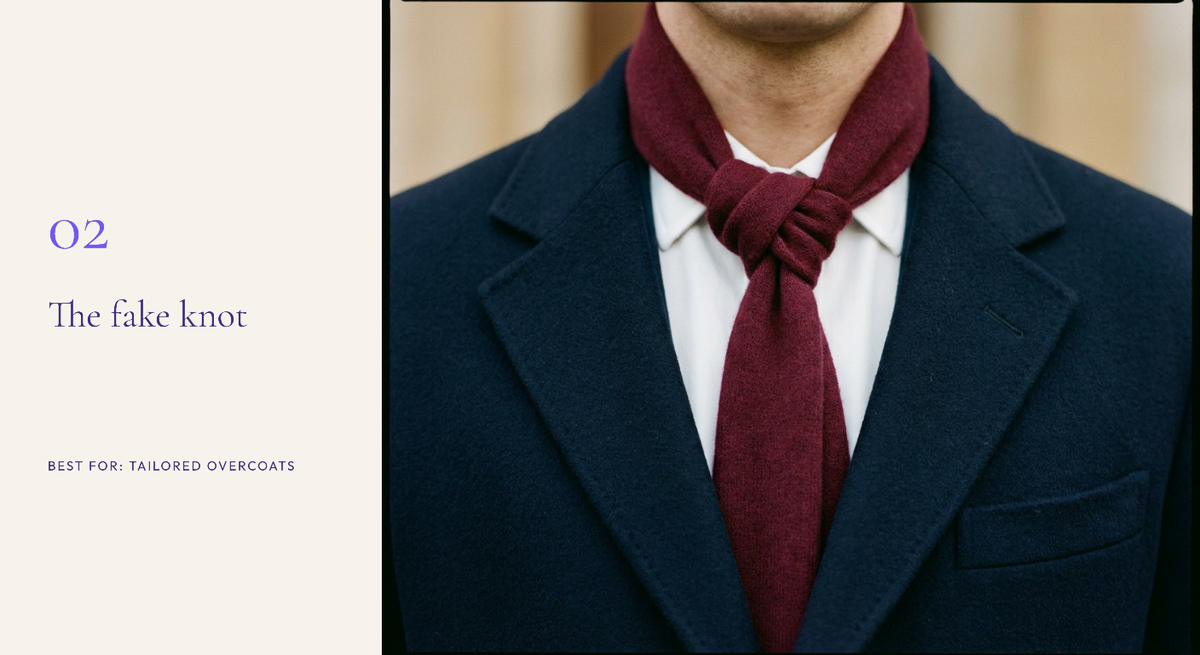
A knot that looks like a neat, tied knot sitting on the chest.
- Fold the scarf in half widthways and drape it so one end is much longer, with the short end sitting at about waist level.
- Tie a loose overhand knot in the long end.
- Pass the short end up through that knot.
- Slide the knot up towards your neck and tighten it, the way you would a tie.
When to use it: smarter occasions. Harry Rosen describes it as elegant and simple despite how elaborate it looks. It lies flat, so it sits neatly under a tailored overcoat.
3. The reverse drape tuck
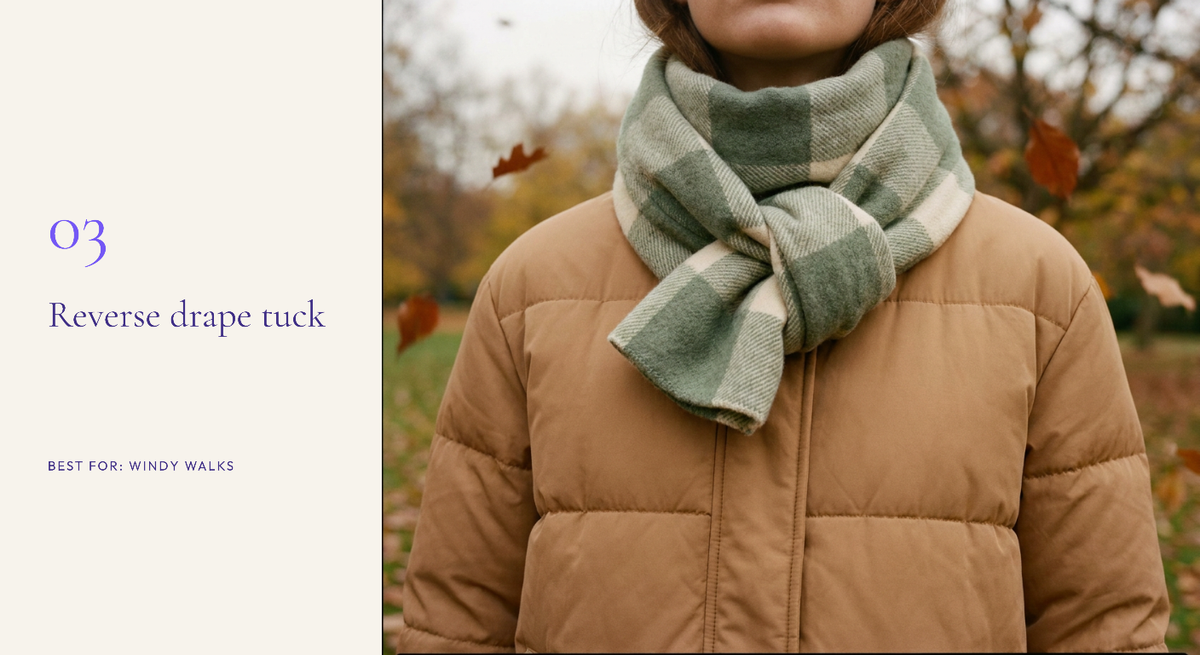
- Fold the scarf in half widthways and drape it round your neck with uneven ends.
- Bring the longer end back round the neck so it comes to the front again.
- Tuck that end into the loop at your neck.
- Tuck the other end through the loop on the opposite side and adjust.
When to use it: when you want warmth with a little more shape. It covers the neck fully and holds both ends in place, so nothing flaps when you walk in the wind.
4. The reverse drape cross
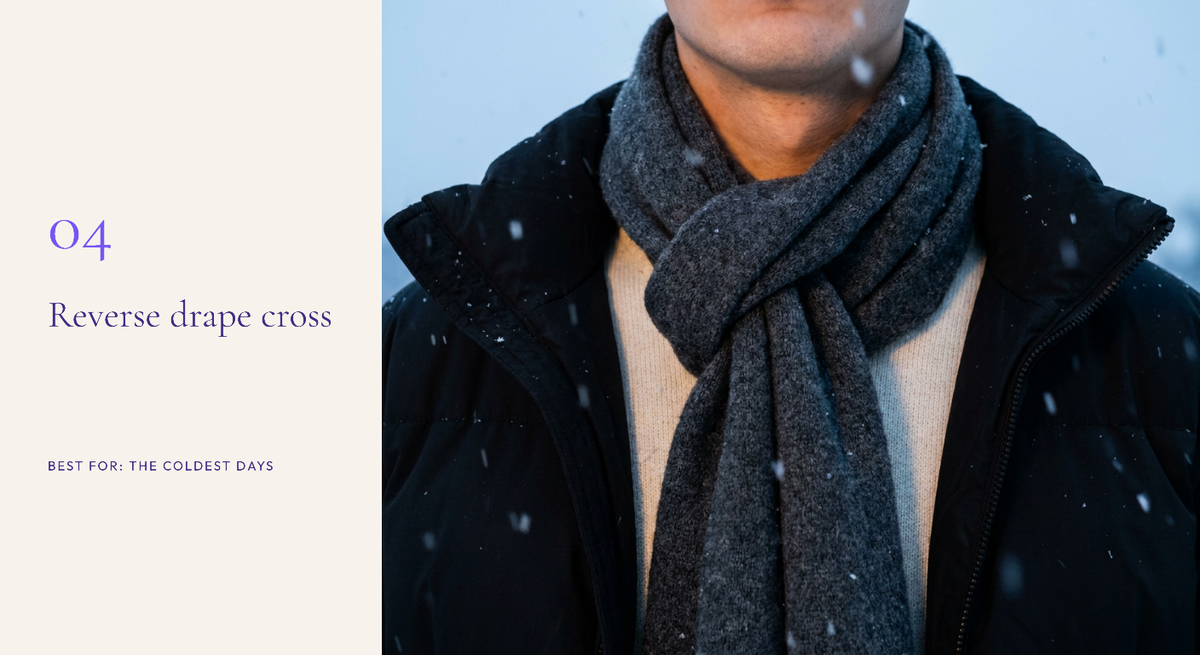
- Start as for the reverse drape tuck, with uneven ends.
Want this styled from your own closet?
Elara builds the look from what you own, then lets you try it on.
- Bring the longer end back round so both ends hang down the front.
- Knot the two ends together under your chin and adjust.
When to use it: the coldest days. Harry Rosen calls it a warm, secure knot, and because it wraps the neck twice and ties the ends, it does not loosen. Wear it over an open coat or with a zip jacket; it is too bulky to fit under fitted lapels.
5. The four-in-hand, or pretzel
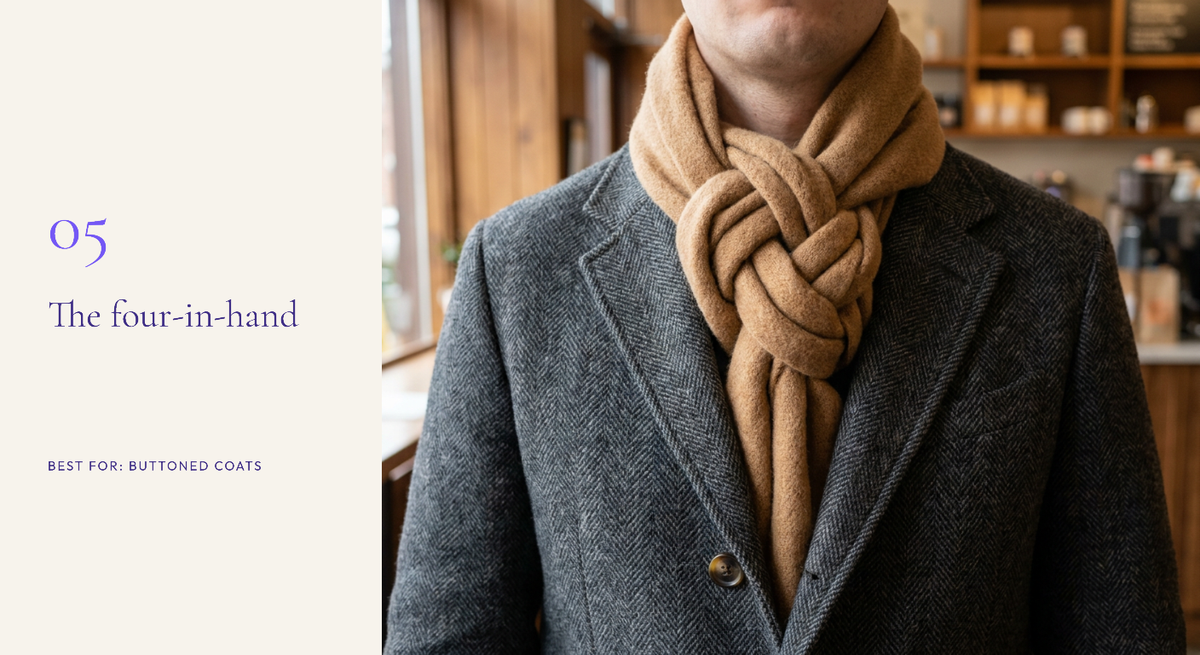
- Fold and drape the scarf as for the Parisian knot.
- Pass only one end through the loop.
- Twist the loop once, so it forms a second loop.
- Pass the other end through that new loop and adjust.
When to use it: when you want the scarf to be the detail. Harry Rosen calls it the trickiest of its knots, with a result that makes an impression. It is flat and neat, which suits a buttoned overcoat.
6. The triangle front knot
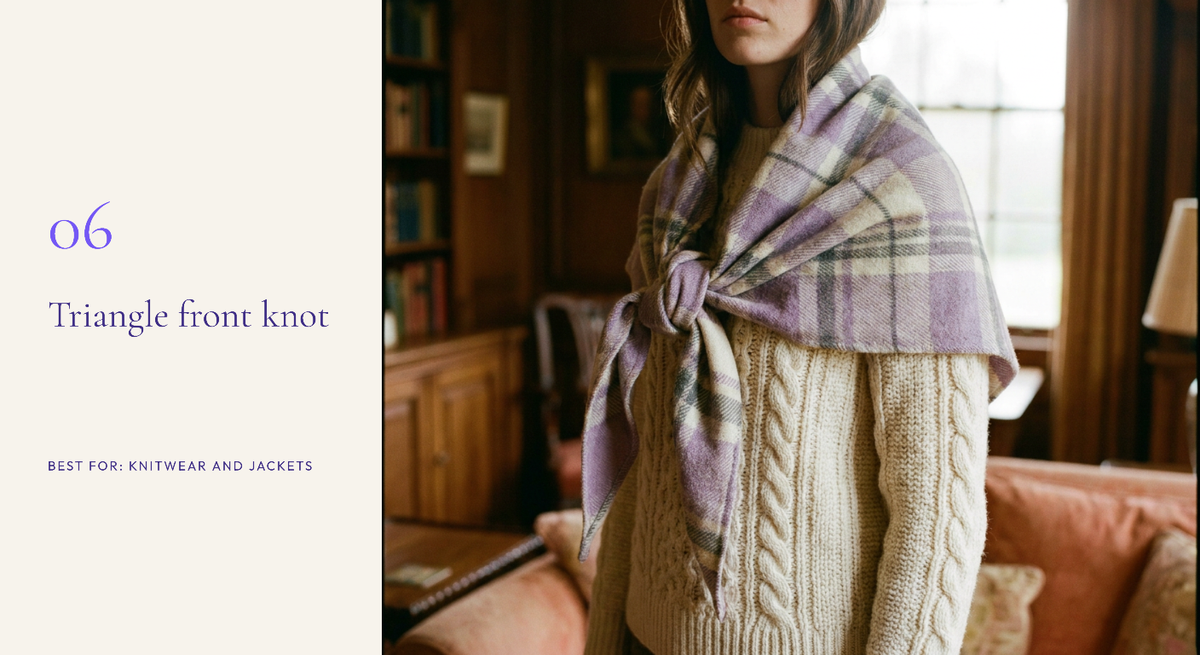
For square scarves folded into a triangle, or triangle blanket scarves.
- Fold a square scarf corner to corner into a triangle, or start with a triangle scarf.
- Drape it round your neck with the point at the front and the ends behind you, or hanging forward.
- Tie the ends at the front in a loose knot, leaving one end longer than the other.
- Adjust so the knot sits slightly off centre.
When to use it: over knitwear and casual jackets. Tartan Blanket Co. suggests leaving one end longer for an asymmetric finish, and the same steps with the ends knotted at the back give you a snug neckerchief.
Which knot for which coat
The simplest rule is to match the bulk of the knot to the space your coat leaves at the neck. This is styling advice rather than a hard rule:
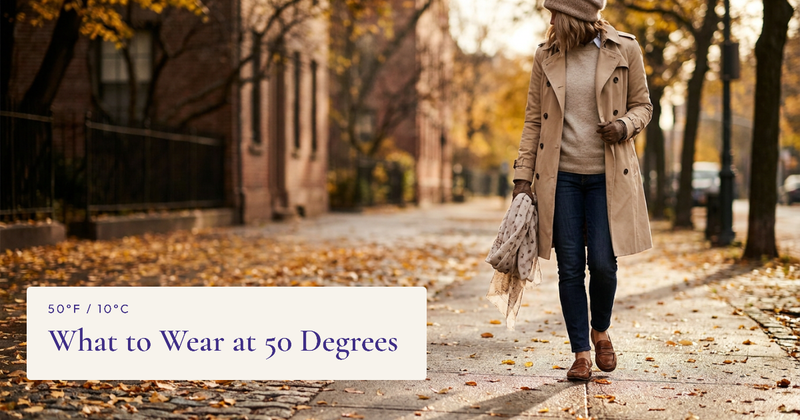
- Tailored overcoat or blazer with lapels: fake knot or four-in-hand. They lie flat and sit inside the coat's V.
- Parka, puffer or zip-up jacket: Parisian knot or reverse drape cross. Wear it outside the jacket's collar, or zip the jacket over a Parisian knot to seal the neck.
- Duffle or pea coat with a high collar: Parisian knot, worn flat so the collar can close.
- Casual knitwear or a shacket: the triangle front knot or a reverse drape tuck.
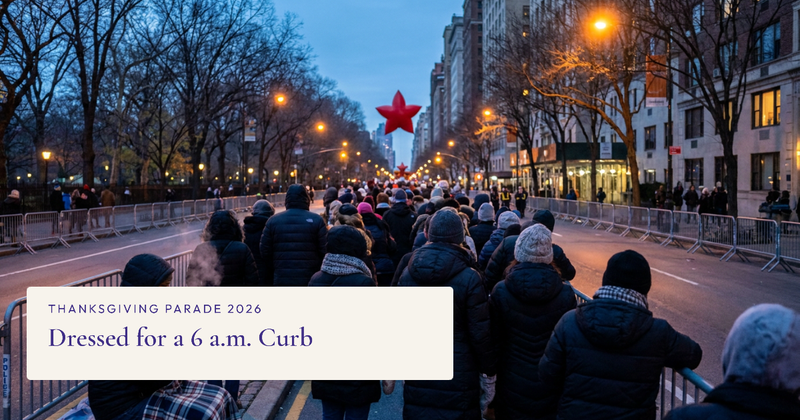
If you will be standing outdoors for a long time, at a market or a parade, choose warmth over neatness. Our guide to what to wear to a Christmas market covers the rest of the outfit for standing still in the cold.
Mistakes that make a scarf look and feel wrong
- Tying a short scarf. If the ends barely reach your chest after one wrap, no knot will hold. Size up rather than fight it.
- Pulling the knot tight against your throat. Leave a finger's width of room. A scarf should close the gap, not compress your neck.
- Doubling up bulk under a fitted coat. If you cannot button the coat comfortably, switch to a flatter knot.
- Letting long ends hang loose near moving parts. On bikes, scooters and escalators, tuck the ends in with a reverse drape tuck.
- Storing wool and cashmere scarves knotted. Untie and fold them so the fibres relax. Our wool and cashmere care guide explains washing, de-pilling and moth prevention.
FAQ
What is the warmest way to tie a scarf?
Knots that cover the whole front of the neck and stay put, such as the Parisian knot and the reverse drape cross. Harry Rosen describes both as warm options, and the reverse drape cross wraps the neck twice.
How long should a winter scarf be?
Gentleman's Gazette recommends about 180 cm (71 inches) long and at least 30 cm (12 inches) wide. Longer is fine for warmth, but a shorter scarf will not hold most knots securely.
How do you wear a scarf with an overcoat?
Choose a flat knot like the fake knot or four-in-hand so it sits neatly inside the lapels, and contrast pattern against the coat: a patterned scarf with a plain coat, or a solid scarf with a patterned one.
Is cashmere or wool warmer for a scarf?
Both are warm. Cashmere is softer against the neck; heavier wool can feel scratchy. Gentleman's Gazette rates alpaca as more insulating than either because its hollow fibre holds air.
How do you tie a blanket or triangle scarf?
Drape it with the point at the front, bring the ends round and tie them loosely at the front with one end longer, as Tartan Blanket Co. suggests, or knot the ends at the back for a neckerchief.
Not sure which scarf in your drawer goes with which coat? Elara, the AI personal stylist, works from a digital closet of the clothes you already own, so you can ask what to pair with tomorrow's coat and see it as a complete outfit. Try Elara free.
Your stylist, in your pocket
Stop reading about outfits. Start wearing them.
Elara knows your closet, shops every store and gets you dressed for any occasion.