


Chhath Puja 2026 What to Wear: Colours, Sarees and Ghat Tips
Chhath Puja 2026 runs Nov 13 to 16. Colours to wear and avoid, sarees and dhotis that work in water, and what to pack for the cold dawn arghya.
 Mehul AgarwalFounder & CEO

Last updated: October 2026
Quick answer: Chhath Puja 2026 runs from Friday 13 November (Nahay Khay) to Monday 16 November (Usha Arghya), with the main evening offering on Sunday 15 November. The usual choice for the vrati is a fresh saree in red, yellow, orange or green, and for men a plain cotton dhoti and kurta, while black, blue and grey are traditionally avoided. Because the vrati stands in water at sunset and again before a cold dawn, choose a breathable fabric that dries fast, pin the pleats high, and carry a dry change of clothes and a shawl.
Chhath is not a dress-up festival in the way Diwali is. It is four days of fasting, cooking prasad by hand and standing in a river, pond or ghat to offer arghya to the setting and rising sun. What you wear has to work for those hours. This guide covers the dates, the colours families usually choose and why, fabrics that behave in water, and a ghat-day checklist for the vrati and for the family who walks with them.
Every family and region follows its own customs, so treat this as a practical starting point and follow your elders where they differ.
Chhath Puja 2026 dates and arghya times
According to Drik Panchang, Chhath Puja (Surya Shashthi) falls on Sunday, 15 November 2026. Puja calendars such as SmartPuja and Shubh Panchang list the four days as:
- Day 1, Nahay Khay: Friday 13 November. A ritual bath, a cleaned home and one simple meal, often lauki (bottle gourd) and rice.
- Day 2, Kharna: Saturday 14 November. A day-long fast that ends in the evening with gur ki kheer (jaggery kheer) and roti, after which the waterless fast begins.
- Day 3, Sandhya Arghya: Sunday 15 November. The main day. The vrati offers arghya to the setting sun while standing in water.
- Day 4, Usha Arghya: Monday 16 November. Arghya to the rising sun, then the fast is broken with prasad.
Arghya times follow local sunset and sunrise, so they differ by city. Hindutone's city table (based on Drik Panchang) gives a Sunday sunset of about 5:01 PM in Patna, 5:28 PM in New Delhi, 4:53 PM in Kolkata and 6:00 PM in Mumbai, and a Monday sunrise of about 6:07 AM in Patna, 6:44 AM in New Delhi, 5:50 AM in Kolkata and 6:46 AM in Mumbai. It also notes that vratis usually reach the water 30 to 60 minutes before sunset. Check your own city on Drik Panchang the day before, because a riverbank or tall buildings can shift the moment you actually see the sun.
That timing matters for clothes: the evening arghya is usually mild, but you leave home in the dark for the morning one, and you may be standing in water before sunrise.
Colours for Chhath and what they mean

There is no single dress code, but the same colours come up across families and guides, and each has a reason.
- Red and maroon. Aza Fashions links red to sindoor and the bridal trousseau, and to the vrati's promise for her family's wellbeing through the 36-hour nirjala fast. Maroon is a quieter red that Aza pairs with the evening arghya.
- Yellow and turmeric shades. Shubh Panchang notes that devotees often wear yellow or orange, the colours of the sun being worshipped. Yellow also echoes haldi, which stands for purity and new beginnings.
- Orange and saffron. The colour of the sunrise the whole ritual builds towards.
- Green. Aza connects green with sugarcane, banana leaves and the harvest, which fill the soop on the ghat.
Navbharat Live, citing tradition, lists black, blue and grey as colours vratis avoid, with black seen as inauspicious for worship. If you are a guest or family member rather than the vrati, following the same palette is a simple mark of respect.
Pairings that look right on the ghat: a maroon saree with a green border, a yellow saree with orange accents, or a red saree with a green blouse (all suggested by Aza). Against a sunset sky and marigolds, warm reds and yellows photograph well, and they are easy to spot in a crowded ghat if someone gets separated.
In many Bihar and Purvanchal families, married vratis apply sindoor in a long line from the nose up to the parting. Aza describes it as a statement of devotion. It is a family and community practice, not something to copy as a look.
What the vrati wears: fabric that works in water
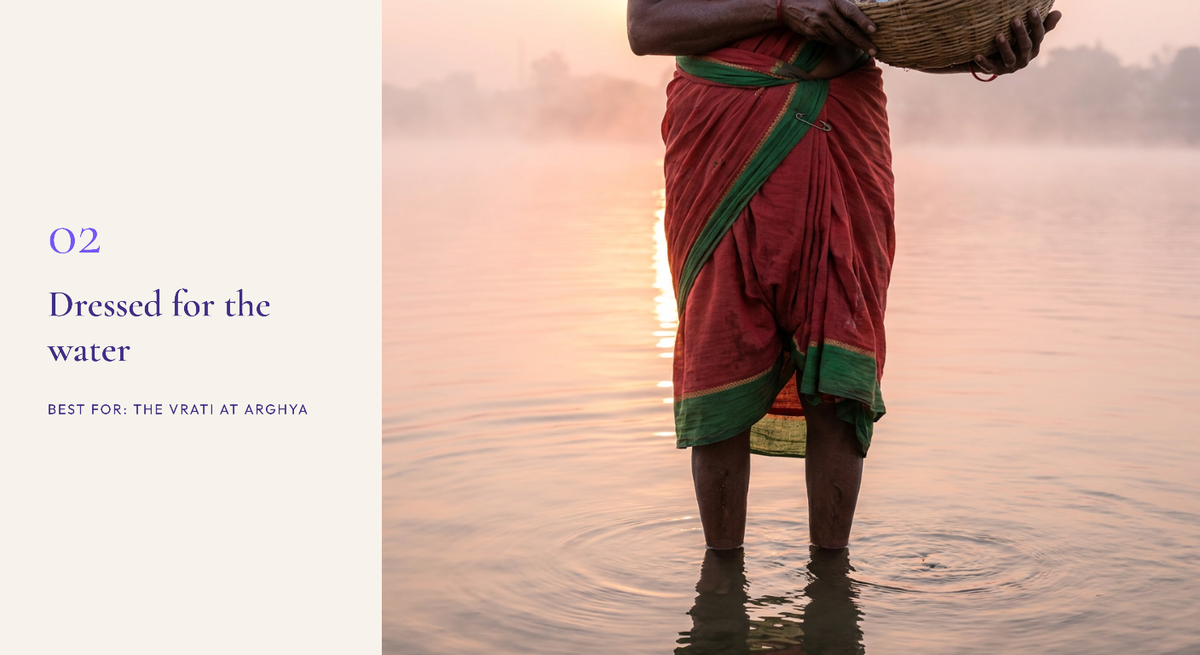
The vrati stands knee-deep or waist-deep in water (Shubh Panchang) for the arghya, sometimes for a long stretch, then walks back through a crowd in wet clothes. That changes the fabric choice more than any trend.
- Cotton and cotton-silk are the practical picks. Pernia's Pop-Up Shop describes cotton sarees like Chanderi as ideal for daytime rituals, and Aza advises fabrics that breathe because you stand for long hours. Cotton dries faster than a heavy silk and is gentler on skin that has been wet and cold.
- Keep heavy zari and embellishment for the walk, not the water. Aza's guidance is restrained embellishment and dressing that moves well in water, wind and long hours. Metallic zari may dull after river water and is slow to dry. If you want to wear a Banarasi silk, one option is to wear it for the evening at home and change into a cotton saree for the ghat.
- Pin the pleats higher than usual. Before stepping in, tuck the pleats firmly and secure them with two safety pins on the inside, so the hem sits around the ankle instead of the floor. A wet hem drags and pulls the drape loose. Pin the pallu at the shoulder too, because both hands will be holding the soop. Our step-by-step nivi drape guide shows where the pins go.
- Choose a fresh or freshly washed saree. Purity runs through every part of Chhath, from cleaning the kitchen to cooking only in brass, copper or earthen vessels (Shubh Panchang). Whether the vrati wears a brand-new saree is a family custom, so ask; if not new, wear one that has been freshly washed and kept aside for the puja.

Want this styled from your own closet?
Elara builds the look from what you own, then lets you try it on.
- Skip anything that turns see-through when wet. Very thin cotton voile or a light chiffon can become transparent in water. A slightly heavier cotton, or a matching cotton petticoat, solves it.
What men and family members wear
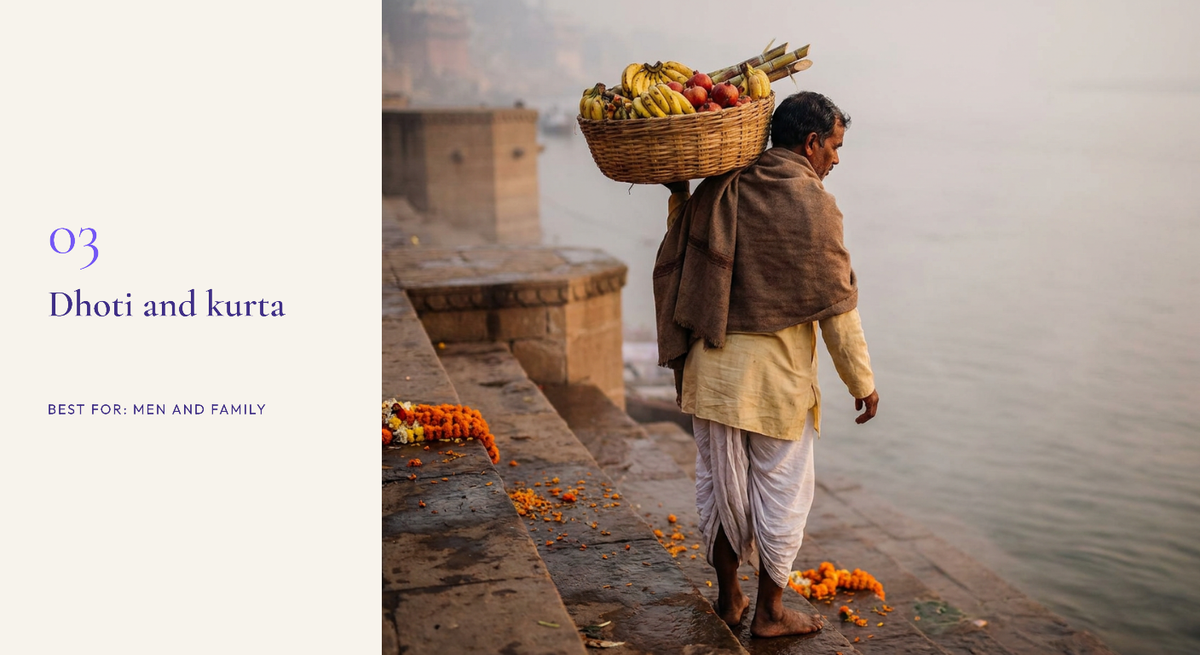
Pernia's describes the typical men's outfit as a dhoti and kurta, sometimes with an angavastram over the shoulder, and notes that plain white cotton dhotis are common as a symbol of purity and simplicity. In Bihar and Jharkhand the dhoti is wrapped at the waist with the ends pleated and tucked at the back, which also keeps the cloth together when a male vrati or helper wades in.
For everyone else walking with the vrati:
- Wear something you can carry in. Family members carry the daura (the bamboo basket of offerings) on their heads or shoulders. Kurtas and suits with some ease across the shoulders work better than fitted festive wear.
- Stick to the warm palette. Red, yellow, orange or green kurtas and suits match the vrati and avoid the colours families skip.
- Leave delicate dupattas at home. A light cotton dupatta is easier than a long net one when the ghat is crowded and the wind picks up after sunset.
- Some devotees perform dandavat, prostrating along the route from home to the ghat (described in both Wikipedia's Chhath article and SmartPuja). If someone in your family does this, they need sturdy cotton they do not mind getting dusty, and you will be walking slowly beside them.
The ghat-day bag: what to pack for the vrati
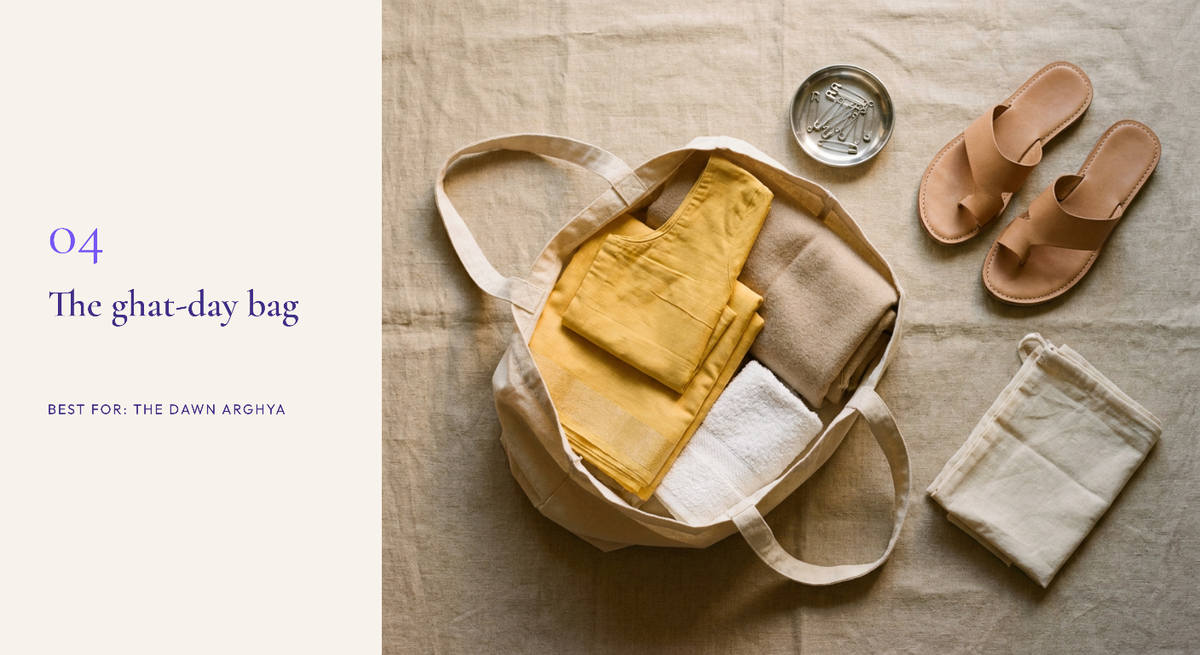
Many clothing problems at Chhath happen after the arghya, not before it. A small bag solves them:
- A full dry change: saree or suit, blouse, petticoat and innerwear. Change as soon as you are out of the water, especially after the dawn arghya.
- A warm shawl or stole. Hindutone's one piece of dress advice for the Monday dawn is a warm shawl. Wool or a thick cotton-blend shawl over the shoulders keeps you warm while you wait for the sun.
- A small towel to dry your feet and legs before you change.
- Safety pins, a spare set.
- Slip-on footwear you can leave on the bank and step back into with wet feet.
- A plastic or cloth bag for wet clothes, so the rest of the bag stays dry.
- A light jacket for children and elders for the early walk, since the morning arghya means leaving home before sunrise.
If you are celebrating outside Bihar, in Delhi, Mumbai, Kolkata, Kathmandu or abroad (Wikipedia notes Chhath is observed by the diaspora in the United States, Australia, Singapore, Malaysia and the UAE), the ghat may be a lake, a beach such as Juhu or a temporary pond. The same rules apply. For colder cities, a thermal layer under a cotton suit is invisible and makes the dawn wait much easier; our guide to staying warm in a saree or lehenga has the layering details.
Caring for Chhath sarees afterwards
River and pond water can leave silt in fabric. Rinse the vrati's saree in clean water the same day rather than leaving it balled up in a bag, then wash as the label says. Dry silk and zari pieces in the shade, flat or on a wide hanger, and only store them once fully dry, folded in muslin, so damp does not set into the folds.
FAQ
When is Chhath Puja in 2026?
The main day, Sandhya Arghya, is Sunday 15 November 2026, according to Drik Panchang. The festival starts with Nahay Khay on Friday 13 November and ends with Usha Arghya on Monday 16 November.
Which colour should I wear for Chhath Puja?
Red, maroon, yellow, orange and green are the colours most often worn, linked to sindoor, the sun and the harvest. Black, blue and grey are traditionally avoided by vratis.
Can I wear a silk saree for Chhath Puja?
Yes. Because you stand in water, a lighter cotton or cotton-silk is more practical for the ghat itself, and heavy zari is best kept out of the water, so many people save the silk for the evening at home.
What do men wear for Chhath Puja?
Typically a cotton dhoti and kurta, often plain white, sometimes with an angavastram. Family members can wear simple kurtas in warm colours that leave room to carry the daura.
Do I need new clothes for Chhath?
It depends on your family's custom. If you are not buying new, wear clothes that are freshly washed and kept aside for the festival, in keeping with the purity the puja asks for.
What should I carry to the ghat for the morning arghya?
A full dry change of clothes, a warm shawl, a small towel, spare safety pins, slip-on footwear and a bag for wet clothes.
Plan the whole family's Chhath outfits in one place
If you are dressing a vrati, the kids and yourself across four days, Elara helps you plan it from what is already in your wardrobe: save each outfit to the right day in the Calendar, check colours work together, and see which pieces you actually need to buy. Try Elara free for 14 days.
Your stylist, in your pocket
Stop reading about outfits. Start wearing them.
Elara knows your closet, shops every store and gets you dressed for any occasion.