Does Virtual Try-On Work for All Body Types? What Actually Changes With Plus-Size and Non-Standard Sizing
Virtual try-on doesn’t perform equally across every body type. This guide explains why older AR-based tools struggled outside standard sizing, how modern photo-based AI has genuinely closed much of that gap, and what real limitations still remain today.

Does Virtual Try-On Work for All Body Types? What Actually Changes With Plus-Size and Non-Standard Sizing
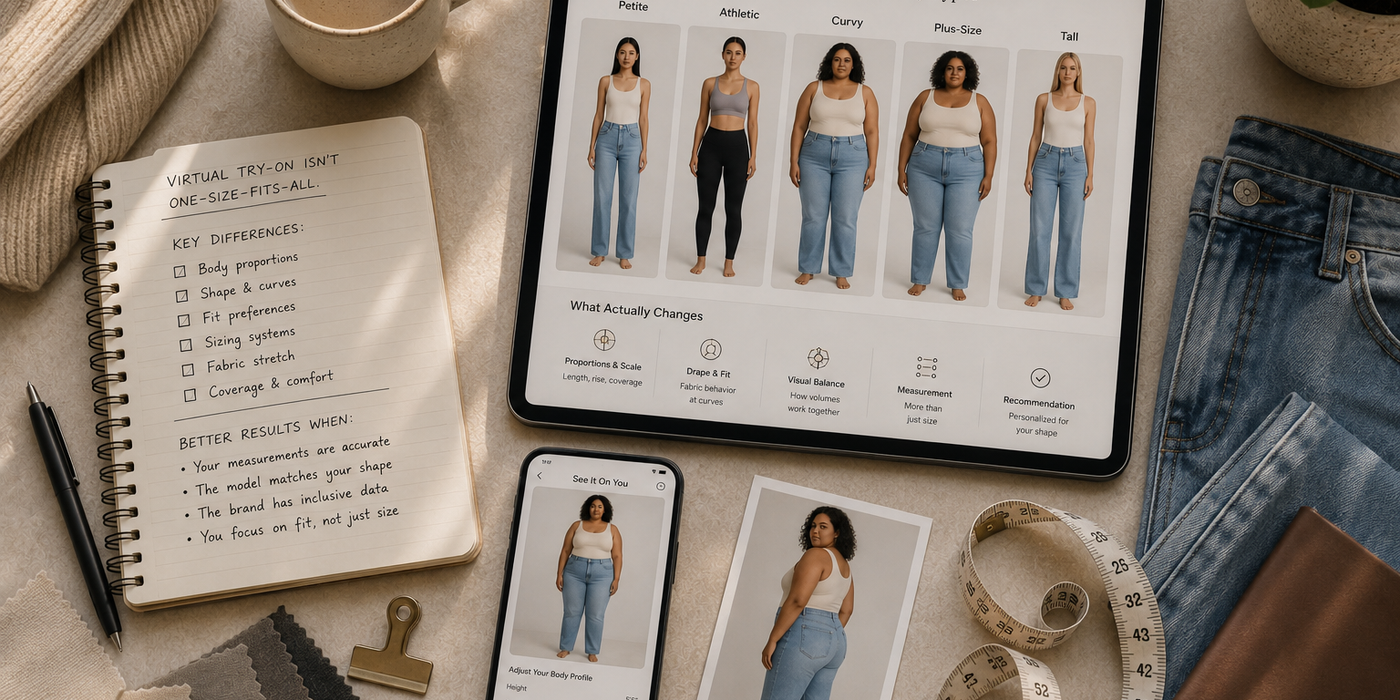
Most virtual try-on demos look the same: a slim, standard-size model, lit perfectly, wearing a garment that drapes exactly how the brand intended. It’s a convincing showcase. It’s also not representative of most shoppers. The real question isn’t whether virtual try-on works. It’s whether it works for you, specifically, if your body doesn’t match the narrow range most of this technology was originally built and trained around.
The honest answer is that it depends heavily on which type of tool you’re using, and the gap between the best and worst options here is bigger than in almost any other part of this technology.
The Representation Gap Behind the Question
This isn’t a small edge case. Roughly two out of three American women wear a size 14 or above, yet the overwhelming majority of fashion product imagery still features straight-size models. That mismatch is the entire reason this question gets asked as often as it does. Shoppers outside the standard sample-size range have spent years scrolling through product pages modeled on bodies that don’t resemble their own, left to guess how a garment will actually translate onto their frame.
Virtual try-on was supposed to close that gap by letting you see the garment on your own body instead of someone else’s. Whether it actually delivers on that depends on how the specific tool was built.
Why Older Systems Struggled Outside Standard Sizing
Early try-on technology, particularly AR-based systems built around a generic 3D avatar or a fixed set of body templates, was trained primarily on a narrow range of body shapes. That’s not a controversial statement, it’s a direct consequence of what data these systems were built on. If the underlying model has seen mostly standard-size bodies during development, it’s naturally going to render standard-size bodies more accurately, and produce less reliable results for anyone whose proportions fall outside that range.
This shows up in a few consistent ways:
● Garments that visually “snap” back toward a standard silhouette instead of accurately reflecting the shopper’s actual shape
● Less accurate handling of how fabric drapes and gathers across fuller or non-standard proportions
● Sizing overlays that were designed around one body template and stretched, rather than genuinely adapted
None of this means the technology was unusable. It means it was inconsistent, and that inconsistency landed hardest on exactly the shoppers who needed the tool most.
Why Photo-Based AI Has Genuinely Improved This
The meaningful shift in the last few years has come from photo-based rendering, tools that map a garment onto your actual uploaded photo rather than projecting your selection onto a generic avatar or fixed set of model bodies. This matters specifically for the body-type question, because the AI is working from your real proportions as the starting point, not adapting a one-size-template after the fact.
That’s a structurally different approach, and it’s why photo-based systems have generally closed more of the representation gap than earlier AR or avatar-based tools. The AI isn’t guessing at how your shape differs from a standard model. It’s building the render directly from what your photo actually shows.
This doesn’t mean every photo-based tool performs identically well across every body type. Model quality still varies by provider, and some systems remain better trained on a wider range of proportions than others. But the underlying method itself is a genuine step forward for anyone outside the standard sizing range, not just a marketing claim attached to it.
What Still Affects Accuracy, Regardless of Body Type
The same fundamentals that affect any virtual try-on result apply here too, and they matter more, not less, when a system is already working with less training data for your body type.
Ready to upgrade your wardrobe?
Get the Elara app for AI-powered styling and virtual try-ons.
● A full-body, front-facing photo gives the AI a complete, undistorted read of your actual proportions
● Even, natural lighting avoids shadows that can be misread as body contours that aren’t really there
● Fitted clothing in your base photo shows your real shape, rather than obscuring it under something loose
● A plain background reduces the chances of the system misreading where your body ends and the surroundings begin
For a full breakdown of how to optimize each of these, the fundamentals are the same ones covered in “getting better virtual try-on results generally”. They just matter with less margin for error here.
The Honest Limitation That Remains
Even the best photo-based systems today still can’t fully solve every part of this. Fabric behavior, how a garment stretches, gathers, or moves across different body shapes, remains one of the hardest problems in the entire category, and that difficulty doesn’t disappear just because the rendering starts from your actual photo.
A stretch fabric on a curvier frame behaves differently than the same fabric on a straight-size frame, and no current virtual try-on tool fully simulates that physical behavior yet. It’s an active area of development across the industry, not a solved problem.
This is also where a tool built around your own photo, rather than a generic model, tends to hold up better simply because it isn’t starting from an inaccurate baseline. Elara’s approach uses your actual photo for this reason, so the starting point for every preview is your real body, not an approximation of it.
Frequently Asked Questions
Q1. Is virtual try-on less accurate for plus-size shoppers?
It depends on the tool. Older AR or avatar-based systems have historically struggled more here, while modern photo-based tools that map to your actual photo tend to perform more consistently, since they aren’t starting from a generic template.
Q2. Why do some virtual try-on results look better on standard-size bodies than others?
Many systems were originally trained on a narrower range of body shapes, which made rendering more reliable for that range and less reliable outside it. This is improving as photo-based, real-image approaches become more common.
Q3. Does a better photo help if a tool struggles with my body type?
Yes. A clear, full-body, front-facing photo in good lighting gives any tool a more accurate starting point, which matters even more for body types the underlying model has less training data on.
The Practical Takeaway for Shoppers
Virtual try-on’s usefulness for your specific body type isn’t a fixed fact about the technology; it’s a fact about which version of the technology you’re using. Older, avatar-based systems built around a narrow range of standard bodies have genuinely struggled here. Photo-based tools that start from your actual image have closed a meaningful part of that gap, without fully solving the hardest remaining problem: accurately simulating how fabric behaves across different body shapes.
That’s worth knowing going in, so you can judge a result for what it actually shows you, rather than assuming every tool in this category performs the same way.
To see how body-type matching fits into the full shopping experience, read our “complete guide to virtual try-on clothes before buying online”.

Your AI Stylist is Here.
live on the App Store & Google Play
Available on iOS and Android for seamless access anytime, anywhere.