Virtual Try On Clothes Before Buying Online: Complete Guide 2026
Virtual try-on lets you see how clothes look on your actual body before buying, backed by real conversion and return-rate data from Zalando and DressX. Here's what it can genuinely do, what it still can't, and how to use it wisely in 2026

Virtual Try On Clothes Before Buying Online: Complete Guide 2026
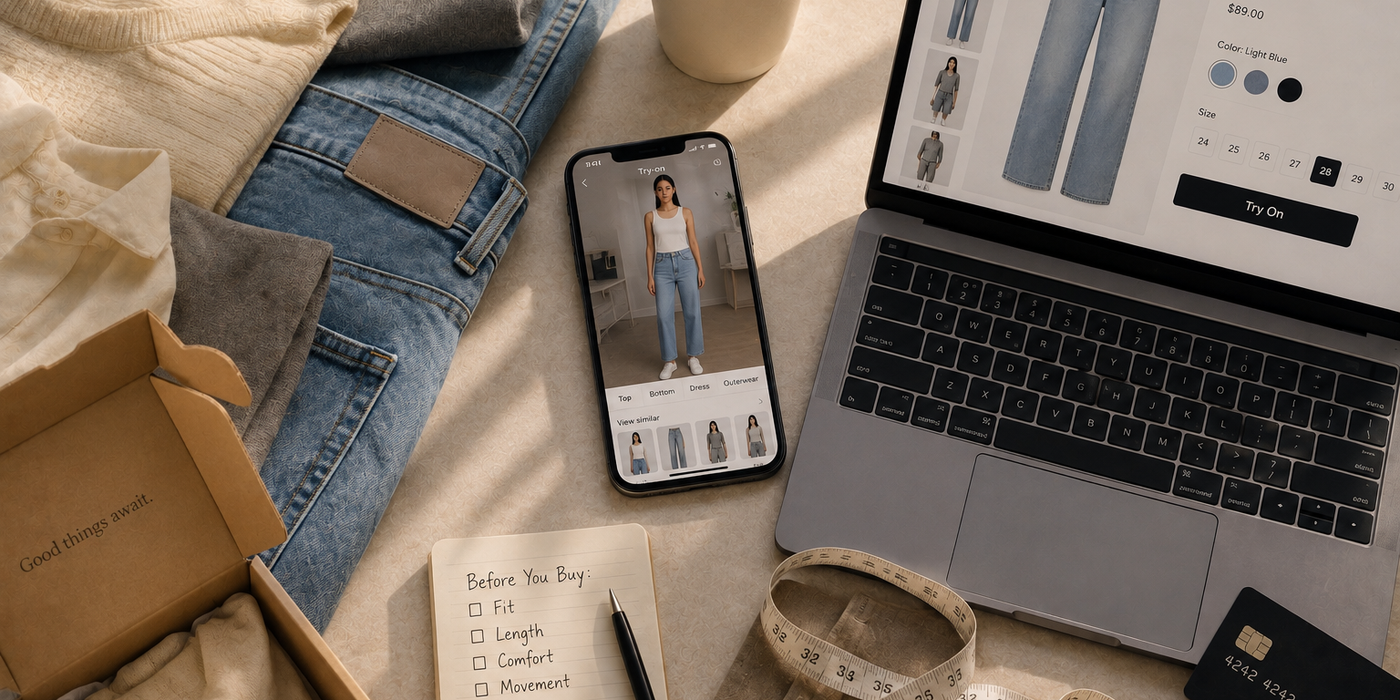
There's a specific kind of hesitation that happens right before you click "buy" on a piece of clothing you've never touched. You've read the description twice, zoomed into the product photo, maybe even opened the size chart in a new tab. And still, some part of you knows you're guessing. That hesitation isn't indecision. It's your instincts correctly identifying that a flat photo on a screen can't tell you what a garment will actually look like on your particular body.
Online retail has lived with this gap for many years, and it's cost everyone involved: shoppers who end up returning things that "looked fine in the photo," and retailers absorbing the cost of shipping, restocking, and processing those returns at scale. Virtual try on is the first technology that meaningfully closes that gap, not by making product photography better, but by putting the garment on your actual body before you spend a dollar.
This guide walks through what the technology actually does, where it genuinely helps, where it still falls short, and how to think about it as one part of a smarter shopping decision rather than the whole answer.
Key Takeaways
● Shoppers who use virtual try on are about 50% more likely to complete a purchase and view nearly 7 times more product listings than those who don't.
● Zalando reported a 40% drop in returns during an early virtual try on pilot with Levi's, a real result from a live commercial test.
● Virtual try on is genuinely strong at showing color, silhouette, and overall fit. It's not yet reliable for confirming exact size, fabric feel, or how a garment moves.
● The technology has matured fast, but it still hasn't reached most online stores, so there's a real gap between how useful it's proven to be and how available it actually is.
● The more valuable question isn't how something looks on you. It's whether it actually belongs in the wardrobe you already own, and that's a question a render alone can't answer.
The Problem Virtual Try On Was Actually Built to Solve
Think about the last few times online shopping frustrated you. Ordering the same jacket in two sizes because you couldn't be sure which one would fit. Scrolling past a dozen nearly identical pairs of black trousers with no real way to tell them apart. Standing in front of a closet that's genuinely full and still feeling like you have nothing to wear.
None of that is a personal failing. It's the predictable result of a structural problem: a product photo, however well lit and well styled, can't show you how a garment interacts with your specific body, and no amount of clever copywriting closes that gap.
The evidence that virtual try on actually addresses this holds up better than most retail technology claims do. According to DressX's 2026 AI Virtual Try On Report, drawn from 1.2M shoppers across luxury fashion ecommerce, people who used virtual try on were about 50% more likely to complete a purchase, roughly 3 times more likely to add items to their cart, and viewed close to 7 times as many product listings as shoppers who never used it. Business of Fashion independently reported that same 50% purchase lift, and noted the effect was even stronger among luxury shoppers specifically.
Most coverage of this technology stops at "try before you buy" and treats it purely as a confidence booster at checkout. That undersells what it's actually capable of. Used well, virtual try on can help answer a bigger question than how something will look on you. It can help answer whether you actually need it at all, provided the tool is built to check a new item against the wardrobe you already own rather than showing you a garment in isolation. That deeper use is where Elara has focused its entire product, rather than treating the render as the finish line.
How Virtual Try On Actually Works
Virtual try on uses AI, and in some cases augmented reality, to digitally place a garment onto a photo or a live camera feed, simulating how it would look on a specific body before you buy it. The underlying methods, body landmark detection, generative image synthesis, and computer vision, have improved dramatically over the last few years, which is why the category has moved from novelty to genuinely useful in a relatively short window.
Three approaches are in active use today, each with a different tradeoff between accuracy and convenience.
1. Photo Based AI Rendering
You upload a static photo, and the AI maps the chosen garment onto your body shape while adjusting for pose and proportion. This is the most common and accessible format, since it needs no special hardware and often doesn't even require an account. Elara uses this approach, paired with a browser extension that works across most online stores rather than locking you into one closed catalog.
2. 3D Modeling
This method builds a 3D avatar or uses a body scan to give a more spatially accurate sense of how a garment drapes and moves. It's genuinely better at conveying silhouette than a flat photo render, but it typically requires more upfront setup, which is likely why it hasn't become the default despite the accuracy advantage.
3. Live AR Overlay
A real time camera feed that moves with you as you turn or shift. This has long been the standard for trying on glasses and jewelry, and it's steadily expanding into apparel, particularly simpler garments like tops and outerwear where movement matters less to how the piece reads.
Google's generative AI try on inside Google Shopping is one of the clearest signals that this technology has reached the mainstream. It lets shoppers preview a garment on a range of body types directly from the search results, before they've even clicked through to a retailer's site.
What Virtual Try On Can and Can't Actually Tell You
This is the section most coverage glosses over, and it's the one that actually determines how much weight you should put on any given preview.
What it reliably shows you:
● Overall visual appearance and general fit
● Silhouette and proportion
● Color, including how a shade reads against your skin tone
● A reasonable sense of how a piece sits on your body shape at a glance
What it can't reliably tell you:
● Your exact size
● Precise body measurements
● Comfort
● How much a fabric stretches or gives
● Fabric weight, texture, and feel
● How the garment moves when you walk, sit, or reach overhead
● Construction quality, stitching, and finish
The core issue is simple once you see it: looking like it fits and actually fitting are two different things. A render can convincingly map a garment's shape onto your silhouette while completely missing the details that determine whether you'll want to keep wearing it six hours later. Fabric behavior and construction quality sit outside what any current visual rendering system is designed to simulate.
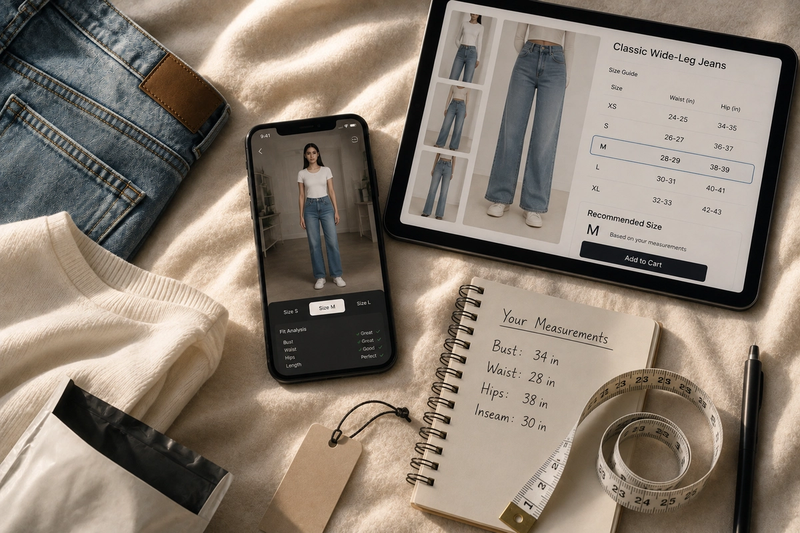
Sizing itself is also genuinely hard to predict online for reasons that have nothing to do with rendering technology. Brands cut differently from one another. A medium at one label isn't the same as a medium at another. Fabric composition changes how a piece drapes and stretches over time. And intended fit varies by design, since an oversized silhouette is supposed to sit loose while a tailored one is supposed to sit close. Virtual try on can show you the visual result once you've picked a size, but it can't reverse engineer the correct size for you from nothing.
Ready to upgrade your wardrobe?
Get the Elara app for AI-powered styling and virtual try-ons.
For a deeper breakdown of sizing mechanics, read our complete analysis on “Can Virtual Try-On Tell You What Size to Buy? What It Can and Can't Predict”.
The smartest way to use it is as one input among several, not the whole decision. Pair it with the brand's actual size chart and real reviews that mention fit, and you get a genuinely more complete picture than any single source gives you alone.
How Accurate Is Virtual Try On, Really
The behavioral evidence here is strong, and it's worth separating from the marketing noise that surrounds this category.
Zalando, Europe's largest fashion platform, reported close to a 40% reduction in returns during an early virtual try on pilot with Levi's garments, run across multiple European markets. That's a real outcome from a live commercial test, not a modeled projection. Zalando itself has been upfront that a single pilot needs a larger sample before that number becomes a stable industry benchmark, and that caution is worth keeping in mind rather than treating the figure as settled fact.
Some numbers in this space deserve more skepticism. Broader industry claims about return rate reductions commonly land somewhere between 20% and 40%, but that range shifts significantly by retailer and product category, and a fair number of the loudest sources publishing those figures are companies selling the exact technology being measured. Market size projections for the category vary just as widely between research firms, anywhere from the low tens of billions to well over a hundred billion dollars by the early 2030s. That spread says more about how young and inconsistent this research space still is than it does about any single dependable estimate.
What actually holds up under real scrutiny is simpler than any headline number: people shop more confidently, and more often, once they can genuinely see themselves in a garment before buying it. That finding survives independent checking. The exact percentage attached to returns or market size depends heavily on who's telling you, and it's worth reading those numbers with that in mind.
Where You Can Actually Try This Right Now
Access Type How It Works Best Suited For Free retailer tools Platforms like Amazon's virtual try on for fashion embed photo based rendering directly into product pages Casual shoppers testing the idea without committing to a new app Google Shopping's built in try on Search a clothing item and look for the try on option; Google renders it across a range of body types right in the results Shoppers who start browsing on Google before landing on a specific store Wardrobe aware AI stylists, like Elara A browser extension checks products against your existing closet while you shop any store, then previews genuinely new items on your own photo Shoppers who want the preview and the buying decision handled together, not as separate steps Standalone try on apps Dedicated apps focused specifically on the render itself, usually limited to their own catalog People who mainly want a quick, isolated fitting room experience Open source models on HuggingFace Diffusion based garment transfer repositories built for experimentation Developers comfortable with Python who want to understand the mechanics firsthand
How to Choose the Right Tool for You
Not every virtual try on tool is solving the same problem, so it's worth matching the tool to what you're actually trying to accomplish.
- Check what it covers: Some tools are locked to a single retailer's catalog. Others, particularly browser based extensions, work across any store you're already shopping on, which matters if you shop across multiple brands.
- Check How It Handles Your Photo: A reputable tool states clearly whether your photo is stored, for how long, and whether it's used for anything beyond generating your own preview.
- Test It With Clothes You Own: If you have the exact garment in real life, try it virtually first. That's the fastest way to judge how trustworthy a given tool's rendering really is before you rely on it for something new.
- See If It Goes Beyond the Preview: A preview alone only answers how something looks. Fewer tools go further and actually check whether the piece makes sense against what's already sitting in your closet.
- Make Sure It Uses Your Actual Body: Results are strongest with tools built around your actual uploaded photo rather than projecting your selection onto a generic model shape.
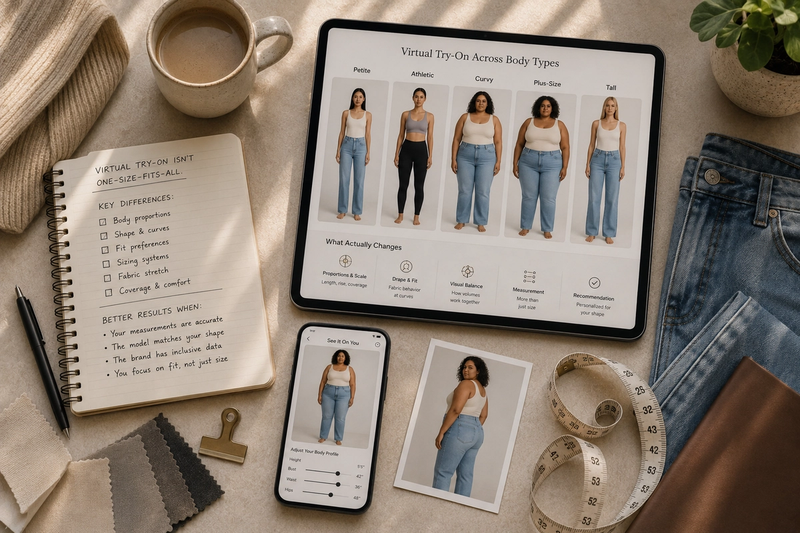
Read our detailed study on “Does Virtual Try-On Work for All Body Types? What Actually Changes With Plus-Size and Non-Standard Sizing” to see how photo based models handle diverse body shapes.
Why Seeing One Item Isn't the Whole Decision
Most coverage of this technology frames it as a pre-purchase safety net, something that reduces the risk of returning an item you've already mentally committed to buying. But the more useful question sits earlier than that: does this piece actually work with what you already own?
The familiar feeling of standing in front of a genuinely full closet and still feeling like you have nothing to wear is rarely a quantity problem. It's a visibility problem. Most people can't easily picture how a new blouse connects to the trousers already hanging a few feet away, or whether a new coat fills a real gap in their wardrobe or just quietly duplicates one bought the winter before. A render alone can't answer that. It shows you the item in isolation, disconnected from everything else you own.
Virtual Try On vs. Wardrobe Aware AI Styling
A standard try on app answers one narrow question: how will this look on me. A wardrobe aware AI stylist answers a broader one: does this actually make sense for my wardrobe, my budget, and my style, with the visual preview functioning as one part of that answer rather than the entire product.
Standard Try On App Wardrobe Aware AI Stylist Core question it answers How will this look on me? Does this make sense for what I already own? Catalog access Usually limited to one app or retailer Works across most stores you already shop Checks against your existing closet No Yes Improves its guidance over time Rarely Yes, based on what you actually keep and return
How Elara Approaches Virtual Try On
Rather than treating try on as a standalone checkout feature, Elara works as an AI stylist that already understands your existing wardrobe before it ever renders a new piece onto your body.
- You photograph the clothes you already own, once, and Elara automatically tags category, color, fabric, and occasion.
- While you're browsing any store with the Elara extension active, it checks whether a product overlaps with something already sitting in your closet, before it ever reaches your cart.
- If the piece is genuinely new to your wardrobe, you preview it on your own photo, on the actual store you're shopping from, rather than being confined to one app's internal catalog.
- Over time, Elara learns what you tend to keep versus what you end up returning, so its guidance sharpens naturally instead of relying on a single style quiz you answered once and never revisited.
This is built around a different goal than producing a convincing image. It's aimed at reducing decision fatigue and unnecessary spending by connecting the preview to the wardrobe you actually have, not just showing you a flattering picture of something new.
Frequently Asked Questions
Q1. Why does my virtual try on result sometimes look distorted or unrealistic?
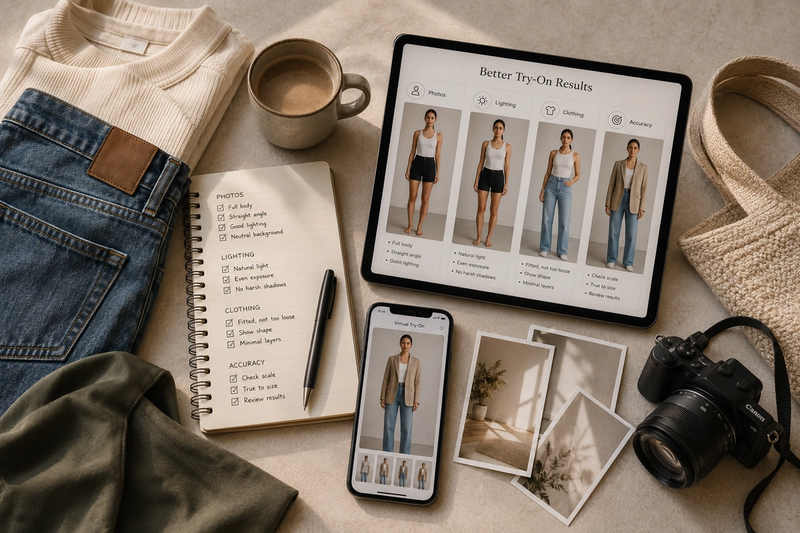
Rendering quality depends heavily on your input photo. Poor lighting, an angled pose, baggy clothing in the original image, or a cluttered background can all confuse body landmark detection. A full body, front facing photo taken in natural light produces noticeably better results across every tool in this category.
Explore our “step by step guide to optimizing try on photos, lighting, and poses” to eliminate distorted visual renders.
Q2. Is there a virtual try on tool that works across any store, not just one app's catalog?
Yes, though it's the exception rather than the rule. Most standalone apps limit you to items already loaded into their own system. Browser based tools attach directly to whatever store page you're already on, so they aren't restricted to a closed catalog.
Q3. Can AI virtual try on actually replace trying clothes on in person?
Not fully, at least not yet. It's genuinely good at showing color, general silhouette, and overall styling before you buy, but it still can't replicate how a fabric physically feels or drapes in motion, or guarantee an exact size match. Think of it as a strong filter against a bad purchase, not a full replacement for physically trying something on.
The Real Question Underneath All of This
Virtual try on solves a real problem, and it solves it well enough that the shift in shopping behavior behind it is genuinely measurable, not just a marketing story. It answers "how might this look on me" more convincingly than anything that came before it.
But that was never actually the hardest question. The harder one, the one most tools never get around to asking, is whether the piece you're looking at belongs anywhere near the life you're already living and the closet you've already built. A great render on a garment that duplicates something you own, or clashes with everything else in your wardrobe, is still a bad purchase, just one that looks convincing right up until it arrives.
That's the gap worth paying attention to as this technology keeps maturing. Not whether the preview gets sharper, but whether it starts connecting to something more than the single item on screen.

Your AI Stylist is Here.
live on the App Store & Google Play
Available on iOS and Android for seamless access anytime, anywhere.