Virtual Clothes Try On: Accuracy Guide for 2026
Virtual clothes try on has grown from $12.09B to $15.29B in 2026, delivering 94% higher conversion rates. Learn what VTO gets right, where it falls short, and why wardrobe-integrated AI is the next frontier.


How Accurate Is Virtual Try-On in 2026? What It Gets Right and Wrong
Table of Contents
- Introduction: Virtual Try-On Has Grown Up — But Has It Grown Accurate?
- What Virtual Try-On Actually Does in 2026 (And How It Works)
- What Virtual Try-On Gets Right in 2026
- Where Virtual Try-On Still Falls Short
- The Adoption Paradox: Why 94% Conversion Lifts Haven't Moved the Needle
- The Next Frontier: Wardrobe-Integrated Virtual Try-On
- FAQ: Your Questions About Virtual Try-On Accuracy and Wardrobe Integration
- Conclusion: Accurate Enough to Matter — But Context Is Everything
Key Takeaways
- The global virtual try-on market reached $15.29 billion in 2026, growing at a 26.5% CAGR from $12.09 billion in 2025 (The Business Research Company; Research and Markets)
- VTO drives up to 94% higher conversion rates (Shopify) — yet only ~1% of ecommerce businesses have adopted it, despite proven return rate reductions of 25–40%
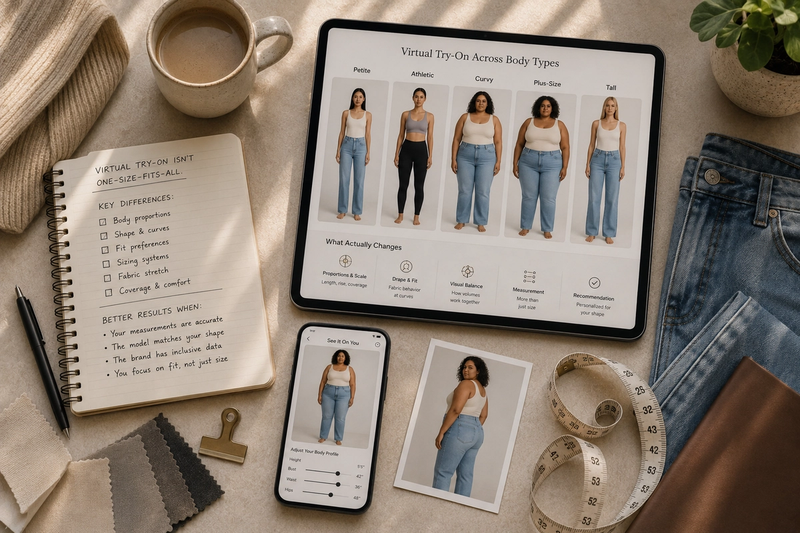
- Current VTO excels at color rendering and silhouette matching but still struggles with fabric drape, texture realism, and body-edge precision
- The biggest accuracy gap isn't visual — it's contextual: almost no VTO tool accounts for what's already in your wardrobe
- Wardrobe-first AI approaches directly target this gap, combining try-on with personalized wardrobe intelligence
Introduction: Virtual Try-On Has Grown Up — But Has It Grown Accurate?
The virtual try-on market grew from $12.09 billion in 2025 to $15.29 billion in 2026 at a 26.5% CAGR, according to The Business Research Company and Research and Markets. That's not a fringe feature scaling quietly — that's a technology reshaping how fashion is bought and sold at commercial speed.
The business case is compelling. According to dlook.app and Forbes, VTO users experience a 10-fold increase in conversion rates and a 48% reduction in return rates. For any retailer watching margin erode under a tide of free returns, those numbers demand attention. Yet the central question most retailers and shoppers still can't answer confidently is whether virtual try-on is actually accurate enough to replace the fitting room — or whether it remains a visually impressive feature that breaks down the moment you need a real decision.
That question matters to a large and growing audience. Roughly 50% of U.S. online shoppers express interest in virtual try-on, according to The Interline. This article examines what the technology genuinely gets right in 2026, where it still falls short, why adoption has stalled despite extraordinary results, and what wardrobe-integrated AI changes about the entire equation.
What Virtual Try-On Actually Does in 2026 (And How It Works)
Virtual try-on in 2026 runs on three distinct modalities, each with different underlying mechanics and use cases. The first is AR overlay, used by platforms like Google and Amazon, which maps a garment onto a live camera feed or static image using skeletal tracking and body segmentation. The second is AI photo synthesis — the approach behind tools like Kolors virtual try-on and DressX — where generative diffusion models composite a garment directly onto a user's uploaded photo, producing a photorealistic render without any 3D asset. The third is avatar and body-scan-based fitting, where a digital twin built from measurements or a body scan wears the garment in a simulated environment.
The infrastructure behind all three has matured significantly. AI and ML-driven technologies now account for 45.8% of virtual try-on market share, according to The Business Research Company, and cloud-based SaaS platforms capture 69% of revenue, per Research and Markets. That concentration in cloud delivery matters: it means try-on increasingly runs in-browser, with no app installation required, on any device a shopper happens to be using.
The most consequential shift is what generative AI did to the cost structure. As ecommboardroom.com notes, "Generative AI is finally making Virtual Try-On accessible, accurate, and highly effective for independent brands, removing the need for enterprise IT budgets." Before diffusion models, producing a photorealistic garment render required expensive 3D modeling, lighting rigs, and per-SKU asset creation. Generative AI replaced that pipeline with a model that learns fabric behavior, body geometry, and lighting from training data — then applies that understanding automatically to any new garment photo.
Think of it as Photoshop that understands your body shape and the physics of fabric — automatically. The practical result is that a boutique with 200 SKUs can now offer the same virtual clothes try-on quality that, three years ago, only a brand with an enterprise technology budget could deploy.
What Virtual Try-On Gets Right in 2026
That democratization of quality has a measurable payoff. According to Forbes and DressX, consumers using modern virtual try-on tools gain up to 89% confidence in fit — a figure that would have been implausible three years ago when the technology still produced waxy, unconvincing overlays.
Three specific capabilities drive that confidence. First, color and pattern rendering: generative AI now faithfully reproduces floral prints, gradient dyes, and bold colorways across a full range of skin tones, eliminating the washed-out or oversaturated results that plagued earlier AR overlays. Second, silhouette and proportion matching: body-type-aware models have become accurate enough to correctly predict how an oversized blazer pools at the shoulder versus how a fitted midi dress tracks the waist — distinctions that matter enormously to purchase decisions. Third, speed and accessibility: WebAR and cloud SaaS delivery mean virtual clothes try-on now runs in-browser, on any device, with no app download required.
The practical experience looks like this: a shopper selects a floral midi dress on a brand's site, uploads a single photo, and within seconds sees a photorealistic render of herself wearing it — color accurate, size-adjusted, and shareable to a group chat for a second opinion. That social sharing loop compounds confidence in ways a static product photo never could.
These accuracy gains translate directly into revenue. Research and Markets and genlook.app data show a 35% increase in add-to-cart conversions for users who engage with try-on features. Customers who complete a virtual try-on convert at twice the rate of standard shoppers and add items to cart 52% more often, according to ecommboardroom.com. Accuracy, in other words, is no longer just a UX nicety — it's a measurable commercial lever.
Ready to upgrade your wardrobe?
Get the Elara app for AI-powered styling and virtual try-ons.
Where Virtual Try-On Still Falls Short
Honesty matters here, because the gap between what VTO promises and what it reliably delivers is exactly where merchant skepticism lives.
Four specific limitations define the current accuracy ceiling. Fabric drape and physics remain the hardest problem: lightweight chiffon billows differently than heavy denim, and structured blazers hold their shape through boning and interfacing that no flat-image synthesis model fully captures. Real-time fabric simulation is computationally expensive, and most commercial tools still apply averaged physics that flatten these distinctions.
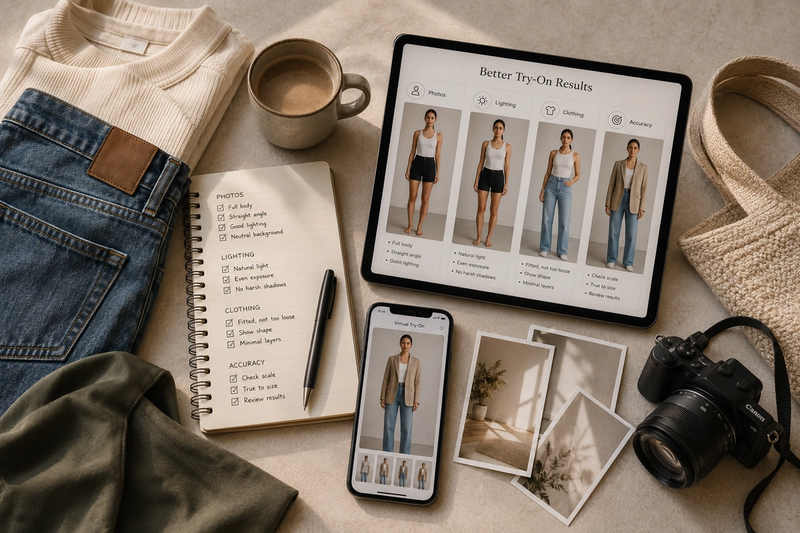
Body-edge precision is the second failure point. At the boundaries where garment meets body — necklines, armholes, hemlines — ghosting and misalignment appear, particularly when the source photo involves motion blur or complex backgrounds. The effect is subtle in a hero image but visible enough to erode trust.
Texture realism compounds this. Knitwear, leather, and bouclé fabrics lose nuance in flat-image synthesis. A cashmere sweater can render with the visual weight of cotton jersey, and a leather jacket may look more like a vinyl approximation. Shoppers who care about hand-feel and texture — which is most shoppers buying premium items — notice.
The fourth limitation is arguably the most consequential: context blindness. Almost no virtual clothes try-on tool asks what you already own. The garment appears in isolation, styled against a blank background or a generic lifestyle shot, with no reference to the three blazers or two pairs of trousers already hanging in the shopper's wardrobe. That isolation makes it genuinely hard to judge real-world wearability.
Even with virtual try-on in place, ecommboardroom.com data shows return rates drop by only 30–50% — meaning a substantial volume of returns persists, which implies accuracy gaps are still costing merchants money.
The ~1% ecommerce adoption rate cited by Research and Markets and Stytrix partly reflects merchant awareness of these limitations, not just cost anxiety. These are active engineering challenges — diffusion models are improving rapidly — but treating them as solved problems would be premature.
The Adoption Paradox: Why 94% Conversion Lifts Haven't Moved the Needle
Here is the number that should stop any ecommerce strategist mid-sentence: virtual try-on delivers up to 94% higher conversion rates (Shopify commerce data) — yet only ~1% of ecommerce businesses have deployed it (Research and Markets / Stytrix). Both statistics are current, both are well-sourced, and the gap between them is one of the stranger puzzles in retail technology right now.
Three barriers explain the disconnect, and none of them are primarily about the technology itself.
Cost and integration perception tops the list. Many mid-market merchants still associate VTO with enterprise IT projects — six-figure integrations, custom 3D asset pipelines, and dedicated engineering teams. That perception is increasingly outdated. According to ecommboardroom.com, "Generative AI is finally making Virtual Try-On accessible, accurate, and highly effective for independent brands, removing the need for enterprise IT budgets." The infrastructure has shifted: cloud-based SaaS platforms now capture 69% of VTO market revenue according to Research and Markets, which means the entry point has dropped dramatically. Merchant awareness simply hasn't caught up.
Attribution complexity is the second barrier. A shopper tries on a dress on mobile during lunch, closes the app, then converts on desktop that evening. Most analytics stacks can't cleanly credit the virtual clothes try-on interaction for that conversion, so the ROI case looks weak internally — even when the causal relationship is real. Marketing managers who can't prove impact to a CFO won't advocate for the budget.
Shallow implementation closes the loop. Brands that add VTO as a bolt-on widget — dropped onto a product page with no integration into recommendations, styling guidance, or post-purchase flows — see low engagement. Low engagement produces underwhelming lift numbers, which confirms the skeptic's prior that VTO "doesn't work."
The wardrobe-integration gap makes all three barriers worse. A virtual clothes try-on tool that shows a dress in isolation still leaves the shopper's core question unanswered: will this actually work with what I already own? Without that answer, the decision-making value of VTO is incomplete — and merchant confidence in ROI stays low. Platforms that combine try-on with wardrobe intelligence, knowing what a shopper already owns before suggesting what to buy, are beginning to close this gap. The market growth trajectory — from $15.29 billion in 2026 toward a projected $38.92 billion by 2030 — signals that investment is flowing toward exactly this more integrated model.
The Next Frontier: Wardrobe-Integrated Virtual Try-On
That gap — the inability to answer does this work with what I already own? — marks the boundary between first-generation virtual try-on and what's emerging now. Standalone garment visualization was a meaningful step forward. Wardrobe-aware, context-intelligent try-on is a different category entirely.
The distinction matters practically. A shopper who can see a burgundy trench coat rendered accurately on her body through virtual clothes try-on still faces the same question she'd face in a fitting room: does this coat work with the charcoal blazer, the three pairs of ankle boots, and the mostly-neutral wardrobe she's built over five years? VTO tools that operate without that context leave the hardest part of the decision unanswered. Wardrobe-integrated platforms solve this by grounding every suggestion in what a shopper already owns — turning try-on from a visualization tool into a genuine styling decision engine.
The sustainability case for this approach is compelling. According to ecommboardroom.com, virtual clothes try-on already reduces apparel return rates by 30–50%. Pair that with wardrobe intelligence that flags duplicate purchases and surfaces underused items, and the reduction in both returns and impulse buying compounds significantly — a meaningful contribution to reducing fashion's waste footprint.
Market investment is validating this direction. The global VTO market, valued at $15.29 billion in 2026, is projected to reach $38.92 billion by 2030 according to Research and Markets, with Asia-Pacific growing fastest at approximately 28% CAGR through 2030 per Grand View Research. That capital is flowing toward more integrated, personalized experiences — not better-looking widgets.
Wardrobe-first approaches reflect this logic directly: digitize your wardrobe first, then layer try-on and shopping recommendations on top — so every suggestion is grounded in what you already own, not just what the retailer wants to sell you next.
FAQ: Your Questions About Virtual Try-On Accuracy and Wardrobe Integration
Q: How accurate is virtual try-on really? Can I trust it to order the right size?
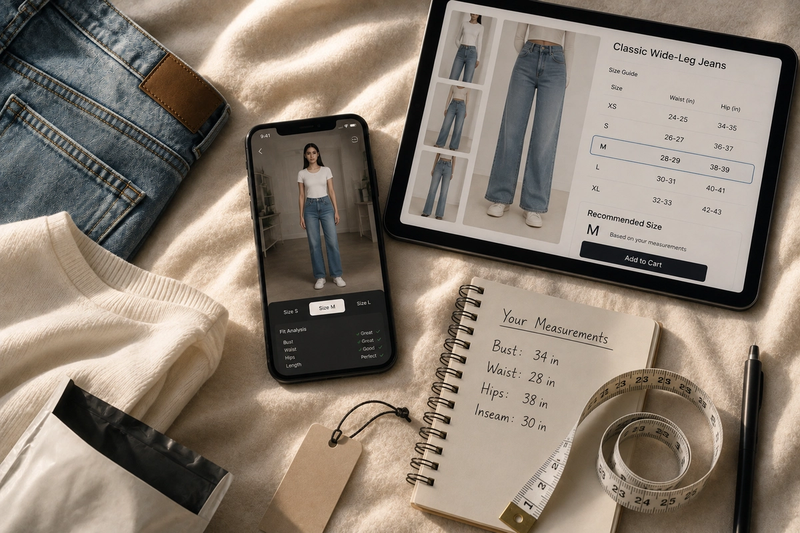
A: Modern virtual try-on excels at color accuracy and silhouette matching — you'll see how a garment actually drapes on your body type with reasonable precision. Conversion rates jump 94% for users who engage with try-on features (Shopify), and return rates drop 30–50% (ecommboardroom.com), which shows real decision-making value. The limitations are real though: fabric physics, texture detail, and body-edge precision still have room for improvement. The biggest gap is contextual — most VTO tools show you the garment in isolation, not how it works with what you already own. That's where wardrobe-integrated try-on makes the difference.
Q: If I upload a photo for virtual try-on, what happens to my image?
A: Cloud-based VTO platforms (which capture 69% of market revenue according to Research and Markets) process your photo server-side to generate the try-on render. Reputable platforms encrypt data in transit and at rest, and many allow you to delete uploaded photos immediately after the render is generated. Check the privacy policy of any tool you use — the best ones are transparent about data retention and give you control over your images.
Q: Does wardrobe-integrated virtual try-on actually reduce impulse buying?
A: Yes, measurably. When a virtual clothes try-on tool knows what you already own, it can flag duplicate purchases and show you how new pieces work with your existing wardrobe before you buy. This context-aware approach reduces both returns and impulse buying — ecommboardroom.com data shows virtual try-on alone cuts returns 30–50%, and wardrobe integration amplifies that by eliminating purchases that don't actually work with your closet. The sustainability impact compounds: fewer returns and impulse buys means less fashion waste.
Conclusion: Accurate Enough to Matter — But Context Is Everything
Virtual try-on in 2026 delivers genuine accuracy where it counts most — color rendering, silhouette proportion, and size-adjusted fit — while still falling short on fabric physics, texture nuance, and body-edge precision. That's an honest verdict. But the more useful frame isn't whether virtual clothes try-on achieves pixel perfection. It's whether it gives shoppers enough confidence to make better decisions.
The data says yes. According to Shopify, products with AR or virtual try-on experiences see up to 94% higher conversion rates. Users who complete a virtual clothes try-on convert at twice the rate of standard shoppers, and a 48% reduction in return rates has been documented by Forbes and dlook.app. These aren't marginal improvements — they're structural shifts in how purchase decisions get made.
The adoption paradox — only approximately 1% of ecommerce businesses using a tool that delivers those results, according to Research and Markets — will resolve as SaaS costs continue dropping and wardrobe-integrated platforms replace bolt-on widgets. The technology maturity is already there. What's catching up is the implementation model.
Want to see how wardrobe-integrated styling changes the try-on equation? Visit joinelara.com.

Your AI Stylist is Here.
live on the App Store & Google Play
Available on iOS and Android for seamless access anytime, anywhere.