Smart Online Shopping Tips: Stop Regret Before Checkout


How to shop online without buying things you’ll regret
Table of Contents
- Introduction: Why Online Shopping Regret Is a Modern Problem
- The Modern Shopping Journey Is Fragmented — And That's Why You Overspend
- How AI Is Changing the Way We Discover and Compare Products
- The Mobile Trap: Why Your Phone Makes Impulse Buying Easier Than Ever
- Validate Before You Buy: A Wardrobe-First Checklist
- Smart Shopping Habits That Actually Work in 2026
- Frequently Asked Questions
- Conclusion: Shop Like You Have a Stylist in Your Pocket
Key Takeaways
- Shoppers average 3+ discovery touchpoints and visit 68 retail banners per year, according to Numerator — making a deliberate purchase strategy essential, not optional
- AI tools are embedded in more than 40% of retailer experiences, meaning retailers already have an AI working for them; you need one working for you
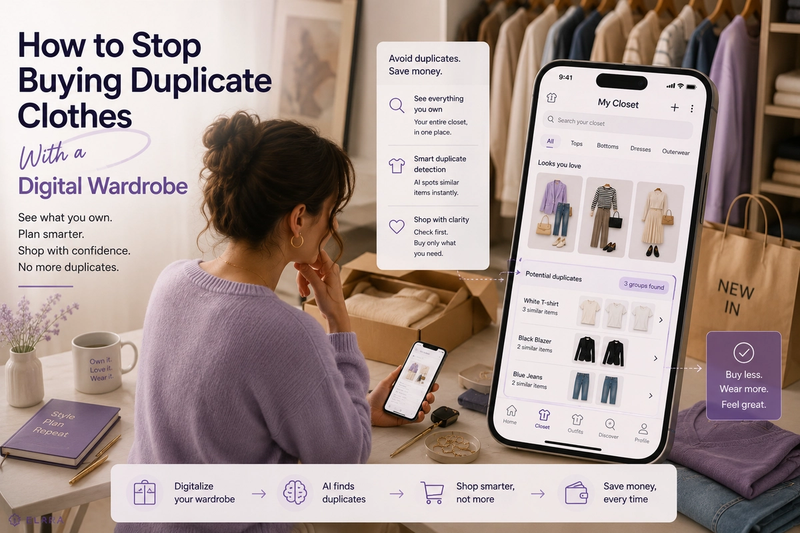
- The most overlooked regret-prevention habit is checking a new item against your existing wardrobe before buying
- This article introduces a wardrobe-first validation framework to catch regret before checkout
Introduction: Why Online Shopping Regret Is a Modern Problem
The average consumer visits 68 retail banners and encounters more than three points of influence before making a single purchase, according to Numerator. That means by the time you tap "buy now," you've already been nudged by a TikTok video, a promotional email, a Google Shopping ad, and possibly a display in a physical store. The decision feels personal. The architecture behind it is anything but.
Most advice about smarter shopping hands you coupon codes and tells you to exercise more willpower. That misses the real issue. The shopping journey is now scattered across social feeds, AI assistants, email promotions, and in-store moments — and none of those channels are designed to make you pause. According to OptinMonster, email and push notifications alone drove nearly half of all online orders during Cyber Week 2024. The triggers are constant; the natural stopping points are gone.
This article isn't a list of hacks. It's a framework for validating purchases before you regret them — anchored in one habit most shopping guides completely ignore: checking what you already own before you buy something new.
The Modern Shopping Journey Is Fragmented — And That's Why You Overspend
Impulse buying isn't a character flaw. It's the predictable output of a system designed to move you from desire to checkout as fast as possible — across as many surfaces as possible.
Numerator data puts the scale of this in stark terms: consumers average more than three points of influence per purchase and visit 68 retail banners in a year. That fragmentation matters because each channel hands off to the next without a reset. You see a jacket on Instagram, search for it on Google, find it on a marketplace, and complete the purchase in under ten minutes — with no moment in that sequence that asks whether you actually need it.
About 60% of Gen Z shoppers discover products through TikTok, Instagram, or YouTube, according to OptinMonster.
Those platforms are engineered for emotional engagement, not considered evaluation. The short-form video format compresses the gap between "I want that" and "I bought that" to a matter of seconds. The algorithm surfaces products calibrated to your existing preferences, which means you're rarely discovering something genuinely new — you're being shown a more purchasable version of what you already want.
The physical world adds another layer of complexity. According to Numerator, 54% of consumers now cite in-store as a channel growing in importance for discovery. So the journey doesn't just cross platforms — it crosses the physical-digital divide entirely. You might discover something in a store, leave without buying it, get retargeted on your phone that evening, and complete the purchase online. At no point in that sequence does the process ask: does this work with what you already own?
The practical fix starts with self-awareness before it starts with tools. When you notice a purchase impulse, identify which channel triggered it. Social media, a promotional email, and an in-store display each carry different emotional weights and different levels of considered intent. Naming the trigger doesn't kill the desire — but it creates the deliberate pause that fragmented discovery is specifically designed to eliminate.
How AI Is Changing the Way We Discover and Compare Products
That deliberate pause becomes even harder to maintain when the entire shopping experience — discovery, comparison, evaluation, and purchase — collapses into a single continuous flow. According to Numerator, consumers can now move through all four stages within integrated AI-assisted experiences, meaning the natural friction points that once created evaluation time have effectively been engineered away.
The retailer's side of this equation is already well-developed. More than 40% of retailers are already using AI tools for personalization, pricing, and logistics, according to Numerator. That AI is not neutral. It is optimizing for conversion, average order value, and return visit rate — outcomes that serve the retailer's revenue, not your wardrobe or your budget.
Understanding this asymmetry is the starting point for using AI as an ally. Retailer-side recommendation engines surface products calibrated to your browsing history and purchase patterns, which means they're very good at showing you things you're likely to click — not things you're likely to wear repeatedly. Shopper-side AI works from the opposite direction: it validates a potential purchase against your personal context, including your existing style profile, what you already own, and how many combinations a new item actually enables.
The difference is whose interest the algorithm is optimizing for.
Tools like Elara represent this shopper-side approach — checking a prospective purchase against your existing wardrobe before you commit, rather than after the package arrives. Before you let a retailer's AI guide you toward checkout, use your own tools to run the same item through a filter that's working for you.
The Mobile Trap: Why Your Phone Makes Impulse Buying Easier Than Ever
Mobile devices accounted for 57% of Cyber Monday purchases, according to OptinMonster citing Adobe data — a figure that reflects how thoroughly the phone has become the default shopping surface. That dominance isn't accidental. Three specific friction removers make mobile the most impulse-friendly channel available.
Ready to upgrade your wardrobe?
Get the Elara app for AI-powered styling and virtual try-ons.
First, the smaller screen compresses comparison. Viewing two products side by side on a phone requires active effort; on a desktop, it's a default behavior. Second, one-tap checkout eliminates the natural pause that entering payment details once created. Third, social-to-cart flows — where a TikTok or Instagram post connects directly to a purchase page — collapse the distance between desire and transaction to a matter of seconds.
The trigger mechanism extends beyond the apps themselves. Email and push notifications accounted for nearly half of all online orders during Cyber Week 2024, according to OptinMonster. Your phone isn't just where you shop — it's actively being used to initiate the urge to shop in the first place.
Three guardrails can reclaim intentionality without abandoning mobile entirely:
- Disable retail push notifications from any store you don't deliberately choose to shop at. Opt back in only when you have a specific purchase planned.
- Apply a 24-hour cart rule for any mobile purchase above a personal threshold — $50 is a reasonable starting point. Add to cart, then revisit the next day.
- Use wishlist features as a cooling-off mechanism. Moving an item to a wishlist instead of directly to checkout introduces exactly the deliberate pause that one-tap checkout removes.
Mobile is a genuinely useful shopping tool. It just needs the friction that retailers have worked hard to eliminate put back in place.
Validate Before You Buy: A Wardrobe-First Checklist
Most shopping advice addresses either the discovery phase (how to find good deals) or the post-purchase phase (how to return things easily). Almost none of it addresses the evaluation gap between the moment you want something and the moment you buy it. That gap is where regret is born.
The framework that closes this gap is a wardrobe gap check — a shift in the core question from do I like this? to does this work with at least three things I already own? Liking an item is a low bar. Versatility is the actual measure of value.
This checklist applies regardless of which channel triggered the discovery. Whether you found the item on Instagram, in a promotional email, or walking past a store window, the evaluation layer is the same:
- Check for duplicates. Search your existing wardrobe for items that serve the same function or occupy the same visual space. A third navy blazer is rarely a gap-filler.
- Identify three outfit combinations. Before purchasing, name the specific items you already own that pair with this piece. If you can't reach three, the item is likely an orphan.
- Verify style-profile fit. Ask whether the item reflects your dominant, established style — not a trend moment you're testing. Trend purchases require higher versatility to justify.
- Confirm the return policy before checkout. Final sale items require a higher confidence threshold. Know the policy before the transaction, not after.
- Use AI virtual pairing. Run the item through a styling tool that can match it against your actual wardrobe inventory and surface real combinations.
According to Numerator, the integrated AI shopping experience now compresses the evaluation window significantly — which makes having a structured checklist more important, not less. Elara's wardrobe integration automates steps 1, 2, and 5 of this process, cross-referencing a new item against your digitized closet and generating real outfit pairings before you commit. The checklist works without any tool; the tools just make it faster to execute with accuracy.
Smart Shopping Habits That Actually Work in 2026
The checklist handles the hardest question — should I buy this? — but execution still depends on how you navigate price, trust, and channel. A few proven tactics remain worth keeping in your toolkit, updated for where shopping actually happens now.
Smart online shopping tips start with the classics. Use price-tracking tools like CamelCamelCamel or Honey for big-ticket items, stack coupon codes with cash-back portals and rewards cards at checkout, and browse in incognito mode to reduce dynamic pricing based on your browsing history — retailers adjust prices in real time, and your own data can work against you.
The 2026 layer is more significant. According to Numerator, consumers can now discover, compare, evaluate, and buy entirely within integrated AI experiences — which means AI assistants are a legitimate pre-purchase research tool, not just a novelty. Before committing, run a quick cross-channel comparison through an AI assistant to surface pricing gaps, alternative sellers, and product reviews you might have missed in a single-retailer flow.
Smart online shopping tips also include trust verification, which deserves more attention than most shopping guides give it. Social commerce and marketplace third-party sellers carry weaker trust signals by default — check seller ratings, return windows, and fulfillment source before paying. A low price from an unverified seller rarely survives the return process.
The highest-leverage habit, though, is the mindset shift: design your shopping around context — what gap does my wardrobe actually have? — rather than channel — what's on sale right now? According to Numerator, more than 40% of retailers already use AI for personalization and pricing, meaning every channel is optimized to create urgency. Starting from your own needs, not the algorithm's prompt, is the most underrated form of shopping discipline.
Frequently Asked Questions
What's the biggest mistake people make when shopping online? The biggest mistake is treating discovery and purchase as a single decision. You see something, like it, and buy it in one motion — without asking whether it works with what you already own. Breaking that into separate steps (discover, evaluate, decide) creates space for regret-prevention habits to actually work.
How do I know if a new item will actually work with my wardrobe? The practical test is simple: can you name three specific items you already own that pair with it? If you can't reach three, the item is likely an orphan that will sit unworn. This is where tools like Elara help — they digitize your wardrobe and show you real outfit combinations before you buy, so you're not guessing.
Is using AI for shopping decisions actually helpful, or does it just push me to buy more? It depends entirely on whose interest the AI is optimizing for. Retailer-side AI (the recommendations you see on shopping sites) is designed to increase conversion and order value — it works for the store, not for you. Shopper-side AI (like Elara) validates purchases against your personal context and existing wardrobe, which means it's working in your favor. The key is using tools that are built to help you decide whether to buy, not just make buying easier.
Conclusion: Shop Like You Have a Stylist in Your Pocket
Shopping regret isn't a willpower problem — it's an information problem. When the journey runs from TikTok to Google to a marketplace checkout in under ten minutes, there's no natural moment to pause and ask whether the purchase actually makes sense for your life.
The framework this article builds is designed to create that moment deliberately: recognize that discovery is fragmented and emotional → use shopper-side AI to validate fit and versatility → run the wardrobe-first checklist before checkout → apply smart online shopping tips as a final filter on price and trust.
Elara exists to make the hardest part of that process — knowing what you already own and what actually works with it — automatic. Digitize your wardrobe, and every potential purchase gets evaluated against your real closet, not your best intentions.
Dress better. Shop smarter. Feel confident.

Your AI Stylist is Here.
live on the App Store
Available on iOS for seamless access anytime, anywhere.