How to Read Clothing Care Labels: Every Laundry Symbol Explained, Plus What the Wording Really Means
What every laundry symbol means: the five base symbols, dots, bars and crosses, dry-cleaning letters, and why dry clean and dry clean only differ.
 Mehul AgarwalFounder & CEO

Last updated: October 2026
Quick answer: Every care label is built from five base symbols, always in the same order: a washtub (washing), a triangle (bleaching), a square (drying), an iron (ironing) and a circle (professional cleaning). Dots mean heat, so more dots means hotter; a number in the washtub is the maximum water temperature in °C. Bars under a symbol mean a gentler cycle, and a cross through any symbol means "do not". In the US, "Dry clean" and "Dry clean only" are not the same instruction, and a label that says only "Machine wash, tumble dry" is telling you the garment can take any temperature and any bleach.
Most of us glance at a care label, see a cluster of tiny shapes, and wash the garment on whatever cycle we always use. That works until a merino jumper comes out child-sized or a silk shirt loses its sheen. Care labels are not decoration: they follow an international symbol system (ISO 3758, administered by GINETEX in Europe) and, in the US, a federal rule from the Federal Trade Commission (FTC) that says what the instructions must cover. Once you know the grammar, you can read any label in seconds, including ones on clothes bought abroad.
The five base symbols and the order they appear in
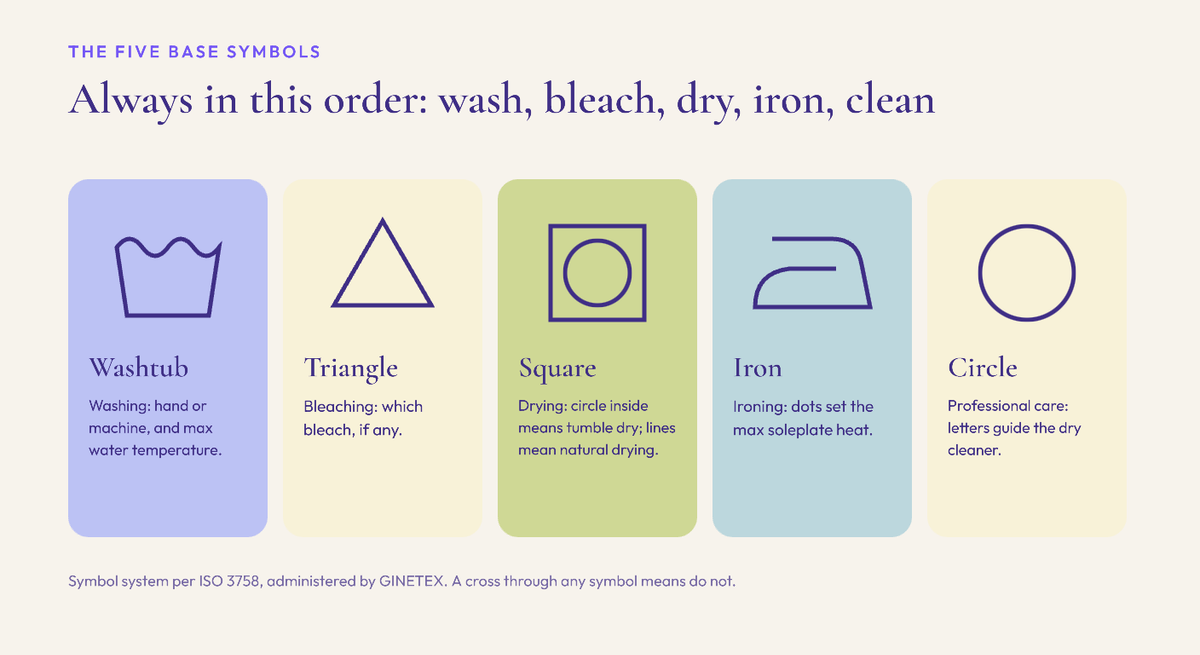
According to GINETEX, the international association that owns the care symbols, labels use five symbol families, shown in this order:
- Washtub: washing. Whether the item can be washed at home, by hand or machine, and the maximum water temperature.
- Triangle: bleaching. Whether bleach is allowed, and which kind.
- Square: drying. A circle inside the square means tumble drying; lines inside the square mean natural drying (on a line, flat, or dripping).
- Iron: ironing. Dots inside set the maximum soleplate temperature.
- Circle: professional care. Letters inside tell a dry cleaner which processes are safe.
The order matters because it mirrors the order you care for a garment: wash, bleach, dry, iron, then professional cleaning if needed. If you see only four symbols, the missing family usually has no special restriction, but check the written instructions too.
The modifiers: dots, bars and crosses

Three small marks change the meaning of every base symbol. Learn these and you can read combinations you have never seen before.
Dots mean heat
Dots appear in the washtub, the tumble-dry circle and the iron, and more dots always means hotter.
- Washtub dots: Maytag's US laundry guide maps one dot to about 30°C (85°F), two to 40°C (105°F), three to 50°C (120°F), four to 60°C (140°F) and five to 70°C (160°F). European labels often print the number itself instead, and GINETEX notes that the number is the maximum temperature.
- Tumble-dry dots: one dot is low heat and two dots is normal heat. GINETEX gives the reference as about 60°C for the mild setting and 80°C for normal. Maytag's guide also lists three dots as high heat on US-style labels, and a filled black circle as no heat (air only).
- Iron dots: GINETEX sets one dot at a maximum soleplate temperature of 120°C (and notes steam may not be suitable for some fibres), two dots at 160°C and three dots at 210°C. As a rule of thumb, one dot covers synthetics such as polyester and acrylic, two dots covers wool and silk, and three dots covers cotton and linen.
Bars mean gentler handling
- One bar under the washtub: a milder cycle with reduced spinning and agitation, often labelled "synthetics" or "permanent press" on machines.
- Two bars under the washtub: a very mild cycle. GINETEX gives woollens as the example.
- A bar under the dry-cleaning circle: the cleaner should limit mechanical action, moisture or drying temperature.
A cross means "do not"
A diagonal cross through any symbol prohibits that process: do not wash, do not bleach, do not tumble dry, do not iron, or do not dry clean. A hand in the washtub means hand wash only.
Drying and bleaching symbols most people misread
Two families are especially easy to misread: the square and the triangle.
Drying. A plain square with a circle inside means you can tumble dry. A square with lines but no circle means natural drying only, and the lines tell you how:
- One horizontal line: dry flat. This is the instruction to follow for knitwear, because hanging a wet jumper stretches it under its own weight.
- A curved line at the top: line dry or hang dry.
- Three vertical lines: drip dry, usually hung up wet without spinning.
- Two diagonal lines in the corner: dry in the shade, to protect dark colours and some fibres from sunlight.
Bleaching. An empty triangle means any bleach can be used. A triangle with two diagonal lines inside means oxygen (non-chlorine) bleach only. A crossed-out triangle means no bleach at all. Colour-safe stain removers are often oxygen-based, so check the pack against the triangle before using one on coloured clothes.
Want this styled from your own closet?
Elara builds the look from what you own, then lets you try it on.
Dry-cleaning letters, and what "dry clean only" really means
The circle is for professionals, but knowing it can save you money.
- Plain circle: dry cleaning is fine.
- Circle with an A: any solvent may be used.
- Circle with a P: suitable for standard dry cleaning with perchloroethylene or hydrocarbon solvents; Maytag's guide adds that trichloroethylene should not be used.
- Circle with an F: petroleum (hydrocarbon) solvent only.
- Circle with a W: professional wet cleaning, a water-based process run by a cleaner.
- Crossed-out circle: do not dry clean.
Here is the part most people never learn. Under the FTC's Care Labeling Rule, US labels must be backed by a "reasonable basis," and the wording matters:
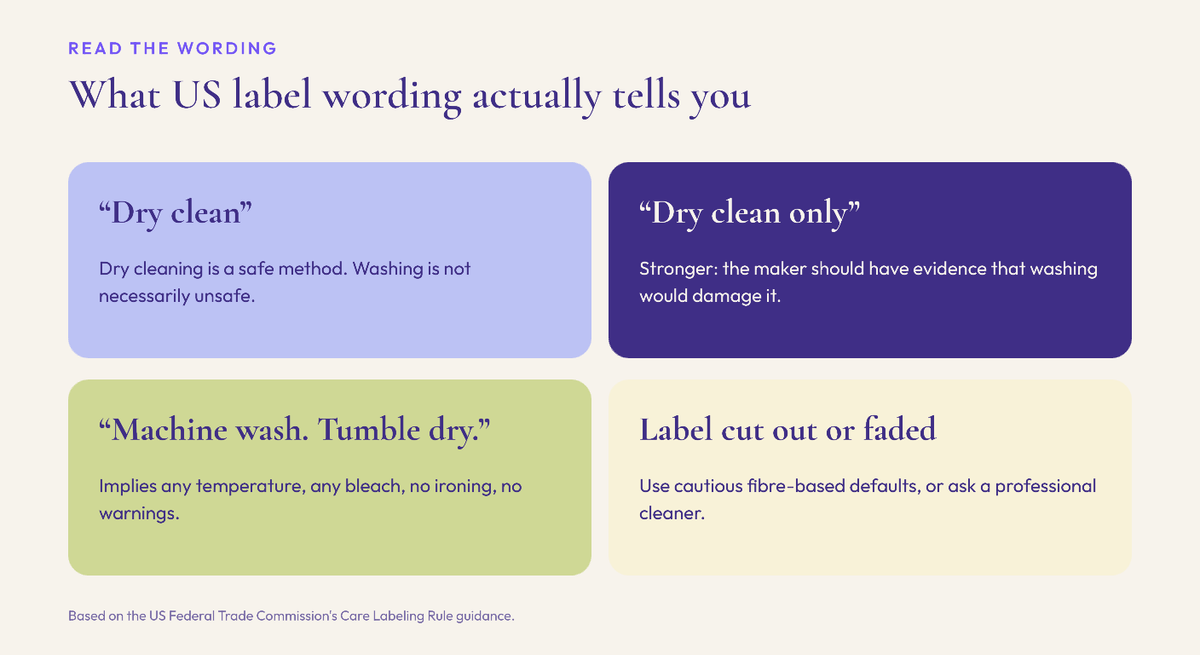
- "Dry clean" means dry cleaning is a safe method. It does not necessarily mean washing is unsafe.
- "Dry clean only" is stronger. According to the FTC, a manufacturer can use it only if it has evidence that washing would damage the garment.
So a blazer labelled "Dry clean" may well survive a careful hand wash, while one labelled "Dry clean only" is telling you the maker tested or knows otherwise. When in doubt with tailoring, structured pieces or anything with interfacing, follow the label.
What a short label is really telling you
The FTC rule also explains what an instruction implies when it says less. According to the FTC's guidance, a label must cover washing method, bleach, drying, ironing and warnings, but it only needs to mention something when the normal approach would harm the garment.
That means a minimal label such as "Machine wash. Tumble dry" is a strong statement. It implies the garment can be washed and dried at any temperature, takes any bleach, needs no ironing and has no warnings. If you see a short label on a delicate-looking piece, it is worth a second look, but the maker is technically claiming it is tough.
The rule also requires labels to be permanently attached and to stay legible for the useful life of the product, so if your labels fade after three washes, that is worth mentioning in a review or to the brand.
When the label is missing or cut off
Many people cut out scratchy labels. If you do, take a photo of the label first and keep it in a phone album. If the label is already gone, these cautious defaults are a sensible starting point, not a guarantee:
- Wool, cashmere and other animal fibres: cool hand wash or a wool cycle, wool detergent, dry flat. Our guide to caring for wool and cashmere sweaters covers the full routine.
- Silk: cool hand wash with a gentle detergent, no wringing, dry flat or hang in the shade, low iron.
- Cotton and linen: machine wash at 30 to 40°C for most everyday pieces; tumble dry on low or line dry to limit shrinking.
- Down jackets: follow a down-specific routine, like the one in our down jacket washing guide.
- Anything structured, beaded or with mixed materials: take it to a professional cleaner and tell them what you know about the fibre.
FAQ
What do the dots on a laundry symbol mean?
Dots mean heat. In the washtub they indicate water temperature (one dot is about 30°C, two about 40°C, three about 50°C, four about 60°C), in the tumble-dry circle they indicate dryer heat, and on the iron they set the maximum soleplate temperature.
What does a square with a circle inside mean?
It means the item can be tumble dried. Dots inside the circle show the heat level, a cross means do not tumble dry, and a square with lines but no circle means natural drying, such as flat or on a line.
What is the difference between "dry clean" and "dry clean only"?
In the US, "Dry clean" means dry cleaning is safe. "Dry clean only" is stronger: according to the FTC, a manufacturer should only use it with evidence that washing would damage the garment.
What does the line under the wash symbol mean?
One bar means a milder cycle with reduced agitation and spin, and two bars mean a very mild cycle, such as a wool or delicates programme.
What does a triangle with two lines mean on a clothing label?
Use only oxygen (non-chlorine) bleach. An empty triangle allows any bleach, and a crossed-out triangle means no bleach.
Why are the care symbols different on clothes from Europe and the US?
They come from the same symbol family, but European labels follow ISO 3758 and often print the wash temperature as a number, while US labels follow the FTC's Care Labeling Rule and often use dots and written instructions.
Keep care instructions with your clothes
The easiest way to never lose care instructions is to photograph each label before you cut it out or before it fades. If you are digitizing your wardrobe in Elara, do it in the same sitting: you end up with a digital closet of everything you own, and an AI stylist that can plan outfits from it, so the pieces you care for properly actually get worn. Try Elara free for 14 days.
Your stylist, in your pocket
Stop reading about outfits. Start wearing them.
Elara knows your closet, shops every store and gets you dressed for any occasion.


