Cost Per Wear Fashion: The Formula That Cuts Spending
Cost per wear fashion reveals what you actually spend on clothing. Learn the CPW formula, audit your wardrobe, and use AI to predict which items deliver real value before you buy.

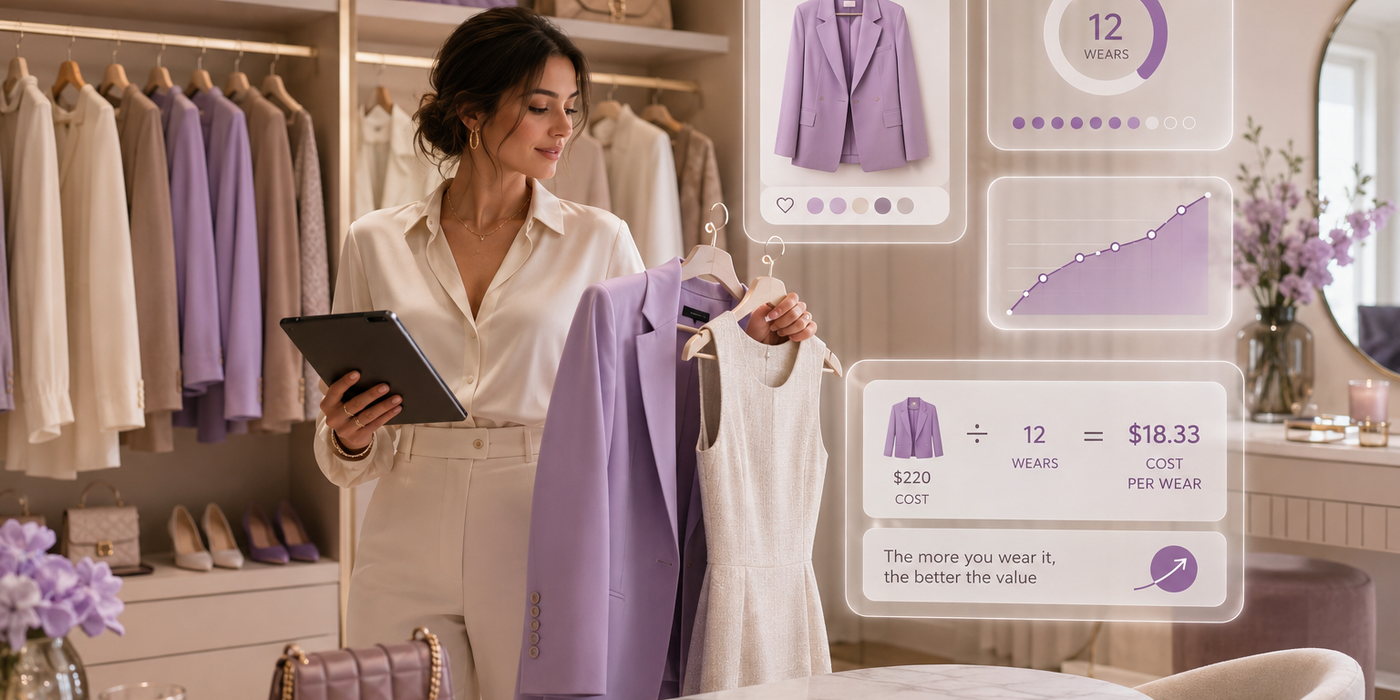
How Cost Per Wear Reveals Your Wardrobe's True Value
Table of Contents
- Key Takeaways
- Introduction: The Math That Changes How You Shop
- What Is Cost Per Wear — And Why Most People Calculate It Wrong
- The CPW Mindset Shift: From Price Tags to Per-Wear Value
- How to Identify High-CPW Items in Your Existing Wardrobe
- CPW as a Buying Framework: New, Premium, and Secondhand
- Using AI to Predict CPW Before You Buy
- Frequently Asked Questions
- Conclusion: Dress Better, Spend Smarter
Cost Per Wear: The Framework That Changes How You Shop
Key Takeaways
- Cost per wear (CPW) = purchase price ÷ number of wears — reveals what a garment actually costs you to wear.
- A $200 jacket worn 100 times ($2/wear) delivers 10x more value than a $40 top worn twice ($20/wear).
- According to Retail Week, ~70% of UK adults now actively calculate CPW. McKinsey's State of Fashion reports 43% of US consumers are buying fewer, higher-quality pieces.
- This article covers CPW audits for existing wardrobes, smarter buying across new, premium, and secondhand purchases, and AI-assisted CPW prediction.
Introduction: The Math That Changes How You Shop
According to Retail Week, approximately 70% of UK adults now actively calculate cost per wear when deciding what clothing to buy — making CPW less a personal finance hack and more a mainstream shopping standard. That number alone should reframe how you think about the $60 blazer you've worn every week for two years versus the $150 dress still hanging with its tags on.
Cost per wear is simple: purchase price divided by number of wears. Simple enough to calculate on a phone. Yet most people still get it wrong — not because the math is hard, but because they underestimate how many times they'll actually wear something, ignore maintenance costs, and never account for resale value.
The real problem is that most people feel they waste money on clothes without any framework to prove it or change it. They buy on impulse, on sale, on trend — and wonder why their wardrobe feels full but their outfit options feel limited.
This article fixes that. It gives you three practical tools: a CPW audit for your existing wardrobe so you can see where your money actually went, a buying framework that applies CPW thinking across new, premium, and secondhand purchases, and a look at how AI-powered tools like Elara can predict a garment's CPW potential before you buy it — so you stop making expensive mistakes that only reveal themselves at the back of your closet.
What Is Cost Per Wear — And Why Most People Calculate It Wrong
Cost per wear is calculated by dividing an item's purchase price by the total number of times it has been worn. One "wear" equals one outfit occasion — a full day at work, an evening out, a weekend errand run. It is not a laundry cycle, and it is not a calendar week. Each time you put the item on and go somewhere in it, that counts as one wear.
The formula's power becomes immediately clear with concrete examples. A $200 jacket worn 100 times costs $2 per wear. A $40 top worn just twice costs $20 per wear — a tenfold difference in actual cost, despite the $40 item appearing to be the budget-friendly choice at the register. The sticker price told the wrong story entirely.
What makes CPW calculations go wrong in practice are two variables most people never factor in. The first is residual value: if you eventually sell an item for $50 on a resale platform, that amount effectively reduces its original cost, lowering its CPW. The second is cost of care: dry cleaning, professional repairs, and specialist laundering all add to a garment's true cost. A silk blouse that requires a $12 dry-clean every few wears can accumulate care costs that significantly increase its effective price over a year.
Beyond the numbers, CPW depends on how often an item actually gets worn — and that depends on versatility and durability more than on price. A well-constructed navy blazer in a classic cut gets worn because it pairs with nearly everything and holds its shape through repeated use. A highly specific printed dress in a trend-driven silhouette gets worn twice because it only works for one type of occasion and starts looking dated by the following season. Styling ease is a CPW multiplier: the harder an item is to incorporate into existing outfits, the fewer wears it accumulates, and the worse its CPW becomes — regardless of what it cost.
The CPW Mindset Shift: From Price Tags to Per-Wear Value
Understanding that styling ease drives wear frequency is one thing — actually applying that logic at the point of purchase is another. The brain doesn't naturally think in per-wear terms. It anchors to sticker price, which is why a $25 hoodie feels like a smart buy and a $90 hoodie feels like an indulgence, even when the math tells the opposite story.
This anchoring bias is well-documented in consumer psychology, and retailers are starting to use it in reverse. Research from phys.org found that displaying CPW information in retail environments measurably shifts shoppers toward higher-quality, more expensive options — not because they spend more carelessly, but because the per-wear framing makes premium items feel financially logical rather than extravagant. The price tag stops being the headline; the value-per-use becomes it.
That shift in framing reflects a broader consumer movement already underway. According to McKinsey & Company's State of Fashion report, 43% of US consumers now explicitly aim to buy fewer, higher-quality items to maximize long-term value. CPW is the mental model quietly powering that behavior change.
The math makes the case plainly:
The fast fashion hoodie costs four times more per wear, despite being priced 72% lower. Seen through a CPW lens, the $90 hoodie isn't the expensive choice — it's the economical one.
What if you could run this calculation before you bought, not after staring at an unworn item six months later? That's exactly where the framework becomes a practical tool rather than a retrospective regret.
How to Identify High-CPW Items in Your Existing Wardrobe
Most CPW guidance focuses on future purchases. The more immediate opportunity sits in the wardrobe you already own — and most people have no idea what their existing clothes have actually cost them per wear.
Ready to upgrade your wardrobe?
Get the Elara app for AI-powered styling and virtual try-ons.
A three-step audit makes this concrete:
- Flag low-wear items. Go through your wardrobe and identify everything you've worn zero to two times in the past year. Be honest — this list is usually longer than expected.
- Calculate their actual CPW. Divide what you paid by the number of times you've worn it. A $75 blouse worn once has a CPW of $75. A $45 dress worn twice has a CPW of $22.50.
- Identify your cost drains. Any item with a CPW above $15 is a cost drain — money spent that hasn't returned value through use. These are your wardrobe's dead weight.
"Wardrobe dead weight" describes items that felt like reasonable purchases at the time but have never earned their cost. They usually share a pattern: they were bought for a specific occasion or trend, they don't pair easily with other pieces you own, or they fit awkwardly enough that you always reach for something else first.
High-CPW items look different. They tend to be neutral in color, versatile across occasions, comfortable enough to wear without overthinking, and easy to style with multiple combinations. Across consumer wardrobe data, a consistent set of categories delivers the lowest CPW: white shirts, dark denim, quality outerwear, and well-fitted knitwear. These are the items that get reached for on a Tuesday morning without deliberation.
Once you can see which items are dragging your wardrobe's ROI down, the next purchase decision becomes clearer — you're shopping to fill genuine gaps, not repeating the same buying patterns that created the dead weight in the first place.
Elara's wardrobe digitization does this analysis automatically. Rather than building a manual spreadsheet, you can digitize your closet and let the platform surface wear patterns, identify underperforming items, and highlight which categories are already working hard. The audit takes minutes instead of an afternoon.
CPW as a Buying Framework: New, Premium, and Secondhand
CPW isn't just a lens for evaluating what you already own — it's a decision framework that works across every type of purchase, including one that most style guides overlook entirely.
New purchases require honest projection. Before buying, ask how many times you'll realistically wear this item in the next 12 months — not how many times you could theoretically wear it. A personal CPW target of under $3 per wear is a practical benchmark: divide the price by 20 realistic wears and ask whether that number feels like fair value. If a $60 item needs 20 wears to hit $3/wear, that's roughly once every 2.5 weeks for a year — achievable for a versatile piece, unlikely for a highly specific one.
Premium items reveal their true value through CPW. Quality materials and construction hold up to repeated wear and washing. Premium cashmere sweaters worn consistently over several years cost significantly less per wear than cheap acrylic alternatives that deteriorate quickly. The upfront price difference rarely reflects the actual cost difference over time.
Secondhand fashion is the CPW advantage that most buying guides miss entirely. A lower entry price means the CPW target becomes achievable with significantly fewer wears. Secondhand purchases offer structural economic benefits compared to buying new. According to McKinsey & Company's State of Fashion report, secondhand is accelerating as a value-seeking strategy in 2025 and into 2026, driven by rising primary market prices and the downstream effects of tariffs on new goods. For CPW-conscious shoppers, secondhand isn't a compromise — it's a structural advantage.
Before any purchase across all three categories, run through this checklist:
- Does this fill a real wardrobe gap? Not a perceived one — an actual gap confirmed by what you already own.
- Can I wear it three or more ways with items I already have? If you can't name the combinations now, you probably won't find them later.
- Will I realistically wear it 20+ times this year? Not in theory — given your actual lifestyle and calendar.
- Does price ÷ 20 feel like fair value per wear? If the number makes you hesitate, the item probably won't earn it.
Elara's context-aware shopping feature handles questions one through three automatically. By cross-referencing your digitized wardrobe, the platform can confirm whether a potential purchase fills a genuine gap, identify how many existing items it pairs with, and flag whether it's likely to integrate into regular rotation — or become the next piece of wardrobe dead weight.
Using AI to Predict CPW Before You Buy
That four-question checklist works well as a manual filter — but it still relies on honest self-assessment, which is exactly where most shoppers fail. Research in behavioral economics consistently shows that people systematically overestimate how often they'll wear novelty or trend-driven items and underestimate how frequently they'll reach for basics. The result: pre-purchase CPW projections built on gut feeling are often wrong in the most expensive direction.
AI wardrobe analysis corrects for this bias by replacing guesswork with behavioral data. Instead of asking "how often will I wear this?", an AI tracks which items and outfit combinations you actually reach for — building a predictive model of your real wear behavior over time. The more data it accumulates, the more accurately it can forecast whether a potential new purchase will integrate into your regular rotation or become another piece of wardrobe dead weight.
Elara's approach makes this concrete. The platform digitizes your closet, tracks the outfit patterns you create, and cross-references that data against any item you're considering buying — generating what amounts to a CPW risk score before you spend a cent. Its Versatility Recommendations feature goes further by surfacing multi-use pieces specifically chosen to work across multiple outfit combinations, directly maximizing CPW potential at the point of decision.
The practical difference is significant. Before buying a $180 silk blouse, Elara can show you it pairs with six items you already own — projecting 40+ wears in year one, for a CPW of $4.50. Compare that to a $65 printed top that only styles two ways with your existing wardrobe. The cheaper item looks like a bargain until the math catches up with it.
Frequently Asked Questions
Q: How do I count "wears" accurately? A wear is one complete outfit occasion — a full day at work, an evening out, a weekend errand. It's not the number of times you wash it or the number of weeks you own it. If you wear a sweater three times in one week, that's three wears. Track this honestly in your closet audit; the accuracy of your CPW calculation depends on it.
Q: What's a realistic CPW target when shopping? A CPW target under $3 per wear is practical for most everyday pieces. This assumes you'll wear the item roughly 20 times per year. For a $60 item, that means hitting your target; for a $120 item, you need to project 40+ wears. Be honest about your actual lifestyle — not your aspirational one.
Q: Does secondhand always have better CPW than new? Secondhand has a structural CPW advantage because the entry price is lower. A $40 secondhand coat you wear 30 times costs $1.33 per wear. However, CPW still depends on actual wear frequency. A $15 secondhand item worn once has a worse CPW than a $60 new item worn 40 times. The lower price helps, but versatility and fit still matter most.
Conclusion: Dress Better, Spend Smarter
Cost per wear is not just a formula — it's a complete value philosophy that governs every purchase decision, whether you're buying new, investing in premium, or hunting secondhand. The consumer shift is already underway: according to Retail Week, approximately 70% of UK adults now actively calculate CPW when investing in clothing, and McKinsey's State of Fashion data shows 43% of US consumers explicitly aim to buy fewer, higher-quality items to maximize long-term value. CPW thinking is becoming the default, not the exception.
This week, pick one section of your wardrobe — your tops, your shoes, your outerwear — and run the audit from this article. Calculate actual CPW, flag the cost drains, and identify the pieces that have genuinely earned their place.
Elara makes that process automatic. By digitizing your wardrobe and tracking how you actually dress, it turns CPW analysis from a spreadsheet exercise into an intelligent, ongoing system that travels with every purchase decision you make.
Dress better. Shop smarter. Feel confident.
→ Start your wardrobe audit at joinelara.com

Your AI Stylist is Here.
live on the App Store & Google Play
Available on iOS and Android for seamless access anytime, anywhere.