Carry-On Packing for a Week Trip: The Formula That Works
Pack a week trip in carry-on with 5-6 tops, 3-4 bottoms, and 1-2 shoes. Learn the color palette strategy and wardrobe audit method that eliminates overpacking anxiety.

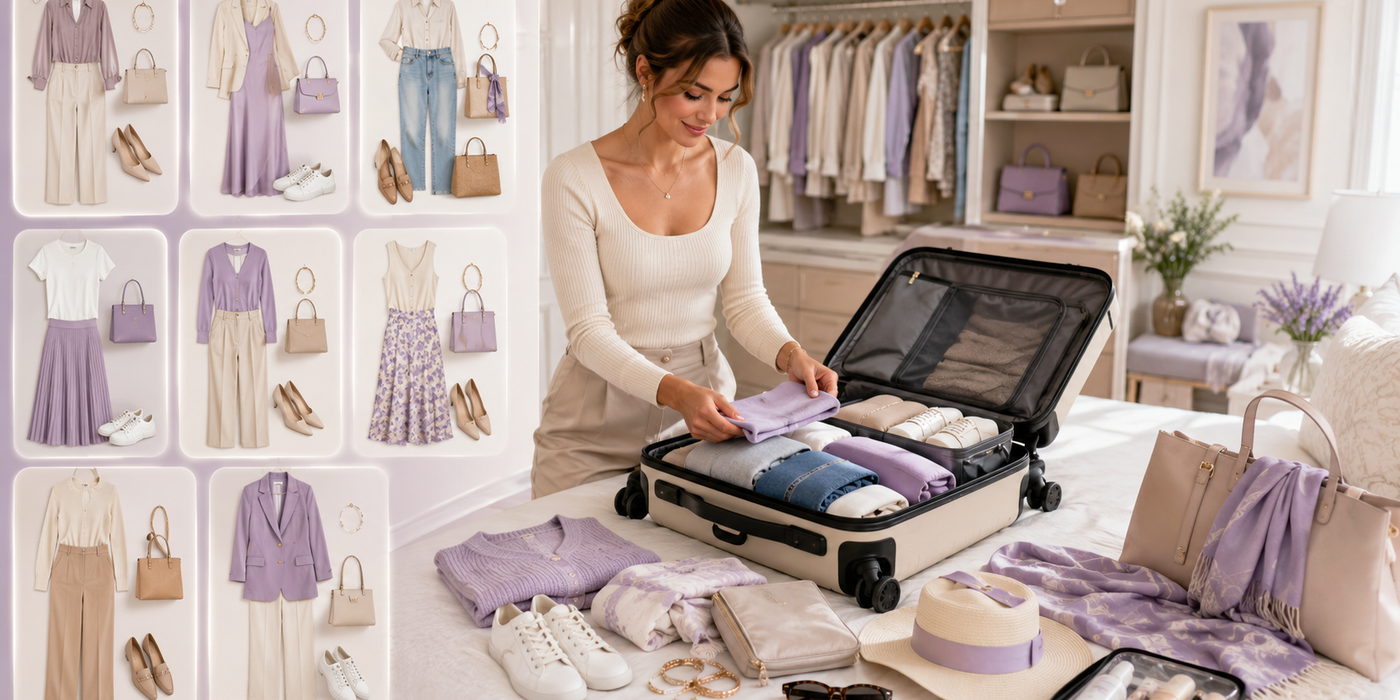
How to pack a carry-on for a week without re-wearing the same outfit
Table of Contents
- Introduction: Why Most Travelers Overpack (And How to Stop)
- The Real Reason You Overpack: Wardrobe Blindness
- The One-Week Carry-On Formula (That Actually Works)
- Build Your Packing List Around a Color Palette, Not Outfits
- Organization and Packing Tools That Actually Save Space
- The Wardrobe-First Mindset: Pack Smarter by Knowing Your Closet
- Frequently Asked Questions
- Conclusion: Light Bags, Confident Traveler
Key Takeaways
- According to Condé Nast Traveler, 65% of Americans find packing challenging — and nearly 25% of what they pack goes unworn.
- The proven 1-week formula: 5–6 tops, 3–4 bottoms, 1–2 shoe pairs, one change of underclothes per day.
- A thoughtfully chosen color palette lets you mix and match a small number of pieces into dozens of outfit combinations.
- The real solution isn't packing less — it's knowing your wardrobe well enough to pack with intention.
Introduction: Why Most Travelers Overpack (And How to Stop)
According to Condé Nast Traveler, 65% of Americans say packing is a challenge — and nearly a quarter of everything they put in their suitcase comes home unworn. That's not a discipline problem. It's a wardrobe visibility problem.
Most people pack from anxiety. Without a clear mental picture of what they own and how it fits together, they default to "just in case" logic: a backup outfit for the backup outfit, three pairs of shoes for a seven-day trip, a blazer for a dinner that may or may not happen. The result is a bag that's too heavy and a closet that feels too full, yet somehow not useful enough.
The fix isn't a better packing list. It's a wardrobe-first framework — one that starts with understanding what you already own before a single item goes into a bag. That's the approach this article takes, and it's deliberately different from the generic checklists that treat packing as an isolated task.
Travel + Leisure's 2026 coverage of carry-on efficiency points to versatile clothing as the foundation of smart packing — not compression technology or ultra-light fabrics, but pieces that work across multiple contexts. That insight reflects a broader shift: travelers packing for a carry-on week trip are simplifying their kits by simplifying their thinking, not just downsizing their bags. The framework here shows you exactly how to do that.
The Real Reason You Overpack: Wardrobe Blindness
"Wardrobe blindness" is the gap between what you own and what you can confidently style together. Most people have more than enough clothes to pack light for a week — they just can't see it. When you can't mentally visualize how your navy trousers pair with that striped shirt, or whether your olive jacket works with anything else you're bringing, you hedge. You pack a second option. Then a third.
This is exactly what drives the statistic Condé Nast Traveler identified: nearly 25% of suitcase contents go unworn. Those unused items aren't random — they're the "just in case" pieces that seemed essential during the anxiety of packing but never found their moment on the trip. A cocktail dress for a dinner that stayed casual. A second pair of jeans because the first felt uncertain. A workout set used once, maybe.
Most packing guides treat this as a problem of quantity — pack fewer things — without addressing why people overpack in the first place. They offer checklists built around generic trip types, ignoring the fact that optimal packing is deeply personal. It depends on your existing wardrobe's color range, the versatility of the specific pieces you own, and the actual activities your trip involves. A checklist that works for a minimalist will frustrate someone whose closet skews toward statement pieces and bold prints.
The practical antidote is a pre-travel wardrobe audit: before you open a suitcase, you review what you own — physically or digitally — and identify which pieces already work together. This single step replaces anxiety-driven packing with intentional selection. You stop asking "what might I need?" and start asking "what do I know works?" That shift, more than any packing cube or compression bag, is what gets a week's worth of outfits into a carry-on.
The One-Week Carry-On Formula (That Actually Works)
That wardrobe-first mindset becomes most powerful when you pair it with a concrete number. Without a target, even the most organized traveler ends up standing over an open bag asking whether five shirts is enough — or too many.
According to Outdoor Gear Lab, the proven formula for a one-week carry-on trip is 5–6 tops, 3–4 bottoms, 1–2 pairs of shoes, and one change of underclothes per day. The math is straightforward: 5 tops multiplied by 3 bottoms gives you 15 outfit combinations — more than double what you actually need for seven days. Add a second pair of shoes and a jacket, and the combinations multiply further without the bag getting heavier.
Travelers who fear this count is too low often change their minds when they see the two-week numbers. A guide from shabbyfufu.com suggests a 14-day carry-on trip requires 7–10 tops and 3–5 bottoms — only marginally more than the one-week formula. The numbers don't double because the combinations do the work. A third bottom doesn't add three days of outfits; it adds six.
Practical constraints reinforce why staying within the formula matters. Regional airline routes commonly cap carry-on weight at 20 pounds YouTube video (unattributed), and that ceiling fills faster than most travelers expect once shoes, toiletries, and electronics are accounted for. Clothing has to earn its place.
Ready to upgrade your wardrobe?
Get the Elara app for AI-powered styling and virtual try-ons.
The one-week formula by category:
- Tops: 5–6 (mix of tees, blouses, or shirts)
- Bottoms: 3–4 (pants, jeans, skirts, or shorts)
- Shoes: 1–2 pairs (one versatile, one activity-specific)
- Underclothes: 7 changes minimum
- Outerwear: 1 jacket or cardigan
Build Your Packing List Around a Color Palette, Not Outfits
The formula gives you the count. The color palette is what makes that count work in practice.
Most travelers pack by outfit — they mentally assemble seven complete looks and then stuff each one into the bag. The problem is that outfit-specific packing treats every piece as a single-use item. A blouse packed to go with one specific pair of pants is dead weight on every other day. Palette-based packing inverts this logic: instead of choosing pieces that belong to outfits, you choose pieces that belong to each other.
A workable travel palette has three components: one neutral base, one accent color, and one bridging pattern. In practice, that might look like black jeans and tan chinos as the base, a terracotta or cobalt accent in one or two tops, and a small-scale stripe or subtle plaid that pulls both colors together. Every item in the bag can touch every other item. Black jeans work with the striped shirt, the solid tee, and the accent blouse. The tan chinos do the same.
Layering extends this further. Travel + Leisure highlights versatile, layerable clothing as a core principle of efficient packing — and for good reason. A lightweight cardigan or packable jacket doesn't just handle unpredictable weather; it visually transforms an outfit, turning a daytime look into an evening one without swapping a single other piece. One layer adds combinations without adding meaningful weight.
The connection back to the wardrobe audit is direct: travelers who already know their color palette — who have looked at their closet and recognized that they naturally gravitate toward navy, white, and rust — pack instinctively. They reach for the pieces that already work together. Travelers without that self-knowledge pack defensively, grabbing redundant pieces "just in case," and arrive at their destination with a bag full of options that don't combine.
Organization and Packing Tools That Actually Save Space
Knowing what to pack solves half the problem. Knowing how to pack it solves the other half.
Travel + Leisure identifies packing cubes, slim organizers, and modular systems as the foundation of efficient carry-on packing. The practical case for cubes isn't compression — most standard cubes don't compress meaningfully — it's organization. When clothes are sorted by category into cubes, you stop losing space to the chaotic shifting and restacking that happens when items sit loose in a bag. You also unpack and repack faster, which matters on multi-city trips.
The roll-versus-fold question has a clear answer: roll casual and knit items, fold structured ones. T-shirts, jeans, and lightweight pants roll tightly and resist wrinkles. Blazers, dress shirts, and structured trousers fold flat to preserve their shape. Mixing both methods within a packing cube maximizes density without sacrificing wearability.
Toiletries are where many carry-on packers lose the battle. TSA's 3-1-1 rule limits liquids to containers of 3.4 ounces or less, all fitting in a single quart-sized bag. Beyond the rules, Outdoor Gear Lab advises a stricter personal standard: only pack toiletries you cannot easily replace at your destination. Shampoo, body wash, and basic skincare are available in virtually every city. Specialty medications, prescription skincare, or a specific sunscreen formula are not. That distinction alone can eliminate a third of what most travelers pack in their toiletry bag.
The personal item — a tote, backpack, or small crossbody — functions as a strategic second compartment, not an overflow bin. Outdoor Gear Lab recommends keeping medication, travel documents, valuables, and electronics in the carry-on at all times, never in checked luggage. The personal item is the right place for these: accessible during the flight, never out of your control, and light enough to slide under the seat without sacrificing overhead bin space for the main bag.
The Wardrobe-First Mindset: Pack Smarter by Knowing Your Closet
Mastering your personal item and carry-on system solves the space problem — but the deeper challenge is deciding what goes inside them in the first place. That decision gets dramatically easier when you know your wardrobe before you open your suitcase.
The most underrated packing skill isn't rolling technique or cube selection. It's the ability to look at your closet and immediately know which pieces work together, which travel well, and which you'll actually reach for on a Tuesday in a new city. Travelers who have that knowledge pack less, wear more, and never stand in a hotel room second-guessing their choices. Those who don't tend to pack duplicates, hedge with "just in case" pieces, and still end up wearing the same three items.
A digital wardrobe audit solves this before the anxiety starts. Rather than pulling everything out of your closet the night before a flight, you review your clothing visually — outfit combinations, color pairings, gaps — while there's still time to think clearly. Travel + Leisure identifies versatile clothing as a core pillar of efficient carry-on packing, and versatility is only visible when you can see your whole wardrobe at once.
This is exactly where Elara fits into the process. Elara digitizes your wardrobe and surfaces outfit combinations from what you already own, so pre-travel planning for your carry-on week trip becomes an intentional exercise rather than a last-minute scramble. The result is a carry-on filled with pieces you've already confirmed work together — not a bag packed from hope. That's the modern minimalist travel mindset in practice: not fewer clothes, just better-known ones.
Frequently Asked Questions
How do I know if my carry-on packing formula is right for my trip? The 5–6 tops, 3–4 bottoms formula works for most seven-day trips because the combinations are flexible. If your trip is activity-specific — say, a beach vacation or a hiking week — adjust the bottoms category (add shorts instead of another pair of jeans) but keep the total count the same. The formula accounts for laundry access; if you don't have laundry on your trip, add one extra top and bottom per week.
Can I use this formula for a longer carry-on week trip? Yes. For a 10-day carry-on trip, add one top and one bottom to the base formula. For two weeks, add two tops and one additional bottom. The combinations multiply faster than the item count, so you don't need to double your packing list to double your trip length.
What if my wardrobe doesn't have a clear color palette? Start by looking at the clothes you actually wear most. Pull out your five most-worn pieces and identify their colors. That's your natural palette. Build your packing list from pieces that match those colors, not from pieces you think you "should" wear. A palette you naturally gravitate toward will feel effortless to pack and wear.
Conclusion: Light Bags, Confident Traveler
Overpacking isn't a discipline failure. It's a wardrobe visibility problem — and it's entirely solvable.
According to Condé Nast Traveler, nearly a quarter of everything most travelers pack goes unworn. That's not because people bring the wrong items; it's because they pack without a clear picture of what they own and how it connects. The one-week formula — 5–6 tops, 3–4 bottoms, one to two shoe pairs, and one change of underclothes per day, as outlined by Outdoor Gear Lab — gives you the structure. A palette-based approach gives you the flexibility. And a pre-trip wardrobe audit ties both together.
"Nearly 25% of suitcase contents go unworn." — Condé Nast Traveler
The single most impactful habit change you can make before your next carry-on week trip is auditing your wardrobe before you pack, not while you're packing. Know your pieces. Know your combinations. Know what you'll actually wear.
Elara makes that audit effortless — digitizing your closet and showing you exactly what you already own and how it works together. When you know your wardrobe, you pack with confidence, not anxiety. And that's worth more than any packing cube.

Your AI Stylist is Here.
live on the App Store & Google Play
Available on iOS and Android for seamless access anytime, anywhere.