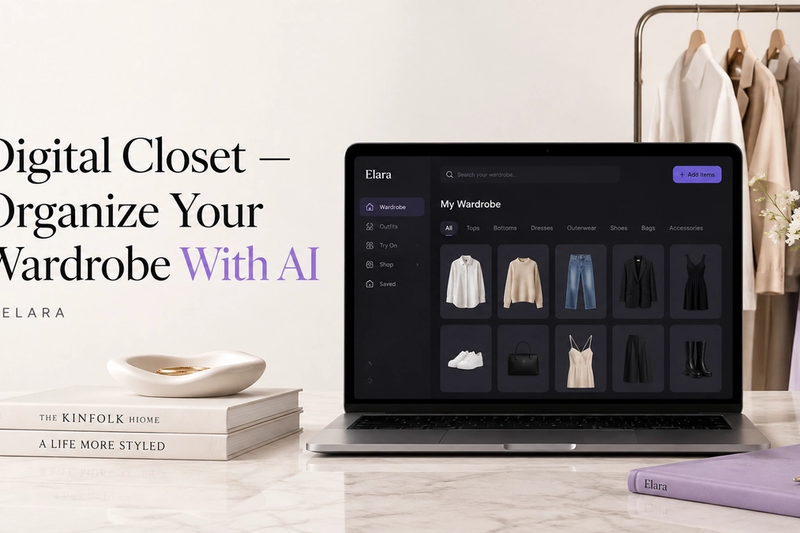
Best Closet App 2026: AI-Powered Wardrobe Organization
Closet apps help you wear 50-70% of your wardrobe instead of just 20%. Discover how AI automation eliminates setup friction and cuts impulse purchases by 40-60%.


Closet App Setup: Beat the 8-Hour Cataloging Barrier
Table of Contents
- Key Takeaways
- Introduction: The Wardrobe Problem Nobody Talks About
- What Is a Closet App — And Why 2026 Is the Inflection Point
- The Real Cost of NOT Using a Closet App
- Breaking the 8-Hour Barrier: How AI Automation Solves Setup Friction
- Closet App Free vs. Paid: What You Actually Get
- How to Choose the Best Closet App for Your Needs
- Conclusion: Your Wardrobe, Smarter
Key Takeaways
- Most people wear just 20% of their wardrobe; closet app users report wearing 50–70% regularly (nouva.app, 2026)
- The 8-hour manual cataloging barrier is the #1 reason people don't start — AI automation now eliminates most of it
- Over 60% of top closet apps offer free tiers; premium plans run $6.99–$9.99/month
- The virtual closet app market hit $2.4B in 2025 and is projected to reach $4.8B by 2033 at a 9.7% CAGR
Introduction: The Wardrobe Problem Nobody Talks About
The average person wears just 20% of the clothes they own. According to nouva.app's 2026 wardrobe app comparison, users who adopt a closet app flip that number dramatically — reporting regular use of 50–70% of their wardrobe within months of getting started.
That's a meaningful behavioral shift. But most people never experience it, because they hit a wall before they even begin: the perception that cataloging an entire wardrobe will consume an entire weekend. Manual photo uploads, item tagging, category sorting — the time estimate alone is enough to close the app and forget about it. Nouva.app identifies this initial time investment as the single biggest barrier to adoption in 2026.
The good news is that barrier is largely a myth now. AI automation — background removal, receipt scanning, browser extensions, database matching — has dramatically shortened setup time. What once took a full afternoon now takes 30 minutes or less for a typical wardrobe.
This is also a category worth taking seriously. The virtual closet app market reached $2.4 billion in 2025 and is growing at a 9.7% CAGR toward $4.8 billion by 2033, according to LinkedIn Pulse market research. What follows covers exactly what closet apps are, what behavioral changes they actually produce, what they cost, and how to pick the right one for your wardrobe and lifestyle.
What Is a Closet App — And Why 2026 Is the Inflection Point
A closet app — also called a virtual wardrobe app — is a digital tool that catalogs your clothing, generates outfit combinations from what you already own, and helps you make smarter decisions about what to buy next. Think of it as a searchable, visual inventory of your wardrobe that also functions as a personal stylist.
The category started as simple photo organizers: you'd photograph each item, assign it to a category, and scroll through a grid when getting dressed. Useful, but limited. What's changed in 2026 is the intelligence layer underneath. As LinkedIn Pulse's Virtual Closet App Market forecast notes, "the deployment of sophisticated AI algorithms, including deep learning and natural language processing, is redefining user engagement by delivering hyper-personalized styling recommendations and outfit simulations." That's the shift from passive catalog to active styling assistant — and it's now standard, not a premium feature reserved for enterprise-tier plans.
The market data reflects how mainstream this has become. The virtual closet app segment reached USD 2.1 billion in 2024 and is projected to grow from USD 2.4 billion in 2025 to USD 4.8 billion by 2033 at a 9.7% CAGR, according to LinkedIn Pulse. That trajectory isn't driven by early adopters anymore — it's driven by everyday users who want a faster morning routine and fewer wasted clothing purchases.
Platform availability has also expanded significantly. Earlier generations of wardrobe apps were largely iOS-exclusive, which limited reach. Today, most leading apps support both iOS and Android, removing a barrier that kept a large share of potential users out entirely. Adoption is concentrated in North America and Asia-Pacific, where smartphone penetration exceeds 85%, according to Intel Market Research — the infrastructure for this category to scale is already in place.
The practical implication: if you've dismissed closet apps as a niche tool for fashion insiders, the product you'd encounter today is fundamentally different from what existed even two years ago. AI personalization, automated cataloging, and cross-platform availability have moved this from novelty to utility.
The Real Cost of NOT Using a Closet App
That shift from novelty to utility has a measurable price tag — and the cost is paid by people who haven't made the switch yet.
According to data from nouva.app's 2026 wardrobe app comparison, the average person wears just 20% of their wardrobe regularly. Users who adopt a closet app report wearing 50–70% of their clothes — a utilization jump that reframes every unworn item in your closet as money sitting idle on a hanger. If your wardrobe cost $3,000 to build, you're effectively locking away $2,400 of it without ever getting dressed in it.
Users rediscover 8–12 forgotten items they already own within the first week of setting up a closet app, according to nouva.app's 2026 comparison data.
That number matters because those rediscovered pieces often eliminate the perceived "need" for a new purchase. The same data shows a 40–60% reduction in impulse clothing purchases among regular app users — a behavioral shift that makes the ROI argument straightforward. As altadaily.com put it in their 2026 closet app review: "Many users report buying fewer impulse purchases because their wardrobe app helps them realize they already own something that works. The cost often pays for itself."
Picture Monday morning without an app: you're staring at a full closet that somehow feels empty, running late, and defaulting to the same five outfits you always wear. Two weeks later, with a closet app set up: your 47 cataloged items surface a combination you'd never considered — a blazer you forgot you owned, paired with something you almost donated. That's not a small quality-of-life improvement. That's the 20%-to-70% utilization gap made visible in real time.
Breaking the 8-Hour Barrier: How AI Automation Solves Setup Friction
The single biggest reason people download a closet app and never actually use it is the setup wall. Uploading photos, tagging items by color, category, and brand, then organizing everything into a coherent system — for a wardrobe of 80 or 100 pieces, that's a weekend project, not a Tuesday evening task. As nouva.app's 2026 comparison report states directly: "Uploading photos, tagging items, and organizing everything can take hours — especially if you have a large collection."
The best apps in 2026 have largely eliminated this problem through four automation tools:
- AI background removal — photograph a garment on any surface and the app strips the background automatically, producing a clean catalog image in seconds. No white sheet, no staging required.
Ready to upgrade your wardrobe?
Get the Elara app for AI-powered styling and virtual try-ons.
- Receipt scanning — point your camera at a paper receipt or forward a purchase confirmation email, and the app auto-populates brand, price, purchase date, and category without manual entry.
- Browser extensions — install a lightweight plugin and item details save automatically while you browse online retailers, building your catalog before clothes even arrive at your door.
- Database matching — AI recognizes garments from photos and fills in metadata (fabric type, color family, care instructions) by cross-referencing product databases.
With these tools working together, setup time has dropped significantly compared to manual cataloging alone. The barrier hasn't just shrunk; for most users, it's effectively gone.
Quick-start tips to get your closet app running today:
- Start with your most-worn 20 items — catalog your weekly rotation first so you see value immediately, before touching the back of the closet
- Use natural light near a window — it produces accurate colors and reduces the AI's error rate on fabric and hue matching
- Connect your email for receipt scanning — most apps can pull purchase history automatically, adding months of wardrobe data in one step
- Don't aim for perfection on day one — a 60-item catalog you actually use beats a 200-item catalog you abandoned halfway through
- Tag items by occasion, not just category — "work," "weekend," and "formal" tags make outfit suggestions dramatically more relevant
Closet App Free vs. Paid: What You Actually Get
Over 60% of the top closet apps available in 2026 offer free tiers, according to nouva.app's 2026 wardrobe app comparison — so the question isn't whether you can try one without spending money. The question is whether the free tier will actually solve your problem, or whether you'll hit its ceiling within a week.
Free tiers typically cap item counts around 100 garments and include basic outfit creation tools with manual cataloging. That's sufficient for a capsule wardrobe or someone just getting started. Several fully free options exist, making them genuinely zero-cost entry points.
Premium subscriptions, which run $6.99–$9.99 per month across most leading apps, unlock unlimited item storage, full AI outfit suggestions, weather-based recommendations, integrated shopping tools, and sustainability tracking. A one-time purchase option also exists — Stylebook charges $4.99 on iOS — sitting between free and subscription in both price and feature depth.
The cost-per-use math favors premium for daily users. One prevented impulse purchase — the kind that nouva.app's data shows drops by 40–60% among regular users — covers multiple months of subscription fees. As altadaily.com's 2026 review notes: "If you use a wardrobe app daily — which is the point — the $5 to $10 per month cost works out to pennies per outfit suggestion."
Android users should note that the iOS-exclusivity era is largely over. Most leading apps in 2026 now support both platforms, so platform compatibility is rarely a deciding factor when choosing between free and paid tiers.
How to Choose the Best Closet App for Your Needs
With platform compatibility no longer a meaningful differentiator, the real question shifts: not which app has the most features, but which app solves your specific problem.
Three distinct user profiles tend to emerge when people evaluate closet apps. Busy professionals need fast AI-powered setup, daily outfit suggestions that sync with their calendar, and weather integration — friction-free mornings are the whole point. Sustainability-conscious users prioritize cost-per-wear tracking, wardrobe utilization statistics, and ethical brand filters that help them shop with intention. Impulse-control shoppers need something different entirely: "do I already own this?" alerts, gap analysis that reveals what's genuinely missing, and budget tracking that creates a pause before checkout.
According to nouva.app's 2026 comparison, the leading apps map neatly onto these personas. Clueless leads for AI-powered outfit planning, Indyx suits professional cataloging with detailed metadata, Alta is the fastest-growing option (recognized by TIME), and Whering is the strongest choice for sustainability tracking. Acloset is a well-known entry-level option — straightforward to set up and good for basic organization — but it requires manual outfit creation, which means the app does what you tell it rather than learning what you need.
That distinction matters. Conversational AI platforms build a preference model over time: you describe what you're looking for, and the app responds — no manual outfit assembly required. This approach learns your taste and adapts as your style evolves.
Before committing to any app, run through this five-question checklist:
- How large is my wardrobe? Under 100 items, a free tier works fine. Above that, you'll need premium.
- Do I want outfit suggestions or just organization? Suggestions require AI; organization doesn't.
- Is Android compatibility required? Most leading apps support both platforms in 2026, but verify before downloading.
- Do I care about sustainability metrics? Only a subset of apps track cost-per-wear and utilization rates.
- Do I want integrated shopping recommendations? This feature separates basic organizers from genuine styling assistants.
Conclusion: Your Wardrobe, Smarter
The 8-hour setup barrier that once stopped people from ever starting is largely obsolete. AI automation — background removal, receipt scanning, browser extensions, database matching — has dramatically shortened what used to take a full afternoon.
The behavioral payoff is real and measurable. According to nouva.app, users report wearing 50–70% of their wardrobe regularly after adopting a closet app, compared to the typical 20% before. Impulse clothing purchases drop by 40–60%, and most users rediscover 8–12 forgotten items during initial setup alone — items that were already paid for and waiting to be worn.
The best closet app isn't just a digital drawer. It's the intelligent layer between you, your wardrobe, and every fashion decision you make — one that gets sharper the longer you use it.
Ready to see what that looks like in practice? Try Elara free — your AI stylist that actually knows you — or read How AI Styling Works to understand what separates a smart wardrobe assistant from a simple photo organizer.
Your AI Stylist is Here.
live on the App Store & Google Play
Available on iOS and Android for seamless access anytime, anywhere.