AI Personal Stylist: Your Wardrobe's New Intelligence Layer
AI personal stylists are decision-support systems for your existing wardrobe, not shopping bots. Learn how 65–78% recommendation acceptance rates and 30–40% return reduction are transforming daily dressing.

What Is an AI Personal Stylist? How It Actually Works in 2026
Table of Contents
- Key Takeaways
- Introduction: AI Personal Stylists Are No Longer a Luxury — They're Infrastructure
- What Is an AI Personal Stylist? (The 2026 Definition)
- How an AI Personal Stylist Actually Works: The Technology Behind the Recommendations
- The Wardrobe-First Difference: Why the Best AI Stylists Start With What You Own
- Real-World Outcomes: What the Data Says About AI Styling ROI
- Choosing the Right AI Personal Stylist: What to Look For in 2026
- Conclusion: The Stylist in Your Pocket Is Already Here
Key Takeaways
- AI personal stylists are decision-support systems for your existing wardrobe — not shopping bots pushing new purchases.
- The market is growing at a 36.5% CAGR, with adoption projected to surpass 85 million users by end of 2026 (HTF Market Insights).
- Leading platforms achieve 65–78% recommendation acceptance rates, outperforming human-curated services at scale (Dataintelo).
- Virtual try-on technology reduces product returns by 30–40% (Dataintelo).
- Elara's wardrobe-first, conversational approach sets the benchmark for what AI styling should actually deliver in 2026.
Introduction: AI Personal Stylists Are No Longer a Luxury — They're Infrastructure
AI adoption among fashion and apparel companies doubled from 20% to 44% in just the first half of 2026, according to data from joinelara.com. That's not a trend line — that's a technology crossing into mainstream infrastructure, the same way mobile payments and cloud storage did before it.
What if getting dressed felt less like a chore and more like a conversation? That's the question the 2026 generation of AI personal stylists is built to answer. But most people are still operating with a 2022 mental model: they picture a recommendation engine that surfaces products, maybe after a short style quiz, and calls itself a stylist. That version is largely obsolete.
This article covers what an AI personal stylist actually is today — the technology behind it, the wardrobe-first philosophy separating serious platforms from shopping-disguised-as-styling, the measurable outcomes users and retailers are seeing, and a practical framework for choosing the right tool. Elara's guiding principle — your AI stylist that actually knows you — serves as the lens throughout.
What Is an AI Personal Stylist? (The 2026 Definition)
An AI personal stylist is a software system that uses machine learning, natural language processing, and computer vision to deliver personalized outfit and shopping recommendations — adapted to an individual's body type, style preferences, existing wardrobe, and real-world context like weather and occasion. The key word in that definition is adapted: these systems don't generate generic looks; they generate your looks.
The contrast with early tools is significant. The 2022 generation of AI stylist apps operated on static logic: answer ten questions about your body shape and color palette, receive a curated product feed. Modern systems are conversational, context-aware, and wardrobe-integrated. They learn through dialogue, refine their understanding with every interaction, and — critically — they start with what you already own before suggesting anything new.
The market numbers reflect how seriously the industry has taken this evolution. According to Cognitive Market Research, the global AI-based personalized stylist market was valued at USD 171.89 million in 2025 and is projected to reach USD 3.82 billion by 2035, growing at a 36.5% CAGR. User adoption tracks the same curve: HTF Market Insights reports that 47 million people used AI-powered fashion apps for outfit planning in 2025, a figure projected to exceed 85 million by the end of 2026.
The most consequential distinction in the 2026 AI stylist app landscape isn't price or interface — it's philosophy. As joinelara.com frames it, modern AI styling tools are "less a shopping assistant and more a decision-support system for the wardrobe you already have." That wardrobe-first vs. shopping-first split defines which platforms genuinely serve users and which ones are monetizing attention under a styling wrapper. Every evaluation of an AI personal stylist should start there.
How an AI Personal Stylist Actually Works: The Technology Behind the Recommendations
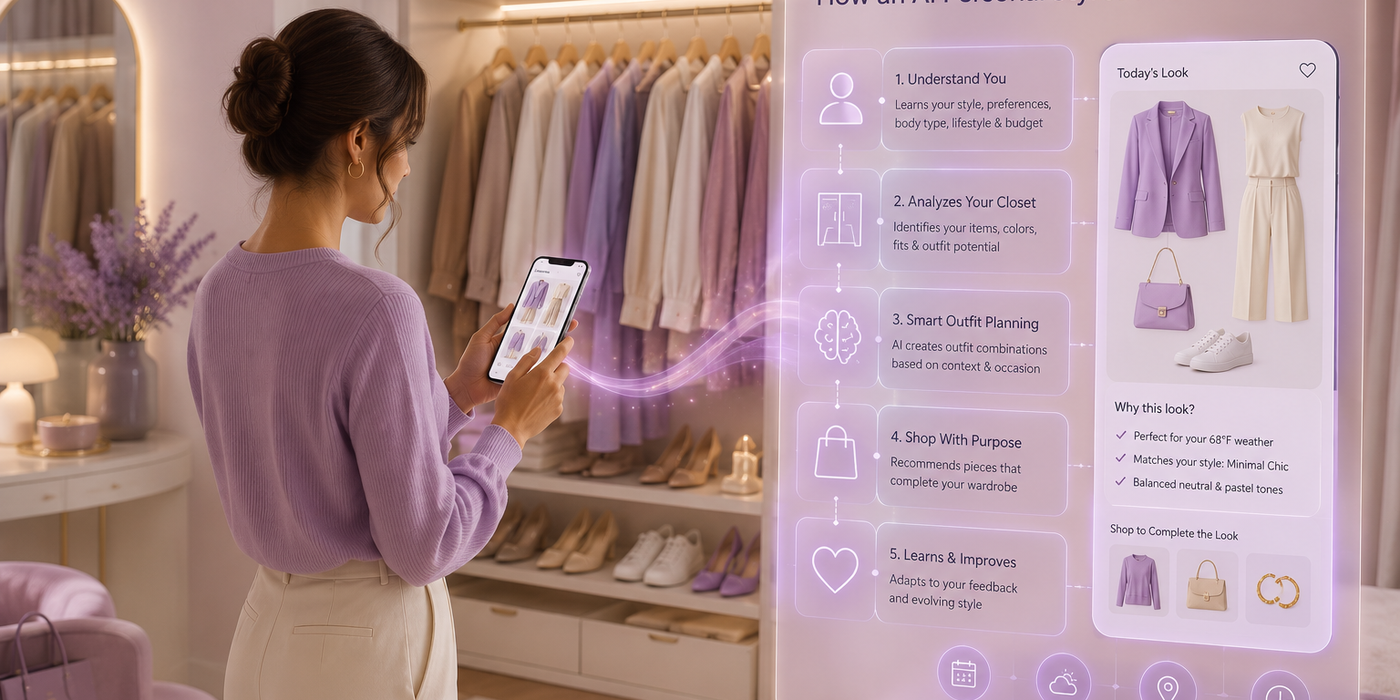
Understanding how these systems work clarifies why the gap between a sophisticated AI stylist and a basic recommendation widget is so wide. The architecture behind platforms like Elara operates across three distinct layers, each doing a different kind of work.
The input layer is where raw information enters the system: wardrobe digitization through photo uploads and retailer integrations, preference onboarding through initial dialogue, and contextual signals like weather conditions, calendar events, and occasion type. This layer is what gives the AI its situational awareness — without it, every recommendation is generic.
The intelligence layer is where that raw information becomes understanding. Natural language processing handles conversational interaction, computer vision identifies garments (fabric, silhouette, color, formality), and machine learning models continuously refine their picture of your taste. Critically, this refinement is iterative, not static. Every time you accept or reject a recommendation, the model updates. This is the fundamental difference from a one-time style quiz: those tools capture a snapshot of your preferences at a single moment; conversational AI captures how your preferences actually evolve.
The output layer translates that intelligence into action — outfit recommendations, shopping gap analysis, virtual try-on previews, and occasion-specific styling. Modern platforms go further by integrating weather APIs and calendar data to deliver context-aware answers to questions like "what should I wear to my 3pm client meeting given today's forecast?"
Ready to upgrade your wardrobe?
Get the Elara app for AI-powered styling and virtual try-ons.
The scale at which this technology now operates confirms it's battle-tested infrastructure, not an experiment. According to Dataintelo, cloud-native platforms processed 4.2 billion styling recommendation requests monthly in 2025 — a figure expected to grow five-fold by 2034. And as joinelara.com reports, AI adoption among fashion and apparel companies doubled from 20% to 44% in just the first half of 2026, signaling that this capability has crossed into mainstream deployment.
The Wardrobe-First Difference: Why the Best AI Stylists Start With What You Own
The previous section established the technology. This one addresses the more consequential question: what is that technology actually for?
As joinelara.com puts it, modern AI styling apps are "less a shopping assistant and more a decision-support system for the wardrobe you already have." That framing is the right starting point for evaluating any platform in this space. An AI stylist that defaults to product discovery before consulting your existing closet isn't really a stylist — it's a monetized recommendation engine wearing a styling interface.
Wardrobe-first platforms work by building a structured inventory of what you already own. Users catalog their clothes through photo AI recognition — the computer vision layer identifies garment type, color, pattern, and formality — supplemented by manual tagging for fit notes or sentimental context. That inventory becomes the AI's primary intelligence layer: before any new purchase is suggested, the system consults what's already there.
Competitors like Klodsy, Acloset, Indyx, and Aiuta each offer genuine value in outfit organization and product discovery. But none of them gate purchase recommendations against existing wardrobe inventory as a default behavior. The shopping feed and the closet exist as parallel experiences rather than an integrated decision loop.
The practical difference becomes clear in a concrete scenario. A user asks: "What should I wear to a casual Friday dinner?" A shopping-first tool surfaces new product recommendations. A wardrobe-first AI like Elara checks the digitized closet first — factors in the evening's weather, the occasion's formality level, and the user's stated preferences — then assembles an outfit from existing pieces. Only if there's a genuine gap (say, no versatile layer for a cool evening) does it suggest a purchase, and that suggestion is anchored to a specific need rather than a trend cycle.
That sequencing — closet first, purchase second — is what separates a styling tool from a shopping tool.
Real-World Outcomes: What the Data Says About AI Styling ROI
Feature lists are easy to compile. What actually drives decisions toward action is evidence that the technology delivers measurable results.
Start with personalization quality. According to Dataintelo, leading AI styling platforms report recommendation acceptance rates of 65–78%, outperforming human-curated services at scale. That figure matters because acceptance rate is a direct proxy for how well the AI understands an individual user — a generic recommendation engine doesn't achieve those numbers.
Virtual try-on technology produces a different category of ROI, one that benefits both sides of the transaction. Dataintelo's research shows virtual try-on reduces product returns by 30–40%. For consumers, that means less buyer's remorse and fewer trips to the post office. For retailers, it means lower reverse logistics costs — a meaningful line item given that return processing can consume 15–30% of a product's original sale price.
The confidence dimension is often underreported in AI styling coverage, but the data is striking. According to Glance AI and Taelor Style research, 67% of men report anxiety about choosing outfits — a figure that reframes AI styling as a practical daily utility rather than a fashion-forward luxury. The same research found that well-dressed individuals receive 27% more online engagement in terms of likes and messages. For anyone navigating professional networking, dating, or social media presence, that's a concrete outcome, not a vanity metric.
Organized by impact category, the evidence breaks down clearly:
- Time saved: Conversational AI delivers a complete outfit recommendation in seconds, replacing 15–20 minutes of closet deliberation.
- Money saved: Wardrobe-first recommendations prevent duplicate purchases; virtual try-on reduces returns by up to 40%.
- Confidence gained: Users who dress with intention report measurably better social outcomes — and 280 million active AI styling users globally as of 2025 (growing 22% year-on-year, according to joinelara.com) suggests the value proposition is sticking.
Choosing the Right AI Personal Stylist: What to Look For in 2026
Those outcome numbers — fewer returns, less decision fatigue, higher recommendation acceptance — only materialize if the platform you choose is built on the right architecture. With dozens of AI stylist apps now competing for attention, the difference between a tool that genuinely improves your relationship with your wardrobe and one that just adds another shopping feed to your life comes down to four criteria.
1. Wardrobe integration depth. Does the platform digitize and learn from your existing clothes, or does it reset with every session? A true wardrobe-first system builds a persistent inventory that gates every recommendation — new purchases are only suggested after the AI confirms your existing wardrobe can't cover the need.
2. Conversational capability. There's a meaningful gap between dialogue-based AI that refines its model of your taste through every exchange and a quiz with a chatbot wrapper bolted on. The former gets smarter over time; the latter delivers the same generic output regardless of how many times you use it.
3. Context awareness. Weather, occasion, calendar, and mood should all feed into recommendations. "Here's an outfit" is not the same as "here's what to wear to your 3pm client meeting given today's forecast."
4. Free tier accessibility. Most readers searching "ai stylist free" or "ai stylist app free" want to validate the value before committing. What's actually free matters — and what's paywalled should be transparent upfront.
Here's how the leading platforms compare across these four criteria:
The virtual styling segment — AR try-on and 3D body modeling — is the fastest-growing area in the space, expanding at a 24.1% CAGR according to Dataintelo. That growth rate signals AR try-on has crossed from novelty to expected feature; platforms without it will increasingly feel incomplete. The broader AI-driven personal styling market sits at approximately $1.8 billion in 2026, projected to reach $9.7 billion by 2034 (Dataintelo) — the infrastructure investment is clearly following user demand.
If you want to see how a wardrobe-first AI stylist works in practice, Elara offers a free trial at joinelara.com — no wardrobe upload required to get started.
Conclusion: The Stylist in Your Pocket Is Already Here
The core argument of this article is simple: AI personal stylists in 2026 are intelligent decision-support systems that start with the wardrobe you already own and work outward — not shopping bots dressed in fashion language. According to Cognitive Market Research, the global AI-based personalized stylist market is on track to reach USD 3.82 billion by 2035, and HTF Market Insights projects active users will exceed 85 million by the end of 2026. This is infrastructure to adopt now, not a trend to monitor from the sidelines.
Elara was built around a single conviction: "We're not building a fashion app. We're building the layer between people, their wardrobe, and fashion." That distinction — wardrobe-first, conversation-driven, context-aware — is what separates a tool that changes how you get dressed from one that just adds noise.
Start with a conversation. No wardrobe upload required. Try Elara free at joinelara.com.
Your AI Stylist is Here.
live on the App Store & Google Play
Available on iOS and Android for seamless access anytime, anywhere.