AI Outfit Planner: Save 10+ Hours Weekly
AI outfit planner tools achieve 97% garment accuracy and save users 10–15 minutes daily while reducing impulse purchases by 20–40%. Learn how they work and which tool fits your needs.

How an AI Outfit Planner Actually Decides What You Should Wear
Table of Contents
- Key Takeaways
- Introduction: The Hidden Intelligence Behind 'What Should I Wear?'
- How AI Outfit Planners Actually Work: The Technology Stack
- The Real Outcomes: What AI Outfit Planning Actually Delivers
- AI Outfit Planning as a Sustainability Tool (Not Just a Convenience)
- Matching Your Need to the Right Tool: A User Segmentation Guide
- What to Look for in the Best AI Outfit Generator
- Conclusion: The Future of Getting Dressed
Key Takeaways
- AI outfit planners achieve 97% garment classification accuracy using computer vision, making them genuinely reliable wardrobe tools
- Users save 10–15 minutes daily, reduce impulse purchases by 20–40%, and increase wardrobe utilization by 200–300%
- Three distinct needs exist: planning from owned clothes, getting styling advice, or generating outfit images — each requires a different tool
- Elara's wardrobe-first, conversational AI bridges all three without forcing you to choose
Introduction: The Hidden Intelligence Behind 'What Should I Wear?'
Most people spend more time staring into their closet each morning than they'd like to admit. You own dozens of pieces — maybe hundreds — yet the same paralysis hits every day. The clothes are there. The right combination isn't obvious. That friction, repeated 365 times a year, is exactly the problem AI outfit planners were built to eliminate.
The technology has moved well past novelty. According to LinkedIn Pulse market analysis, the AI-powered outfit planning tools market is currently valued at approximately $2.3 billion, and it's projected to grow at a CAGR of 8.2% to 15% over the next five years. That kind of investment trajectory reflects genuine consumer demand, not hype.
This article delivers three things. First, a plain-language explanation of how AI outfit planners actually work — the real technology underneath, not marketing language. Second, a look at the measurable outcomes users experience, backed by research data rather than testimonials. Third, a practical guide to matching your specific need to the right type of tool, because "best AI outfit planner" means something different depending on what you're actually trying to solve.
The team behind Elara works at the intersection of AI research and personal styling every day. What follows reflects that practitioner perspective — not a generic roundup of apps, but an honest map of how this technology works and where it genuinely helps.
How AI Outfit Planners Actually Work: The Technology Stack
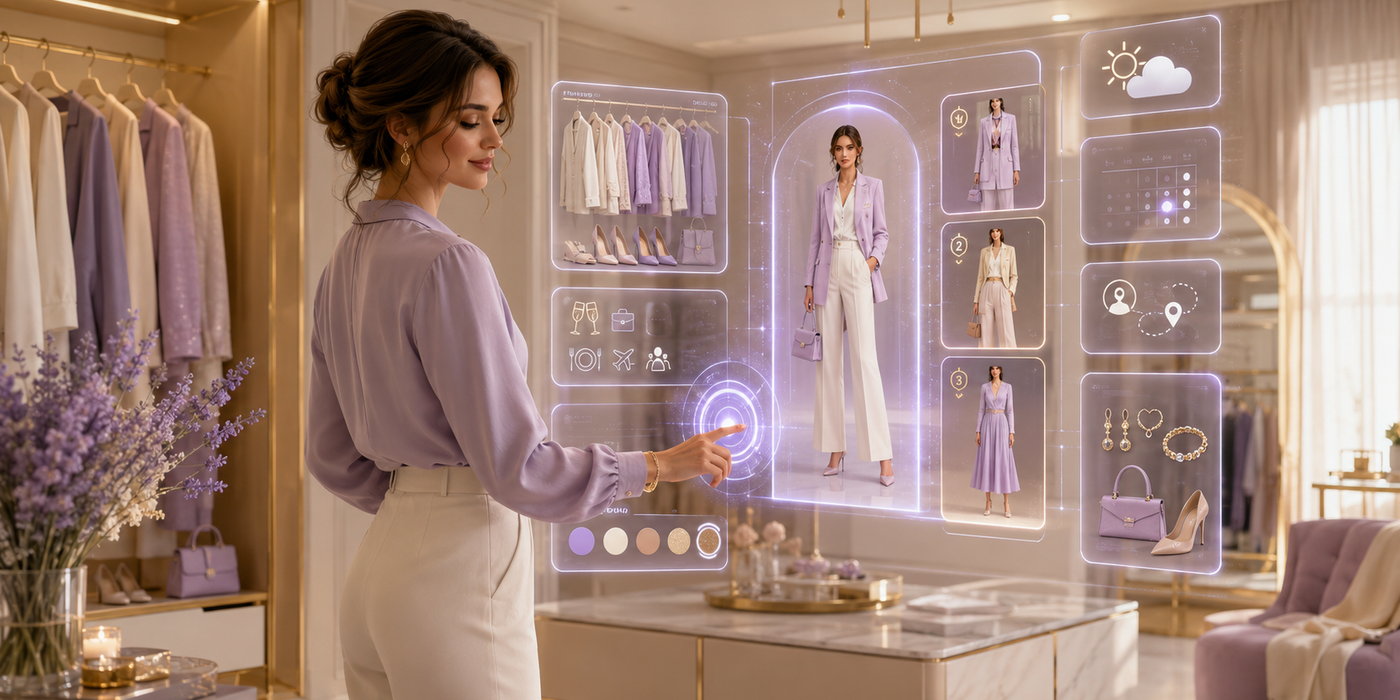
An AI outfit planner is best understood as a stylist who has memorized every item in your closet and checks the weather before you wake up. That analogy captures the three core technology layers powering any serious tool in this category: computer vision for garment recognition, personalization algorithms for preference learning, and contextual data integration for situational relevance.
Computer vision is the foundation. When you photograph a garment and upload it, the AI doesn't just see "a blue top" — it identifies fabric texture, cut, collar type, color hex value, and category with near-human precision. According to aggregated findings from Klodsy, Mockit AI, and Clueless Clothing, current computer vision models achieve 97% accuracy in garment classification. In practical terms, that means the system reliably distinguishes a structured blazer from an oversized cardigan, or a silk midi skirt from a jersey wrap dress — distinctions that matter enormously when building a coherent outfit.
Personalization algorithms work on top of that foundation. Every time you accept or reject a suggestion, mark an item as a favorite, or log a wear, the model updates its understanding of your style preferences. This is fundamentally different from a static lookbook or a manually curated Pinterest board — those don't adapt, and they don't scale to your specific wardrobe. A well-trained personalization layer learns that you avoid cropped silhouettes, prefer earth tones on weekdays, and reach for statement accessories on weekends, without you ever having to state those preferences explicitly.
The third layer — contextual integration — is what separates genuinely intelligent tools from basic outfit filter apps. Leading AI outfit generators pull in weather API data, calendar events, and occasion tags to make suggestions situationally relevant. A Monday morning commute outfit looks different from a Saturday brunch look, and the best virtual outfit creators account for that automatically.
According to industry benchmarks, AI daily outfit suggestions now achieve 85%+ accuracy — a figure that continues to improve as models train on larger behavioral datasets (Klodsy / Mockit AI / Clueless Clothing, aggregated).
Emerging capabilities are pushing the category further still. Color harmony scoring evaluates whether combinations are visually balanced before surfacing them. AR virtual try-on layers garments onto a user's body model, eliminating the need to physically pull items from the closet. And agentic shopping curation — where the AI autonomously identifies genuine wardrobe gaps and surfaces specific products to fill them — represents the next frontier for the best AI outfit generators on the market.
The Real Outcomes: What AI Outfit Planning Actually Delivers
Those emerging capabilities — color harmony scoring, AR try-on, agentic shopping curation — are compelling on paper. But the more immediate question for most users is simpler: does this actually change anything about my daily life? The data says yes, and the numbers are more concrete than most coverage acknowledges.
The most immediate impact is time. AI outfit planners save users 10–15 minutes daily, according to aggregated findings from industry analysts including Klodsy and Mockit AI. That figure sounds modest until you consider the annual scope: across a year, that time compounds to meaningful hours no longer spent deciding what to wear.
The financial impact is equally tangible. Users of AI outfit planning tools report a 20–40% reduction in impulse clothing purchases (Klodsy Blog / Clueless Clothing Blog, aggregated). That's not a behavioral abstraction — it's money that stays in users' pockets rather than funding purchases that duplicate what already hangs in their wardrobe.
Wardrobe utilization tells perhaps the most striking story. AI outfit planners drive a 200–300% increase in wardrobe utilization, meaning clothes that previously sat untouched for months rotate into regular weekly wear. Most people don't have a clothing shortage; they have a visibility problem. AI solves it by surfacing items that would otherwise be forgotten.
Ready to upgrade your wardrobe?
Get the Elara app for AI-powered styling and virtual try-ons.
AI daily outfit suggestions now achieve 85%+ accuracy — Klodsy Blog / Mockit AI Blog / Clueless Clothing Blog (aggregated finding)
That accuracy benchmark matters because it separates genuine personalization from random suggestion. A 2024 Heriot-Watt University study analyzing nearly 6,000 wardrobe app reviews confirmed what the accuracy numbers imply: users of these tools buy less and wear their existing clothes more frequently. The technology isn't just convenient — it measurably changes purchasing behavior.
AI Outfit Planning as a Sustainability Tool (Not Just a Convenience)
The financial and time benefits are compelling enough on their own. The sustainability dimension, however, is where AI outfit planning becomes something more significant — and where most coverage goes quiet.
AI-powered sustainable fashion intelligence features reduce overconsumption by up to 25%, according to LinkedIn Pulse market research on outfit planner app growth. That reduction isn't driven by guilt or messaging campaigns. It comes from a simple mechanism: when an AI shows you exactly what you own and how often you wear it, the impulse to buy something new weakens considerably.
The return rate problem compounds the issue further. Fashion returns are environmentally costly — each returned item generates transport emissions, and a significant share ends up in landfill rather than back on shelves. AI personalization tools cut clothing return rates by up to 36% (StyTrix Blog), because recommendations grounded in a user's actual body, preferences, and existing wardrobe are far more likely to result in kept purchases than generic algorithmic suggestions or trend-chasing impulse buys.
The Heriot-Watt University study of nearly 6,000 reviews provides the academic anchor here: tracking wardrobe use doesn't just change what users wear — it changes what they buy. When people see their wardrobe data, purchasing behavior shifts. This is behavioral economics in action, not lifestyle aspiration.
The practical implication for tool selection is this: the best AI outfit planners operate on a wardrobe-first philosophy. Rather than surfacing new purchases as the default output, they treat a user's existing wardrobe as the primary resource. New products enter the picture only when the AI identifies a genuine gap — a missing layer for cold weather, a neutral shoe that would unlock three underused outfits — not because a brand paid for placement. Sustainability, framed this way, is less a moral stance than a straightforward financial and lifestyle advantage: spend less, waste less, and get more from what you already own.
Matching Your Need to the Right Tool: A User Segmentation Guide
Generic "best AI outfit planner" roundups treat all users as interchangeable. They're not. Three fundamentally different needs drive searches in this space, and conflating them leads readers to download tools that solve the wrong problem entirely.
Segment 1: "I want to plan outfits from clothes I already own"
This is the largest and most underserved segment — and it's the one behind most "outfit planner app free" and "outfit maker online free" searches. These users don't need image generation. They need wardrobe integration: a tool that catalogs their existing items and builds outfit combinations from them.
Whering is the benchmark here. As WearView notes, Whering "is fully free, with no premium tier gating the core wardrobe and styling features" — a meaningful differentiator in a space where most apps reserve useful functionality for paid tiers. Elara occupies the same wardrobe-first category but adds a conversational layer, allowing users to refine suggestions through natural dialogue rather than clicking through static menus.
Segment 2: "I want general styling advice or inspiration"
These users aren't cataloging a wardrobe — they want to understand what suits them, explore new aesthetics, or get a second opinion on a specific look. Conversational AI tools (ChatGPT, Gemini) handle this reasonably well for general guidance. Elara bridges segments 1 and 2: because it knows a user's actual wardrobe, its styling advice is grounded in clothes they can wear today, not hypothetical looks requiring new purchases.
Segment 3: "I want to generate images of new outfit ideas"
Image generation tools like Midjourney or DALL-E serve this need. They're creative and visually compelling, but they don't connect to real wardrobes or produce wearable recommendations — a distinction worth making explicit before a user invests time in a tool that won't solve their actual problem.
Not sure which segment you belong to? Ask yourself three questions:
- Am I trying to get more use from clothes I already own?
- Am I trying to learn what styles, cuts, or colors actually suit me?
- Am I trying to visualize a look I've imagined but don't yet own?
Your answer to whichever question feels most urgent points directly to the tool category you need.
What to Look for in the Best AI Outfit Generator
Once you know which user segment you belong to, the next question is how to evaluate the tools competing for your attention. The best AI outfit generator for your needs isn't necessarily the one with the longest feature list — it's the one that performs well across the criteria that actually matter to your daily use.
Five evaluation criteria separate genuinely useful tools from ones that impress in demos but disappoint in practice:
- Wardrobe integration depth. Does the tool learn from your clothes, or does it serve up generic looks that ignore your actual closet? A wardrobe-first tool like Elara builds suggestions from what you own, not from a lookbook.
- Personalization accuracy over time. Static recommendation engines don't improve — they make the same quality of suggestion on day 90 as they did on day one. According to aggregated findings from Klodsy and Mockit AI, leading AI outfit planners now achieve 85%+ suggestion accuracy, a benchmark worth asking any tool to justify.
- Contextual awareness. Does the tool factor in weather, occasion, and calendar events? A Monday morning board meeting and a Saturday farmers' market require fundamentally different outputs, and the best tools handle that distinction automatically.
- Sustainability features. Wear-frequency tracking, underused-item alerts, and duplicate-purchase warnings distinguish tools designed for wardrobe intelligence from those designed for engagement metrics.
- Conversational interface quality. Can you refine a suggestion through natural dialogue — "make it more casual" or "I'm wearing heels, not flats" — or are you stuck clicking through rigid menus?
With the AI-powered outfit planning market projected to grow at 8.2–15% CAGR over the next five years, competition in this space will intensify sharply. The tools that survive that consolidation will be the ones that score well across all five criteria — not just one or two.
Conclusion: The Future of Getting Dressed
Three things should be clear by now: the technology powering AI outfit planning is accurate and maturing fast, the outcomes it delivers are measurable rather than theoretical, and the right tool depends entirely on understanding your own specific need.
The dual ROI holds whether you're optimizing for personal convenience or environmental impact. AI outfit planning saves users real time, keeps real money from funding impulse purchases, and reduces the fashion overconsumption and return-driven emissions that make clothing one of the world's most wasteful industries. These benefits compound — the longer a tool knows your wardrobe, the better it performs on every dimension.
According to LinkedIn Pulse market research, the AI-powered outfit planning tools market is growing at 8.2–15% CAGR. That trajectory signals something significant: AI styling is no longer a novelty feature in a niche app. It's becoming infrastructure for how people manage their wardrobes and make purchasing decisions.
If you're ready to move from browsing to building, explore Elara at joinelara.com, subscribe for more styling intelligence content, or read our guide on building a capsule wardrobe with AI assistance.
The best outfit planner isn't the one with the most features. It's the one that actually knows you.
Your AI Stylist is Here.
live on the App Store & Google Play
Available on iOS and Android for seamless access anytime, anywhere.