

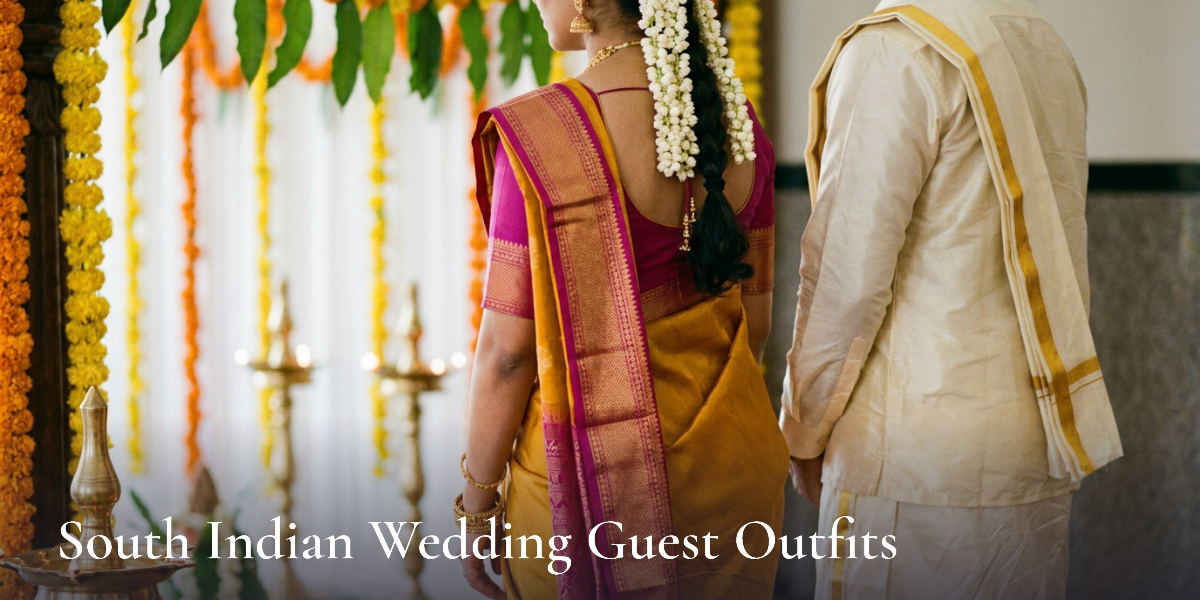
South Indian Wedding Guest Outfits: What to Wear (Women and Men)
A silk saree or silk-cotton set for women, a veshti and silk shirt for men. Colours to skip, regional weaves and why the muhurtham is often at dawn.
 Mehul AgarwalFounder & CEO
Last updated: November 2026
Quick answer: For a South Indian wedding, women guests wear a silk saree (a Kanjivaram, Mysore silk or a lighter silk-cotton) with gold jewellery and jasmine in the hair, and men wear a veshti or pancha (a white or cream dhoti with a gold border) with a silk or white shirt, adding an angavastram for the most traditional look. Skip all-black and all-white for the ceremony and avoid the bride's red. Plan for an early start: Culture Trip notes that many South Indian wedding rituals happen before sunrise, sometimes from 4 am.
South Indian weddings dress differently from the North Indian wedding week most outfit guides are written for. There is usually no sangeet or cocktail night to plan for, the main ceremony is often in the morning, and the dress code leans on handwoven silk and cotton rather than embellished lehengas. Get the fabric, the colour and the timing right and you will look like you belong in the family photos.
This guide covers what women and men wear, how it changes between Tamil, Telugu, Kannada and Kerala weddings, what to do at Christian and Muslim weddings in the south, and how to stay comfortable at a dawn ceremony in the heat. If you have several functions across a North Indian wedding instead, see our Indian wedding guest outfits by ceremony guide.
When South Indian weddings happen this season
Wedding dates follow the family's calendar, and this winter has a gap many Tamil families observe. Margazhi, the Tamil month that runs from 16 December 2026 to 14 January 2027 according to both Hindutone and Hindu Blog, is set aside for worship, and many Tamil families avoid holding weddings in it. Hindutone notes that customs vary and suggests checking with the family priest, so treat this as a common tradition rather than a rule.
After Margazhi comes the month of Thai, which begins with Thai Pongal. Drik Panchang lists Thai Pongal on Friday 15 January 2027, with the Sankranti moment at 9:14 pm IST on 14 January. Thai is widely considered a favourable month for weddings, so if your invitation is for mid-December or late January, that is likely why.
Timing matters for your outfit too. The muhurtham, the auspicious moment of the wedding, is often at dawn. Aza Fashions' Telugu wedding guide says Telugu weddings often start early in the morning, and Culture Trip says ceremonies can begin as early as 4 am. That means dressing in the dark, so choose an outfit you can put on quickly and confidently, and have a pre-pleated saree or a ready-to-wear veshti if you are not practised.
What women wear: the silk saree
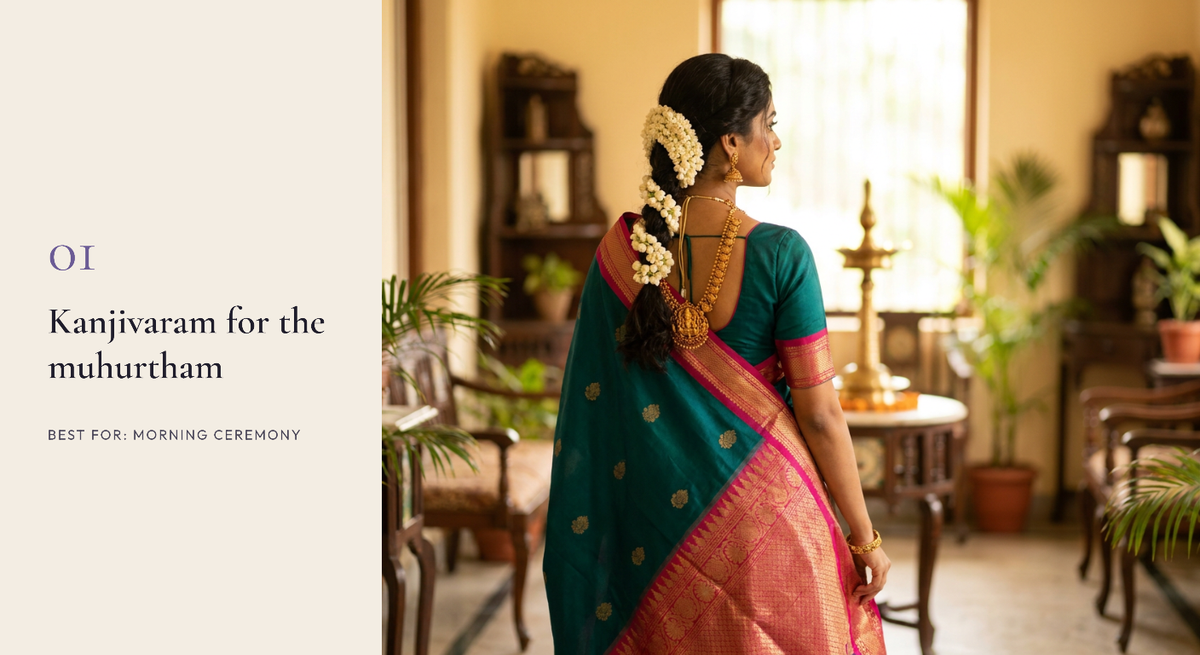
A silk saree is the safest and most respected choice for the main ceremony. According to Aza Fashions' Tamil wedding guest guide, pattu (silk) sarees, especially Kanjivaram, are the top choice, with silk-cotton blends and raw silk also working well.
How to style it so it looks considered, not costume:
- Pick a contrast border. A Kanjivaram's signature is a body and border in different colours, such as peacock green with rani pink or mustard with magenta. Contrast reads as traditional and photographs well.
- Wear gold, and let it be temple jewellery if you have it. A long necklace, jhumkas and bangles are typical. Aza's 2026 wedding guest guide recommends temple jewellery for South Indian weddings.
- Add flowers. Fresh jasmine wound into a braid or bun is a common finishing touch. Madurai Malli, the jasmine from the Madurai region, even carries a Geographical Indication tag.
- Wear flat or block-heeled shoes. Aza suggests skipping tall heels. You may be standing for long stretches, walking on stone floors or removing your shoes entirely.
Can you wear a lehenga? Aza's Tamil guide lists an elegant lehenga as acceptable, but a silk saree is still the most traditional choice. A half-saree style (pavadai davani) or a silk salwar set also works for younger guests and anyone uncomfortable draping a full saree.
What men wear: veshti, shirt and angavastram
For men, the classic guest look is a veshti, a white or cream unstitched cloth with a coloured or gold border, worn with a shirt or kurta. Aza says adding an angavastram, a cloth draped over one shoulder, gives the most traditional finish, and Culture Trip describes a white shirt and veshti as the usual guest outfit.
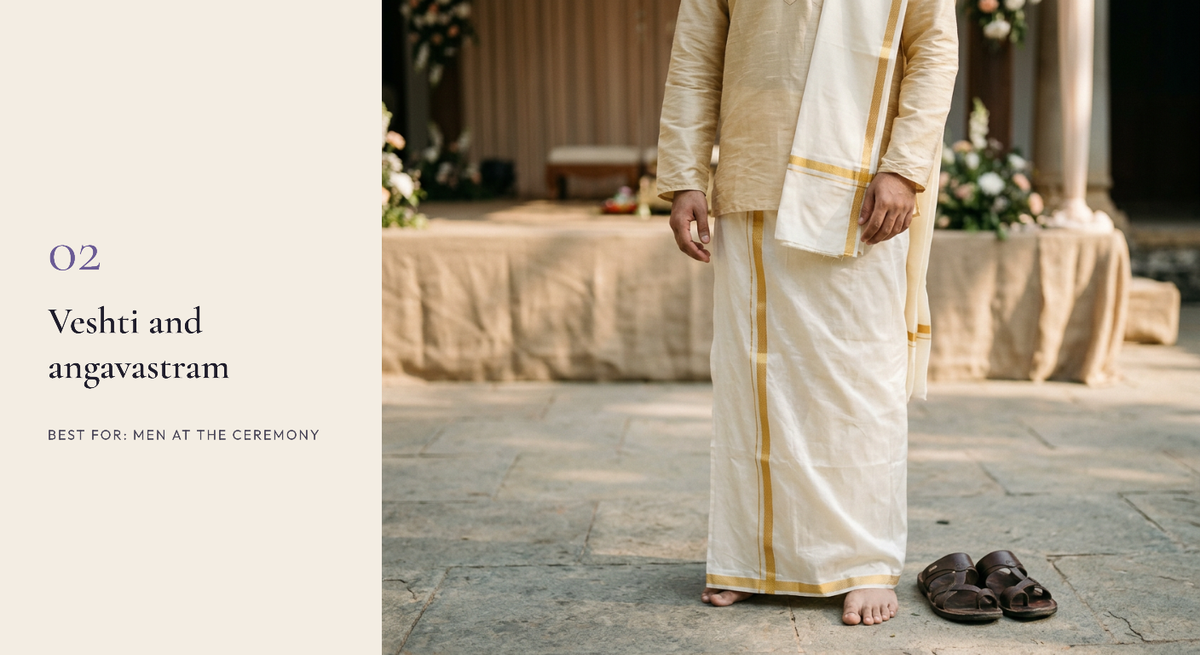
Three ways to wear it, from simplest to most formal:
- Veshti and white cotton shirt. Comfortable in heat and right for most guests.
- Veshti and silk shirt in cream, gold or a soft pastel. Smarter, and a good match if your partner is wearing a silk saree.
- Veshti, silk shirt and angavastram. The most traditional, and the right call if you are close family.
Never tied a veshti? Pothys' dhoti guide explains the basic method: hold the cloth behind you with the border facing out and the ends equal, bring both ends to the front, then knot or tuck them at the waist. Ready-to-wear veshtis with a Velcro or elastic waist are widely sold and are a sensible backup for a 5 am start. Culture Trip's advice is simple: ask someone experienced to help you tie it.
A North Indian sherwani is not wrong, but Culture Trip notes it will make you stand out. A silk kurta is a reasonable middle ground, and Aza's Telugu guide suggests a sherwani mainly for the reception.
How it changes by region
The silk-saree-and-veshti formula holds across the south, but each region has its own weaves and words, and wearing a local weave is a thoughtful gesture.
Tamil weddings
Kanjivaram (Kanchipuram) silk is the headline saree. Men wear a veshti and shirt, often with an angavastram. The reception, usually the evening before or after, is more relaxed: Aza notes it is where you can wear a lehenga, a lighter saree or, for men, a suit or bandhgala.

Want this styled from your own closet?
Elara builds the look from what you own, then lets you try it on.
Telugu weddings
Kanjivaram and pattu silk sarees are common, and men wear a pancha (dhoti), which Aza describes as often cream with a gold border, or a silk kurta. Telangana and Andhra Pradesh also have their own celebrated weaves. Gadwal sarees, according to Telangana Tourism, combine an unbleached cotton body with an attached silk border and pallu. The cotton-bodied versions are light, which helps in the heat. Pochampally ikat, Uppada and Venkatagiri are other Geographical Indication-protected weaves from the region.
Kannada weddings
Mysore silk is the local wedding saree, and men wear a panche (the Kannada word for dhoti) with a shirt. Aza's Karnataka textiles guide describes Mysore silk as reserved for weddings and festivals like Dasara. Ilkal sarees, with their red silk pallu, are more often everyday wear, so save them for a smaller function.
Kerala weddings
Kerala Hindu weddings use a different palette. White and cream with gold zari is the tradition, in the kasavu saree and the two-piece mundum neriyathum, as Manyavar's Kerala wedding guide explains. Men wear a mundu, usually cream with a gold border, and a shirt. Aza notes the ceremony itself is often completed within an hour, so it is a shorter dress-up than many guests expect.
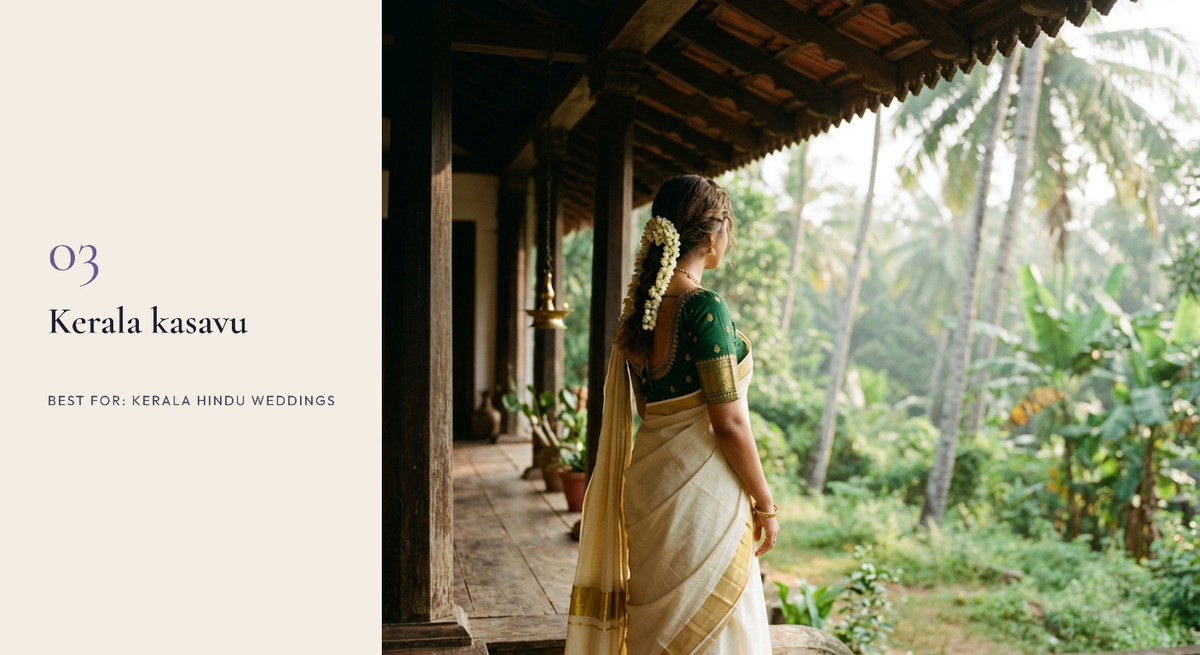
This is the one place where the "avoid white" advice below does not apply in the same way: cream and gold is the traditional wedding palette in Kerala. If you would rather not match the family, a kasavu saree with a coloured border or a pastel silk is a safe alternative.
Christian and Muslim weddings in the south
For a church wedding, Aza's South Indian Christian wedding guide advises covered shoulders and no high slits in church, pastels for the day and jewel tones for the reception, and ivory or cream rather than all-white. Men can wear a navy, grey or charcoal suit. For a nikah, Aza's nikah guide suggests covered shoulders, three-quarter or full sleeves, and carrying a dupatta or scarf because some venues expect a head covering. Men can wear a kurta-pyjama or shalwar kameez.
Colours to wear and colours to skip
Wear bright, festive colours: gold, mustard, peacock green, rani pink, maroon, royal blue and orange all suit a South Indian wedding. Then avoid three things for a Hindu ceremony. These are etiquette points from fashion and wedding guides, not rules, and families differ.
- All-black. Aza's Telugu guide says black is considered inauspicious for religious ceremonies. It is usually fine at an evening reception.
- All-white. The same guide links all-white to mourning in many South Indian households. White or cream with a gold or coloured border is different, and is standard menswear.
- The bride's red. Aza's Tamil guide suggests avoiding solid red or anything close to the bride's red, maroon or gold. If you love red, choose wine, coral or a red border on another colour instead.
Practical tips for temples, heat and the meal
Many South Indian weddings take place in temples or temple-style halls, and that shapes what works on the day.
- Temple dress codes vary by temple. Guruvayur in Kerala, a popular wedding temple, allows men in a plain white or cream dhoti but not shirts or trousers inside, according to Kerala Tourism, and does not allow footwear. Women can wear a saree, a skirt and blouse, or a churidar. Ask the hosts if the venue has rules.
- Expect to remove your shoes. Wear sandals you can slip off and on easily, and carry a small bag for them if needed.
- Choose breathable fabric for heat. Silk-cotton, Chettinad cotton (a checked cotton saree with a Geographical Indication tag) and cotton-bodied Gadwal sarees are cooler than heavy brocade silk.
- Be ready for a banana-leaf meal. Culture Trip notes that food is served on a banana leaf and eaten with the right hand, and that folding the top half of the leaf over when you finish signals you enjoyed it. Avoid long, trailing sleeves and pick a saree you can manage at a low table or on floor seating.
- Carry a light shawl for an air-conditioned hall after a hot walk in.
How to check a silk saree is real before you buy
If you are buying a silk saree for the wedding, a few checks protect you from paying silk prices for a blend. For Kanjivaram, the Kancheepuram district administration explains that the body and border are woven separately and then interlocked, so the border will not come off even if the saree tears, and that there is often a zigzag line where the body meets the pallu. It also mentions a zari-testing facility in Kanchipuram that checks gold and silver content for a small fee.
Look for the Silk Mark label, a quality assurance mark run by the Silk Mark Organisation of India under the Central Silk Board, which the Ministry of Textiles says signifies the product is pure silk. For Mysore silk, Deccan Chronicle reports that genuine sarees come from KSIC and carry its hologram and a unique code. Our real silk saree guide goes deeper on Silk Mark and zari testing.
Plan your outfit with Elara
If you have a wedding coming up, Elara can help you put the look together from what you already own. Add your sarees, veshtis and jewellery to your digital closet, tell the AI stylist the wedding is a morning muhurtham in Chennai or an evening reception in Kochi, and it will suggest combinations, flag what you are missing and save the outfit to your Calendar so you are not deciding at 4 am.
FAQ
Can I wear black to a South Indian wedding?
Avoid all-black for the wedding ceremony, as black is considered inauspicious for religious ceremonies in many South Indian families. Black is usually fine for an evening reception, and a black saree with a bright border is less of an issue than a head-to-toe black outfit.
Can I wear white to a South Indian wedding?
Avoid all-white at a Hindu ceremony because many families associate it with mourning. White or cream with a gold or coloured border is different: it is standard for men's veshtis and is the traditional palette at Kerala Hindu weddings.
What do men wear to a South Indian wedding?
A veshti or pancha (a white or cream dhoti with a gold or coloured border) with a white or silk shirt, plus an angavastram over one shoulder for a more traditional look. A silk kurta is a good alternative, and a suit or bandhgala works at the reception.
Can I wear a lehenga to a South Indian wedding?
Yes, an elegant lehenga is acceptable, especially at the reception, but a silk saree is the most traditional choice for the main ceremony. A half-saree or silk salwar set is a comfortable middle ground.
What time do South Indian weddings start?
Often very early. The muhurtham is frequently at dawn, and some ceremonies begin around 4 am. Check the time on the invitation and plan to dress the night before if you are travelling.
Can I wear a saree if I am not Indian?
Yes. Guests from outside the culture wearing a saree or veshti is generally welcomed as a sign of respect. Ask a friend or the host family to help with the drape, and follow the same colour etiquette as everyone else.
Your stylist, in your pocket
Stop reading about outfits. Start wearing them.
Elara knows your closet, shops every store and gets you dressed for any occasion.