
What to Wear in 40 Degrees Celsius: Fabrics, Fit and 4 Outfits
At 40°C (104°F), wear loose, light-coloured linen or cotton, a wide-brimmed hat and breathable shoes. Why fit beats colour, best fabrics and 4 outfits.
 Mehul AgarwalFounder & CEO
Last updated: November 2026
Quick answer: At 40°C (104°F), wear loose, lightweight, light-coloured clothes in breathable natural fibres such as linen or cotton, cover your head with a wide-brimmed hat or a cloth, and wear closed sandals or breathable shoes rather than going barefoot. That is the same advice India's National Disaster Management Authority, the US CDC and Australia's Healthdirect all give. Looser beats lighter in colour: the air gap around your body does more of the cooling than the shade of the fabric.
At 40°C, the India Meteorological Department starts treating the weather as a possible heatwave: a heatwave is considered once a plains station reaches at least 40°C and is well above its normal (IMD heatwave definition). Whether you are in Delhi in May, Perth in January or Phoenix in July, the clothing rules are the same. This guide explains which fabrics and cuts actually help, what the research says about colour, and four outfits for the situations people search for most. If you meant 40°F, see our guide to what to wear in 40 degree weather instead.
What the official heat advice says to wear
Every major health agency gives the same three-part rule: loose, light-weight and light-coloured, plus a head covering.
- India (NDMA): "Wear light-weight, light-coloured, loose, cotton clothes" and "Cover your head: use a cloth, hat or umbrella" (NDMA heatwave guidance). India's health ministry adds "towel and other traditional head gears" as head cover and says to wear shoes or chappals in the sun (MoHFW public health advisory).
- United States (CDC): "Wear a brimmed hat and loose, lightweight, light-colored clothing" (CDC).
- Australia (Healthdirect): light-coloured, loose-fitting clothes, remove excess clothing, and wear a hat if you must go outside (Healthdirect).
The rest of this guide explains why each of those words matters, so you can make good choices with what is already in your wardrobe.
Loose fit matters more than you think
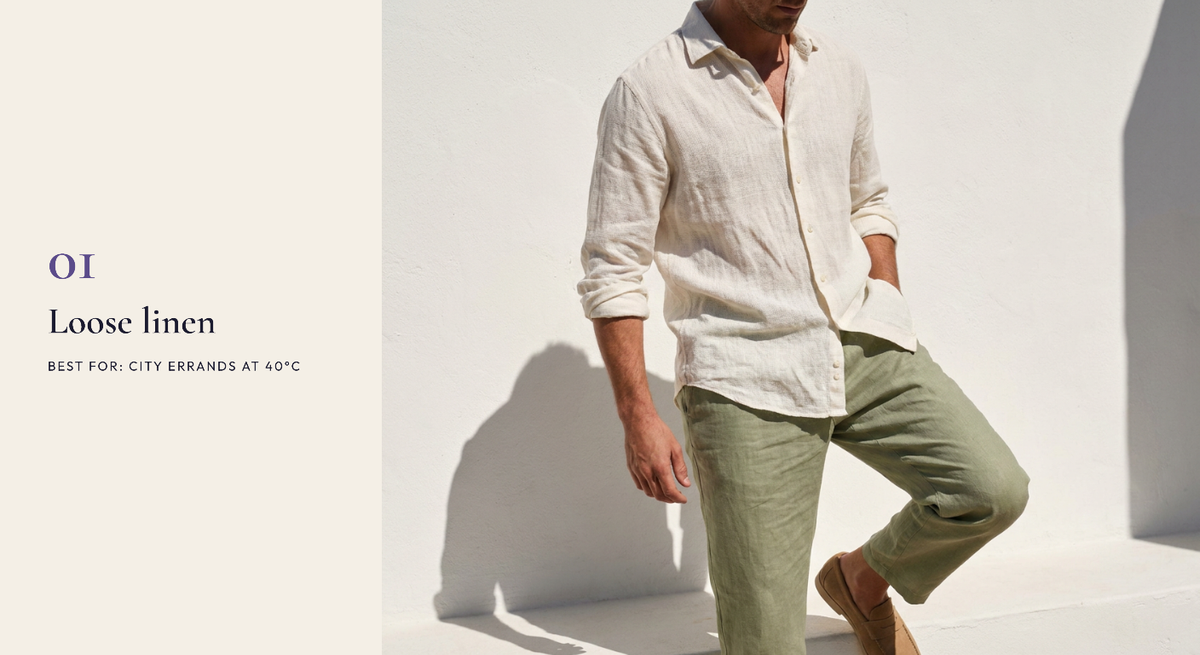
Choose clothes that hang away from your body, with open necks and wide sleeves or legs, because moving air carries heat and sweat away. A loose linen shirt and wide trousers beat a fitted tee and skinny jeans at 40°C, even in the same colour.
The reason is the layer of air between your skin and your clothes. A 2025 review in the International Journal of Biometeorology found that more than 60% of a clothing system's insulation can come from that trapped air layer, and that garment openings increase ventilation through it (Torres et al., 2025). When the air can move, it stops insulating you and starts carrying heat away.
Textile researcher Meredith McQuerry of Florida State University told the AP that for standing or sitting, people may prefer "a looser fit that allows for more airflow," while a tighter fit can suit exercise, and that "open weave and loose knit structures are best" (AP via NBC New York).
Best fabrics for 40 degree heat
Linen first, then cotton in an open weave; wear technical wicking fabrics when you are moving, not when you are sitting still.
- Linen. Georgia Tech's Professor Sundaresan Jayaraman notes that "the moisture vapor transport rate for linen is much greater than that for cotton or polyester" (Georgia Tech). Linen also tends to be woven loosely and hangs away from the skin.
- Cotton, mulmul, voile and khadi. McQuerry says cellulosic fibres "like cotton and flax (linen), tend to be more breathable" (AP). Thin, open weaves (mulmul, voile, lawn) are the cotton to look for. Thick denim and heavy jersey are not.
- Polyester, with a catch. Jayaraman calls regular polyester "terrible when it comes to moisture absorption", though wicking performance polyester "doesn't feel clammy" (Georgia Tech). In a small 1995 study of women resting at 37°C, local sweat rates were higher in polyester than in cotton for five of six people (Ergonomics, 1995). Save the gym tee for running.
- Avoid finishes that block air. McQuerry advises fabrics "free of any water- or soil-repellent finishes," which can reduce breathability.
Does colour matter? White vs black at 40°C
Light colours are the safe default, but the cut matters more. In a classic 1980 study published in Nature, loose Bedouin robes worn in a hot desert gave the wearer the same heat gain whether black or white, because "the additional heat absorbed by the black robe was lost before it reached the skin" (Shkolnik et al., Nature). A tight black tee has no air gap to lose that heat in.
There is a trade-off with sun protection. Australia's radiation agency ARPANSA notes that darker colours absorb more UV and that tighter weaves let less through (ARPANSA). So for long hours outdoors, a tightly woven light fabric, or one labelled UPF 50+, gives you both. ARPANSA says UPF 50 and higher provides all-day protection even for fair skin, and that protection drops when fabric is stretched or wet (ARPANSA labelling). The Skin Cancer Foundation notes a wet T-shirt "provides a UPF of only 3" (Skin Cancer Foundation), worth remembering if you soak your shirt to cool down.
4 outfits for 40°C days
These cover the situations people plan for most, using pieces most wardrobes already have.

Want this styled from your own closet?
Elara builds the look from what you own, then lets you try it on.
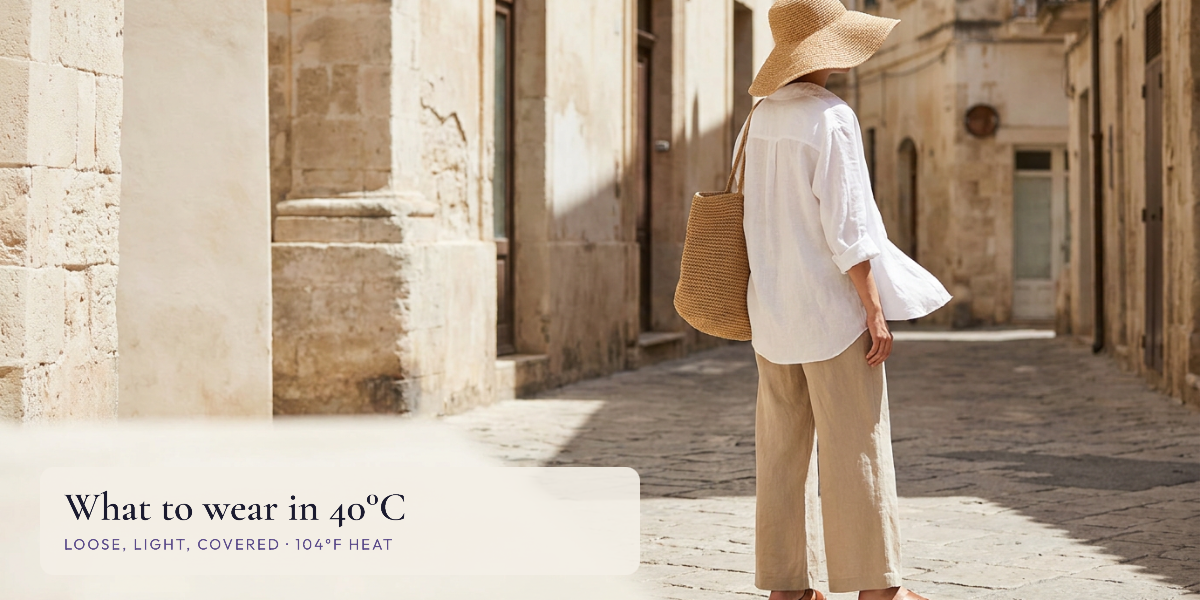
- City errands and commuting: a loose linen or cotton shirt with rolled sleeves, wide-leg linen or cotton trousers, breathable loafers or closed sandals, a wide-brimmed hat and a tote. Long, loose sleeves protect your arms from sun without trapping heat.
- Indian summer, everyday: a loose mulmul or cotton kurta with cotton pants or a palazzo, flat chappals, and a cotton dupatta, stole or gamcha over your head in direct sun, as the health ministry's "traditional head gears" advice suggests. Khadi is another breathable option.
- Office with air-conditioning: a breathable cotton or linen-blend shirt or kurta, unlined trousers or a loose midi dress, and a light layer for the cold office. The commute is the hot part, so dress for that and add the layer indoors.
- Early-morning walk or run: a loose, light-coloured wicking tee, shorts, a running cap with a neck flap, sunglasses and water. Go before the heat builds; in heatwave conditions, health agencies advise avoiding strenuous activity in the hottest part of the day.
Hats, sunglasses and shoes
Wear a broad-brimmed or legionnaire-style hat, UV400 sunglasses and closed, breathable shoes. ARPANSA says broad-brimmed, bucket and legionnaire hats "provide the most protection", that a broad brim for adults is 7.5 cm or more, and that "baseball caps do not protect the neck and ears" (ARPANSA hats).
For sunglasses, the World Health Organization says to look for a "UV400" label and notes that lens darkness and price do not show how much UV a pair blocks (WHO). In Australia, sunglasses must meet AS/NZS 1067.1, and wrap-around styles also block UV from the sides (ARPANSA sunglasses).
For feet, NDMA's advice is simply "don't go out barefoot", and hot pavements are the reason. Breathable closed sandals, canvas sneakers or leather chappals with a thick sole work better than thin flip-flops.
What not to wear at 40°C
- Skinny jeans, thick denim and tight synthetic layers that trap air and sweat.
- Fitted black clothing in direct sun (loose black is fine; tight black is not).
- Water-repellent or heavily coated fabrics.
- A baseball cap alone in strong sun, which leaves your neck and ears exposed.
- New, unbroken shoes on long hot walks.
FAQ
What should I wear in 40 degree Celsius weather?
Loose, lightweight, light-coloured clothes in linen or breathable cotton, a wide-brimmed hat or head cloth, sunglasses and closed breathable shoes. NDMA, the CDC and Healthdirect all give this same core advice.
What should a woman wear in 40 degree Celsius weather?
A loose cotton or linen kurta, shirt dress or midi dress, or a loose shirt with wide-leg trousers, plus a dupatta, stole or wide-brimmed hat for sun and flat breathable sandals. Avoid tight synthetics and thick denim.
Is linen or cotton better for 40°C?
Linen has the edge: Georgia Tech research notes its moisture vapour transport is much greater than cotton's or polyester's. Thin, open-weave cotton such as mulmul or voile is a close second.
Is it better to wear white or black in extreme heat?
Light colours are the safe default, but fit matters more. A loose black robe performed the same as a white one in the 1980 Bedouin study, while tight dark clothing has no air gap. For long sun exposure, darker or tightly woven fabrics block more UV.
Is 40 degrees Celsius a heatwave?
It can be. IMD considers a heatwave once a plains station reaches at least 40°C and is well above its normal, or hits 45°C or more outright.
Should I wear shorts in 40 degree heat?
Shorts are fine for short trips and exercise, but loose long trousers or skirts in light fabric shade your skin from the sun while still letting air move, which many people find more comfortable in direct sun.
Build a heatwave wardrobe from what you own
Elara is an AI personal stylist that works with your real closet. Add your clothes, tell Elara it is 40°C and you have a commute, an office day and an evening out, and it builds outfits from your breathable pieces, shows you which gaps matter (a linen shirt, a wide-brimmed hat) and lets you try looks on before you buy. Try Elara free.
Your stylist, in your pocket
Stop reading about outfits. Start wearing them.
Elara knows your closet, shops every store and gets you dressed for any occasion.