Personal Stylist Cost 2026: US & India Pricing Guide
Personal stylist costs range $100–$500/hour in the US, $150–$400 per session, or $500–$3,000+ for wardrobe overhauls. Compare human stylists vs. AI tools at $9–$20/month to find your best ROI.


Personal Stylist Cost 2026: AI vs Human Pricing
Table of Contents
- Key Takeaways
- Introduction: What Does a Personal Stylist Actually Cost in 2026?
- The US Personal Stylist Pricing Breakdown (2026)
- Personal Stylist Costs in India (2026): What We Know
- AI vs. Human Stylist: A True Cost Comparison
- When Should You Hire a Human Stylist vs. Use AI?
- FAQ: Personal Stylist Costs and AI Styling
- Conclusion: Stop Paying for Styling You Don't Need
How Much Does a Personal Stylist Cost in 2026 (US and India)
Key Takeaways
- US personal stylist rates run $100–$300/hour typically; premium markets like NYC and San Francisco reach $150–$500/hour
- One-time sessions cost $150–$400; wardrobe overhauls run $500–$3,000+; celebrity engagements hit $5,000–$15,000+
- AI styling tools cost $9–$20/month—a fraction of any human alternative
- Hourly rate comparisons are misleading; package scope and outcomes-per-dollar matter more
- For most users, an AI-first approach with occasional human consultations delivers the strongest ROI
Introduction: What Does a Personal Stylist Actually Cost in 2026?
Personal styling in 2026 spans a price range most people don't expect: human stylists charge anywhere from $100 to $500 per hour depending on city and experience level, while AI-powered styling tools run $9–$20 per month. That's not a rounding error—it's a fundamental shift in how styling services are delivered and priced.
The gap matters because most people searching "how much does a personal stylist cost" are asking something different: which type of styling service solves my specific problem without wasting my budget? A $200/hour human stylist and a $12/month AI platform don't compete on the same terms. They serve different needs, different schedules, and different definitions of "looking good."
The 2026 market reflects this reality. As noted by Sterling Style Academy, Wardrobe Editor, and coloranalysistech.com, styling is no longer a single-rate service but a tiered market where experience, city, and deliverables determine pricing. There is no meaningful "average" rate anymore.
This article breaks down three distinct service tiers—traditional human stylists, virtual and hybrid services, and AI-powered platforms like Elara—with enough pricing detail that you can identify exactly where you fit and what you should expect to pay. By the end, you'll have a decision framework, not just a price list.
The US Personal Stylist Pricing Breakdown (2026)
Personal stylist pricing in the US follows a clear tier structure once you organize it by service type rather than hourly rate. Here's what each tier actually costs and who it's designed for.
US Personal Stylist Pricing Tiers (2026)
Service Type
Typical Cost
Best For
Hourly in-person (standard markets)
$100–$300/hour
Ongoing wardrobe support, personal shopping
Hourly in-person (NYC, SF, premium cities)
$150–$500/hour
High-end clients, editorial, executive
One-time styling session
$150–$400
Event prep, wardrobe audit
Wardrobe overhaul package
$500–$3,000+
Full closet reset, style repositioning
Executive/high-net-worth retainer
$1,000–$5,000/month
Ongoing access, travel styling, seasonal updates
Celebrity/luxury engagements
$5,000–$15,000+
Red carpet, press tours, high-profile appearances
According to Sterling Style Academy, Wardrobe Editor, and coloranalysistech.com, standard US hourly rates run $100–$300, while top-tier stylists in New York and San Francisco routinely command $150–$500 per hour. One-time sessions—useful for a wardrobe audit before a new job or a single event—typically land between $150 and $400 per session. Wardrobe overhauls, which involve a full closet edit plus outfit planning, range from $500 to $3,000+ depending on the size of the project and the stylist's experience level.
At the top of the market, executive retainers start around $1,000–$5,000 per month for ongoing access—a model used by executives who need consistent, occasion-specific styling across a full calendar. Celebrity and luxury engagements operate in a different category entirely: $5,000–$15,000+ for high-profile work where the stylist's network, press relationships, and designer access are part of the value.
Four factors drive most of the price variation you'll see:
- Experience and reputation — A stylist with 15 years of editorial credits charges differently than someone two years into their practice, even in the same city.
- Location — Rates in NYC and San Francisco run higher than mid-market cities like Denver or Nashville.
- Deliverables included — Does the rate cover a written style guide? A curated shopping list? A follow-up session? These inclusions dramatically affect value.
- Personal shopping involvement — Stylists who accompany clients to stores or manage online orders often charge a separate shopping fee or higher hourly rate to account for the time involved.
According to Wardrobe Editor and latestcost.com, comparing stylists by hourly rate alone is misleading. Package inclusions and market positioning often matter more than the headline number. A $150/hour stylist who delivers a detailed style guide, a curated shopping list, and a follow-up check-in may represent better value than a $120/hour stylist whose session ends when the clock stops.
The practical implication: before requesting a quote, know what deliverable you actually need. A one-time session for event prep has a completely different cost structure than a monthly retainer for ongoing wardrobe management.
Personal Stylist Costs in India (2026): What We Know
That same principle—scope and deliverables over headline rate—applies even more sharply when looking outside the US market, where pricing data is far thinner and comparisons break down quickly.
India-specific 2026 pricing for personal stylists is genuinely scarce in published research. Rather than present uncertain figures as fact, this section gives you a framework to evaluate what you find locally.
What research confirms is that India rates are materially lower than US luxury-market rates. Beyond that directional truth, the variation within India is substantial. A stylist in Mumbai or Delhi serving corporate clients commands very different fees than one in Pune or Jaipur working primarily on wedding and occasion styling. In-person services cost more than virtual consultations. Ongoing retainers carry a different structure than one-off event packages.
For Indian readers evaluating local stylists, ask these questions before agreeing to any fee:
Ready to upgrade your wardrobe?
Get the Elara app for AI-powered styling and virtual try-ons.
- Is the rate hourly or package-based? Hourly billing can escalate quickly; a fixed package gives you cost certainty.
- What's explicitly included? Style consultation, wardrobe audit, shopping assistance, and follow-up sessions are often priced separately.
- Is in-store or online shopping assistance extra? Many stylists charge a separate sourcing fee or commission.
- Is the session in-person or virtual? Virtual sessions are almost always cheaper and increasingly common post-2020.
One option that sidesteps the local pricing uncertainty entirely: AI-powered styling tools like Elara, priced at approximately $9–$20/month, are fully accessible to Indian users and deliver wardrobe-aware, personalized styling at a globally consistent price point.
AI vs. Human Stylist: A True Cost Comparison
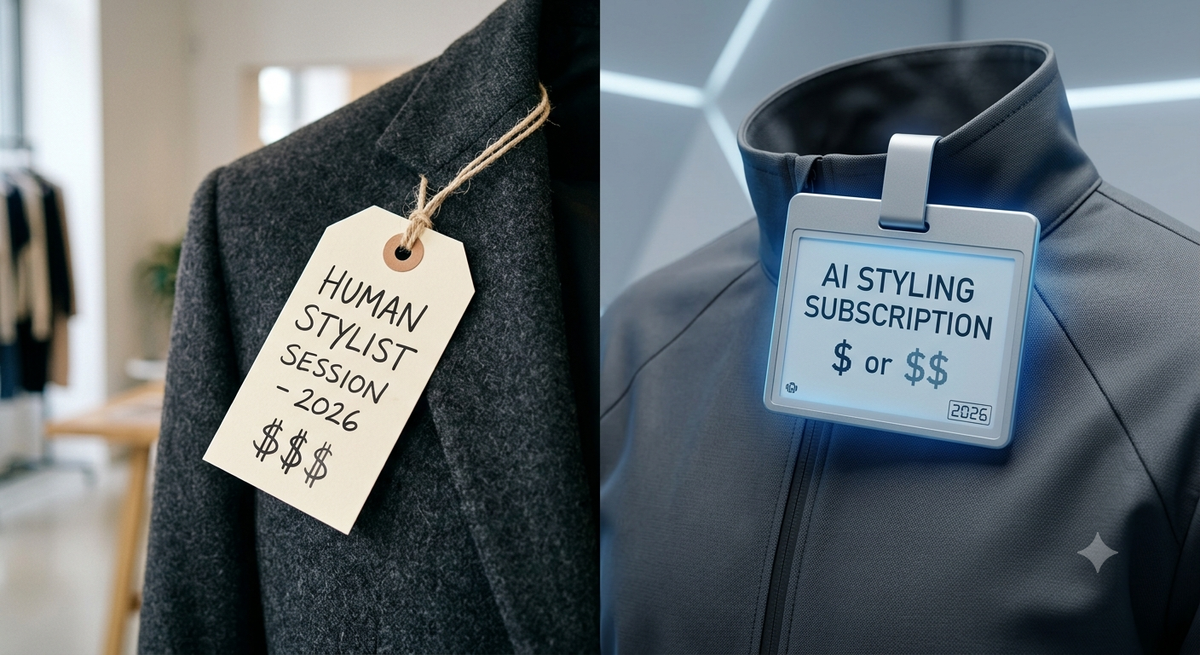
Most stylist cost guides stop at listing rates. None answer the question that actually matters: what do you get per dollar spent, and which model fits your real life?
The anchor contrast is stark. Human stylists in the US run $100–$500/hour depending on city and experience level. AI styling tools like Elara cost $9–$20/month. That's not a marginal difference; it's a structural one.
Here's how the two models compare across the dimensions that actually drive value:
Dimension
Human Stylist
AI Stylist (e.g., Elara)
Cost
$100–$500/hour
$9–$20/month
Availability
Scheduled appointments
Always-on, 24/7
Personalization
Deep, for complex needs
Learns continuously from your wardrobe and preferences
Scalability
Not practical for daily use
Built for daily outfit decisions
Scope
Session-bound
Ongoing—wardrobe, shopping, occasions
The real value proposition most guides skip: an AI tool that helps you avoid purchases that don't work with what you own delivers measurable savings. For someone managing a tight clothing budget, that math is decisive. Wardrobe digitization and smart gap identification mean you buy only what actually integrates with what you already have.
But the smarter case isn't AI versus human—it's AI plus human, deployed strategically. An AI-first approach with Elara as the daily layer covers the high-frequency, low-stakes decisions that eat up mental energy every morning. A human stylist consulted once or twice a year for a strategic wardrobe reset becomes a targeted, high-leverage investment rather than an ongoing expense.
Elara's specific strengths make this hybrid case concrete: wardrobe digitization means your AI stylist actually knows what you own; conversational AI means recommendations adapt to your taste over time rather than serving generic looks; outfit curation from existing clothes means you stop defaulting to the same five combinations; and smart shopping gap identification means new purchases earn their place before you buy them.
"Styling is no longer a single-rate service, but a tiered market where experience, city, and deliverables determine pricing." — Sterling Style Academy, Wardrobe Editor
For most users, the hybrid model—AI daily, human occasionally—delivers better outcome-per-dollar than either option alone.
When Should You Hire a Human Stylist vs. Use AI?
The honest answer most guides avoid: the right choice depends entirely on what you're trying to solve, not on which option sounds more premium.
Hire a human stylist when:
- You're navigating a major life transition—a new executive role, a wedding, a post-pregnancy wardrobe rebuild—where the stakes are high and the brief is complex
- You need in-store personal shopping support for a high-budget wardrobe investment where tactile judgment and brand relationships matter
- You're preparing for editorial, red carpet, or public-facing work where a professional's eye and industry contacts are genuinely irreplaceable
These are high-specificity, low-frequency needs. A human stylist's premium is justified precisely because the situation demands it.
Use AI styling when:
- Your goal is daily outfit decisions without the mental load—the Marketing Manager who needs to walk out the door looking polished for a client meeting without spending 20 minutes staring at a closet
- You want to maximize what you already own before spending more—the Administrative Assistant who can't afford $150/session but wants every item to earn its place
- You're trying to build style consistency on a budget, stop impulse purchases, or rediscover pieces you've forgotten you own
A simple decision framework:
- If your goal is daily outfit confidence → AI styling (Elara) is your primary tool
- If your goal is a one-time wardrobe overhaul → human stylist for the session, AI to maintain it afterward
- If your goal is smarter shopping → AI-first; let gap identification guide every purchase
- If your goal is major-event or life-transition styling → human stylist, supplemented by AI for the day-to-day before and after
- If your budget is under $30/month → AI styling covers 90% of your needs; save the human consultation for when the brief genuinely requires it
The hybrid model—Elara as the daily foundation, a human stylist once or twice a year for strategic resets—beats a standalone $300/hour human for most people's actual lives. The stylists who deliver the most value are those whose model matches the client's real frequency of need, not their aspirational one.
For most readers, that foundation starts at $9–$20/month. Elara covers daily outfit curation, wardrobe maximization, and smarter shopping from day one—no appointment needed, no hourly clock running. Start a free trial at joinelara.com and find out what your existing wardrobe is already capable of.
FAQ: Personal Stylist Costs and AI Styling
How much does a personal stylist cost on average? US personal stylists typically charge $100–$300/hour in standard markets, with premium cities like NYC and San Francisco reaching $150–$500/hour. One-time sessions run $150–$400, while wardrobe overhauls cost $500–$3,000+. Costs vary based on the stylist's experience, location, and what's included in the package—so comparing hourly rates alone doesn't tell the full story.
Is a personal stylist worth the cost? A human stylist makes sense for high-stakes moments: career transitions, major wardrobe rebuilds, or event preparation where professional expertise and industry connections matter. For daily outfit decisions and wardrobe maximization, an AI tool like Elara at $9–$20/month delivers better value for most people. The strongest approach combines both: AI as your daily foundation, a human stylist for occasional strategic resets.
How much does an AI stylist cost compared to a human stylist? AI styling tools run $9–$20/month, while human stylists charge $100–$500/hour. That's roughly 1–2% of the cost of a single human session, but the services aren't identical. AI excels at daily outfit curation and wardrobe maximization; human stylists shine for complex, high-stakes styling needs. Many people benefit from using both—AI for everyday decisions and a human stylist for occasional consultations.
Conclusion: Stop Paying for Styling You Don't Need

The real question was never whether you can afford a personal stylist. It's whether the styling model you choose actually fits how you live and delivers results you can measure.
Human stylists remain genuinely valuable for high-stakes moments: a career pivot, a wardrobe rebuild, a major life transition. At $100–$500/hour, that investment makes sense when the stakes match the cost. Styling is now a tiered market where experience, deliverables, and service model determine value—not the hourly rate alone. For the daily decisions that quietly drain your time and budget, AI has closed the personalization gap in a way that makes a $9–$20/month tool genuinely competitive.
Styling done right saves money, reclaims mornings, and builds the kind of decision confidence that compounds over time. That's an investment, not an indulgence.
Your AI stylist that actually knows you. Try Elara free and let it show you what your wardrobe is already capable of — joinelara.com.
Your AI Stylist is Here.
live on the App Store
Available on iOS for seamless access anytime, anywhere.