Fall Work Outfits: Build a 20-Day Capsule
Fall work outfits don't require a full wardrobe overhaul. Learn how to audit your existing pieces and build 20 distinct outfits from just 10–12 core pieces using the 2026 tailored-but-comfortable aesthetic.

Fall Work Outfits: The Business Casual Capsule That Covers 20 Days
Table of Contents
- Introduction: Why Fall Is the Most Important Wardrobe Reset of the Year
- The 2026 Fall Work Aesthetic: What's Actually Trending (and Why It Matters)
- The 20-Day Business Casual Capsule: Core Pieces and How to Build It
- Fall Work Outfits by Body Type and Demographic: One Philosophy, Many Fits
- How to Audit Your Existing Wardrobe Before Buying Anything New
- Styling the Capsule: Outfit Formulas for Real Work Weeks
- FAQ: Your Fall Capsule Questions Answered
- Conclusion: Build Your Fall Capsule, Not Someone Else's
Key Takeaways
- Fall is the #1 wardrobe reset window: search interest for "office wear" peaked at 79 in October 2025, the year's highest point.
- The dominant 2026 fall work aesthetic is tailored-but-comfortable — heritage textures, rich autumn palettes, and modern proportions.
- Women lead workwear growth; Gen Z normalizes repeatable neutral staples; men's office style is shifting toward balanced, wider fits.
- Audit first, buy gaps second — 10–12 core pieces cover 20 distinct outfits.
- Elara's AI stylist maps your existing closet to fall-ready combinations instantly.
Introduction: Why Fall Is the Most Important Wardrobe Reset of the Year
Search interest for "office wear" hit a trend score of 79 in October 2025 — the highest point of the entire year, according to Accio.com's workwear trend analysis. That number isn't a coincidence. Fall is when dress codes tighten, performance reviews loom, and the visual shorthand of professional credibility suddenly matters again. The data confirms what most working people already feel: August through October is the primary wardrobe reset window, not January.
The problem most people face isn't a shortage of clothes. It's standing in front of a full closet as temperatures drop and office expectations shift, realizing that nothing quite works together — and nothing feels right for the season. Buying more rarely fixes that. Strategy does.
This article delivers a 20-day business casual capsule built around the 2026 dominant aesthetic — tailored professionalism with practical ease, featuring heritage textures and rich autumn palettes. The capsule is designed to work with what you already own, not replace it. Three demographic lenses run throughout: women's workwear, men's evolving office style, and inclusive/plus-size applications — because fall dressing strategy isn't one-size-fits-one-gender. For readers who want to skip the manual work, Elara's AI stylist can map an existing wardrobe to fall-ready outfit combinations in a single conversation.
The 2026 Fall Work Aesthetic: What's Actually Trending (and Why It Matters)
The 2026 fall workwear aesthetic is best described as refined retro tailoring with practical layering. "Refined retro" means structured silhouettes borrowed from the 1970s and early 1980s: wide lapels, generous trouser legs, and heritage fabrics like needlecord, wool, and brocade. "Practical layering" means those silhouettes are worn with pieces that actually function in a hybrid work environment — unlined trench coats you can carry on a commute, collarless vests that move from desk to meeting without looking overdressed.
Five style pillars define this aesthetic in practice:
- Power suiting — Suiting in 2026 runs looser and more wearable than the sharp-shouldered versions of five years ago. A relaxed blazer over tailored trousers reads as authority without rigidity.
- Wide-leg and needlecord trousers — Needlecord trousers appeared in 63% of business-casual Google Image searches for fall 2026, up from just 29% in 2024, per Accio.com's trend analysis. That 34-point jump reflects a genuine shift. A needlecord trouser in camel or forest green pairs naturally with a button-down and loafers — two things most professional wardrobes already contain.
- Office-appropriate maxi and midi skirts — Searches for office-appropriate maxi skirts increased 45% versus the prior fall, according to Accio.com. The midi length threads the needle between formal and relaxed, especially when worn with a structured blazer or tucked blouse.
- Intentional layering — Marie Claire UK's 2026 workwear trend report highlights unlined trench coats, collarless vests, and quilted gilets as the practical layer choices dominating hybrid and urban markets. These aren't decorative — they solve the temperature-variable problem of offices that run cold while commutes run warm.
- Rich autumn palettes — Brown, camel, burgundy, olive, forest green, and warm neutrals dominate fall 2026 office dressing. These colors work across skin tones, photograph well in video calls, and age gracefully through the season.
Needlecord trousers appeared in 63% of business-casual Google Image searches for fall 2026, up from 29% in 2024 — Accio.com workwear trend analysis.
What makes these five pillars worth building a capsule around is their durability. None of them are single-season novelties. Wide-leg trousers have been gaining ground since 2022; rich autumn palettes recur every fall with minor variation; intentional layering is a permanent feature of hybrid work life. Investing in these pieces — or identifying which ones you already own — means the capsule works in 2027 with minor updates, not a full rebuild. The goal isn't to dress for October 2026 specifically. It's to dress for the next several falls with the same 10–12 pieces, remixed intelligently.
The 20-Day Business Casual Capsule: Core Pieces and How to Build It
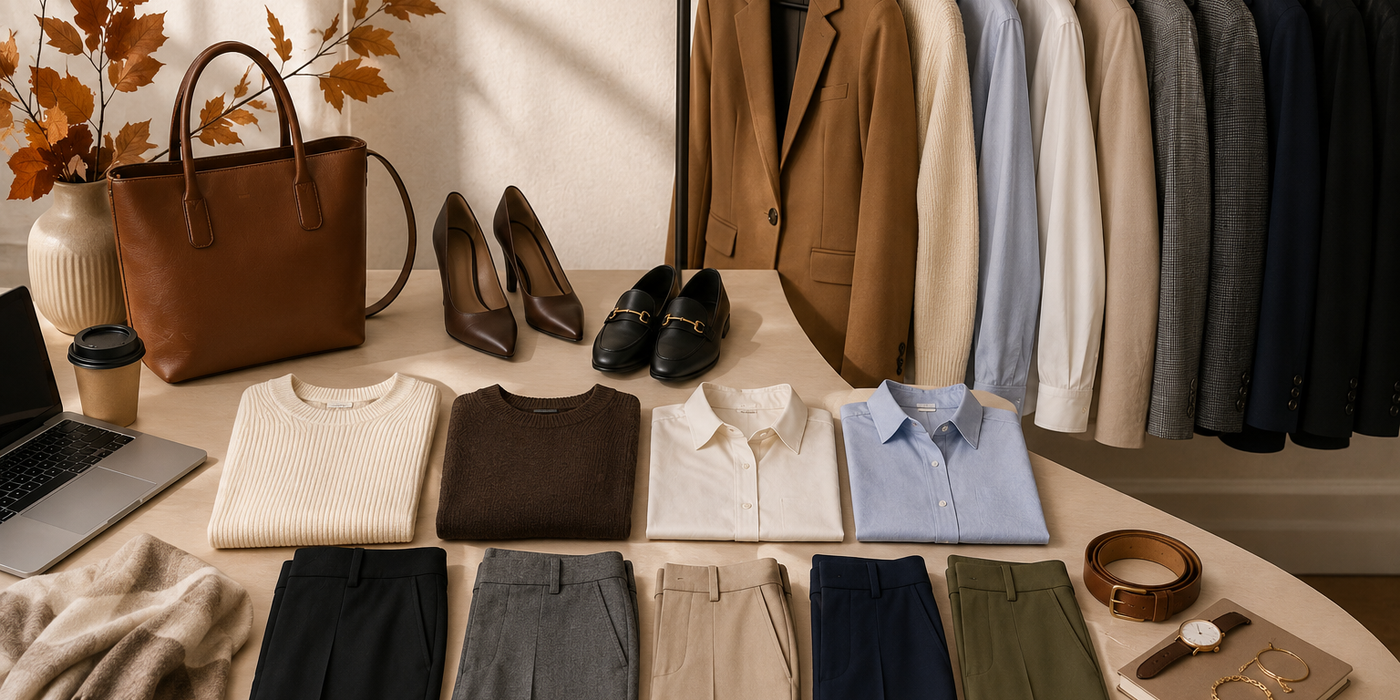
Ten to twelve well-chosen pieces, mixed with intention, generate 20 distinct work outfits — without requiring a full wardrobe overhaul every September.
Here's the core framework, organized by category:
Tops: 2–3 button-downs or blouses (two neutrals, one autumn tone such as burgundy or camel), plus one fine-knit turtleneck or crewneck.
Bottoms: One wide-leg trouser in needlecord or wool, one tailored slim trouser, and one midi or maxi skirt.
Layers: One relaxed blazer, one collarless vest or quilted gilet.
Outerwear: One unlined trench coat or structured wool coat.
Ready to upgrade your wardrobe?
Get the Elara app for AI-powered styling and virtual try-ons.
Shoes: Two pairs — one polished (loafer, block-heel boot), one commute-ready (clean sneaker, cushioned flat).
The 20-day formula breaks into four weekly themes:
- Week 1 — Tailored Base: Establish the foundation with suit separates and button-downs. Every outfit this week is crisp and unambiguous.
- Week 2 — Texture and Layering: Introduce needlecord, knit, and blazer combinations. Rich autumn palettes — brown, camel, burgundy, olive, forest green — do the visual work.
- Week 3 — Skirt and Dress Combos: Pair the midi skirt with the trench; layer the blouse under the collarless vest.
- Week 4 — Remix Week: The same blazer that anchored Monday in Week 1 now appears in six different configurations. This is the proof-of-concept week.
Before buying a single new piece, run an audit. Many readers already own pieces that fit this aesthetic. Check what you have against this list first, then identify genuine gaps. Elara's AI wardrobe digitization does this in one conversation: describe or photograph your existing pieces, and the AI maps what you own to capsule gaps immediately.
Fall Work Outfits by Body Type and Demographic: One Philosophy, Many Fits
The 2026 tailored-but-comfortable philosophy applies across every demographic — what changes is the execution, not the logic.
Women's fall workwear is the fastest-growing workwear segment in 2026, according to the JOOR Women's Fall Fashion Trend Report. The emphasis is on bold power suiting with wearable cuts, refined tailoring that moves from desk to dinner, and midi and maxi skirts as genuine office staples. A structured blazer over a midi skirt, finished with ankle boots, captures the office-to-after-work versatility that defines this moment.
Plus-size fall work outfits benefit directly from where 2026 tailoring has landed. Wide-leg trousers and relaxed blazers — the two dominant silhouettes this season — are inherently more size-inclusive than the slim-cut alternatives they replaced. A practical example: a belted trench coat worn over wide-leg trousers defines the waist at any size while keeping the proportions balanced. The aesthetic doesn't need to be adapted for plus-size bodies; it already fits them.
Gen Z's approach to fall workwear centers on dependable neutral staples, boxy knits, utility jackets, and vintage-inspired references, according to Marie Claire's Gen Z Fashion Trends 2026 report. Secondhand pieces are increasingly part of Gen Z wardrobe strategy — which aligns naturally with the capsule philosophy. Repeatable staples worn in rotation, sourced new or secondhand, are the Gen Z workwear strategy by default.
Men's fall office style is loosening without going casual. GQ's 2026 coverage documents a clear shift away from skinny suits toward balanced-fit, wider-leg trousers and more expressive but still professional tailoring. A camel wide-leg trouser with a textured knit and a structured coat reads as distinctly contemporary — and fits the same capsule framework.
The unifying principle: the same autumn palette, the same layering logic, the same 10–12 piece capsule strategy. Execution varies by body, preference, and workplace culture. The philosophy doesn't.
How to Audit Your Existing Wardrobe Before Buying Anything New
Fall should be a strategic planning moment, not a shopping trigger. Readers who audit first, buy second consistently discover they already own more of the capsule than they thought.
The audit takes three steps:
- Pull everything out. Bring last fall's pieces back into view. Surface what's been buried since October 2025. You can't map what you own if you can't see it.
- Map to the capsule. Check your existing wardrobe against the 10–12 core pieces listed above. Which categories are covered? Which are genuinely empty?
- Identify real gaps — not redundancies. This is the critical distinction: "I don't own a wide-leg trouser" is a gap. "I own three slim trousers but no wide-leg" is a gap. "I own a collarless vest and a quilted gilet" means that category is covered.
According to Accio.com's workwear trend analysis, search interest for "office wear" and "professional attire" peaks between August and October — with "office wear" hitting a trend score of 79 in October 2025. Readers who audit in late August shop with intention when September arrives. Those who wait until October are reacting to the season rather than preparing for it.
Elara's AI wardrobe digitization removes the friction from this process. Photograph your existing pieces, and the AI identifies which capsule categories are covered, which are genuinely missing, and which outfit combinations are already available in your closet — no spreadsheet, no guesswork. Most users find they need two or three targeted additions, not a full seasonal refresh.
Styling the Capsule: Outfit Formulas for Real Work Weeks
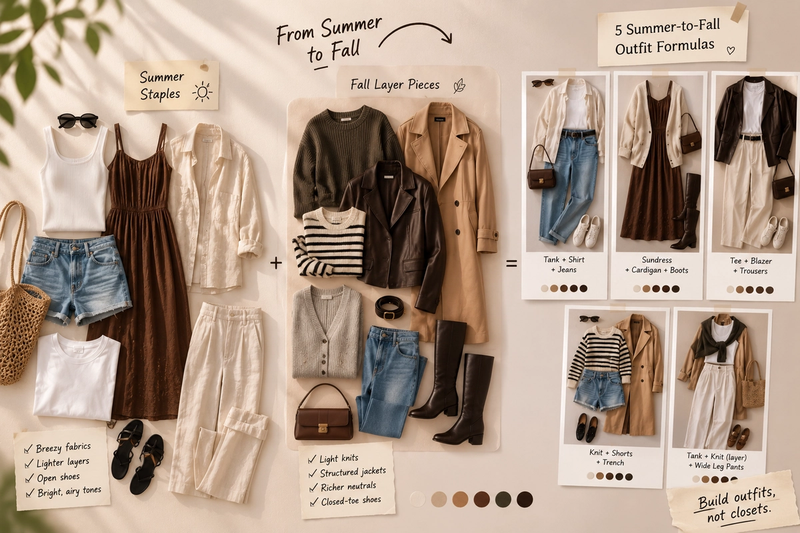
Knowing which pieces belong in your capsule is only half the work. The other half is seeing exactly how they combine. Here are five outfit formulas, one per workday, built from the core capsule pieces.
Monday — Power Tailoring: Wide-leg needlecord trouser + crisp white button-down + relaxed blazer + loafers. Needlecord appeared in 63% of business-casual Google Image searches for fall 2026, up from 29% in 2024 (Accio.com), so this reads as current without trying. Palette logic: warm tobacco or camel needlecord against white — the simplest autumn contrast. Layering logic: the blazer adds structure for morning meetings; remove it by afternoon. Remix note: the blazer reappears Thursday over a turtleneck, then Friday belted over a knit.
Tuesday — Texture Day: Fine-knit turtleneck + tailored slim trouser + collarless vest + ankle boots. Palette logic: olive vest over a cream knit — two neutrals, one rich. Layering logic: collarless vests handle the temperature swings of hybrid offices. Remix note: the turtleneck moves under the blazer on Wednesday.
Wednesday — Skirt Combination: Midi skirt + tucked blouse + unlined trench coat. Palette logic: burgundy or forest green skirt grounds the whole look in the 2026 autumn palette. Layering logic: the trench handles the commute; the skirt-blouse combination needs no additional warmth indoors. Remix note: the trench becomes outerwear over every remaining outfit.
Thursday — Palette Focus: Camel wide-leg trouser + white button-down + wool coat. Palette logic: monochromatic warmth — the 2026 equivalent of a neutral suit. Layering logic: the coat does the temperature work; the outfit underneath stays polished without bulk. Remix note: swap the button-down for the turtleneck and you have a different outfit entirely.
Friday — Relaxed but Polished: Boxy knit + tailored trouser + loafers. Palette logic: rich neutral — warm grey, oat, or rust. Layering logic: one fewer layer signals the end of the week without sacrificing professionalism. Remix note: the trouser has now appeared three times across five days in three distinct combinations.
FAQ: Your Fall Capsule Questions Answered
Q: Do I have to buy everything new, or can I use pieces I already own? A: Start with what you have. Most readers discover they own 60–70% of the capsule already — they just haven't seen how the pieces work together. Audit first, then buy only the genuine gaps. That's where Elara helps: upload photos of your existing pieces, and the AI shows you exactly which capsule categories you've covered and which ones need filling.
Q: How long does it take to build a fall capsule? A: The audit takes one afternoon. Strategic shopping — filling real gaps rather than impulse buying — takes another week or two. The payoff is immediate: once you have the 10–12 core pieces, you generate 20 distinct outfits without daily decision-making.
Q: Will these outfits work if my office is business formal, not business casual? A: Yes, with one adjustment: add a second blazer or structured jacket in a neutral tone, and use the capsule as your base layer. Business formal dressing is still built from the same core pieces — button-downs, trousers, structured layers — just with fewer casual pieces and more tailored precision. The audit and capsule logic apply regardless of your dress code.
Conclusion: Build Your Fall Capsule, Not Someone Else's
Fall work outfits are a system to build, not a trend to chase. Audit what you own first, fill real gaps second. That single shift in approach, supported by the 2026 aesthetic of polished professionalism and intentional ease in a rich autumn palette, is what turns 10 to 12 pieces into 20 days of outfits without decision fatigue each morning.
The capsule logic works for fall work outfits for women, men, and plus-size bodies equally. The silhouettes differ. The proportions shift. The strategy — anchor in neutral heritage textures, layer for temperature, remix deliberately — doesn't change regardless of who's wearing it.
If you want to know exactly which of these outfits you can build today, tell Elara what's in your closet. The AI will map your existing pieces to fall-ready combinations and show you precisely which gaps are worth filling — no guesswork, no full seasonal overhaul required. Start at joinelara.com.
Your AI Stylist is Here.
live on the App Store
Available on iOS for seamless access anytime, anywhere.