Diwali 2026 Outfits for Women: Beyond the Lehenga
Diwali 2026 outfit ideas for women: jewel-tone silk pieces, five lehenga alternatives, and the formula that works. Skip trends you'll regret by next season.
 Mehul AgarwalFounder
Key Takeaways
- Jewel tones (emerald, ruby, royal blue, wine and plum) are the dominant Diwali 2026 palette across multiple independent fashion guides
- Silk (Banarasi, Kanjeevaram, chanderi) is the most universally recommended fabric for festive richness
- The five strongest lehenga alternatives: pre-draped saree, co-ord set, sharara, palazzo suit, Anarkali gown
- The outfit formula that works: rich base fabric + thoughtful detailing + a silhouette that doesn't need constant adjusting
- Audit your wardrobe before buying: you likely already own the building blocks
Introduction: Why "What to Wear for Diwali" Is the Wrong Question
Most Diwali outfit guides follow the same structure: a hero section on lehengas, then a short bullet list of "alternatives" that reads more like an afterthought than actual advice. Women who can't wear a lehenga comfortably, or simply don't want to, are left with five lines of text where they deserved five paragraphs. This guide addresses that gap.
The more useful question isn't "what should I wear for Diwali?" It's "why do certain choices work, and which of those principles apply to what I already own?" That shift, from trend list to formula, is what separates a guide you return to from one you forget by Thursday.
The formula is grounded in real patterns. Multiple 2026 fashion sources converge on the same palette and fabric tier: jewel tones, silk, and structured silhouettes that move well. According to reviews across barkhaboutique.com, hausofhandmade.com, and outfittrends.com, emerald, ruby, royal blue, wine, and plum dominate the 2026 Diwali palette. This consensus emerged across guides independently, not because a single trend authority declared it, but because multiple fashion editors reached the same conclusion. That kind of cross-guide agreement is the closest thing fashion has to data.
This article solves two specific problems. First, lehenga-centrism: the assumption that every other silhouette is a fallback option. Second, trend-versus-timeless confusion: knowing whether a piece will still feel right at Diwali 2028 or whether it's peak-2026. By the end, you'll have a clear formula and a practical framework for applying it to your existing wardrobe before you shop.
The Diwali 2026 Color and Fabric Formula (What the Data Actually Says)
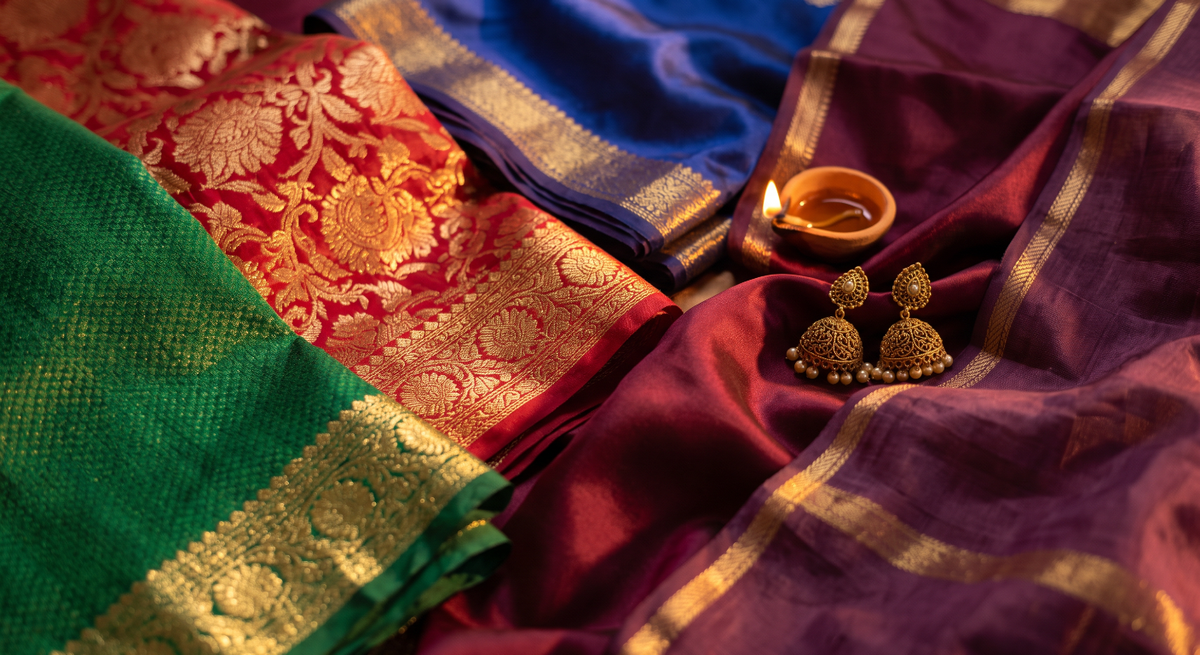
A formula is repeatable. The color and fabric choices that make a Diwali outfit work aren't arbitrary. They emerge from consistent patterns across multiple independent sources.
The color consensus is unusually clear. Jewel tones (emerald, ruby, royal blue, wine, plum and deep gold) appear across multiple 2026 festival guides from barkhaboutique.com, hausofhandmade.com, articles.wifd.in, outfittrends.com, and likeadiva.com. This isn't a single editor's preference; it's a cross-guide pattern. The practical reason: as articles.wifd.in notes, jewel tones "photograph beautifully under warm lights," which matters enormously for evening Diwali events where diyas, string lights, and warm indoor lighting are the norm. Flat or muted tones tend to disappear in that environment. Jewel tones don't.
There's also a cultural dimension. According to looqs.me, vibrant jewel tones better capture Diwali's spirit than black or white, and the richness of a deep emerald or wine carries the visual weight the occasion calls for.
On fabrics, the tier is equally consistent. Banarasi silk, Kanjeevaram, chanderi, matka silk, raw silk, and silk blends are the most-repeated festive fabrics across 2026 guides from outfittrends.com, likeadiva.com, and lifeandtrendz.com. What unites them is surface richness: the way they catch light, hold structure, and communicate occasion wear without requiring heavy embellishment. A plain Kanjeevaram in deep wine reads as festive by virtue of the fabric alone.
Not everything recommended is equally essential. Organza with 3D floral work is a peak 2026 trend, and barkhaboutique.com describes it as a standout this season, but it's trend-led rather than foundational. If you want a piece that works for years, silk is the safer investment.
The accent palette follows the same logic. Neon colors are flagged as out in multiple 2026 trend guides, while gold, champagne, ivory, and antique metallics are the warm festive accents that complement jewel-tone bases.
The formula in its simplest form: A jewel-tone silk or silk-blend piece, finished with gold or antique metallic accents, in a silhouette that moves well.
If you already own something that fits that description, you're closer to Diwali-ready than most guides suggest.
Beyond the Lehenga: The Silhouettes That Actually Work

That formula (jewel-tone silk, gold accents, a silhouette that moves) applies whether or not you wear a lehenga. Most Diwali guides treat the lehenga as the default and everything else as a footnote. Here, the five silhouettes below are primary choices, each solving a specific problem.
Pre-draped saree eliminates the need to manage a drape throughout the event. Since the pleats are set, there's no re-tucking mid-conversation or adjusting the pallu every time you sit down. In wine or emerald silk, it carries genuine festive presence.
Co-ord sets, particularly structured cape styles or kurta-palazzo pairings, deliver a polished, coordinated look without requiring traditional saree-draping skill. A cobalt or royal-blue co-ord in a silk blend photographs beautifully under warm Diwali lighting and transitions easily between the puja, dinner, and post-dinner gathering.
Shararas and palazzo suits allow you to sit cross-legged on the floor during puja, walk freely between rooms, and dance without restriction. The occasion-wear appeal comes from the fabric and color: a plum georgette sharara with mirror work carries festive weight.
Anarkali gowns are structurally flattering across a wide range of body types. The fitted bodice and flared skirt create a formal silhouette. In ruby or deep gold, an Anarkali works as a complete look.
Chanderi or georgette kurta sets with mirror work suit mixed indoor-outdoor settings or celebrations that blend puja with casual family time. They're lighter and easier to move in, but a jewel-tone chanderi with gold zari detailing still carries genuine festive presence.
Want this styled from your own closet?
Elara builds the look from what you own, then lets you try it on.
As hausofhandmade.com notes, the best festive outfits share one principle: rich base fabrics, thoughtful detailing, and a silhouette that doesn't require constant adjusting. Every option above meets that standard.
Trend vs. Timeless: How to Tell the Difference Before You Buy
Most Diwali guides treat 2026-specific trends and perennially strong choices as if they belong in the same category. They don't, and conflating them leads to purchases that feel dated within a season.
The framework is straightforward:
Timeless choices recur across multiple years of Diwali guides. They derive appeal from cultural resonance, fabric quality, and color depth, not from what's trending this year. Examples: jewel tones, silk fabrics, gold jewelry, structured silhouettes.
Trend-led choices work precisely because of their 2026-specific detailing. Examples: organza with 3D floral work (flagged as a peak 2026 trend by barkhaboutique.com), maximalist layering, heavily embellished capes.
The decision rule: If a piece would look out of place at Diwali two years from now, it's trend-led. If it would still look right, it's timeless. Apply that test to anything you're considering.
The most reliable combinations from 2026 fashion guides sit firmly in the timeless tier: an emerald silk saree with gold jewelry, a wine pre-draped saree with minimal accessories, or a royal-blue co-ord set with a statement dupatta. According to hausofhandmade.com and likeadiva.com, these combinations recur independently across guides because they don't depend on any single season's detailing.
This is where wardrobe intelligence adds real value. Before buying a trend-led piece, the relevant question isn't "is it beautiful?" (it usually is) but "does it fill a genuine gap, or does it duplicate something I already own?" That's a wardrobe question, not a taste question.
Your Diwali Wardrobe Audit: What You Probably Already Own

Before opening a shopping app, run this three-question audit on your existing wardrobe. It takes ten minutes and will tell you whether you actually need to buy anything.
Question 1: Do you own anything in a jewel tone? Check for emerald, wine, royal blue, plum, and ruby first. These are the dominant Diwali 2026 palette. Deep gold and rich burgundy count too. If yes, that piece is a candidate.
Question 2: Is it in a festive fabric? According to 2026 fashion sources including outfittrends.com and likeadiva.com, silk, Banarasi, Kanjeevaram, chanderi, georgette, and silk blends carry the visual weight the occasion calls for. A wine georgette kurta works well. A wine cotton piece reads differently: cotton typically feels more casual than celebratory in most Diwali settings.
Question 3: Does the silhouette allow comfortable movement for a full celebration? If the answer is no (it requires constant adjusting, restricts movement or only works standing up), it's not the right choice regardless of color or fabric.
If you answered yes to all three, you likely already have a Diwali outfit. The gaps that actually matter are more specific: you have the outfit but no gold jewelry to finish it; you have the fabric but in a casual silhouette; you have the jewel tone but it's a Western cut that doesn't read as festive. Those are solvable, targeted problems, not reasons to buy a complete new look.
FAQ: Your Diwali Outfit Questions Answered
Can I wear a jewel-tone cotton saree for Diwali? Cotton works for casual daytime celebrations or family gatherings, but silk and silk blends better capture the festive weight most Diwali events call for. If cotton is what you own, pair it with gold jewelry and structured styling to elevate the look.
How do I know if a pre-draped saree will stay in place all evening? Pre-draped sarees are designed with set pleats and secure anchoring, so they stay in place throughout the event. Try one on before buying to ensure the fit is secure at the waist and shoulders.
What's the best way to accessorize a jewel-tone Anarkali? An Anarkali in ruby or deep gold carries enough visual weight on its own. Stick to gold jewelry (a pair of earrings, a bracelet and a necklace) rather than layering multiple pieces. Let the silhouette and color do the work.
Key Takeaways: What Actually Matters
- Jewel tones and silk are the foundation. These two elements appear across every major 2026 Diwali guide because they work, not because they're trendy, but because they photograph beautifully under warm light and carry genuine festive presence.
- Lehenga alternatives are legitimate first choices. Pre-draped sarees, co-ord sets, shararas, and Anarkalis solve real problems that lehengas create: the need to manage a drape, the skill required to wear a traditional saree, or the restriction of movement in a heavily structured skirt.
- Timeless beats trend-led. If you're investing in a Diwali outfit, choose pieces that will still feel right next year. Jewel tones, silk, and structured silhouettes have staying power. Heavily embellished trend pieces do not.
- Audit before you shop. Most people already own the building blocks of a Diwali outfit. Gold jewelry, a jewel-tone piece in silk or silk-like fabric, and a comfortable silhouette are often already in your closet.
Next Steps: Make Your Wardrobe Work Harder
Wardrobe intelligence, knowing what you own before deciding what you need, separates a confident Diwali outfit from a last-minute panic purchase. The formula is simple: jewel tones + silk or silk-like fabric + a silhouette that moves well + gold accents = Diwali-ready.
Run the three-question audit on your existing wardrobe. You may already be done.
If you want to take this further, tools like Elara help you digitize your closet and surface combinations you may have genuinely forgotten about: a chanderi dupatta that pairs with last year's co-ord set, or a silk blouse that works with a saree you haven't worn in two seasons. The goal is wardrobe intelligence: knowing what you own so you shop with intention, not impulse.
Your stylist, in your pocket
Stop reading about outfits. Start wearing them.
Elara knows your closet, shops every store and gets you dressed for any occasion.