Summer Capsule Wardrobe: 25-Piece Checklist & Build Guide

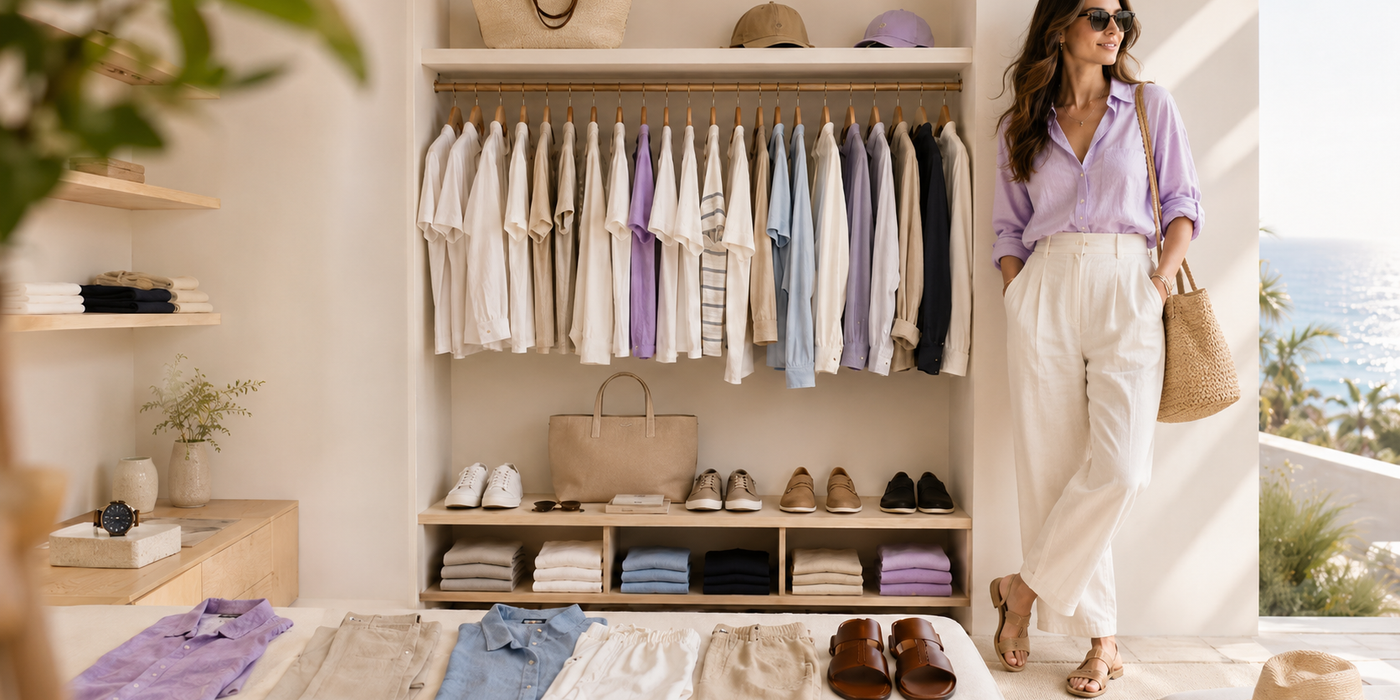
How to build a summer capsule wardrobe with 25 pieces
Table of Contents
- Introduction: Why 25 Pieces Is the Magic Number
- Step 1: Audit Your Closet Before You Buy Anything
- The 25-Piece Summer Capsule Wardrobe Checklist
- Building Your Color Palette: The 70/30 Rule
- Adapting Your Capsule by Demographic: Over 40, Over 50, Men, and Beyond
- From Theory to Practice: How to Actually Build and Wear Your Capsule
- FAQ: Building Your Summer Capsule Wardrobe
- Conclusion: Your Capsule Is a Living System, Not a One-Time Project
Key Takeaways
- A 25-piece summer capsule wardrobe generates multiple outfit combinations when built around versatile, mix-and-match items.
- Audit before you buy—most people already own significant portions of their capsule.
- The 70/30 rule (70% neutrals, 30% accent colors) is the simplest framework for maximum outfit flexibility.
- Demographic needs—age, lifestyle, climate—should shape your capsule, not a universal shopping list.
Introduction: Why 25 Pieces Is the Magic Number
Search interest for summer outfits for women over 50 rose 38,300% year-over-year, according to data from Klodsy—a signal that people across demographics are rethinking how they dress. The capsule wardrobe has emerged as a structural answer to a problem most people know intimately: a closet full of clothes and nothing to wear.
That paradox is real. The average American household owns far more clothing than it uses, yet deciding what to wear each morning is nearly universal. A capsule wardrobe solves this by design—not by restricting your style, but by ensuring every piece you own gets worn regularly.
The 2026 consensus among leading style guides—including Cosmopolitan UK, Gaala, and The Capsulist—puts the ideal seasonal capsule at 25 to 30 pieces. That range is specific for good reason: it's large enough to cover genuine variety across occasions, weather shifts, and mood, but small enough to keep every item in regular rotation. When chosen deliberately around a coherent color palette and versatile silhouettes, pieces from a 25-piece summer capsule wardrobe can be mixed and matched to create dozens of distinct outfit combinations.
This article walks through that build process in concrete steps: auditing what you already own, assembling the 25-piece checklist, applying a color strategy, adapting the formula by demographic, and activating the capsule in daily life. The goal is a wardrobe that works harder than the one you have now—without requiring you to start from scratch.
Step 1: Audit Your Closet Before You Buy Anything
Most capsule wardrobe guides open with a shopping list. That's the wrong starting point. Before spending a dollar, you need to know what you already own—because a significant portion of your capsule is almost certainly already hanging in your closet.
The audit process is straightforward, but it requires full commitment: pull everything out. Not a quick skim through the rail—everything, including the items pushed to the back and the shoes living in bags. Lay it all out and categorize by type: tops, bottoms, dresses, outerwear, shoes, and accessories. Working in categories prevents the common mistake of realizing mid-build that you own eleven black tops and zero bottoms that work with any of them.
Once categorized, assess each piece against three criteria: fit (does it fit your body right now, not five pounds ago), condition (is it worn, pilled, or faded beyond recovery), and versatility (can it work across at least two different settings or occasions). Pieces that pass all three are your raw material.
This is where the cost-per-wear mindset becomes useful. A linen trouser worn 40 times over a summer has a lower effective cost than three trend pieces worn twice each—even if it cost three times as much. Applying this logic to existing pieces reframes what's "worth keeping" and makes the audit feel less like decluttering and more like asset management.
What you're identifying through this process is your capsule skeleton: the neutral, well-fitting, multi-occasion pieces you already own that can anchor the 25-piece build. A white cotton tee in good condition, a pair of tailored shorts that fit, a canvas tote—each of these is a free head start.
If the manual audit feels overwhelming, AI-powered wardrobe tools like Elara can accelerate the process. By digitizing your closet through conversation, Elara surfaces which pieces already have capsule potential and flags genuine gaps—so you're shopping with a precise list rather than a vague sense of needing "more basics."
The 25-Piece Summer Capsule Wardrobe Checklist
With your audit complete and your capsule skeleton identified, the next step is mapping what you have against a validated framework. According to multiple 2026 style guides—including Cosmopolitan UK, Gaala, and The Capsulist—25 to 30 versatile pieces represents the ideal target for a fully functional seasonal wardrobe, striking the balance between genuine variety and manageable simplicity. The breakdown below uses 25 as the working number, organized by category so you can slot in what you already own before identifying what's missing.
Tops (8 pieces)
- 3 neutral tees or tanks (white, cream, black)
- 2 linen or cotton button-downs (one white, one in a light neutral or soft stripe)
- 1 striped or textured top for visual interest
- 1 sleeveless blouse in a solid or subtle print
- 1 lightweight knit for cooler evenings or air-conditioned offices
Bottoms (5 pieces)
- 1 tailored linen trouser
- 1 denim short (mid-length)
- 1 midi skirt (linen, cotton, or Tencel)
- 1 Bermuda short in a neutral
- 1 straight-leg casual pant
Dresses & Co-ords (4 pieces)
- 1 casual sundress
- 1 midi or wrap dress for elevated occasions
- 1 co-ord set, which counts as both pieces and doubles your outfit options
Outerwear & Layers (2 pieces)
- 1 lightweight denim or linen jacket
Ready to upgrade your wardrobe?
Get the Elara app for AI-powered styling and virtual try-ons.
- 1 cardigan or unstructured blazer for climate-controlled environments
Footwear (3 pairs)
- 1 strappy sandal
- 1 white sneaker
- 1 loafer or mule
Accessories (3 items)
- 1 woven or canvas tote
- 1 pair of quality sunglasses
- 1 versatile jewelry set (simple hoops, a delicate chain, or a stackable bracelet)
Across every category, breathable natural fabrics—linen, cotton, and Tencel—are non-negotiable. Synthetic blends trap heat and lose shape faster, which undermines the cost-per-wear logic that makes a capsule financially sound.
This checklist is a starting template, not a mandate. Vacation-focused wardrobes might swap the blazer for a second dress and add a sarong. Office environments might replace a denim short with a second tailored trouser. The 25-piece structure holds; the specific pieces flex around your actual life.
Building Your Color Palette: The 70/30 Rule
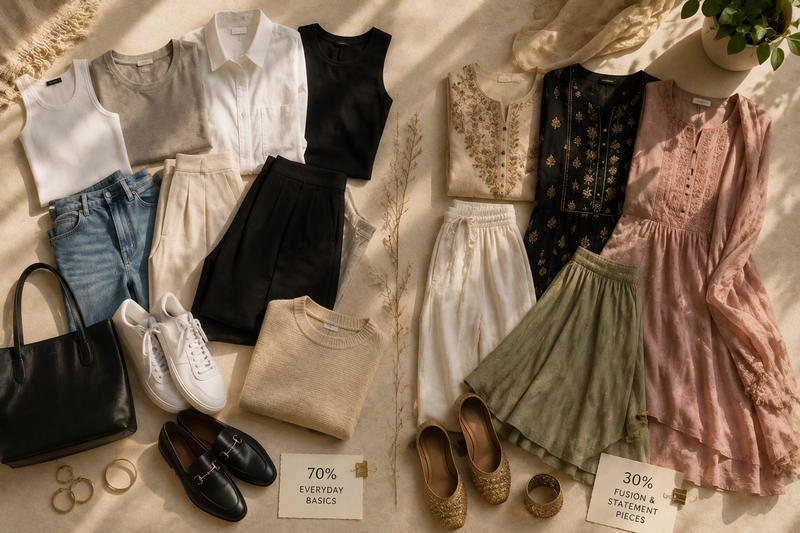
The most common reason a 25-piece summer capsule wardrobe fails in practice is poor color cohesion—pieces that don't talk to each other. The 70/30 rule, recommended by multiple 2026 style guides including Cosmopolitan UK and Clueless Clothing, solves this directly: 70% of your 25 pieces should sit in neutrals (white, cream, beige, sand, navy, stone), and 30% should carry accent tones.
That 70% neutral foundation is what makes the math work. Every neutral piece pairs with every other neutral piece, which means your outfit combinations multiply rather than add. A cream linen trouser, for example, pairs effortlessly with a white tee for a clean daytime look, a striped button-down for weekend errands, a coral blouse for dinner, and a lavender knit for an evening out. That's four distinct outfits from a single bottom—and none of them require any deliberate planning.
The remaining 30% is where personality enters. The dominant 2026 summer accent palette across style guides converges on butter yellow, lavender haze, ocean coral, and crisp white used as a pop against deeper neutrals. These tones photograph well, feel distinctly summery, and work across a range of skin tones when selected carefully.
That last point matters more than trend reports do. A butter yellow that washes out your complexion will sit unworn regardless of how current it is. Choose your accent tones based on what genuinely flatters you—warm skin tones tend to thrive in coral and golden yellow; cooler tones often carry lavender and soft sage more naturally. A capsule built around colors you actually reach for will outlast any single season's trend cycle by years.
Adapting Your Capsule by Demographic: Over 40, Over 50, Men, and Beyond
Most capsule wardrobe guides are written as if their reader is a 28-year-old with a flexible social calendar. The reality is that life stage, body comfort, and occasion mix vary enormously—and the demand for tailored guidance reflects that gap. According to Klodsy, search interest for summer outfits for women over 50 rose 38,300% year-over-year, a figure that signals a demographic actively looking for advice that actually applies to them.
Search interest for summer outfits for women over 50 rose 38,300% year-over-year, according to Klodsy—making it one of the fastest-growing style search categories in recent data.
Women over 50 benefit most from a capsule that prioritizes polished silhouettes over trend-driven cuts. Swap denim shorts for tailored linen trousers. Favor midi lengths over minis—not as a style concession, but because midi hemlines photograph better, work across more occasions, and move more elegantly. Boatneck and V-neck tops offer comfort without sacrificing refinement. For footwear, block-heeled sandals and loafers outperform flat thong sandals in both support and versatility—they carry an outfit from a morning market to an evening restaurant without a shoe change.
Women over 40 follow similar principles with slightly more flexibility in silhouette. Wrap dresses are a reliable anchor piece: universally flattering, easy to dress up or down, and available in natural fabrics that hold up to summer heat. Tailored co-ords and elevated basics that bridge professional and social settings are particularly valuable for this demographic, which often navigates both in the same week.
Men's summer capsule runs leaner by design: 3 neutral tees, 2 linen or Oxford shirts, 2 pairs of chino or linen shorts, 1 tailored trouser, 1 lightweight jacket, 1 swimwear piece, and 2 footwear options—a leather sandal and a white sneaker. Accessories stay minimal: a quality watch and a canvas tote cover most occasions.
Casual summer capsule skews toward relaxed fits and breathable cotton throughout. Swap the blazer for a second lightweight jacket, add an extra dress or co-ord in place of a formal trouser, and prioritize ease of movement over polish.
The 25-piece framework doesn't change across any of these variations—the structure holds. What changes is which specific pieces fill each slot. That's where a capsule stops being a generic list and becomes a wardrobe that actually fits the life you're living.
From Theory to Practice: How to Actually Build and Wear Your Capsule
Knowing which 25 pieces to own is only half the problem. The harder half is actually changing how you get dressed every morning—and that's where most capsule experiments quietly fail.
When faced with too many options, people tend to make worse choices and feel less satisfied with their selections. A closet full of options doesn't create freedom; it creates paralysis. A capsule works precisely because it eliminates low-value decisions—you're no longer choosing between 40 tops, you're choosing between 8 that all work together.
The capsule activation routine makes this concrete in three steps:
- Photograph all 25 pieces individually against a neutral background. This creates a visual inventory you can reference when packing or planning outfits without opening your closet.
- Consolidate them in one closet section—physically separate from anything not in the capsule. Out of sight genuinely means out of mind.
- Commit to a 30-day challenge using only those pieces. Thirty days is long enough to stress-test every item and surface any real gaps.
Before adding anything new after that 30 days, run it through a three-part purchase-validation test. A new piece must:
- Pair with at least 3 existing items in your capsule
- Fill a function not already covered (a third white tee fails this test)
- Work in at least 2 different settings—brunch and a work meeting, beach and dinner, not just one context
This is exactly the logic Elara applies conversationally. Describe what you already own and the occasion you're dressing for, and Elara identifies the 3–5 gap pieces you actually need—not a new shopping list, just the specific additions that complete what you've already built.
FAQ: Building Your Summer Capsule Wardrobe
Q: How long does it take to build a 25-piece summer capsule wardrobe from scratch?
A: If you're auditing existing pieces first, most people complete the process in 2–3 weeks. The audit itself takes a few hours, then you identify what's missing and add pieces gradually rather than buying everything at once. This approach also prevents impulse purchases and ensures each new piece actually works with what you already own.
Q: Can I use a 25-piece summer capsule wardrobe for travel?
A: Yes. The capsule is designed for maximum outfit combinations from minimal pieces, which makes it ideal for packing. A 25-piece summer capsule wardrobe fits easily into a carry-on and covers a 10–14 day trip across multiple occasions. Simply adjust the specific pieces based on your destination's climate and activities.
Q: What if my lifestyle doesn't match the checklist—I work in an office but also go to the beach?
A: The checklist is a template, not a mandate. A 25-piece summer capsule wardrobe adapts to your actual life. If you split time between an office and beach, you might keep 2 tailored trousers instead of 1, add a second pair of shorts, and reduce the number of dresses. The 25-piece structure and the 70/30 color rule stay the same; the specific pieces shift to match your calendar.
Q: How often should I update my 25-piece summer capsule wardrobe?
A: A capsule is a living system that evolves as your life does. Seasonally, you might swap out 3–5 pieces based on weather or occasion changes. Annually, you might retire pieces that wear out or no longer fit and add new basics that refresh the look without changing the structure. The goal is a wardrobe that stays functional, not one frozen in time.
Conclusion: Your Capsule Is a Living System, Not a One-Time Project
A 25-piece summer capsule wardrobe works because it's built on three repeatable principles: audit before you buy, apply the 70/30 neutral-to-accent color ratio for maximum outfit flexibility, and adapt the framework to your actual demographic and lifestyle rather than following a generic list. These aren't one-time decisions—they're the operating logic of a wardrobe that stays functional as your life shifts.
A new job changes your occasion mix. A vacation changes your packing priorities. A seasonal transition changes which pieces earn their slot. The capsule evolves with those changes, and that's the point. It was never meant to be a rigid inventory you set and forget.
AI tools like Elara make that evolution less effortful. As you add pieces, retire others, and describe new occasions, Elara learns your wardrobe over time—surfacing what you have, what you're missing, and what actually fits the life you're living now.
Ready to stop guessing and start building with intention? Explore Elara to digitize your wardrobe and discover your capsule potential without starting from scratch.

Your AI Stylist is Here.
live on the App Store
Available on iOS for seamless access anytime, anywhere.