

Digital Closet App: Wear More, Buy Less in 2026
Digital closet apps help you wear more of your existing wardrobe and reduce impulse purchases. Discover AI-powered styling, sustainability benefits, and how to choose the best app for your needs.
 Mehul AgarwalFounder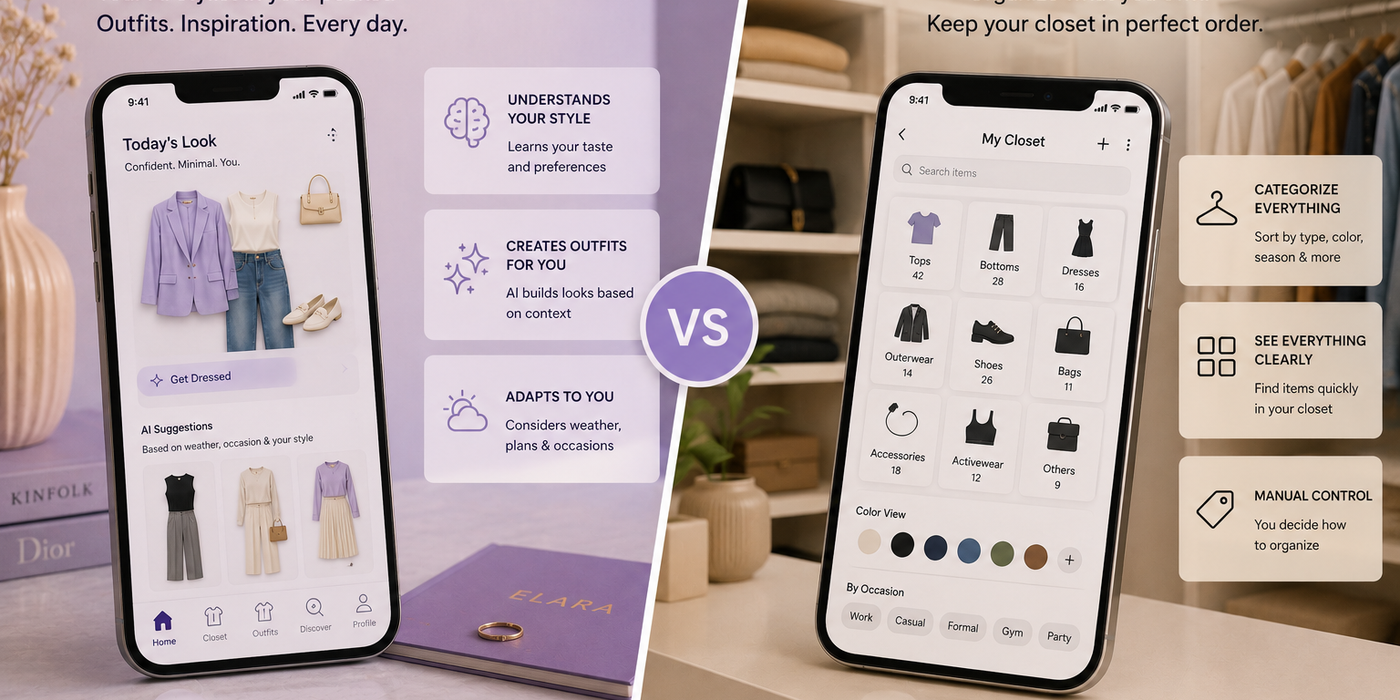
Digital Closet App vs Closet Organizer App
Table of Contents
- Introduction: Why Your Closet Needs a Brain, Not Just a Shelf
- What Is a Digital Closet App? (And What It Isn't)
- The Numbers Behind the Shift: Market Growth & User Behavior
- AI & Automation: How the Best Digital Closet Apps Work in 2026
- Sustainability & Behavior Change: The Case Competitors Aren't Making
- Digital Closet App Free vs. Paid: What You Actually Get
- Enterprise & Brand Adoption: The B2B Angle Nobody's Covering
- How to Choose the Best Digital Closet App for You
- Frequently Asked Questions
- TL;DR
- Conclusion: Your Wardrobe Is Data — Start Using It That Way
Key Takeaways
- Digital closet apps help users wear significantly more of their existing wardrobe
- The global market continues to grow, with increasing adoption of AI-powered features
- App users wear substantially more of their wardrobe compared to non-users
- Fashion brands are rapidly adopting proprietary digital closets
- Elara represents the next generation: a conversational AI stylist, not just a wardrobe organizer
Introduction: Why Your Closet Needs a Brain, Not Just a Shelf
Most people wear only a fraction of what hangs in their closet. Users of digital closet apps wear significantly more of theirs. That gap — the measurable outcome of replacing passive storage with active intelligence — is what separates a filing system from a tool that actually changes behavior.
Most people assume a "digital closet app" and a "closet organizer app" are the same thing with different branding. They aren't, and that distinction now has direct financial consequences. Organizer apps help you catalog what you own. Digital closet apps help you use what you own — and make smarter decisions about what to buy next. Getting that wrong means paying for a feature set that doesn't change your behavior.
The market has already voted on which direction matters. Digital wardrobe tools have accumulated millions of downloads and users globally, with the market expanding rapidly. This isn't a niche productivity tool anymore — it's a category with serious scale and accelerating AI investment.
This article maps the full spectrum: from basic photo-upload organizers to AI-powered styling ecosystems like Elara, which uses conversational AI to learn your wardrobe and guide smarter shopping decisions. Understanding where a tool sits on that spectrum is the only way to choose one that actually changes how you dress.
What Is a Digital Closet App? (And What It Isn't)
A digital closet app creates a structured, searchable inventory of your physical wardrobe — and then does something with that inventory. Outfit planning, wear frequency tracking, style analysis, and shopping recommendations all build on that foundation. A closet organizer app, by contrast, stops at the catalog. It answers "what do I own?" but not "what should I wear?" or "what am I missing?"
That distinction defines two ends of a spectrum. On one end sit organizer-tier tools: photo-upload platforms where you manually tag items and browse your wardrobe like a digital filing cabinet. On the other end sit AI-driven styling ecosystems that actively recommend, learn from behavior, and connect wardrobe data to shopping decisions. Industry analysts have started framing this as the "organizer vs. decider" divide — apps that store information versus apps that act on it.
By 2026, the feature baseline for a true digital closet app has shifted considerably. The leading platforms now offer automatic receipt scanning that logs purchases the moment you buy them, on-device AI background removal for clean item photos without manual editing, and database auto-fill that populates brand, size, material, and care instructions from a photo alone. These aren't premium add-ons — they're table stakes for apps competing at the top of the category.
The market has already shifted toward the intelligence end of that spectrum. A growing majority of active users have moved past basic cataloging and expect their app to make decisions, not just display options. Apps that haven't built recommendation and feedback loop capabilities are increasingly competing for a shrinking slice of the market.
The Numbers Behind the Shift: Market Growth & User Behavior
That shift toward AI-driven intelligence isn't just a product trend — it's being driven by measurable financial outcomes that are reshaping how consumers think about their wardrobes. The data makes a compelling case.
The global digital wardrobe market is growing at a steady pace, with mobile access expanding faster than web-based access. Smartphone remains the primary access point for most users.
The behavior-change statistics are where the real story lives — and where most competitor content goes silent. Users of AI-powered digital closet apps report significant improvements in how they use their existing wardrobes, with many spending less annually on new clothing and experiencing fewer impulse purchases.
Users of digital closet apps wear substantially more of their wardrobe compared to non-users, representing one of the most dramatic behavioral shifts documented in consumer fashion research.
Engagement metrics reinforce that these apps have crossed the threshold from novelty to habit, with retention and daily usage figures rivaling mainstream social platforms in stickiness.
Geographically, North America leads in adoption, with Asia-Pacific emerging as the fastest-growing region, driven by mobile-first consumer behavior and rapid e-commerce integration. The global momentum is real, and it's accelerating.
AI & Automation: How the Best Digital Closet Apps Work in 2026
The gap between a digital closet app and a smart closet app comes down to one thing: what happens after you upload a photo. Basic apps stop there. The leading platforms in 2026 have built automation layers that eliminate most of the manual work entirely.
On-device AI is now standard in top-tier apps. Automatic receipt scanning logs purchases the moment you buy them. Background removal produces clean, consistent item photos without any editing. Database auto-fill matches uploaded items against brand catalogs to populate size, material, color, and care instructions automatically. What used to take 10 minutes per garment now takes seconds — and that friction reduction drives higher engagement.
Augmented reality is the next frontier. Virtual try-on features are becoming standard in leading apps, allowing users to visualize how items combine before committing to a purchase or an outfit. The practical effect: fewer returns, fewer regret purchases, and a tighter feedback loop between wardrobe and shopping behavior.
AI adoption across digital closet platforms is widespread. Many platforms have rolled out adaptive styling modules that learn from wear patterns and user feedback.
Elara represents a distinct approach within this AI wave. Rather than a grid-based outfit builder that requires users to manually drag and arrange items, Elara uses a chat-first interaction model — you just talk or type, and the AI responds with outfit suggestions, wardrobe insights, or shopping recommendations. The distinction matters for adoption: users who find traditional wardrobe apps tedious engage far more readily with conversational interfaces. Elara also introduces context-aware shopping — surfacing only items that fill genuine gaps in your existing wardrobe, rather than algorithmically pushing whatever is trending. That's a meaningful step beyond outfit planning.
Want this styled from your own closet?
Elara builds the look from what you own, then lets you try it on.
Sustainability & Behavior Change: The Case Competitors Aren't Making
The sustainability case for digital closet apps is one of the most data-rich arguments in the category — and consistently one of the least covered. Many digital closet app users report extending garment lifecycles and actively reducing textile waste.
The mechanism is straightforward. When users complete their first wardrobe audit — digitizing everything they own — they encounter a version of their consumption habits they've never seen clearly before. The behavioral cascade that follows is well-documented:
- A meaningful portion of wardrobes are typically donated or sold following the first digital audit
- Wardrobe utilization climbs significantly among users compared to non-users
- Many users actively choose existing items over new purchases, driven by sustainability concerns
The fashion industry is a major contributor to global carbon emissions, making it one of the largest industrial sources of environmental impact. Digital closet apps function as a consumer-level intervention against that footprint — not through campaigns or pledges, but through the simple act of making ownership visible.
Some apps have made sustainability their explicit identity. Whering, for instance, markets directly to eco-conscious consumers and positions wardrobe visibility as an environmental act. That's a coherent strategy. Elara's approach is different: sustainability isn't the pitch — it's a byproduct of intelligence. When an AI already knows every item you own, can cross-reference your style history, and surfaces real wardrobe gaps before you shop, you naturally buy less. The environmental benefit arrives without requiring the user to think of themselves as an environmentalist. That distinction — sustainability through behavior change rather than through branding — may prove more durable as the category matures.
Digital Closet App Free vs. Paid: What You Actually Get
That sustainability-through-intelligence framing has direct implications for how you evaluate pricing tiers — because the AI layer that drives behavior change is almost exclusively a paid feature.
Free tiers across the digital closet app market follow a predictable pattern: item upload caps, basic outfit creation tools, and no AI-powered recommendations, receipt scanning, or shopping integration. With limited item capacity, you're cataloging a fraction of the average wardrobe, which undermines the core value proposition before it has a chance to work.
Premium tiers are where the category's real value lives. Paid plans typically unlock unlimited wardrobe uploads, AI outfit suggestions, wear frequency analytics, shopping integration, and cloud sync — a feature that many users prefer for flexibility across devices. The competitive landscape breaks down roughly by tier: Acloset operates as a freemium digitization tool with solid photo-upload capabilities; Stylebook is a paid, organizer-focused app with no meaningful AI layer; Whering offers a sustainability-focused freemium model; and Elara is built AI-first, using conversational interaction to connect wardrobe intelligence with context-aware shopping.
The financial case for premium is straightforward. Users who consistently use digital closet tools typically spend less annually on clothing. Most premium plans cost far less than the typical savings users achieve. The math makes premium adoption financially rational, not aspirational.
Enterprise & Brand Adoption: The B2B Angle Nobody's Covering
Consumer adoption tells only half the story. Fashion brands are rapidly adopting proprietary digital closets, and white-label digital closet solutions are growing year-over-year — a market signal that mainstream coverage has almost entirely missed.
The brand motivation is more strategic than it first appears. When a retailer knows what's already in a customer's wardrobe, they can recommend complementary pieces rather than competing with items the customer already owns. That's a fundamental shift in e-commerce personalization: from "here's what's popular" to "here's what your specific wardrobe is missing." The wardrobe dataset becomes a targeting layer that no third-party cookie or purchase history can replicate.
Fashion brands are rapidly adopting proprietary digital closets; white-label solutions are growing significantly year-over-year.
This is what enterprise-grade solutions must deliver: not just a best digital closet app experience for the end user, but a data infrastructure that gives brands genuine wardrobe context. The difference between a consumer digital closet app and an enterprise deployment is the API layer — the ability to pipe wardrobe gap data into product recommendation engines in real time.
Elara's retail partner value proposition sits squarely in this space. By reaching users who are actively in wardrobe-gap discovery mode, brand placements inside the Elara experience function as styling advice rather than advertising interruptions — a distinction that matters enormously for conversion quality and customer trust.
How to Choose the Best Digital Closet App for You
Choosing the right digital closet app comes down to five criteria, and being honest about which one matters most to you will narrow the field quickly.
- AI vs. organizer intent. Do you want a filing system or a decision-making tool? Apps like Stylebook excel at cataloging; Elara and similar AI-first platforms actively recommend, learn, and adapt.
- Onboarding friction and time-to-value. A smart closet app that requires manually photographing 200 items before delivering any value will be abandoned. Look for receipt scanning, auto-fill from brand databases, and AI background removal as friction-reducers.
- Shopping integration and context-aware purchasing. Most users access their digital closet via mobile at the point of purchase — making in-app shopping integration a practical necessity, not a premium luxury.
- Sustainability and wear tracking. If reducing waste matters to you, look for apps that surface cost-per-wear data and flag underutilized items. Whering leads here among freemium options; Elara surfaces this as a byproduct of its AI recommendations.
- Free vs. paid value threshold. Acloset's freemium tier works well for users with smaller wardrobes who need basic digitization. For anyone wanting AI-driven styling, the paid tier is the only tier that delivers.
On the digital closet website question: cloud access exists across most platforms, and many users prefer cloud-synced storage for flexibility. But the AI features that define the category — real-time outfit generation, camera-based item capture, AR try-on — are mobile-native. A web interface is a convenience layer, not the core product.
If you want an AI that learns your wardrobe and acts like a stylist — not just a filing system — Elara is built for that. Learn more at joinelara.com.
Frequently Asked Questions
Q: How much time does it take to upload my entire wardrobe to a digital closet app?
A: That depends on the app's automation features. Apps with receipt scanning, AI background removal, and brand database auto-fill can digitize a 100-item wardrobe in 30–60 minutes. Apps requiring manual tagging of each item can take several hours. Elara's chat interface lets you upload photos naturally while talking through your style, making the process feel less like data entry.
Q: Will a digital closet app really help me spend less on clothes?
A: Users of digital closet apps consistently report reduced annual clothing spending because the apps surface gaps in your existing wardrobe before you shop. When you can see what you already own and how new items combine with existing pieces, impulse purchases drop significantly. The financial benefit typically exceeds the cost of a paid subscription within the first year.
Q: Can I use a digital closet app on my phone, or do I need a computer?
A: Most digital closet apps are mobile-first. You can upload photos, view outfits, and access shopping recommendations entirely on your phone. Cloud sync means your wardrobe stays updated across devices. A web interface is helpful for bulk uploads or detailed editing, but it's optional — not required for the app to deliver value.
Q: What's the difference between Elara and other digital closet apps?
A: Most digital closet apps use grid-based outfit builders where you manually arrange items. Elara uses a conversational AI approach — you just talk or type about what you need, and the AI responds with outfit suggestions, shopping recommendations, and wardrobe insights. Elara also prioritizes context-aware shopping, showing you only items that fill genuine gaps in your wardrobe rather than pushing trending products. This approach reduces decision fatigue and helps you shop smarter.
TL;DR
Digital closet apps have evolved from simple photo catalogs into AI-powered styling systems that help users wear more of their existing wardrobe and spend less on new clothing. The category is growing rapidly, with mobile access and AI features becoming standard. Elara stands out by combining conversational AI with context-aware shopping recommendations, helping you style what you own and buy only what you actually need. If you want an AI that learns your wardrobe and acts like a stylist — not just a filing system — start at joinelara.com.
Conclusion: Your Wardrobe Is Data — Start Using It That Way
The evolution traced across this article follows a clear arc: from photo-based cataloging, to outfit planning, to AI systems that learn your habits, flag wardrobe gaps, and make shopping feel deliberate rather than impulsive. That progression isn't cosmetic. It represents a genuine shift in how people relate to what they own.
Users of digital closet apps wear substantially more of their wardrobe and report reduced annual clothing spending compared to those who don't use them. At scale, that's less waste, fewer regret purchases, and a wardrobe that actually works.
"We're not building a fashion app. We're building the layer between people, their wardrobe and fashion." — Elara
That framing matters. The most useful digital closet tools aren't organizers dressed up with AI features — they're behavioral intelligence systems that happen to live in your wardrobe. Elara is built around that premise.
If you're ready to see what that looks like in practice, explore Elara at joinelara.com, or subscribe for ongoing insights into AI wardrobe management and smarter styling decisions.
Your stylist, in your pocket
Stop reading about outfits. Start wearing them.
Elara knows your closet, shops every store and gets you dressed for any occasion.