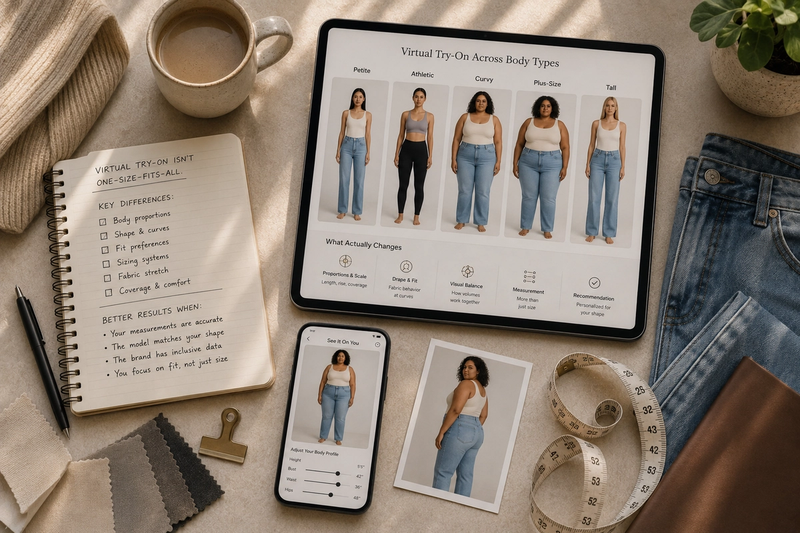
Best Shopify Apps for Fashion: Try-On & Returns 2026
Best Shopify apps for fashion brands combine size guidance, visual reviews, AI try-on, and exchange-first returns. Learn the proven stack framework that reduces returns by 27% and lifts conversion by 12%.

Best Shopify Apps for Fashion Brands: AI Try-On & Returns
Table of Contents
- Introduction: Why Your Fashion App Stack Is a Margin Strategy, Not a Feature List
- The Four-Category Stack Framework: How the Best Fashion Brands Build Their App Ecosystem
- Category 1 — Size & Fit Guidance: The Highest-ROI Starting Point
- Category 2 — Visual Reviews & Social Proof: Closing the Fabric-and-Fit Imagination Gap
- Category 3 — AI Try-On & Customization: Why Generative AI Beats Rigid AR for Clothing
- Category 4 — Exchange-First Returns: The 2026 Fashion Margin Lever
- Addressing the Gap: Why Competitors' Generic App Lists Won't Move Your Metrics
- Building Your 2026 Fashion App Stack: A Prioritized Rollout Plan
- FAQ: Best Shopify Apps for Fashion Brands in 2026
- Conclusion: Stack First, Then Optimize
Key Takeaways
- The highest-ROI Shopify app stack for fashion brands combines size/fit guidance + visual reviews + AI try-on + exchange-first returns as an integrated system.
- Loop Returns converts 30–40% of return requests into exchanges rather than refunds, directly protecting margins.
- Kiwi Size Chart cuts returns by up to 27%; a full fit-recommender flow adds a 12% conversion lift on top.
- Generative AI try-on (Genlook, Antla) outperforms rigid AR for clothing — fabric-drape realism requires generative rendering.
- Build in this order: size guidance → reviews → try-on → returns.
Introduction: Why Your Fashion App Stack Is a Margin Strategy, Not a Feature List
Fashion ecommerce has a returns problem that no single app fixes. Loop Returns converts 30–40% of return requests into exchanges rather than refunds — a number that represents real margin saved on every transaction. Kiwi Size Chart is linked to up to 27% fewer returns when deployed for fit guidance. These are not isolated wins. They are what happens when the right tools address the right friction points in sequence.
Most Shopify app roundups miss this entirely. They produce ranked lists — "the 10 best fashion apps" — without explaining how the tools interact or in what order they should be deployed. The result is merchants stacking apps randomly, paying for tools that duplicate effort, and wondering why return rates stay stubbornly high.
This guide organizes the decision differently, around four categories that map directly to shopper hesitation: size/fit guidance, visual reviews, AI try-on, and exchange-first returns. Each category targets a specific point where a shopper abandons or regrets a purchase. Layered in the right order, they compound rather than overlap.
One additional layer worth naming: Elara, an AI wardrobe-intelligence platform, sits above this stack — knowing what a shopper already owns so that every fit recommendation and try-on result becomes contextually relevant rather than generic. This guide is built for fashion brand operators who want a data-driven prioritization framework, not another feature checklist.
The Four-Category Stack Framework: How the Best Fashion Brands Build Their App Ecosystem
The stack-first mental model works because each category addresses a distinct shopper hesitation, and hesitations compound if left unresolved. The best default apparel stack starts with size guidance, then reviews, then returns — because fit uncertainty and post-purchase friction are the core reasons fashion shoppers hesitate. Try-on fits between reviews and returns, bridging the gap between seeing a product on others and imagining it on yourself.
Here is what each category fixes — and what it cannot fix alone:
Category
Shopper Hesitation Addressed
Cannot Fix Alone
Size/Fit Guidance
"Will this fit me?"
Style uncertainty, color accuracy
Visual Reviews
"Does this look good on real people?"
Fit data, post-purchase regret
AI Try-On
"Can I see myself wearing this?"
Sizing errors, returns logistics
Exchange-First Returns
"If it's wrong, I won't lose money"
Pre-purchase hesitation
The compounding math matters here. Kiwi Size Chart alone is associated with up to 27% lower returns. A full fit-recommender flow — moving beyond a static size chart to dynamic measurement inputs and per-product recommendations — reduces returns by up to 25% and lifts conversion by 12%. These two tools attack the same friction from different angles: one removes uncertainty before the shopper picks a size, the other confirms the choice with personalized data.
The recommended build order follows a clear logic. Size guidance comes first because it addresses the most common return driver in fashion — the wrong size. Visual reviews come second because shoppers who can see a garment on a real body convert at higher rates and return less often. Try-on comes third because it requires a confident product catalog and review base to be credible. Returns infrastructure comes last because its job is to recover sales that size guidance and try-on couldn't prevent — and it performs best when the volume of avoidable returns has already been reduced.
Category 1 — Size & Fit Guidance: The Highest-ROI Starting Point
Starting with size guidance isn't just logical — it's the only defensible first move for any fashion brand serious about margin. Fit uncertainty is the most cited reason shoppers return clothing, which means every dollar spent here attacks the problem at its source rather than cleaning up after it.
Kiwi Size Chart is the strongest starting recommendation. It's associated with up to 27% fewer returns when deployed for size and fit guidance. What makes Kiwi more than a static chart is its interactivity: shoppers input body measurements directly, and the app generates per-product fit recommendations rather than forcing them to interpret a generic S/M/L grid. That distinction matters because a table of measurements tells shoppers nothing about how a specific cut or fabric behaves on their body.
Ready to upgrade your wardrobe?
Get the Elara app for AI-powered styling and virtual try-ons.
The upgrade path from a size chart to a full fit-recommender flow is worth understanding before you buy. A complete recommender flow — one that collects measurements, applies brand-specific sizing logic, and surfaces a personalized size recommendation — can reduce return rates by up to 25% and lift conversion by 12%. That's a meaningfully different outcome than a chart alone delivers.
When evaluating any size or fit app, apply three selection criteria:
- Multi-brand sizing support — essential if you carry third-party labels with inconsistent sizing
- Product catalog integration — recommendations should be product-specific, not category-generic
- Downstream data capture — measurement data collected here should be usable by try-on and personalization tools later in your stack
Brands running return rates above 15% should install size guidance before touching anything else on this list. No other app category addresses the root cause as directly.
Category 2 — Visual Reviews & Social Proof: Closing the Fabric-and-Fit Imagination Gap
Size charts tell shoppers what should fit. Visual reviews show them what actually fits — on real bodies, in real light, with real fabric behavior. That's a fundamentally different kind of reassurance, and it's why visual social proof is the second layer to build.
Judge.me is the primary recommendation here. It's associated with a 23% conversion lift, and the mechanism is straightforward: photo and video reviews submitted by verified buyers reduce the uncertainty that product photography alone cannot eliminate. A brand's model in controlled studio lighting tells shoppers nothing about how a linen dress drapes on a size-14 frame in natural light. Customers do. Judge.me's review request automation and verified buyer badges increase both volume and credibility of that social proof over time.
Loox is the strongest alternative for brands where visual presentation takes priority over review volume. Its photo-grid display format suits editorial aesthetics better than Judge.me's more traditional review layout — a meaningful distinction for premium or lifestyle fashion labels.
Neither app reaches its potential without a mechanism to actually collect reviews at scale. That's where Klaviyo becomes the connective tissue. Klaviyo is associated with 16.3% of fashion sales attribution, and its post-purchase email flows are the most reliable driver of review volume. The practical configuration: trigger a photo review request 7–14 days after delivery, timed for when the customer has worn the item at least once and can speak to real-world fit and color accuracy.
The stack logic here mirrors Category 1. Size charts attack fit uncertainty through data. Visual reviews attack the same uncertainty through social proof. Together, they reduce the imagination gap from two directions simultaneously.
Category 3 — AI Try-On & Customization: Why Generative AI Beats Rigid AR for Clothing

The most important distinction in the try-on category isn't which app you choose — it's which underlying technology it uses. Clothing requires generative AI try-on rather than rigid AR-heavy approaches, because apparel needs fabric-drape realism that point-cloud AR mapping cannot produce. AR works credibly for hard objects: sunglasses sit on a face, a watch sits on a wrist. Clothing moves, stretches, and drapes in ways that AR overlays render unconvincingly. Generative AI, by contrast, synthesizes photo-realistic output from a single product image — no 3D asset pipeline, no uncanny valley.
Genlook is the primary recommendation for most fashion brands. Its photo-based setup requires no 3D modeling or dedicated tech team, which removes the implementation barrier that has historically made try-on tools a large-brand luxury. A merchant uploads product photos; the AI handles the rest.
Antla is the entry-level alternative, starting at $19.99/month. For smaller fashion brands testing try-on ROI before committing to a larger platform, Antla provides generative AI output at a price point that makes the experiment low-risk.
Teeinblue serves a different use case entirely: print-on-demand and customizable product brands. Its strength is product personalization — letting shoppers preview custom text or graphics on a garment — rather than body-fit simulation. If your catalog includes customizable pieces, Teeinblue belongs in the stack; if not, it doesn't.
The "when to invest" decision is straightforward: try-on ROI is highest for categories where visual uncertainty drives returns — statement pieces, dresses, patterned outerwear, bold colorways. For basics (white t-shirts, solid-color joggers), the investment rarely pays back at the same rate. Prioritize try-on for the SKUs where a shopper's inability to visualize the garment on themselves is the actual barrier to purchase.
Category 4 — Exchange-First Returns: The 2026 Fashion Margin Lever
Returns are unavoidable in fashion. The question isn't how to eliminate them — it's whether you keep the revenue when they happen. Most Shopify merchants default to refund-first workflows and absorb the margin loss. The smarter model in 2026 treats every return request as a recovery opportunity.
The strategic principle is straightforward: "exchange over refund" is the key lever for fashion margins. When a shopper returns a size-8 dress because it runs small, swapping it for a size-10 preserves the full sale. Issuing a refund destroys it. The tool you use determines which outcome is more likely.
Loop Returns is the primary recommendation here. Loop converts 30–40% of return requests into exchanges rather than refunds — a direct margin recovery rate that compounds across high-volume SKUs. The mechanism is deliberate: Loop's self-service portal surfaces exchange options before the refund path, making the swap the path of least resistance for the shopper.
AfterSell operates at a different point in the post-purchase journey — the order confirmation page — but pairs naturally with a returns strategy. AfterSell is associated with a 10–30% AOV lift by presenting relevant upsell offers immediately after checkout, increasing net revenue per transaction before a return ever occurs.
Decision rule: Brands processing more than 50 returns per month should invest in a dedicated returns platform like Loop. Below that threshold, Shopify's native returns tooling combined with a manual exchange workflow is likely sufficient — the platform cost won't justify itself at lower volumes.
One prerequisite applies: exchange-first returns work best after Category 1 (size guidance) is already in place. If Kiwi has already reduced returns by 27%, the remaining returns are the harder cases — and converting those to exchanges rather than refunds is exactly where Loop earns its cost.
Addressing the Gap: Why Competitors' Generic App Lists Won't Move Your Metrics

Most "best Shopify apps for fashion" articles function as catalogues: a paragraph on Judge.me, a paragraph on Loop, a paragraph on Klaviyo. Each tool is evaluated in isolation. That's the problem.
Installing Judge.me without Kiwi collects reviews but does nothing about the return volume that better size guidance would prevent. Installing Loop without Kiwi means you're converting returns that shouldn't have happened in the first place. The tools only compound when they address the same shopper friction from different angles.
The math makes the case directly. Kiwi's size guidance is associated with up to 27% lower returns. A full fit-recommender flow reduces return rates by a further 25% and lifts conversion by 12%. Judge.me adds a 23% conversion lift on top. Loop then converts 30–40% of the remaining returns into exchanges rather than refunds. Each layer addresses what the previous one couldn't — and the compounding effect across all four is categorically different from any single-app win.
TinyIMG's 2.5x conversion boost and Smile's retention cost advantage — five times cheaper than alternatives — function as stack amplifiers: they protect the gains the core four categories generate, but they don't replace them.
The right question to ask isn't "which app should I install?" It's "which gap in my shopper journey is costing me the most revenue right now?" — and then building toward it systematically.
Building Your 2026 Fashion App Stack: A Prioritized Rollout Plan
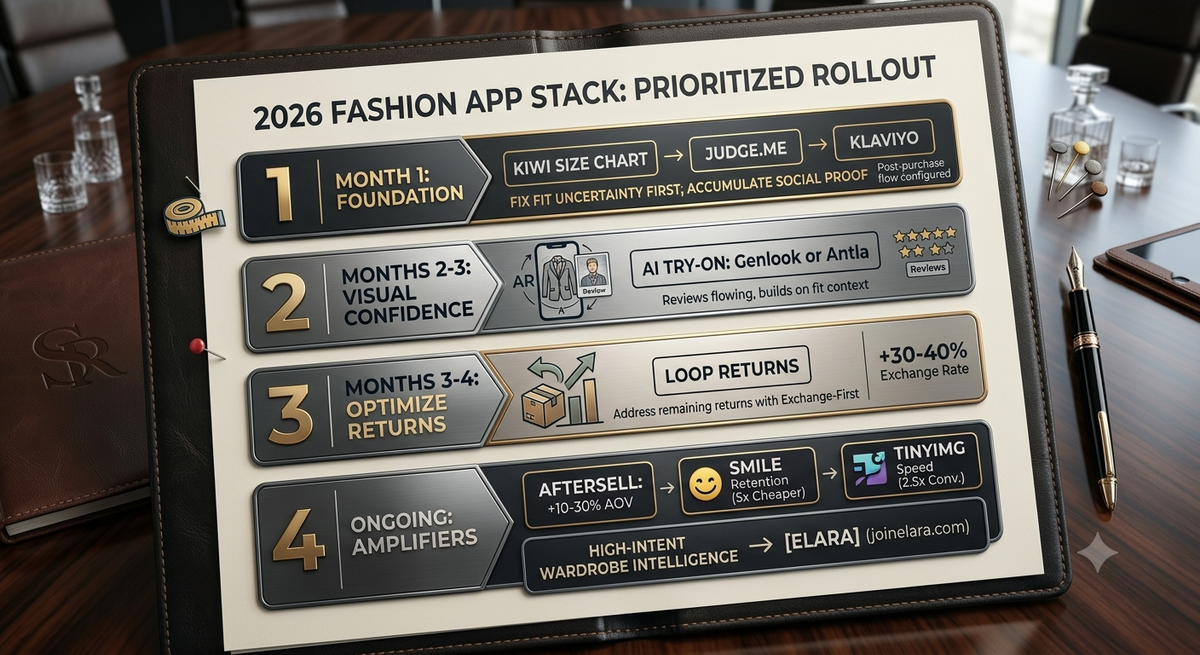
The sequencing matters as much as the selection. Installing try-on tooling before you have size guidance in place is like soundproofing a room with a broken window — you're addressing the wrong problem first.
Phase 1 (Month 1): Kiwi Size Chart + Judge.me + Klaviyo. Fix fit uncertainty first, then start accumulating social proof. Klaviyo's post-purchase flows should be configured to request photo reviews at the 7–14 day mark. This builds the review inventory that Phase 2 tools will depend on.
Phase 2 (Months 2–3): Add Genlook or Antla for AI try-on. Once size guidance is established and reviews are flowing, visual confidence tools have something to build on. Shoppers arriving with fit context and real-body review photos are better positioned to benefit from generative try-on.
Phase 3 (Months 3–4): Add Loop Returns. With fit guidance and visual confidence in place, the returns that remain are the ones an exchange-first workflow can actually recover. Loop's 30–40% exchange conversion rate lands harder when return volume has already been reduced upstream.
Phase 4 (Ongoing): Layer in amplifiers. AfterSell for AOV growth (10–30% lift), Smile for retention economics (5x cheaper than alternatives), and TinyIMG for site speed (2.5x conversion boost) all protect and extend the gains the core stack generates. For brands looking to reach high-intent shoppers through a wardrobe-intelligence layer, Elara — available at joinelara.com — offers a distribution channel where recommendations are grounded in what a shopper already owns, making every touchpoint more contextually relevant than a standard product feed.
FAQ: Best Shopify Apps for Fashion Brands in 2026
Q: Should I start with try-on or size guidance?
Start with size guidance. Fit uncertainty is the most common return driver in fashion, which means Kiwi Size Chart (or a similar tool) will reduce returns before you ever need try-on. Try-on works best after size guidance is in place because shoppers already have confidence in the fit. Installing try-on first is like adding a second coat of paint before the primer dries.
Q: How much can I realistically reduce returns with this stack?
The compounding effect across all four categories can reduce returns by 40–50% depending on your starting baseline. Kiwi delivers up to 27% reduction. A full fit-recommender flow adds another 25%. Visual reviews (Judge.me) and generative try-on (Genlook) reduce hesitation further. Loop then converts 30–40% of remaining returns into exchanges, protecting margin. The exact outcome depends on your product mix and current return rate.
Q: Do I need all four categories, or can I skip some?
You can skip try-on if your product mix is mostly basics (solid-color items where visual uncertainty isn't the barrier). You cannot skip size guidance or returns infrastructure if you're serious about margin. Visual reviews (Judge.me) are optional but highly recommended — a 23% conversion lift is substantial. The priority order is: size guidance → returns → reviews → try-on.
Q: How does Elara fit into this stack?
Elara is a wardrobe-intelligence layer that sits above your Shopify app stack. It knows what a shopper already owns, which means every recommendation from Kiwi, Judge.me, Genlook, and Loop becomes more contextually relevant. Instead of suggesting a generic product, Elara suggests products that fill gaps in an individual's existing wardrobe. Visit joinelara.com to learn how it complements your Shopify ecosystem.
Conclusion: Stack First, Then Optimize
Building a high-performing fashion app stack isn't about finding the best individual tool — it's about following the sequence of shopper hesitation. Size guidance comes first, then visual reviews, then try-on, then exchange-first returns. That order isn't arbitrary; it mirrors exactly where shoppers lose confidence and where margins leak when confidence fails.
One variable worth building around now: generative AI try-on will likely displace most rigid AR approaches within the next 18–24 months, because apparel demands fabric-drape realism that AR overlay cannot deliver. Merchants who lock into inflexible AR platforms today will face costly migrations. Build for adaptability.
The next frontier goes further still. The most powerful layer isn't a better try-on tool — it's a wardrobe-intelligence system that knows what a shopper already owns and surfaces the right product at the right moment. That's the direction the category is moving, and it's what Elara is built to be. Visit joinelara.com to see how Elara's AI stylist layer can complement your existing Shopify stack.
Your AI Stylist is Here.
live on the App Store
Available on iOS for seamless access anytime, anywhere.