


Nothing to Wear? Fix Your Closet Without Shopping
 Mehul AgarwalFounder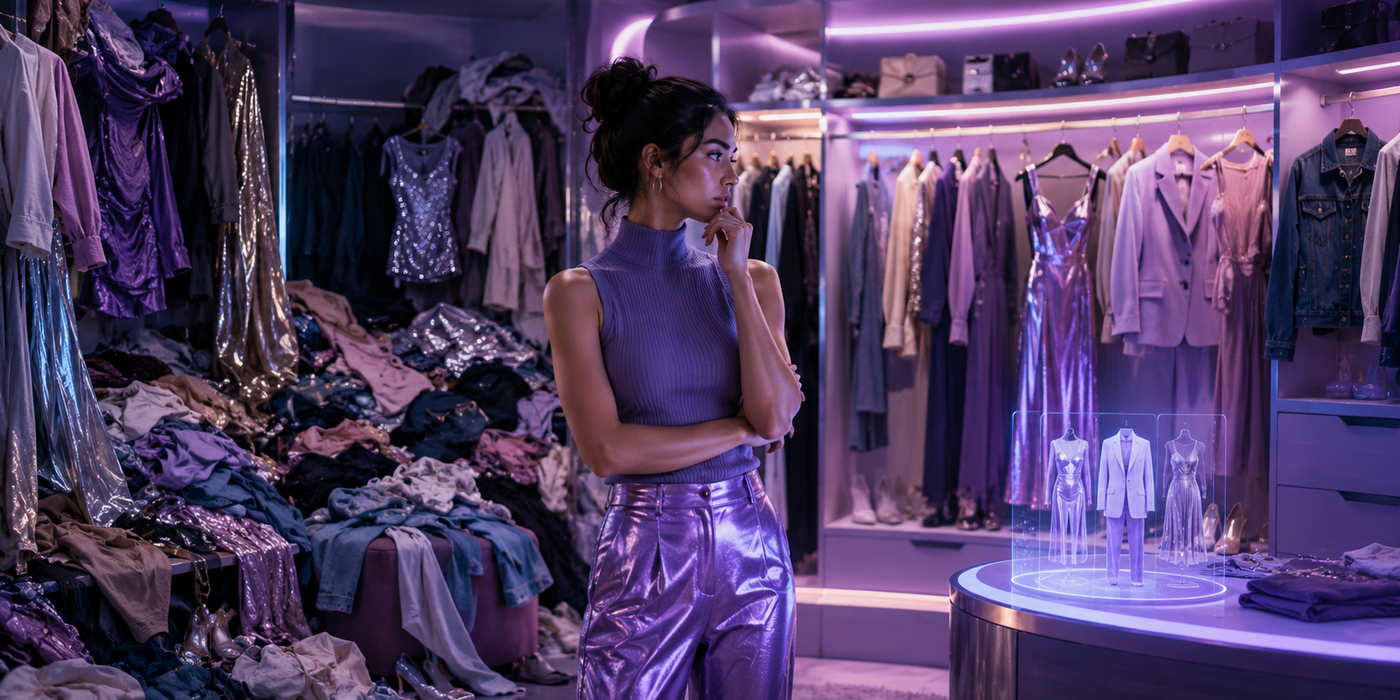
Why you have a full closet but nothing to wear (and how to fix it)
Table of Contents
- Introduction: The Closet Paradox
- What "Nothing to Wear" Actually Means in 2026
- Why Your Closet Feels Empty Even When It's Full
- The Secondhand and Accessories Shift: How Smart Shoppers Actually Solve It
- The AI-Powered Fix: Rediscovering What You Already Own
- Practical Steps to Fix "Nothing to Wear" Without Shopping
- Conclusion: Your Wardrobe Already Has the Answer
Key Takeaways
- "Nothing to wear" is a decision fatigue and wardrobe activation problem — not a quantity problem.
- Preppy aesthetic searches surged more than 200% since early 2025, signaling a documented shift toward expressive, personality-driven dressing.
- Gen Z now allocates nearly half their apparel budget to secondhand fashion — resale is the real-world fix.
- Elara is an AI-powered wardrobe-first tool that helps you restyle what you already own before buying anything new.
Introduction: The Closet Paradox
You've stood there. Staring at a rail packed with clothes, drawers that barely close, and a floor that's more fabric than carpet — and still felt like you had absolutely nothing to wear. It's one of the most common frustrations in modern life, and it makes no logical sense.
Except it does, once you understand what's actually happening.
The global apparel market is projected to reach approximately USD 1.80 trillion in 2026, according to Fortune Business Insights. Consumers have never owned more clothing. Yet the morning closet paralysis persists — which means buying more is clearly not the solution at any scale, individual or societal.
The real problem is not quantity. It's decision fatigue and wardrobe activation failure: too many disconnected pieces, no system for combining them, and a closet full of clothes that don't actually work together. This article covers why that happens, how fashion is shifting in ways that make it worse, and what actionable fixes look like — most of which don't require spending a single dollar.
What "Nothing to Wear" Actually Means in 2026
In 2026, "nothing to wear" rarely means a literal shortage of clothing. It means a wardrobe that feels incomplete — not because it lacks quantity, but because it lacks personality, flexibility, or any coherent styling formula. The clothes are there. The outfits aren't.
This is the mechanics of decision fatigue applied to fashion. When a closet contains dozens of disconnected options with no organizing logic, the brain doesn't find freedom in the variety — it finds paralysis. The cognitive load of evaluating every possible combination every morning is exhausting, so most people default to the same five outfits on rotation and ignore everything else. The rest of the wardrobe becomes invisible.
For several years, the dominant cultural response was minimalism. The capsule wardrobe movement of 2020–2024 promised that owning fewer, better pieces would solve the problem. For some people, it did. But the data suggests a significant portion of consumers found minimalism unsatisfying — not because it was wrong, but because it stripped out the personality that makes getting dressed feel worthwhile.
The 2026 shift is unmistakable. According to Heuritech, searches for the preppy aesthetic have surged by more than 200% since the start of 2025 — a signal that consumers are actively seeking expressive, identity-driven dressing rather than pared-back neutrals. Heuritech also recorded an 18% rise in color-blocking demand between August and September 2025 alone, confirming that the appetite for visual personality in clothing is accelerating, not retreating.
Want this styled from your own closet?
Elara builds the look from what you own, then lets you try it on.
Preppy aesthetic searches surged 200%+ since early 2025, and color-blocking demand rose 18% in a single month — both pointing to the same consumer desire: a wardrobe with a point of view. (Heuritech, 2025)
The insight this trend data reveals is structural: the "nothing to wear" problem isn't that people own too little. It's that what they own doesn't activate into outfits. Wardrobe activation failure — the inability to see the combinations hiding inside an existing closet — is the actual diagnosis. And it's one that more shopping, on its own, will never fix.
Why Your Closet Feels Empty Even When It's Full
Wardrobe activation failure doesn't happen because people shop too little. It happens because the clothes they own don't work together — and nobody ever taught them how to make them do so. Three root causes explain almost every "nothing to wear" moment: pieces bought to chase trends that have since faded, items that lack any stylistic connective tissue with the rest of the wardrobe, and the complete absence of a system for discovering outfit combinations.
The trend-chasing driver is well-documented. According to Cotton Incorporated and NRF data, 29% of U.S. consumers now plan to buy more of what they need rather than what they want — a meaningful signal that impulse-driven wardrobe building has left a generation of shoppers surrounded by clothes that no longer feel like them. The financial pressure reinforcing this shift is real: 47% of U.S. consumers cited personal finances as a top concern in 2026, which means buying your way out of a wardrobe problem simply isn't a viable strategy for most households.
What makes the situation structurally harder is that accumulation has never been easier. Electronic shopping and mail-order firms grew 33% between 2017 and 2022, according to the U.S. Census Bureau, flooding consumers with low-friction purchasing opportunities at every scroll. More clothes entered closets than any system existed to organize them. The result is a wardrobe that looks full on the rack but feels empty at 7 a.m. — not because the right pieces don't exist inside it, but because no one has connected the dots between them. The shift required isn't more shopping. It's moving from collecting clothes to curating a wearable identity.
The Secondhand and Accessories Shift: How Smart Shoppers Actually Solve It
The most perceptive consumers have already figured out that the answer to "nothing to wear" isn't a new purchase — it's a smarter relationship with what they already own, supplemented by secondhand finds and well-chosen accessories. Gen Z is leading this behavioral shift most visibly: according to Printful, Gen Z shoppers now allocate nearly half of their entire apparel budget to the secondhand market. That's not frugality. That's a strategic reallocation toward variety and freshness without the waste of buying new.
McKinsey & Company projects that the secondhand fashion and luxury resale market will grow two to three times faster than the firsthand market through 2027.
This isn't a subcultural trend that will fade when economic pressure eases. It's a structural industry realignment. Resale platforms give shoppers access to a wider range of styles, price points, and one-of-a-kind pieces than any single retailer can offer — which is exactly what a wardrobe with "nothing to wear" needs: diversity, not volume.
Accessories are the other underused lever. Trend data from Heuritech shows thong sandals growing 49% in EU women's SS26 data and 11% in the U.S., pussybow styles up 33%, and padded shoulders up 22%. These aren't marginal movements. They represent specific, affordable ways to update the silhouette and personality of clothes already hanging in a closet. A straight-leg trouser worn with a pussybow blouse reads entirely differently than the same trouser styled with a fitted crewneck. The clothes don't change — the combination does.
The practical takeaway is straightforward: before purchasing anything new, run a full audit of your accessories and explore secondhand channels. In most cases, the wardrobe gap that feels like a missing dress is actually a missing pair of sandals or a single statement layer.
The AI-Powered Fix: Rediscovering What You Already Own
The most practical 2026 solution to wardrobe activation failure isn't another shopping app — it's a tool that treats your existing closet as the starting point, not the afterthought. Conversational AI designed around wardrobe-first logic can digitize what you already own and surface outfit combinations that would never occur to you in the five minutes you have before leaving the house. This is a genuine problem-solver: the intelligence is applied to the clothes you already paid for, not used to sell you more.
The distinction matters. Most fashion apps are built around discovery — surfacing new products, new trends, new reasons to spend. A wardrobe-first AI inverts that logic entirely, asking what combination of existing pieces fits today's context before it ever considers recommending a purchase. Elara operates on this principle, functioning as a stylist who knows your wardrobe rather than a storefront that knows your payment details.
Industry forecasting backs this direction. Strategy& (PwC) identifies agentic commerce and smart value as two of the defining 2026 fashion retail trends — meaning AI that acts on behalf of the user, and tools that help consumers extract more worth from what they already own. These aren't aspirational concepts. They describe a consumer environment where value extraction beats volume accumulation.
According to McKinsey & Company, more than 50% of fashion executives cite retention strategies as a key 2026 theme.
For consumers, that executive priority translates into a useful filter: the tools worth adopting are the ones that earn continued use by genuinely helping, not by engineering new purchase cycles. An AI stylist that helps you see five outfits you didn't know you owned is worth far more than an algorithm that shows you five items you don't need.
Practical Steps to Fix "Nothing to Wear" Without Shopping
Seeing outfits you didn't know you owned is more valuable than buying new ones—and that insight translates directly into a repeatable process. Here's a five-step wardrobe activation framework you can start today.
1. Digitize your closet. Photograph every item and organize them in one place—a dedicated app or even a shared photo album. Seeing your wardrobe as a grid rather than a pile of hangers exposes combinations that physical browsing never reveals.
2. Identify orphan pieces. These are items you own but never reach for because they feel disconnected from everything else. Pull them out and treat them as the starting point, not the afterthought.
3. Build new combinations through accessories and color-blocking. This is where current trends become genuinely useful. According to Heuritech, preppy aesthetic searches surged more than 200% since early 2025, and color-blocking demand rose 18% between August and September 2025 alone. Both trends are built on basics—chinos, blazers, solid-color separates—which most people already own. A color-blocked combination of pieces you've had for years reads as intentional and current.
4. Audit for true gaps only. Before adding anything to your cart, ask whether a missing piece genuinely prevents outfit-building or whether a styling adjustment would solve the problem instead. Elara's context-aware shopping feature is designed specifically for this step—it cross-references what you already own before surfacing any purchase recommendation, so you're filling real gaps rather than creating new ones.
5. When you do shop, go secondhand first. According to Heuritech, cigarette trouser searches are up 33%—a silhouette that's widely available in resale channels at a fraction of retail price.
The goal here is outfit activation, not accumulation. That distinction is the 2026 consumer imperative.
Conclusion: Your Wardrobe Already Has the Answer
The "nothing to wear" feeling is a system problem, and systems can be fixed without spending money. The 2026 consumer environment makes this clearer than ever: with 47% of U.S. consumers citing personal finances as a top concern (Cotton Incorporated/NRF, 2026), McKinsey projecting secondhand fashion to grow two to three times faster than the firsthand market through 2027, and expressive dressing surging back into mainstream style culture, three independent forces are pointing toward the same answer—work smarter with what you already own.
That's not a compromise. It's the smarter approach.
Everyone deserves a stylist who knows their wardrobe, not just their credit card. If you're ready to stop buying and start actually getting dressed, explore Elara at joinelara.com—or read our guide to building a smarter wardrobe from the clothes you already have.
Your stylist, in your pocket
Stop reading about outfits. Start wearing them.
Elara knows your closet, shops every store and gets you dressed for any occasion.


