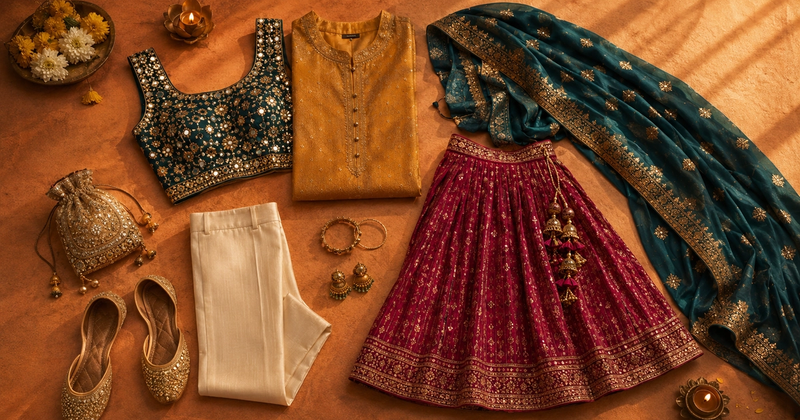


Build a Fusion Wardrobe: 70/30 Rule for Both Styles
Build a fusion wardrobe with Western and ethnic wear using the 70/30 rule. Learn how 5 foundation pieces and smart styling multiply outfits without doubling your closet.
 Mehul AgarwalFounder
Build a Fusion Wardrobe: The 70/30 Rule
Table of Contents
- Introduction: You Don't Need Two Wardrobes
- What the 70/30 Rule Actually Means (And Why It Works)
- The Closet Audit: Find Your Fusion-Ready Pieces First
- Building Your Fusion Foundation: The 5–10 Piece Starting Set
- Styling Multipliers: Proportion, Color, and Layering
- What to Buy Next: A Smart Shopping Decision Framework
- Frequently Asked Questions
- Conclusion: Your Wardrobe, Smarter
Key Takeaways
- The 70/30 rule—70% one style system, 30% the other—is the structural solution to building a fusion wardrobe without doubling your closet.
- A fusion capsule needs as few as 5 foundation pieces to function, not a full second wardrobe.
- Every piece earns its place by passing the three-role test: casual Western, ethnic/fusion, and occasion wear.
- Neutral anchors (black, ivory, beige, navy) and co-ord sets deliver the highest utility across both style systems.
Introduction: You Don't Need Two Wardrobes
Most people assume that building a wardrobe that works for both Western and ethnic wear means buying twice as much—two sets of bottoms, two shoe collections, two mental filing systems for what goes with what. That assumption is the problem, not the wardrobe.
Fusion wardrobing is a planning problem, not a shopping problem. A capsule wardrobe typically starts with around 33 items, and a practical Indo-Western fusion wardrobe can start with as few as 5 foundation pieces. The math alone dismantles the "I need more" instinct.
The structural solution is the 70/30 rule: your wardrobe leans 70% toward one style system—Western or ethnic—and 30% toward the other, based on how you actually live. This ratio is the most practical framework for blending both aesthetics without redundancy.
By the end of this article, you'll have a decision framework for auditing what you already own, spotting true gaps (not wishlist gaps), and making one or two strategic purchases that unlock significantly more outfit combinations. The goal is to work with your existing wardrobe first—and shop only when the audit proves you need to.
What the 70/30 Rule Actually Means (And Why It Works)
The 70/30 rule is straightforward: your wardrobe is built around one dominant style system—either Western or ethnic—with the other system making up roughly 30% of your pieces. This ratio works because it anchors your wardrobe in a single coherent logic while leaving room for the other aesthetic to layer in strategically.
The reason most people end up with two separate, underused wardrobes is that they shop occasion by occasion. A wedding here, a work trip there, a brunch on Saturday. Each purchase answers a single context, which means pieces rarely earn their keep across multiple situations. The 70/30 rule breaks that pattern by forcing a hierarchy: one system is your default, the other is your complement.
The best way to apply this is through what you can call the three-role test. Before any piece earns a permanent spot in your wardrobe, it should serve at least three distinct contexts—casual Western, ethnic or fusion, and occasion wear. A co-ord set is the clearest example: worn together with minimal jewelry, it reads as a polished ethnic or fusion look; separated, the top pairs with straight-leg trousers for a Western-casual office outfit, while the bottom works under a structured blazer for a weekend event. That's three roles from two pieces. Co-ord sets consistently deliver this kind of crossover utility because they're designed with separability in mind.
Indo-Western fusion is also mainstream now, not a niche styling category. That matters practically: it means more pieces are designed with crossover utility built in, and it means you won't look like you're "mixing" so much as dressing with intention.
To find your own ratio, run a quick lifestyle audit. Count the days in a typical week when you need ethnic wear—family occasions, festive events, cultural contexts—versus days when Western wear is the default. If ethnic wear comes up two or fewer days a week, you're likely a 70% Western, 30% ethnic wardrobe. If it's three or more days, flip it. Your ratio follows your life, not the season's trends.
The Closet Audit: Find Your Fusion-Ready Pieces First
Once you know your ratio, the instinct is to open a shopping app. Resist it. Most people already own more fusion-ready pieces than they realize—the audit comes before the cart.
The process has three steps:
- Pull everything out and categorize by style system. Sort into three piles: Western, ethnic, and already hybrid (pieces that have crossed over at least once). The hybrid pile is usually larger than expected.
- Identify crossover candidates. These are pieces that could work in both systems with different styling—not pieces that need to be replaced, just pieces that need a new context. Structured blazers, palazzos, neutral coord sets, midi dresses, and kaftans are the most common crossover candidates people already own. A blazer worn over a kurta is not a style experiment—it's a wardrobe strategy.
- Flag true gaps. A true gap is something you genuinely need but don't own. Not something you want. Not something you saw on Instagram. The distinction matters because most "gaps" people identify are actually duplicates of things they already have in a different color.
Once the audit is complete, apply the one-in, one-out rule as a standing closet-health principle: every new piece that enters should displace or replace something already there. This prevents the slow accumulation of occasion-specific pieces that sit unworn between festivals.

Want this styled from your own closet?
Elara builds the look from what you own, then lets you try it on.
Pieces that appear "ethnic" in isolation often function as neutral bases when separated and restyled. Surfacing those combinations manually takes time, which is where a wardrobe digitization tool earns its place: Elara's AI stylist can catalog your existing pieces and flag crossover pairings you haven't tried yet, making the audit faster and considerably more useful.
Building Your Fusion Foundation: The 5–10 Piece Starting Set
Five pieces is the proven floor for a functional fusion wardrobe: a solid cotton base kurti, a printed co-ord set, a palazzo suit set, a festive suit set, and a versatile cotton dupatta. These five pieces aren't a starter kit—they're a complete, re-stylable system if chosen carefully.
From there, an 8–10 piece ceiling is realistic: four kurtas, three Western bottoms, two to three tops or layers, one dress, one saree or lehenga, and four footwear types. Treat this as a ceiling, not a target. Reaching it should take months of intentional additions, not a single shopping trip.
Each piece earns its place through multi-role logic:
- Palazzo suit set: functions as a full ethnic look, separates into a Western casual bottom paired with a fitted top, and layers under a blazer for office contexts.
- Printed co-ord set: worn together for festive or brunch occasions; separated so the top pairs with jeans and the bottom pairs with a plain kurta—three outfits from two pieces.
- Cotton dupatta: transforms a casual kurti into occasion wear, doubles as a wrap layer in air-conditioned spaces, and adds ethnic register to an otherwise Western-leaning outfit.
Silhouette matters as much as the category. Structured, minimal silhouettes work harder across both contexts than heavily ornate pieces—ornate embellishment is harder to re-style and tends to anchor a piece to a single occasion. A heavily embroidered kurta reads festive and only festive. A clean A-line kurta in solid cotton reads festive or casual, depending on what surrounds it.
For color, the most practical strategy is to build the foundation entirely in neutrals—black, ivory, beige, navy, sand, charcoal, olive—then add one jewel-tone accent piece. Neutrals bridge both style systems without effort. A black palazzo works with a printed kurta and with a white linen shirt. The jewel-tone piece (a deep teal sharara, a burgundy festive set) creates occasion variety without expanding the foundation.
Styling Multipliers: Proportion, Color, and Layering
The section most wardrobe guides skip entirely is the one that actually determines how many outfits you get from a fixed number of pieces. Styling technique—not additional purchases—is the primary lever.
Proportion play is the fastest way to make an ethnic piece read Western, or vice versa. A voluminous ethnic top (kurta, kaftan, embroidered tunic) immediately reads more contemporary when paired with slim Western bottoms—straight-leg trousers, fitted jeans, cigarette pants. The contrast in volume is what makes the combination feel intentional rather than accidental. The reverse works equally well: a structured Western blazer worn over a flowy ethnic set borrows authority from the tailoring while the ethnic silhouette underneath keeps the look from reading purely corporate.
The one-pattern rule is the single most useful combination-multiplier available. If one piece carries print, embellishment, or texture, every other piece in the outfit stays solid. This isn't a conservative styling choice—it's a mathematical one. A printed kurta that works with five solid bottoms gives you five outfits. The same printed kurta paired with another printed piece gives you one look that's difficult to re-wear without the combination feeling repetitive.
Layering as a style switch is where the same base outfit earns two entirely different readings. A cotton kurta and palazzo worn with a dupatta draped across the shoulder reads ethnic. The same kurta and palazzo with the dupatta removed and a denim jacket added reads Western-casual. Two looks, zero extra purchases, one outfit as the base.
Co-ord sets are the most efficient foundation for this technique because they're designed with separability in mind. Styled together, they function as a complete ethnic or fusion look. Separated, each piece integrates into the broader wardrobe as an independent item. Natural fabrics like cotton, linen, and chanderi move between both style contexts without effort and hold up to daily wear in warm climates in a way that synthetic fabrics don't.
What to Buy Next: A Smart Shopping Decision Framework
With your foundation pieces identified and your styling techniques in place, the next question is inevitably: what should I actually buy? This is where most wardrobes go sideways—not from lack of options, but from shopping without a filter.
Before any new purchase, run it through three questions:
- Does this piece serve at least three roles in my lifestyle ratio? A piece that only works for one context—say, a heavily embellished anarkali you'll wear twice a year—is a wardrobe cost, not an investment.
- Does it work with at least five things I already own? If you're mentally pairing it with items you'd still need to buy, stop. The piece isn't ready for your wardrobe yet.
- Does it fill a gap I identified in my audit—or am I buying it because it's beautiful in isolation? Beautiful in isolation is how unworn clothes happen.
The highest-ROI purchase categories for a fusion wardrobe are consistent across styling guidance. Neutral coord sets deliver maximum utility because they function as a complete ethnic or fusion look together and as independent separates with Western pieces. Structured blazers are replacing ornate layering pieces for everyday office and brunch contexts—one blazer unlocks dozens of combinations across both style systems. For festive occasions, a single well-chosen piece—a ready-to-wear saree, crop-top suit, or sharara set—covers more ground than three mediocre alternatives.
For any new purchase, default to pastels and neutrals. A neutral and pastel palette integrates immediately with existing pieces, while one jewel-tone accent handles occasion variety. New pieces in this palette work from day one—no waiting for the rest of your wardrobe to catch up.
If you've digitized your wardrobe with Elara, the smart shopping recommendation feature lets you validate any potential purchase against what you already own before you buy—so the three-question filter runs on real data, not memory.
Frequently Asked Questions
How long does a closet audit actually take? A thorough audit typically takes 2–3 hours the first time. Start by pulling everything from your closet and sorting into three piles: Western, ethnic, and pieces you've already mixed. Then go through the hybrid pile and note which pieces have worked in multiple contexts. Once you know your ratio and identify crossover candidates, the process gets faster. If you use Elara to digitize your wardrobe, you can photograph pieces as you go and let the AI surface crossover combinations you haven't tried yet.
What if my lifestyle ratio changes seasonally? Your ratio can shift—that's normal. If you travel for work in winter and have more time for ethnic events in summer, adjust your ratio for each season. The foundation pieces (neutral coord sets, structured blazers, versatile kurtis) stay the same year-round. What changes is which of your 30% pieces you rotate in. A summer wardrobe might lean more ethnic for family events; a winter work-travel wardrobe might shift more Western.
Can I start with fewer than 5 foundation pieces? Technically yes, but practically no. Three pieces is the absolute minimum for any functional wardrobe, but you'll hit outfit repetition quickly. Five pieces is the threshold where you can actually create distinct combinations without feeling like you're wearing the same thing. If you're starting from scratch, prioritize: a solid kurti, a co-ord set, a palazzo, a neutral top, and a dupatta or layering piece. These five cover casual, festive, and office contexts.
How do I know if something is a "true gap" versus a "wishlist gap"? A true gap is something you reach for and don't have. A wishlist gap is something you think would be nice to own. The test: for the next two weeks, every time you get dressed, notice what you wished you had. Write it down. If the same item comes up three or more times, it's a true gap. If it comes up once or not at all, it's a wishlist gap. True gaps earn a purchase. Wishlist gaps earn a Pinterest board.
Conclusion: Your Wardrobe, Smarter
A fusion wardrobe is a planning achievement, not a shopping achievement. The people who crack this aren't buying more—they're thinking more clearly about what they already own.
The framework is five steps: establish your 70/30 lifestyle ratio, run a closet audit to surface what's already fusion-ready, build a 5–10 piece foundation anchored in neutrals, apply styling multipliers to multiply outfit combinations without multiplying purchases, and filter every new buy through the three-question decision framework.
The payoff is practical: fewer decisions every morning, genuine confidence across both Western and ethnic contexts, and no more "nothing to wear" paralysis when the dress code shifts. Your wardrobe works because it was built to—not because it's large.
If you want to see how this plays out in practice, explore how Elara helps you digitize your existing wardrobe and surface combinations you haven't tried yet.
Your stylist, in your pocket
Stop reading about outfits. Start wearing them.
Elara knows your closet, shops every store and gets you dressed for any occasion.