ChatGPT as Personal Stylist: What Works & Where It Fails
ChatGPT excels at trend research and capsule planning but fails on fit, fabric, and inventory. Learn exactly where AI styling works and where it predictably breaks down.


ChatGPT as Personal Stylist: What It Nails (and What It Misses)
Table of Contents
- Introduction: The AI Styling Surge Nobody Saw Coming
- What ChatGPT Actually Gets Right: The Styling Tasks It Handles Well
- Where ChatGPT Breaks Down: The Limits You Need to Know
- The Accuracy Question: What the Numbers Actually Mean
- How to Use ChatGPT for Styling Without Getting Burned: A Practical Workflow
- FAQ: Your Questions About ChatGPT and AI Styling Answered
- Conclusion: The Right Tool for the Right Job
Key Takeaways
- Shopping-related generative AI searches surged 4,700% in 2025, and 53% of AI search users now shop through it (Business of Fashion, 2026).
- ChatGPT genuinely earns its place in ideation, capsule planning, and pre-purchase research — it breaks down on fit, fabric, live inventory, and taste.
- The reported 85–92% body-type accuracy figure comes from a single practitioner guide, not an independently validated study.
- Elara adds the wardrobe-context layer ChatGPT lacks: fit intelligence and styling that actually knows your closet.
Introduction: The AI Styling Surge Nobody Saw Coming
Shopping-related generative AI searches increased 4,700% in 2025, according to the Business of Fashion's State of Fashion 2026 report — a number that stops most people mid-sentence. That's not gradual adoption. That's a fundamental shift in how people shop.
What makes this figure more striking is what comes next. According to the same report, 53% of U.S. consumers who used generative AI for search also used it to make actual purchase decisions. This isn't early-adopter behavior anymore. It's mainstream consumer infrastructure, and fashion is one of its fastest-growing applications.
Yet most of the conversation around AI styling still asks the wrong question. Competitor articles frame this as a binary: can AI replace a stylist, or can't it? That misses what actually matters. The more useful question — the one that changes how you get dressed — is which specific tasks ChatGPT handles well, and where it predictably falls apart.
This article maps that distinction. Not a philosophical take on AI's role in fashion, but a practical answer: where ChatGPT earns a place in your styling routine, and where you'll hit a wall if you push it past its actual capabilities.
What ChatGPT Actually Gets Right: The Styling Tasks It Handles Well
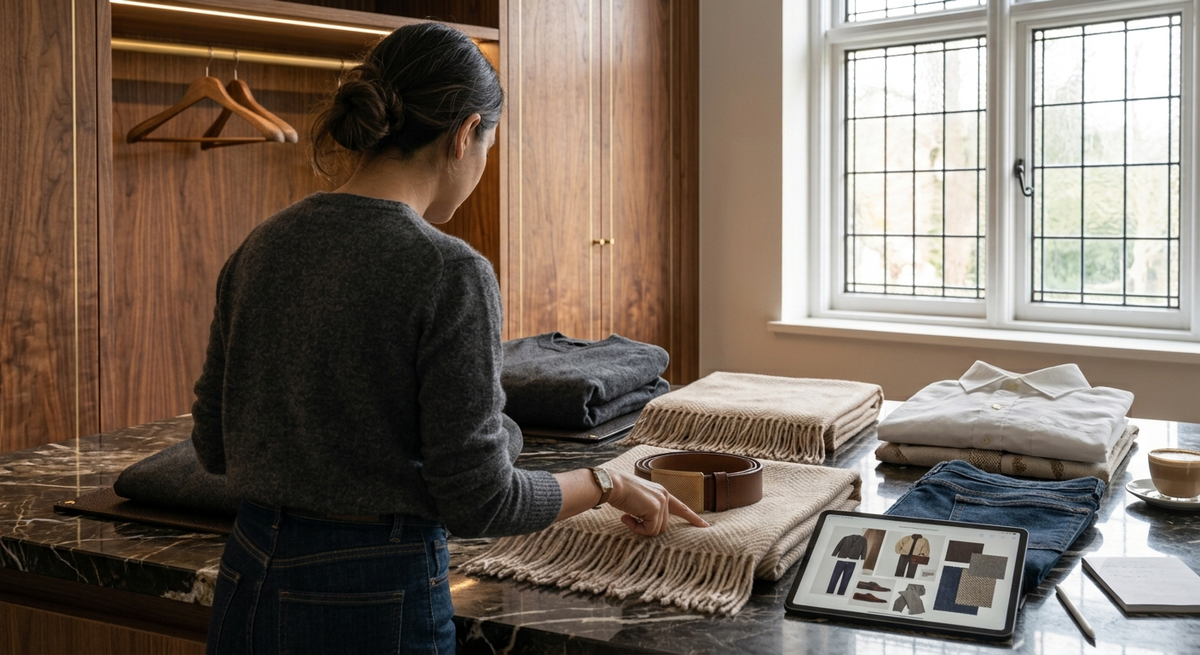
ChatGPT functions best as a first-pass stylist — strongest at ideation and organization, and most valuable when you bring clear, specific inputs. Within that framing, four use cases consistently deliver real results.
1. Trend research and outfit formulas. ChatGPT can translate a runway reference, a Pinterest board, or a vague aesthetic description ("quiet luxury but I work in a creative agency") into concrete, wearable combinations. It draws on an enormous training corpus of fashion editorial, retail copy, and styling guides. Ask it to build three outfits around a camel trench coat for a creative professional, and the output is usually solid — not groundbreaking, but structurally sound and immediately actionable.
2. Capsule wardrobe planning and closet audits. This is arguably ChatGPT's strongest styling use case. Given a list of existing pieces, a set of occasions, and a target wardrobe size, it can generate a structured framework that most people would take weeks to build manually. The output isn't personalized in any deep sense, but it's organized, occasion-mapped, and gap-aware in ways that genuinely accelerate the planning process.
3. Pre-purchase shopping research. Faced with a specific need — say, a blazer under $200 that works for both video calls and in-person client meetings — ChatGPT can narrow a broad search into a shortlist of viable candidates. It won't pull live inventory, but it can identify the right category, suggest brand tiers, and flag what to look for in terms of fabric, cut, and versatility.
4. Prompt-based personalization. The quality of ChatGPT's styling output scales directly with the quality of your inputs. When you provide lifestyle context (remote work three days a week, office two), climate, color preferences, existing wardrobe anchors, and budget, the suggestions become meaningfully tailored rather than generic. The model rewards specificity.
To make this concrete: imagine a millennial professional building a work-from-home-to-office capsule wardrobe for a hybrid schedule in a northern climate. You supply ChatGPT with your current wardrobe gaps, a $600 seasonal budget, a preference for neutral palettes, and a note that you're petite. The output — a prioritized shopping list with outfit formulas for each context — is the kind of structured starting point that would otherwise take hours to assemble independently.
That productivity signal is real. Practitioners using AI in styling workflows report saving 5 to 15 hours per week, according to a ChatGPT Brasil practitioner-oriented guide. That figure comes from self-reported practitioner experience, not a controlled study, so treat it as directional rather than guaranteed. But the underlying mechanism is sound: AI compresses the research and ideation phases that historically consumed the most time.
The consistent thread across all four use cases is that ChatGPT works best as the drafting layer — the tool that gets you from blank page to informed starting point. What it cannot do is close the loop on the decisions that actually require knowing your body, your wardrobe, and your taste.
Where ChatGPT Breaks Down: The Limits You Need to Know
Knowing what ChatGPT cannot do is just as useful as knowing what it can — and the failure points are far more specific than "AI can't replace a stylist." The real issue isn't whether ChatGPT belongs in a styling workflow. It's which stages of that workflow it will predictably get wrong.
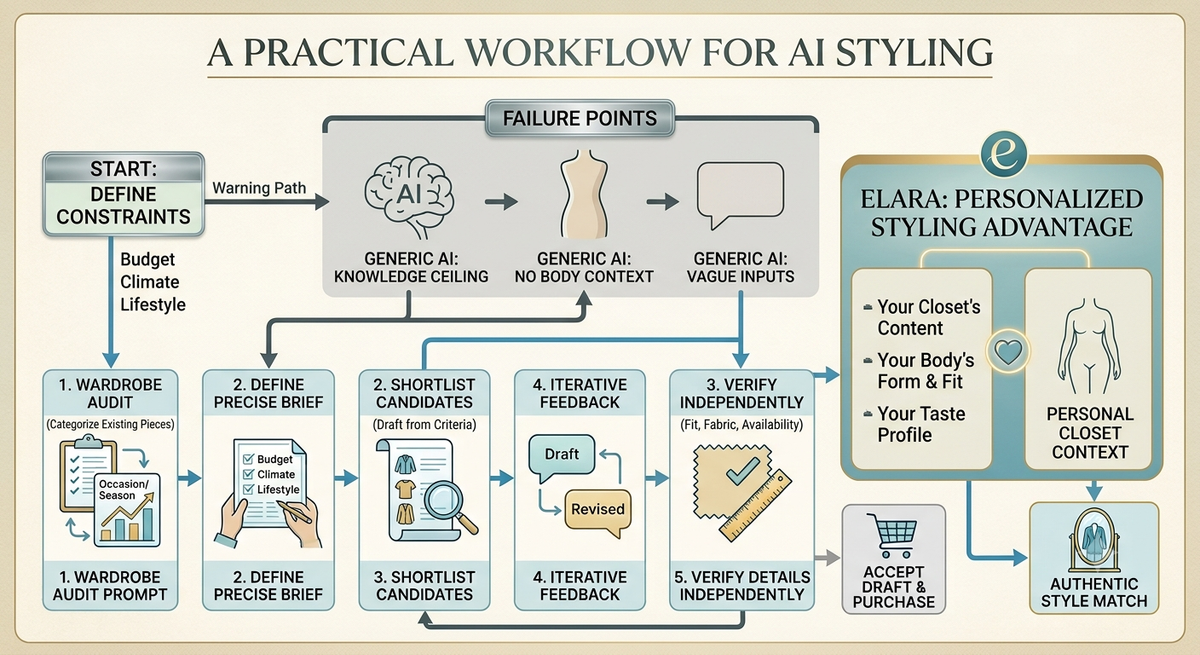
Five failure points appear consistently across practitioner accounts and independent assessments.
1. Fit and body movement. ChatGPT has no way to assess how a garment drapes across your shoulders, pulls at the hip, or moves when you walk. Recommending a slim-cut blazer is easy; predicting whether it will gap at the chest on your specific frame is impossible without physical feedback.
2. Fabric and texture verification. Even with image inputs, AI cannot reliably evaluate hand-feel, weight, or construction quality. The difference between a $40 linen-blend and a $200 true linen reads visually as almost nothing — and that gap matters enormously to how a piece wears and ages.
Ready to upgrade your wardrobe?
Get the Elara app for AI-powered styling and virtual try-ons.
3. Live inventory, pricing, and stock. ChatGPT's training data has a cutoff, and it has no real-time connection to retailer databases. According to The Rundown AI, ChatGPT can brainstorm outfits and build checklists, but it cannot reliably guarantee fit, fabric quality, color accuracy, stock, or authenticity — or how a garment will actually look in person. Recommendations that were accurate at training time may point to discontinued colorways or sold-out sizes.
4. Authentic taste calibration. This is the subtlest failure point, and arguably the most consequential. Style identity is built through accumulated feedback, emotional resonance, and honest challenge — none of which a language model is equipped to deliver. ChatGPT will not help you discover personal style or develop better taste the way a human stylist can.
5. Hallucination risk. When you treat ChatGPT as an authority rather than a drafting tool, the model's confident tone becomes a liability. It will name specific products, cite measurements, and describe garment details with equal certainty whether the information is accurate or fabricated.
None of these failure points make ChatGPT useless for styling. They make it a tool that works best when you understand exactly where the floor drops out.
The Accuracy Question: What the Numbers Actually Mean

One figure circulates widely in AI styling coverage: ChatGPT achieves 85–92% accuracy for the five main body types when users provide three standardized photos and precise measurements. That claim comes from a ChatGPT Brasil practitioner-oriented guide — a single source, not an independent benchmark study. Treating it as industry-validated performance would be a mistake, and most coverage that cites it does exactly that.
The conditions buried in the claim matter more than the number itself. Achieving that accuracy range requires three standardized photos taken from specific angles under consistent lighting, plus precise body measurements. That's a bar most casual users will not meet. Someone typing "I'm curvy and 5'4"" into a chat window is not providing the structured input the accuracy claim depends on. The gap between what users actually submit and what the model needs to perform at its reported ceiling is wide.
This is the distinction competitors consistently miss: claimed accuracy versus validated performance. Claimed accuracy describes what a tool reports under optimal, controlled conditions. Validated performance describes what independent testing finds across the messy, inconsistent inputs real users actually provide. No peer-reviewed study has yet benchmarked ChatGPT's styling accuracy across a representative sample of casual users.
"AI is helpful for people just starting to think seriously about style, but it 'isn't there quite yet' as a replacement for professional judgment." — Business Insider
That framing from Business Insider captures the honest position. Even accepting the 85–92% figure at face value, structured task performance and professional judgment are different things. A tool can categorize body types with reasonable accuracy and still fail to understand why a particular silhouette feels wrong to you on a particular day. Accuracy on a classification task is not the same as styling intelligence.
How to Use ChatGPT for Styling Without Getting Burned: A Practical Workflow
Given what ChatGPT does well and where it breaks down, the most effective approach treats it as a first-pass stylist — strong on ideation and research, unreliable on the decisions that require knowing your actual body, wardrobe, and taste. Here's a five-step workflow that routes around the failure points.
1. Start with a wardrobe audit prompt. Ask ChatGPT to help you categorize your existing pieces by occasion, season, and frequency of wear. Supply a rough inventory — even a list of 15 to 20 items — and ask it to identify gaps and redundancies. This is exactly the structured, text-based task where ChatGPT performs reliably.
2. Define your constraints upfront, specifically. Before asking for outfit suggestions, input your budget range, climate, lifestyle context (remote work, office, frequent travel), and any fit preferences or items you already know work for your body. Vague inputs produce vague outputs. The more precise your brief, the more useful the suggestions.
3. Use ChatGPT for shortlisting, not final decisions. Let it compress a broad search — say, 40 possible white shirts — into a shortlist of 6 to 8 candidates that match your criteria. Then verify fit, fabric, and current availability independently before purchasing. ChatGPT narrows the field; it doesn't close the deal.
4. Treat every suggestion as a draft. The first output is a starting point, not a recommendation to act on. Follow up with specific objections: "This reads too formal for my lifestyle" or "I need something that works without ironing." Iteration produces significantly better results than accepting the initial response.
5. Know when to escalate. For major wardrobe investments, event dressing, or any decision that touches personal style identity, ChatGPT's ceiling becomes visible quickly. That's the moment to move to a tool with richer context — or a human stylist who can ask the questions a language model won't think to ask.
This is where Elara picks up. Unlike ChatGPT, Elara works from your actual wardrobe — learning what you own, what fits, and what you reach for — so styling suggestions are grounded in your real closet rather than generic ideation. The result is the difference between a first-pass draft and a recommendation that actually knows you.
Want to see what AI styling looks like when it actually knows your wardrobe? Explore Elara → joinelara.com
FAQ: Your Questions About ChatGPT and AI Styling Answered
Can ChatGPT actually tell me if something will fit my body?
No. ChatGPT cannot assess how a garment will drape, move, or sit on your specific frame without physical feedback. It can help you identify the right size range or suggest brands known for certain fits, but the actual fit test requires trying something on or getting feedback from someone who knows how clothes move on your body. That's where tools like Elara make a difference — they learn from your actual wardrobe what fits and what doesn't.
Is ChatGPT better than hiring a real stylist?
ChatGPT and a real stylist do different things. ChatGPT is faster and cheaper for research, ideation, and organizing your existing wardrobe. A real stylist (or an AI tool like Elara that knows your wardrobe) excels at the taste calibration and personalized judgment that ChatGPT can't deliver. The best approach often uses ChatGPT for the drafting work and human judgment (or wardrobe-aware AI) for the final call.
Why does ChatGPT sometimes give me outfit suggestions that don't match anything in my closet?
Because ChatGPT doesn't know what's actually in your closet. It generates suggestions based on general styling principles and its training data, not your real inventory. That's why the workflow in this article emphasizes starting with a wardrobe audit and using ChatGPT for shortlisting rather than final recommendations. Elara solves this by digitizing your closet first — so every suggestion is built from what you actually own.
How accurate is ChatGPT at body-type classification?
The widely cited 85–92% accuracy figure comes from a single practitioner guide under controlled conditions (three standardized photos, precise measurements). Independent validation across real-world users doesn't exist yet. That figure also describes best-case performance, not what happens when you type a casual description into a chat. Treat it as directional, not guaranteed.
Should I use ChatGPT or an AI styling app?
Both have roles. ChatGPT is free and useful for research, ideation, and organizing your thinking. An AI styling app like Elara adds a layer ChatGPT lacks: knowledge of your actual wardrobe, fit history, and taste. The combination — ChatGPT for brainstorming, Elara for wardrobe-grounded recommendations — is more powerful than either alone.
Conclusion: The Right Tool for the Right Job
ChatGPT earns its place in a modern styling workflow — as a research layer, an ideation engine, and a first-pass organizer. What it cannot do is know your wardrobe, read how a fabric moves on your body, or develop the kind of taste calibration that comes from understanding who you actually are, not just what you've typed. As Business Insider put it, AI styling "isn't there quite yet" as a replacement for that depth of judgment — and the most effective use of these tools starts with accepting that honestly.
The real skill isn't choosing between AI and human judgment. It's knowing which layer of the styling process each one handles well. ChatGPT drafts; it doesn't decide. It brainstorms; it doesn't fit-check. Used inside those boundaries, it's genuinely powerful.
The next evolution of AI styling moves past the drafting stage entirely — toward tools that know what's already in your closet, remember what you actually wear, and build recommendations from your real wardrobe outward. That's the kind of intelligence worth waiting for.
Follow along as we map that future at joinelara.com.
Your AI Stylist is Here.
live on the App Store
Available on iOS for seamless access anytime, anywhere.