AI Styling App: Complete Guide to 2026 Tools


AI Styling App Guide: What These Tools Do and How to Choose One
An AI styling app helps you decide what to wear by combining information about your wardrobe, your body, and your context — then generating outfit suggestions or shopping recommendations tailored specifically to you. Unlike basic style quizzes or trend feeds, the best AI styling apps build a persistent understanding of your preferences and get sharper the more you use them.
This guide covers the three main types of AI styling apps, what each one actually does, where they fall short, and a practical framework for choosing the right one.
Key Takeaways
- AI styling apps in 2026 fall into three categories: wardrobe-first, shopping-first, and visual discovery tools — and they solve fundamentally different problems.
- The AI-based personalized stylist market is growing at a 36.5% CAGR, from $171.89M in 2025 to a projected $3.82B by 2035 (InsightAce Analytic).
- Personalization depth scales with wardrobe data, not subscription tier. A free account with a fully digitized closet will outperform a paid account with five items uploaded.
- Free AI stylist tools exist, but the best recommendations come from apps that learn your preferences through ongoing interaction, not a one-time quiz.
What an AI Styling App Is — and Isn't
Most people still picture AI styling apps as glorified Pinterest boards or shopping push notifications. That reputation isn't entirely unearned, but the category has moved well past it.
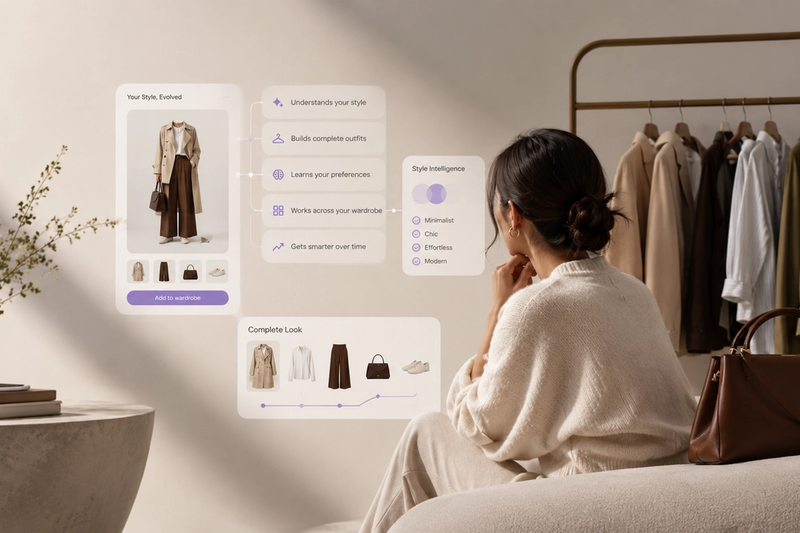
A modern AI styling app does four things: it catalogs what you own, generates outfits from that catalog based on context (occasion, weather, preference), identifies genuine gaps in your wardrobe, and — in the best implementations — learns your taste through every interaction. What it doesn't do is replace the tactile judgment of a human stylist, accurately simulate how structured fabrics will drape, or perform well on niche aesthetics if the training data is thin.
The distinction between types matters enormously when you're choosing:
Wardrobe-first apps treat your existing closet as the primary resource. You upload your clothes, the app catalogs them, and outfit suggestions draw from what you already own before ever pointing you toward a purchase. The value proposition is decision support — reducing the "nothing to wear" feeling that plagues full closets. Elara is built on this philosophy: every suggestion starts with your wardrobe.
Shopping-first apps are built around product discovery. Their core function is surfacing items that match your aesthetic from partner brand catalogs. They're not building a model of your wardrobe; they're predicting your next purchase. Useful if you want to find things, less useful if you want to wear what you have.
Visual discovery tools — think AI-enhanced moodboards — are closer to social platforms than stylists. They surface trends and inspiration but don't generate recommendations specific to your body, your closet, or your context. Good for ideas; not a substitute for practical outfit guidance.
What AI Styling Apps Actually Do Well in 2026
Across all three types, four capabilities have become standard in quality apps:
1. Wardrobe digitization. You photograph your clothing — item by item or batch — and the app catalogs each piece by category, color, fabric type, and occasion suitability. Background removal and auto-tagging have eliminated most of the manual setup friction that killed early wardrobe apps.
2. Outfit generation. From a digitized catalog, the outfit engine draws combinations you might never have considered — surfacing pairings across items that rarely share the same mental category. A blazer you haven't touched in six months might be exactly what completes three of your most-worn outfits.
3. Shopping gap analysis. Rather than suggesting products at random, better apps identify what's genuinely missing from your wardrobe versus what you just haven't thought to combine yet. This distinction is the difference between contextually intelligent recommendations and a product feed.
4. Conversational interface. The shift from grid browsing to natural language has been the most significant UX change in the category. You type "job interview at a creative agency on Thursday, might rain" and the app responds with specific outfit options from your closet — including the reasoning. That interaction model also compounds: every response you give the app refines its understanding of how you think about clothes.
"Best For" Comparison: Which Type Fits You
Wardrobe-first apps are best for:
- People who own more than they wear
- Anyone trying to reduce shopping frequency or impulse buying
- Users who want outfit suggestions from what they already own
- Morning decision fatigue sufferers who just need a fast answer
Shopping-first apps are best for:
Ready to upgrade your wardrobe?
Get the Elara app for AI-powered styling and virtual try-ons.
- Active shoppers who love discovery
- Users who want to find specific items that match a style direction
- People in the early stages of building a wardrobe
Visual discovery tools are best for:
- Style inspiration and trend exploration
- Users who don't need practical outfit recommendations
What AI Styling Apps Still Can't Do
Honesty about limitations matters more than enthusiasm about features.
Tactile judgment. A skilled stylist knows within seconds whether a fabric will hold its shape through a long day or whether a collar sits awkwardly on a specific neckline. No image analysis replicates that physical, embodied knowledge. Treat virtual try-on as a confidence signal, not a definitive fit verdict — especially for structured or heavily textured fabrics.
Niche aesthetics. AI models trained predominantly on mainstream fashion data produce mainstream outputs. If your personal style draws from a narrow subculture — technical workwear, Japanese avant-garde silhouettes, specific vintage eras — the training data is sparse and the recommendations will feel generic.
Low-data environments. The most common complaint about AI styling apps — "generic after a few uses" — almost always traces back to incomplete wardrobe data. The problem isn't the AI; it's that the system doesn't have enough information to individualize. Well-designed apps counter this by making digitization as frictionless as possible and prompting users to log outfit feedback.
FAQ
What is an AI styling app? An AI styling app uses information about your wardrobe, body, and personal preferences to generate outfit suggestions, identify what's missing from your closet, and — in some cases — help you shop for specific gaps. The best ones learn your taste through ongoing interaction rather than relying on a one-time quiz.
Are AI stylist apps worth it? That depends on the problem you're trying to solve. If you frequently feel like you have nothing to wear despite owning plenty of clothes, a wardrobe-first AI stylist will help. If you mainly want help finding new items, a shopping-first tool is more relevant. Free tiers on most apps are usable, but personalization depth improves significantly with more wardrobe data and more interaction.
What's the best free AI styling app? The answer depends on your priority. For wardrobe-based outfit suggestions and virtual try-on, Elara offers a free tier on iOS that includes full closet digitization, conversational outfit generation, and shopping recommendations tied to your actual wardrobe. Free tiers across most apps have meaningful caps, but enough functionality to evaluate whether the approach fits you.
How does an AI styling app learn your style? Through a combination of explicit feedback (ratings, skips, saves) and behavioral patterns (what you accept at 7am versus what you accept for weekend occasions). The longer you use it and the more wardrobe data you provide, the more accurate the recommendations become.
Can AI choose outfits for me? Yes — though the quality of those suggestions depends on what data the app has access to. An AI that knows your wardrobe, your past choices, your occasion context, and your style preferences will produce significantly better suggestions than one working from a five-question quiz and your Instagram feed.
What data does an AI stylist need? At minimum: wardrobe inventory (what you own), basic preference inputs (occasions, fit preferences, style direction), and feedback on suggestions. The most powerful signal is behavioral: which outfits you actually wear, which you skip, and which you save. Wardrobe images are the single highest-value input — apps without wardrobe data can only generalize.
How to Choose the Right AI Styling App
Three questions cut through most of the noise:
1. Do you want to maximize clothes you already own, or discover new ones? This is the most important decision. Wardrobe-first apps (like Elara) and shopping-first apps are genuinely different products with different value propositions.
2. Do you prefer chat-based interaction or visual browsing? Some users think in images and prefer scrolling grids; others find it easier to type "rooftop dinner, not too formal" and get a direct answer. Match the interaction model to how you actually think about clothes.
3. How much time are you willing to invest upfront? Wardrobe digitization takes real effort, especially for larger closets. Apps that require it return significantly more value — but the setup cost is real. AI-assisted onboarding (auto-tagging, background removal) has dramatically reduced this friction, but it's still a factor.
On free versus paid: the personalization gap between free and paid tiers is usually about feature depth — shopping integration, unlimited outfits, priority AI — not about whether basic recommendations work. Start free, upgrade if the core value is clear.
Conclusion
AI styling apps have become a practical tool — not a novelty. The best ones are building a persistent fashion layer that connects your wardrobe, your purchasing decisions, and your evolving preferences into something that actually learns who you are.
The category split is the most important thing to understand before downloading anything: wardrobe-first apps help you get more value from what you own; shopping-first apps help you find new things. Neither is universally better. They solve different problems for different people.
If you want a wardrobe-first, conversation-driven starting point, Elara is a useful place to see what the category can actually do — joinelara.com.
Your AI Stylist is Here.
live on the App Store
Available on iOS for seamless access anytime, anywhere.