AI Personal Stylist: How It Works & Why It Matters

AI Personal Stylist: What It Is, How It Works, and Whether It's Worth It
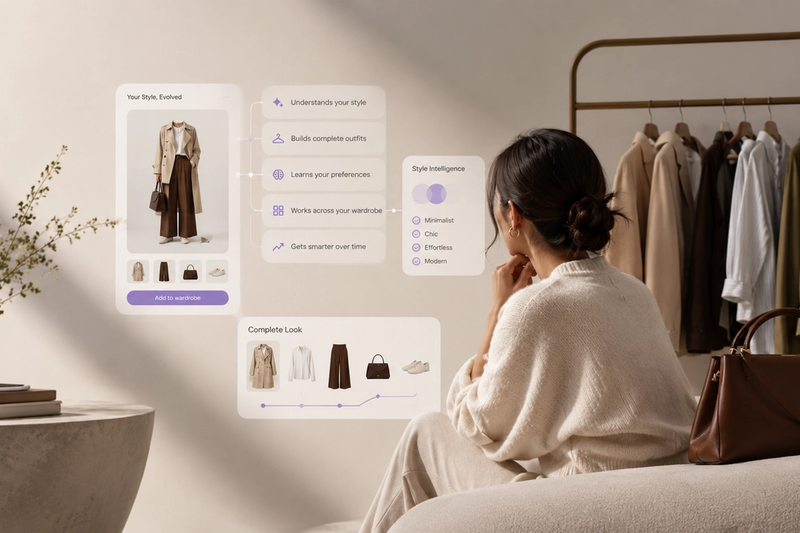
An AI personal stylist is an app that recommends outfits and shopping decisions based on your wardrobe, your preferences, and your context — then gets better at both the longer you use it. It's not a trend feed, a style quiz, or a shopping notification engine. It's a system that builds a model of your taste and generates specific suggestions from that model.
The AI-based personalized stylist market was valued at $171.89 million in 2025 and is projected to reach $3.82 billion by 2035 — a 36.5% CAGR (InsightAce Analytic). Active AI styling users globally have reached 280 million, with recommendation acceptance rates running between 65% and 78% (Dataintelo). These aren't niche adoption numbers. They reflect a technology that has already entered mainstream behavior.
This article explains exactly how an AI personal stylist works — the five-step process, the three technologies underneath it, and what the honest limitations are.
What an AI Personal Stylist Actually Does
The core user flow:
- Wardrobe input — You upload photos of your clothing, answer preference questions, or connect your shopping history. This is the raw data the system learns from.
- Style profile construction — The app builds a model of your taste: body type, preferred fits, occasions you dress for, colors you gravitate toward.
- Context intake — For each recommendation, you provide context: occasion, weather, mood, specific constraints.
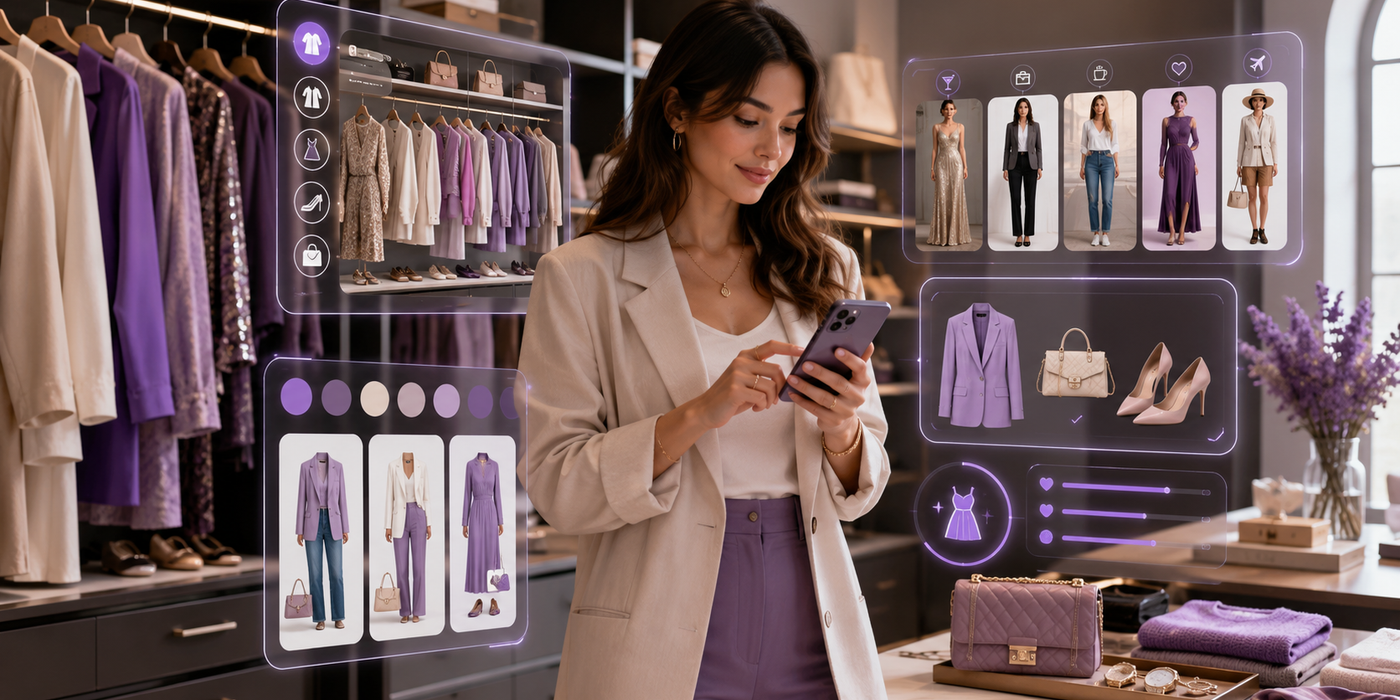
- Recommendation generation — The AI draws from your wardrobe and style profile to generate specific outfit suggestions, ranked by how well they match your context and preferences.
- Feedback loop — What you accept, reject, save, or modify feeds back into the model, refining every future output.
That feedback loop is what separates an AI personal stylist from a one-time quiz. It compounds. Every interaction sharpens the system's understanding of you.
AI Stylist vs. AI Shopping Assistant vs. Digital Closet App
These three terms are often conflated. They describe genuinely different products:
AI personal stylist: Combines wardrobe knowledge and preference modeling to generate outfit suggestions for you specifically. The output is personalized styling advice, not product recommendations.
AI shopping assistant: Focused on product discovery. Takes your stated preferences and surfaces items from catalogs that match. Doesn't require a wardrobe catalog. Good for finding things; doesn't help you use what you have.
Digital closet app: A catalog of your wardrobe. Stores photos, tracks wear frequency, calculates cost-per-wear. Some include basic outfit planning tools. The sophistication of AI varies widely across these apps.
An AI personal stylist like Elara combines all three: wardrobe catalog + style profile + outfit generation + shopping recommendations tied to real wardrobe gaps.
The Three Technologies Underneath
Computer vision handles what the system sees. When you photograph a garment, algorithms parse it for clothing type, dominant color, pattern structure, fabric texture, and silhouette — without any manual tagging. This is how an app can recognize that a navy herringbone blazer is formal-leaning, structured, and works in cool or neutral palettes, purely from pixels.
Natural language processing handles what you mean. A prompt like "business casual for a summer wedding" contains occasion context, formality range, and a seasonal constraint — packed into six words. NLP decodes intent so the recommendation engine knows what to rank highly, not just what category to search.
Ready to upgrade your wardrobe?
Get the Elara app for AI-powered styling and virtual try-ons.
Recommender models do the ranking. These take the attributes identified by computer vision and the intent decoded by NLP, then score possible outfit combinations against your style profile, past feedback, and contextual signals like weather. This layer accounts for 62.5% of component share in the AI personal stylist market (Dataintelo 2025) — reflecting how much of the system's intelligence lives here, not in the interface.
In practice: you type "job interview, warm outside." Computer vision has already catalogued your wardrobe. NLP parses "job interview" as formal-adjacent and "warm" as a temperature constraint. The recommender surfaces a lightweight linen blazer, tailored trousers, and loafers the system knows you've worn together before — ranked above a wool suit you own but have never selected on warm days. One output. Three layers.
How It Learns Your Taste Over Time
The data inputs are broader than most users realize:
- Wardrobe images establish your existing inventory
- Explicit preference settings (occasions, fits to avoid) provide a starting framework
- Behavioral signals — what you browse without saving, which suggestions you act on at 8am versus 8pm, how choices shift seasonally — build a more precise model than any quiz
Recommendation acceptance rates of 65–78% (Dataintelo) reflect that this learning works. The system that suggested mediocre outfits in week one produces accurate ones by month three.
The practical difference this creates is best illustrated by contrast. A generic recommendation engine tells you what's trending. An AI personal stylist tells you that the camel blazer you uploaded three months ago works with seven items you already own, and that pairing it with your straight-leg trousers matches the fit profile you've consistently chosen for work occasions. That specificity only exists because the system has been learning from you, not at you.
Limitations Worth Knowing
Tactile and fit judgment. No AI replicates the embodied knowledge of a skilled human stylist — whether a fabric will hold its shape through a long day, how a collar sits on a specific neckline, or how a color reads under office lighting versus a phone screen.
Niche aesthetics. If your personal style is subcultural — technical workwear, avant-garde silhouettes, specific vintage eras — the training data is thin and recommendations will feel mainstream. The further your taste is from the center of the fashion distribution, the less accurate the AI will be.
Data dependency. The "generic after a few uses" complaint almost always traces to incomplete wardrobe data, not a flawed AI. The system can only personalize to what it knows. More wardrobe data and more interaction feedback consistently produce better outputs.
FAQ
What is an AI personal stylist? An AI personal stylist is an app that recommends outfits and shopping decisions based on your wardrobe, body, and preferences — and gets better at both through ongoing interaction. Unlike a style quiz that gives you a one-time result, an AI personal stylist builds a persistent model of your taste and updates it with every session.
Can AI choose outfits for me? Yes. A wardrobe-connected AI personal stylist can generate specific outfit combinations from your clothing given any occasion, weather, or style brief. The quality depends on wardrobe data quality and interaction history — the more both improve, the more accurately the suggestions will reflect your actual preferences.
Are AI stylist apps worth it? For most people, yes — with the caveat that value is proportional to setup investment. An AI personal stylist that has access to your full wardrobe and three months of interaction feedback will consistently outperform one with a partial catalog and minimal engagement. The free tiers on most apps provide enough functionality to assess whether the approach is genuinely useful for how you dress.
What data does an AI personal stylist need? At minimum: wardrobe inventory, basic preference inputs, and feedback on suggestions. The highest-value input is wardrobe images, which enable the AI to generate outfit combinations from your actual clothing rather than generic suggestions.
Conclusion
AI personal stylists are not magic. They are a convergence of computer vision, NLP, and recommender models — each layer doing a specific job, each getting sharper with every interaction.
The best ones don't push trends. They learn you. That distinction — an AI that starts with what you own and builds outward from there — is what separates a wardrobe-first personal stylist from a dressed-up product feed.
Elara is built on that principle. If you want to see what an AI personal stylist that actually knows your wardrobe looks like, joinelara.com.
Your AI Stylist is Here.
live on the App Store
Available on iOS for seamless access anytime, anywhere.