AI in Fashion: 45 Statistics on Styling & Try-On
AI in fashion is reshaping how people shop and style. Explore 45 data-backed statistics on virtual try-on, returns reduction, and personalized recommendations driving the 2026 fashion retail revolution.


AI in Fashion: 2026 Stats on Fit, Conversion & Wardrobe AI
Table of Contents
- Introduction: AI Has Entered the Dressing Room
- The Consumer Adoption Picture: Who Is Using AI in Fashion Right Now?
- Virtual Try-On: From Novelty to Conversion Engine
- The Returns Problem: Why Fit Data Is Fashion's Biggest Unlock
- Personalization & Styling AI: The Revenue Driver Nobody Talks About
- The Market Behind the Movement: AI in Fashion by the Numbers
- What These Stats Mean for How You Dress (Not Just How Brands Sell)
- Frequently Asked Questions
- The Styling Layer Is Being Built Right Now
Key Takeaways
- 66% of consumers have already used AI in fashion shopping — for styling, discovery, price comparison, and product research.
- 64% of shoppers now expect brands to address sizing and fit challenges, making AI adoption a consumer demand, not just a retail experiment.
- Virtual try-on tools are linked to 20–40% lower return rates across fashion e-commerce.
- AI recommendation engines drive 35% of online fashion sales — more than a third of revenue.
- The most underreported benefit: AI's ability to maximize existing wardrobes, not just accelerate new purchases.
Introduction: AI Has Entered the Dressing Room
Two-thirds of consumers have already used AI in some form while shopping for fashion. That 66% adoption figure, tracked by morphed.app's AI Fashion Statistics, isn't a projection — it's the current baseline. AI is already inside the shopping experience, helping people compare prices, discover new styles, get outfit suggestions, and evaluate products before buying.
And yet, most people still open their closet every morning and feel like they have nothing to wear.
That gap is exactly what this article explores. The data on AI in fashion is extensive — and often conflicting — so the goal here is to surface the statistics that actually matter to real shoppers in 2026, not just to retail analysts. Three use cases dominate the current landscape: virtual try-on, personalized recommendations, and returns reduction. Each has its own set of numbers, and each reflects something larger than a conversion metric — a genuine shift in how people relate to their own wardrobes.
The Consumer Adoption Picture: Who Is Using AI in Fashion Right Now?
AI in fashion is no longer a niche behavior. According to morphed.app's AI Fashion Statistics, 66% of consumers have used AI while shopping for fashion, with usage concentrated across four core tasks: price comparison, product discovery, styling assistance, and product comparison. These aren't early adopters running experiments — they're everyday shoppers using AI the way they'd use a search engine or a size chart.
The demand goes beyond casual use. 64% of shoppers now expect brands to address sizing and fit challenges, per the same morphed.app dataset. That expectation is significant: it means AI adoption isn't just being driven by retailers pushing new tools, but by consumers who are actively frustrated with the status quo and looking for brands to solve it.
Even at the luxury end of the market, where skepticism about technology tends to run highest, adoption is stronger than most assume. According to RenderedFits' AI Fashion Shopping Statistics 2026, 55% of luxury consumers have used virtual try-on tools, and 15% use them frequently. That's a meaningful portion of a segment defined by high standards and low tolerance for poor experiences — a signal that virtual try-on has cleared the credibility bar even among discerning shoppers.
The breadth of adoption extends well beyond the consumer-facing tools most people encounter. The FashionaLabs AI Fashion Industry Report 2026 identifies six distinct segments driving industry-wide uptake: AI imagery and virtual photoshoots, virtual try-on, AI-assisted design, supply chain forecasting, personalization engines, and sustainability AI. Each represents a different layer of the fashion value chain being rebuilt around machine intelligence. Together, they make clear that what's happening in fashion AI isn't a single product trend — it's a structural shift across the entire industry.
Virtual Try-On: From Novelty to Conversion Engine
Virtual try-on has crossed a threshold. What began as an experimental feature — a marketing novelty that let shoppers superimpose sunglasses onto a webcam selfie — is now becoming core retail infrastructure. As fashioninsta.ai's 2026 AI in Fashion report puts it, virtual try-on is "moving from novelty to infrastructure, especially when combined with personalization engines."
The conversion data makes the business case impossible to ignore. According to RenderedFits' AI Fashion Try-On Industry Trends 2026, retailers deploying virtual try-on tools report a 25–30% increase in conversion rates. That's a meaningful lift at the retailer level — but the user-level effect is even sharper. Shoppers who actively engage with try-on features convert at 2.3× the rate of those who don't. The distinction matters: the retailer-level figure reflects the average across all visitors, including those who never touch the tool; the 2.3× multiplier captures what happens when someone actually uses it.
The mechanism is straightforward. Virtual try-on answers the question every online shopper is quietly asking: will this actually look good on me? That uncertainty is the single biggest source of purchase hesitation in fashion e-commerce — and it's not irrational. With 64% of shoppers now expecting brands to address sizing and fit challenges (morphed.app AI Fashion Statistics), the demand for visual confidence before purchase is mainstream, not niche.
Ready to upgrade your wardrobe?
Get the Elara app for AI-powered styling and virtual try-ons.
Most coverage stops at the conversion numbers without explaining why they move. The real story is consumer confidence: try-on doesn't just show a product on a model — it closes the gap between "this looks good on the website" and "this will look good on me." Paired with personalization engines that understand body type and style preferences, that gap narrows further still.
The Returns Problem: Why Fit Data Is Fashion's Biggest Unlock
Fashion's returns crisis is structural, and the numbers are specific enough to be uncomfortable. According to morphed.app AI Fashion Statistics, fashion e-commerce returns average 24.4% overall — but break that down by category and it gets worse: shoes return at 31.4%, and women's apparel at 27.8%. In practical terms, a shopper ordering three pairs of shoes fully expects to send two back. That's not an edge case; it's the default behavior the industry has built its logistics around.
AI fit tools are the most direct intervention available. The reported impact range is wide — and worth being honest about. Virtual try-on and fit tools are linked to 20–40% lower return rates (morphed.app AI Fashion Statistics); one report cites a more conservative 15% reduction (morphed.app AI Fashion Statistics); RenderedFits' 2026 data points to reductions of up to 40% in some retail contexts. The spread reflects real differences in implementation depth, product category, and how well the tool is integrated into the purchase flow — not contradictory data. A basic AR overlay produces different results than a fit engine trained on thousands of body scans.
The connection to consumer expectation is direct. The 64% of shoppers demanding that brands address sizing and fit challenges (morphed.app AI Fashion Statistics) are the same shoppers generating those return rates. They're not returning items out of indifference — they're returning because the gap between expectation and reality is too wide, and current product pages don't close it.
Framing this as a retailer problem alone misses half the story. Every return represents a disappointed shopper who waited for a delivery, tried something on, felt let down, repacked it, and printed a label. Fewer returns mean fewer of those moments — less wasted time, less frustration, and meaningfully more confidence shopping online. The retailer ROI and the consumer benefit are the same tool solving the same problem from opposite ends.
Personalization & Styling AI: The Revenue Driver Nobody Talks About
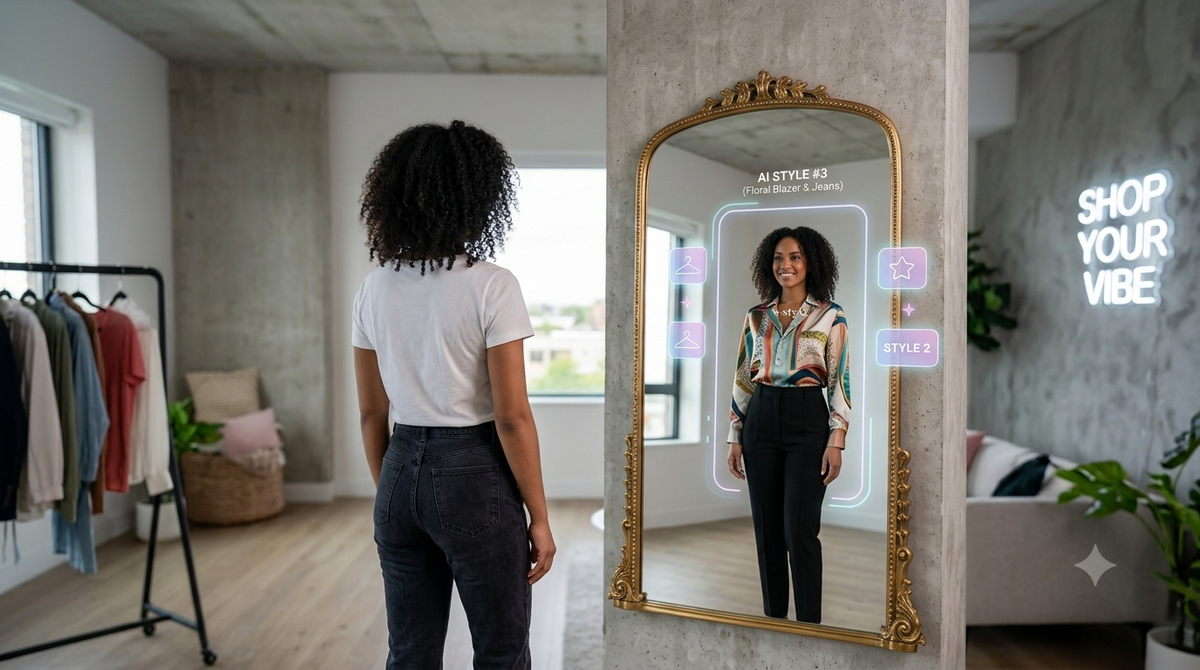
AI recommendation engines drive 35% of online fashion sales, according to worldmetrics.org AI in the Fashion Industry Statistics. That figure reframes the entire conversation about personalization. It's not a support feature or a nice-to-have engagement layer — it's generating more than a third of online fashion revenue right now.
What gets underreported is the difference between generic recommendation engines and styling-specific AI. Most e-commerce personalization runs on purchase history and browsing behavior: you bought a blue shirt, here are more blue shirts. That's useful, but it's not styling intelligence. Styling-specific AI operates on a different set of inputs — occasion context, body type, existing wardrobe composition, and personal aesthetic preferences. The output isn't "more of what you bought"; it's "here's what works with what you already own, for where you're actually going."
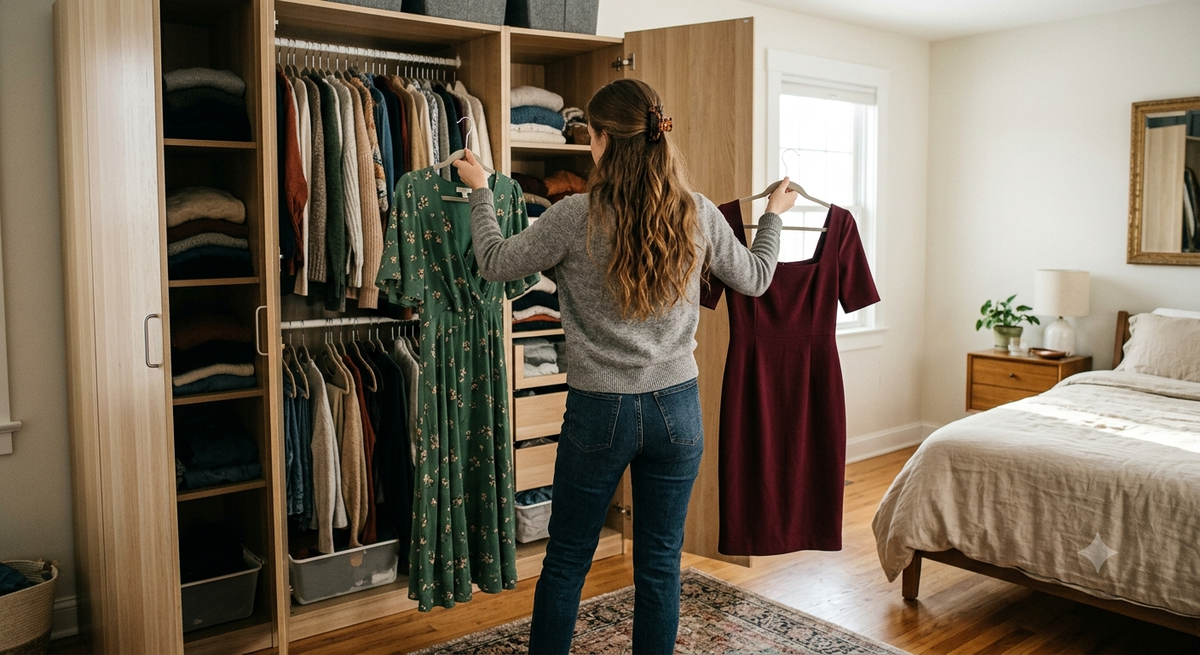
That distinction points to what is arguably AI's most underreported consumer benefit in fashion: wardrobe maximization. The average person's closet contains far more outfit potential than they're actually using. Decision fatigue, forgotten pieces buried at the back of the rail, and the absence of any system for combining what's already there all conspire to produce the familiar feeling of having nothing to wear despite owning plenty of clothes. AI that understands your wardrobe as a whole — not just your last three purchases — can resurface those forgotten pieces, suggest combinations you wouldn't have reached for, and reduce the morning paralysis that comes from too many options with no clear logic connecting them.
This is the gap that tools like Elara are built to close: a wardrobe-first, conversational AI approach that moves styling intelligence from the retail checkout page into everyday use — acting less like a product recommendation engine and more like the stylist most people never had access to.
The Market Behind the Movement: AI in Fashion by the Numbers
That wardrobe-first framing matters even more when you understand the scale of investment flowing into AI across the fashion industry. The numbers tell a clear directional story — though they require some interpretation.
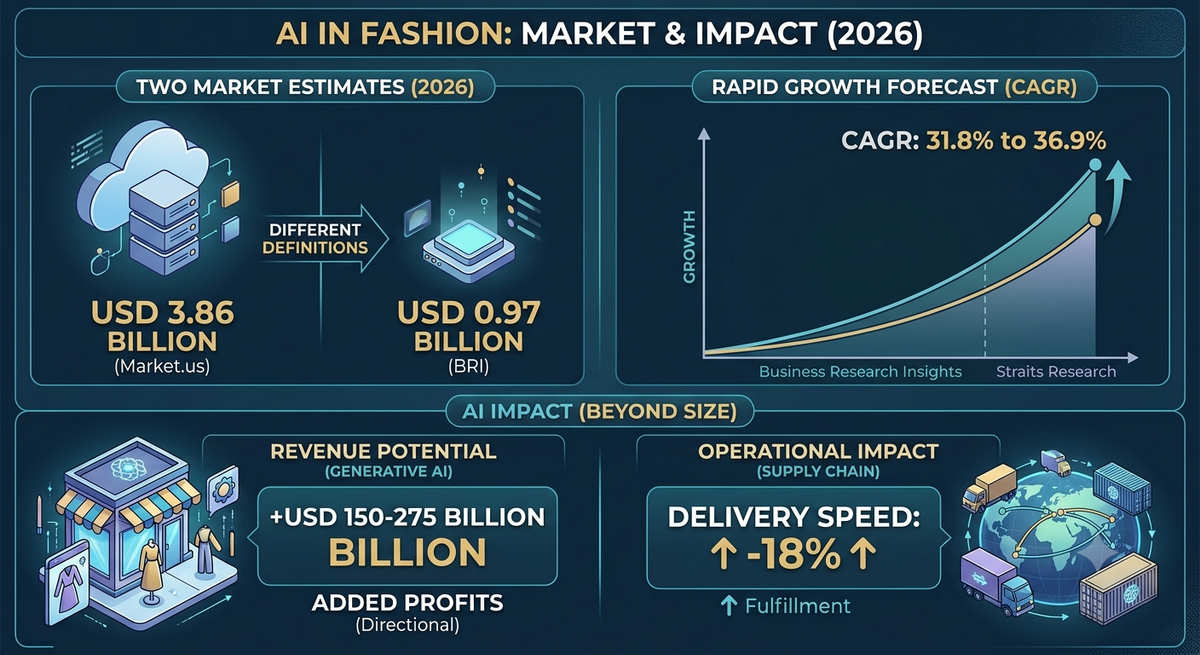
Two prominent 2026 market reports arrive at very different figures: market.us values the AI in fashion market at USD 3.86 billion, while Business Research Insights places it at USD 0.97 billion. Neither is wrong. The gap reflects different market definitions — one includes adjacent AI infrastructure, the other draws a tighter boundary around fashion-specific applications. Readers encountering both figures in the wild shouldn't treat them as contradictory; they're measuring different slices of the same phenomenon.
What's consistent across reports is the growth trajectory. According to Business Research Insights and Straits Research, generative AI in fashion is forecast to grow at a CAGR of 31.8% to 36.9% — a range that signals rapid expansion regardless of which base estimate you use. At either end of that range, this is not a slowly maturing market.
Generative AI could add USD 150–275 billion to operating profits in fashion, according to fashioninsta.ai's 2026 industry summary — though this figure aggregates projections across sources rather than representing a single primary study, so treat it as directional rather than definitive.
AI's reach in fashion also extends well beyond what consumers see at checkout. According to worldmetrics.org, AI-powered supply chain tools are already reducing delivery times by 18% — a back-end efficiency gain that ultimately shapes the front-end experience of faster, more reliable fulfillment. The consumer-facing and operational layers of AI in fashion are growing in parallel.
What These Stats Mean for How You Dress (Not Just How Brands Sell)
Most coverage of AI in fashion stops at the retailer's dashboard — conversion rates, return volumes, revenue per session. But the 66% of consumers already using AI in fashion shopping and the 64% who now expect brands to address sizing and fit challenges, according to morphed.app, aren't abstractions. They're people trying to figure out what to wear.
The "I have nothing to wear" problem is rarely about a shortage of clothes. Most people have wardrobes full of pieces they like individually but can't seem to combine into outfits that feel intentional. That's not a shopping problem — it's a styling intelligence problem. AI that understands your existing wardrobe, your body, and your occasions can surface combinations you'd never reach for on your own, turning a closet full of orphaned pieces into a functional, rotating wardrobe.
Decision fatigue is real and measurable. When every morning starts with an open-ended search through dozens of options and no clear system for evaluating them, the cognitive load adds up. An AI that narrows those choices to a curated shortlist — based on what you actually own, what fits, and what suits the day — removes that friction without removing your agency.
Adoption friction is worth acknowledging honestly. Setup time, skepticism about whether an algorithm can understand personal taste, and frustration with generic suggestions are legitimate barriers. But the adoption data suggests that consumers who engage with AI styling tools find genuine value — which is why two-thirds of shoppers are already using them, and why demand is only accelerating.
Frequently Asked Questions
How much time does it take to set up a digital wardrobe?
Setup time varies depending on wardrobe size and the tool you're using. Most people can photograph and catalog 50–100 key pieces in 30–60 minutes. The real payoff comes over weeks and months as the AI learns your preferences and surfaces outfit combinations you wouldn't have discovered on your own. Many tools also let you start small — you don't need to photograph everything upfront to see value.
Will AI styling recommendations actually match my personal taste?
The best styling AI learns from your choices over time. Initial recommendations may feel generic, but as you rate outfits, provide feedback, and build history with the tool, the suggestions become more specific to your body, occasions, and aesthetic. The difference between a cold-start recommendation and one informed by weeks of your feedback is substantial. Conversational AI — where you can explain what you're looking for — tends to perform better than algorithm-only approaches.
Can AI really help me buy less and wear more of what I own?
Yes. AI's core strength in fashion is identifying outfit potential in existing wardrobes. Before suggesting a new purchase, a wardrobe-first tool will surface forgotten pieces, suggest combinations you haven't tried, and help you understand exactly what gaps actually exist in your closet. That clarity often means buying less overall — but buying more intentionally when you do shop.
The Styling Layer Is Being Built Right Now
AI in fashion has moved from experiment to expectation. The 66% of consumers already using AI in shopping, the 64% expecting better fit solutions, and a market expanding at 31%–37% annually all point toward the same conclusion: this shift is structural, not cyclical.
The more important story isn't the market size. It's that personal styling — once the exclusive domain of people who could afford a human stylist or had the time to develop deep fashion fluency — is becoming accessible to everyone. That's a meaningful change in how people relate to their own wardrobes.
The smartest application of AI in fashion isn't nudging you toward another purchase. It's helping you love what you already have, wear it more confidently, and shop only for what you genuinely need. That's the principle behind Elara. If you're curious about what a wardrobe-first AI actually looks like in practice, explore joinelara.com.
Your AI Stylist is Here.
live on the App Store
Available on iOS for seamless access anytime, anywhere.