


From Google Sheets to AI stylist: how one user stopped guessing and started dressing with intention
Based on a recorded user interview, July 2026. This is one person's story, told in her own words.
- Location
- Princeton, NJ
- Occupation
- Biotech researcher
- Usage
- Daily, since early access
A closet that felt empty
There's a specific kind of frustration that comes from standing in front of a full wardrobe and feeling like you have nothing to wear. Most people know it. Few have a solution for it.
She was one of them. A biotech researcher based in Princeton, NJ, she had a closet full of clothes and no real system for using them. Her fix? A Google Sheet. She'd log pieces as she bought them, try to remember what went with what, and still end up cycling through the same outfits on rotation.
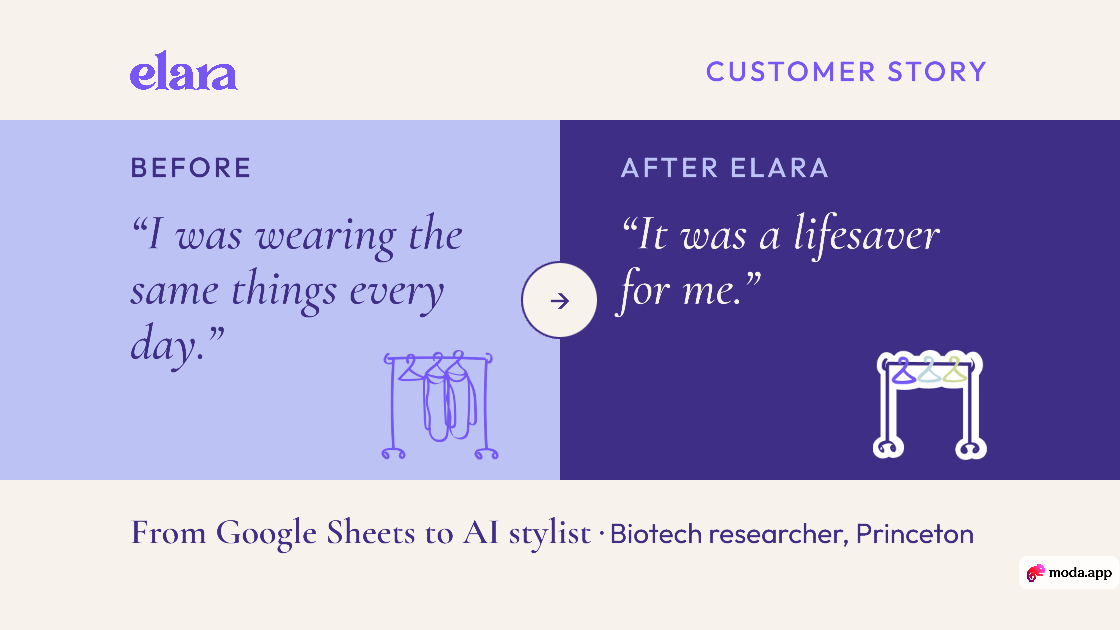
“I can't keep track of my clothes. I was wearing the same things every day.”
The problem wasn't the clothes. It was the mental overhead: knowing what she owned, remembering what worked together, and figuring out what to wear for a given occasion — all before 9am. She has a boho aesthetic, leans toward muted pastels and flowy silhouettes, and needed work outfits that sat somewhere between casual and semi-formal. Getting that right from a spreadsheet and memory alone wasn't working.
Without a system, the default was always the safe, familiar choice. Which meant most of her wardrobe sat untouched.
A lifesaver, in her words
She found Elara through a personal connection and downloaded it hoping for outfit suggestions. What she got was that, and more.
“It was a lifesaver for me.”
The first thing that clicked was wardrobe digitization. She could finally see everything she owned in one place, organized and accessible. The Google Sheet was gone. The mental load of tracking what she had, what fit, what was available — that started to lift.
But the more surprising shift was what happened to her shopping habits. Once her wardrobe was visible, she could see the gaps — and the redundancies. She stopped buying on impulse and started buying with intention.
“Now I'm thinking more carefully before buying.”
She'd also started telling people about Elara before we even sat down to talk. Several friends, all with the same immediate reaction: finally, something for this. The “I have nothing to wear” problem is universal. She'd found something that actually solved it.
How she uses Elara every day
Chat is her home base. She uses it the way you'd text a stylish friend — casually, conversationally, without overthinking it. She describes what she's going for, the occasion, the vibe, the constraints, and gets specific suggestions back pulled from her actual wardrobe.
She rates the recommendation quality at roughly two out of three being genuinely good. Not perfect, but good enough that she kept coming back. And the one that surprised her most wasn't a safe pick.
“One of the outfit suggestions that was completely different from my normal choices actually turned out really good.”
That's the moment that builds real trust in a product. Not the feature list, not the onboarding flow — the moment it shows you something about yourself you didn't already know.
She also uses Elara as a second opinion on shopping. If she spots something in a store or online, she can upload a photo and ask “should I buy this?” and get a clear answer based on what she already owns. It's the difference between buying something that fills a gap and buying something that duplicates what's already there.

Want this styled from your own closet?
Elara builds the look from what you own, then lets you try it on.
More than an outfit generator
Midway through our conversation, something shifted. She started discovering features she didn't know existed — and her reaction to each one told the story.
Browser extension: Add items directly from Zara, H&M, or ASOS into her wardrobe without leaving the tab. Ask “should I buy this?” from within the store itself. Her reaction: “Wow.”
Playground: A virtual mix-and-match space to pull wardrobe pieces and build outfits visually. She'd heard of it but hadn't used it. Once it loaded, she immediately saw the point: “I'll use it more now.”
Styling toggle: Every wardrobe item has an “allow in styling” switch. Disable a piece and Elara stops including it in recommendations automatically — no manual exclusion needed each time.
The pattern here matters. Elara wasn't just doing what she expected. It was doing more, quietly, and she was only now finding it. That's a product with depth. The job now is making sure users find that depth sooner.
Elara as an inspiration layer, not a replacement
One exchange from our conversation was particularly revealing. We were discussing a potential universal checkout feature — the ability to place orders across multiple stores directly from Elara. She said she'd still prefer to go to Zara herself, even if the checkout worked perfectly.
Why? Because she likes browsing. She wants to see similar items, explore colorways, get distracted by things she didn't know she wanted.
Elara isn't a replacement for the experience of shopping or getting dressed. It's the layer that makes both of those things better. It brings clarity to what you own, confidence to what you wear, and intention to what you buy. The decision is still yours. Elara just makes it easier to make.
When asked what she'd tell a friend Elara does, her answer was immediate: “Personal stylist.” Not “outfit app.” Not “wardrobe tracker.” A personal stylist.
What she's waiting for
She's a power user with strong opinions, which means her feedback directly shapes where Elara goes. Three things she's asking for:
Faster virtual try-on (In-progress): Ideally instant — because seeing outfits on herself is how she actually makes decisions. The current wait is the biggest friction point.
Side-by-side outfit comparison (Requested): So she can evaluate options against each other rather than scrolling through them one at a time.
Accessories surfaced automatically in every outfit (Requested): Jewelry, bags, shoes — because a recommendation that stops at clothing isn't really complete.
These aren't edge case requests. They're the next layer of what a real personal stylist does. And they're what Elara is building toward.
“I recommend it to whoever thinks they have no clothes when they actually have a lot, and to anyone who needs to style themselves better.”
Working professional, Princeton, NJKey Outcomes
- Replaced manual Google Sheet tracking with 1-click digital wardrobe organization.
- Discovered new outfit combinations outside her usual safe rotation.
- Eliminated impulse buying by evaluating new items against existing closet pieces.
- Reduced morning decision fatigue with conversational AI personal styling.
Your stylist, in your pocket
Stop reading about outfits. Start wearing them.
Elara knows your closet, shops every store and gets you dressed for any occasion.