What to Wear: AI Styling Guide for 2026
What to wear today? This AI styling guide covers 2026 fashion trends, climate-adaptive dressing, and how AI stylists use your wardrobe and weather to suggest outfits you'll actually wear.

Can AI Help Me Decide What to Wear? What It Can and Cannot Do
Table of Contents
Key Takeaways
- AI stylists like Elara work from your actual wardrobe, real-time weather, and stated preferences — not generic trend lists.
- According to The Mom Edit and Real Simple, 6 out of 10 top 2026 fashion trends prioritize comfort and ease over structure.
- Climate-adaptive dressing is now a near-necessity in 2026, according to Style Analytics.
- The biggest AI styling limitation is incomplete wardrobe data — better input produces better output.
Introduction: The Daily 'What to Wear' Problem Is Bigger Than You Think
Most mornings, the problem isn't an empty closet — it's a full one that still yields nothing to wear. That frustration is real, and it's more common than the fashion industry likes to admit.
Here's the honest answer: yes, AI can help you decide what to wear, but only when it has four things to work with — your wardrobe data, your preferences, today's weather, and your occasion. Without those inputs, it's just another trend feed with a chatbot attached.
The trends themselves are simpler than most people assume. According to The Mom Edit and Real Simple, 6 out of 10 top 2026 fashion trends center on comfort-driven silhouettes — wide-leg jeans, relaxed tailoring, and easy proportions. The problem was never knowing what's in style. It's connecting those trends to the specific clothes hanging in your actual closet.
This article covers both sides honestly: what AI can genuinely do for daily outfit decisions, and where it still falls short. Tools like Elara represent a new class of AI stylist built to close the gap between fashion inspiration and real-world execution — and understanding what they require from you is the starting point.
What AI Can Actually Do: Wardrobe-First Outfit Suggestions
The most important thing to understand about AI styling is that it operates from your wardrobe, not from a shopping catalog. Wardrobe digitization — adding your actual clothes to the system — is the foundation everything else builds on. Without it, an AI stylist has nothing specific to suggest.
This is what separates genuine AI styling from the trend-listing content that dominates most fashion media. Take two data points making the rounds in 2026: searches for platform and cushioned flip-flops surged 325% compared to 2025, according to Yahoo Shopping and Style in Bloom, and conversations about relaxed-fit trouser styles increased 115% year-over-year from the same source. Both are interesting signals. Neither tells you whether the wide-leg trousers you bought last spring work with the sandals already in your wardrobe — or what to add to make that outfit functional.
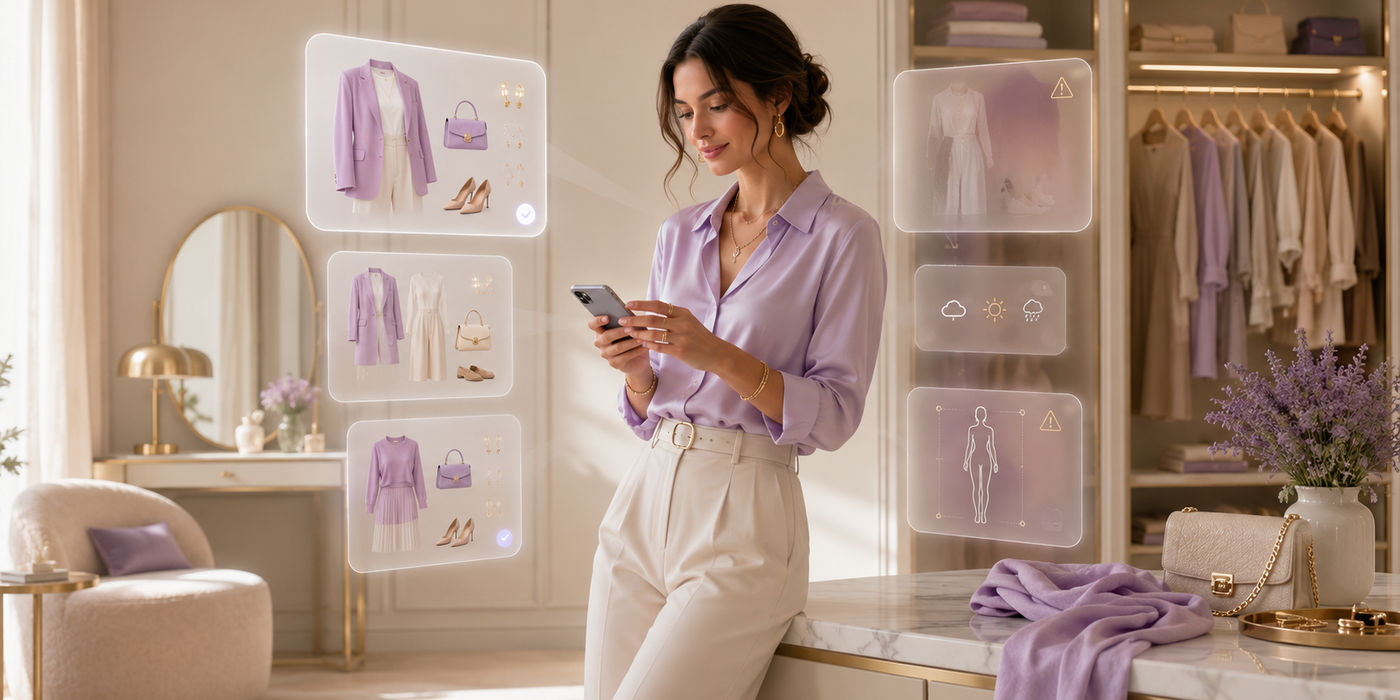
That's the gap AI closes when it's working properly. Picture a concrete scenario: you type "what to wear today" into a conversational AI stylist. Instead of returning a mood board of items you'd need to buy, it cross-references your digitized wardrobe, pulls the current weather forecast, and checks your calendar for the day's context. The output is a specific outfit from clothes you already own — not an aspirational suggestion that requires a shopping trip.
Elara is built around exactly this workflow. You just talk or type and the AI responds, adjusting suggestions in real time. No manual outfit-building, no drag-and-drop interfaces. The system also improves with use — every item you add and every outfit you accept or reject sharpens its understanding of your taste, so suggestions become more accurate week over week rather than staying static.
What AI Cannot Do (Yet): The Honest Limitations
That continuous improvement loop is genuinely useful — but it only works when the inputs are solid. Transparency demands acknowledging where AI styling falls short, because the limitations are real even if they're manageable.
Wardrobe digitization is the biggest friction point. If you've only catalogued five items in a fifty-piece closet, the AI has no choice but to fill gaps with generic recommendations. The output quality is directly proportional to input completeness — this is the most common reason AI styling disappoints new users, and it's entirely fixable with incremental effort rather than a weekend overhaul.
Three other limitations are worth naming honestly:
- No tactile feedback. AI cannot tell you whether a fabric feels scratchy, whether a waistband sits right on your specific frame, or whether an outfit gives you confidence when you see it in the mirror. That final judgment is always yours.
- Data quality determines suggestion quality. Vague preference inputs produce vague outputs. The more specific your feedback — accepting or rejecting suggestions, flagging what fits well — the sharper the recommendations become.
- Hyper-local cultural context is hard to encode. Dress codes vary by city, workplace culture, and community in ways that no dataset fully captures. AI narrows your choices intelligently; you apply the local knowledge.
Think of it as a decision-support tool that does the shortlisting, not the deciding.
Dressing for Today's Weather: How AI Handles Climate-Adaptive Styling
Climate-adapted clothing has moved from lifestyle choice to practical necessity — and weather is now one of the most consequential inputs an AI stylist can process. According to Style Analytics, 2026 is projected to rank as the second-warmest year on record, with a greater than 60% probability of El Niño conditions emerging between May and July. That's not a background detail; it's a direct driver of what you should be putting on your body each morning.
The cultural shift this creates is captured in a pointed observation from Style Analytics: "Fewer decisions will be made based on wanting to save the environment, and more will be made based on having to survive it." Dressing for weather is no longer about aesthetics with a practical footnote — it's the primary design constraint.
Where static weather apps stop at temperature, AI styling goes further. A well-designed system integrates real-time or forecast conditions to recommend specific fabrics — linen and cotton for heat management, per the function-first shift documented by Style Analytics — along with layering strategies for unpredictable spring and summer days, and outerwear when rain is in the forecast. Retailers have already read this signal: trench coat styles increased 56% in collections compared to last year, according to Yahoo Shopping data.
The 2026 comfort-first silhouette trend, documented by Vogue, is also a climate response hiding in plain sight. Wide-leg jeans, Capri pants, and balloon trousers aren't just aesthetically dominant — they're thermally practical. Airy silhouettes allow airflow that fitted cuts don't. An AI stylist can make this functional connection explicit, recommending the wide-leg option from your wardrobe not just because it's on-trend but because today's forecast calls for it.
What to Wear for Men vs. Women: Navigating Gender-Specific and Gender-Neutral Trends
The most important structural shift in fashion right now isn't a silhouette or a color — it's the dissolution of the gender binary as an organizing principle. The unisex clothing market reached $11.7 billion in 2024 and is projected to hit $61.9 billion by 2033, according to Glance AI — a trajectory that reflects genuine behavioral change, not just marketing language. Gender boundaries in fashion are dissolving at commercial scale.
That said, gender-specific trend signals remain real and worth understanding on their own terms.
For women in 2026, the data from Heuritech points to lace maxi skirts surging 20% in EU markets and cow print up 87% in the US — two aesthetics that couldn't look more different, which itself signals how fragmented women's fashion has become. Corset maxi dress search volume grew 58% year-over-year according to Glimpse, reflecting a broader appetite for silhouettes that feel both structured and maximalist.
For men, the story is relaxed volume and sport-casual crossover. Conversations about long, flowing relaxed-fit trousers increased 115% compared to last year per Yahoo Shopping, and the athleisure crossover is measurable: ASICS sportstyle business grew 52.9% in Q2 2025, carrying significant momentum into 2026. Hybrid pants — blending tailored structure with sweatpant comfort — represent the same functional logic applied to formal dressing.
Ready to upgrade your wardrobe?
Get the Elara app for AI-powered styling and virtual try-ons.
Cutting across both: Gen Z is pulling all fashion toward oversized silhouettes and retro references from the 70s, 90s, and early 2000s, according to Printful — a generational aesthetic that operates largely independent of gender category.
A well-built AI stylist doesn't assume your preferences from a gender label. It asks. Preference learning means the system adapts to how you actually dress — whether that's strictly within conventional gender categories, somewhere across them, or entirely outside them — and every feedback signal refines that understanding over time.
What to Wear by Occasion: School, Play, Work, and Everything In Between
That preference-learning capability matters most when a single day demands multiple versions of you. Most fashion content treats occasion dressing as separate universes — a work article, a school article, a night-out article — when real life routinely stacks all three before dinner.
Here's how 2026 actually looks across occasions:
- Casual/Play: Streetwear holds its dominant position, with elevated platform and cushioned flip-flops now the footwear statement of the moment — searches for them surged 325% compared to 2025, according to Yahoo Shopping. Athleisure is no longer a gym-to-errand compromise; it's the aesthetic.
- School: Gen Z is setting the agenda here with oversized silhouettes, wide-leg proportions, and retro denim pulled from 70s, 90s, and early 2000s references, according to Printful. Blue is the defining color story for Spring 2026, per Yahoo Shopping — which means existing navy pieces are suddenly very current.
- Evening: Vogue identifies "Evening Glam" as a blend of classic cuts with metallic sheens and sculptural sleeves — emotional, expressive dressing that prioritizes feeling over formula.
- Work/Professional: The dominant professional aesthetic is "elegant utility" and "quiet performance" — relaxed tailoring, functional layering, and refined color palettes replacing rigid structured suiting.
The real gap isn't knowing these categories — it's bridging them. When a user inputs "school presentation then dinner," an AI stylist can suggest a single transitional outfit from their existing wardrobe rather than two separate shopping lists.
The 2026 Trend Landscape: What's Actually Worth Wearing
Vogue's 2026 fashion guidance cuts through trend noise with a clear directive: wearability over costume. The goal isn't to dress in a trend — it's to let trends inform clothes you already own. That philosophy shapes every recommendation below.
Color: Blue and navy are replacing black as the neutral backbone of 2026 wardrobes, according to Yahoo Shopping. If you own navy trousers or a cobalt shirt, they're already on-trend. Butter yellow and chartreuse are the statement additions — one new piece in either shade updates an existing neutral wardrobe immediately.
Wardrobe integration tip: Swap your black trousers for navy this season — same formality, more current.
Silhouettes: According to The Mom Edit and Real Simple, 6 out of 10 top 2026 trends center on comfort-driven proportions — wide-leg jeans, Capri pants, and balloon trousers. Vogue confirms this comfort-first direction. If you own wide-leg trousers, pair them with a fitted linen top and you've hit the silhouette story without buying anything.
Textures: Sheer layers, lace, and fringe are Vogue's texture pillars for 2026. A sheer blouse over a fitted tank, or fringe details on an existing bag, adopts the trend without a wardrobe overhaul.
Outerwear and Footwear: Retailers increased trench coat styles by 56% versus last year, per Yahoo Shopping — making a classic trench the single most versatile outerwear investment of 2026. Platform flip-flops, up 325% in search volume, complete the footwear story.
The thread connecting all four pillars is what Yahoo Shopping calls "elegant utility" and "quiet performance" — functional pieces with considered aesthetics. This isn't a random trend list; it's a coherent wardrobe philosophy.
How to Build a Decision Framework: Stop Guessing, Start Styling
Most people approach the morning closet with no system — which is why the decision feels harder than it is. A repeatable four-step framework collapses the chaos into a process that takes minutes, not thirty.
- Check the weather. Fabric and layering choices come first. With 2026 projected as potentially the second-warmest year on record, according to Style Analytics, prioritizing breathable linen and cotton in heat isn't a style preference — it's practical necessity. Temperature swings mean a lightweight layer is almost always the right call.
- Check your calendar. Formality context shapes everything else. One meeting, a school presentation, and dinner after are three different dress codes that a single transitional outfit can resolve — if you plan for it rather than react to it.
- Check your wardrobe before you shop. The 2026 trend landscape, as Vogue frames it, rewards wearability over novelty. Most people can adopt the dominant silhouette and color trends from pieces they already own. Identifying what you have prevents duplicate purchases and surfaces forgotten pieces.
- Check your mood. Vogue's 2026 expert guidance is explicit: fashion is emotion-driven, and wearability beats trend accuracy every time. An outfit you feel confident in outperforms a technically correct one you don't.
An AI stylist compresses all four steps into a single conversational query. Instead of checking four separate sources, you describe your day — weather included — and the AI cross-references your wardrobe, your calendar context, and your preference history simultaneously. Elara is built to operationalize exactly this: knowing your wardrobe, your weather, your schedule, and your taste at once, so the decision takes seconds rather than the better part of your morning.
Frequently Asked Questions
How long does it take to digitize my wardrobe? You don't need to photograph everything at once. Start with your most-worn items — the pieces you reach for 80% of the time. Most people build a functional digital wardrobe in 20-30 minutes by adding one item every time they get dressed. Elara learns as you go, so suggestions improve incrementally rather than requiring a complete upload upfront.
Will the AI recommendations actually match my personal taste? Not at first. The system starts with broad suggestions based on general preferences you set. As you accept or reject recommendations, the AI learns your specific taste — your color preferences, fit sensitivities, and style boundaries. After two weeks of regular use, most users report that suggestions feel genuinely personal rather than generic. The key is consistent feedback; the more you interact, the faster it adapts.
What happens when I buy new clothes or seasons change? Adding new pieces to your wardrobe takes seconds. When you bring home something new, upload a quick photo and the AI immediately incorporates it into future outfit suggestions. Seasonal shifts are handled automatically — the system adjusts recommendations based on weather forecasts and temperature, so your spring wardrobe suggestions won't include heavy sweaters once summer arrives.
TL;DR
AI styling works best when it has four inputs: your actual wardrobe, your preferences, today's weather, and the occasion. Without complete wardrobe data, even the best AI falls back on generic recommendations. The 2026 fashion moment makes this useful — 6 out of 10 top trends center on comfort-driven silhouettes that most people already own. Climate-adaptive dressing has shifted from preference to necessity, making weather integration critical. An AI stylist like Elara compresses the daily decision into seconds by cross-referencing all four factors at once. The honest limitation: you still need to do the work of digitizing your wardrobe and giving feedback. The payoff: outfit decisions stop being a morning bottleneck and start being automatic.
Conclusion: AI Doesn't Replace Your Style—It Amplifies It
That four-step decision loop — wardrobe, preferences, weather, occasion — is exactly what makes the daily outfit question so draining. AI doesn't eliminate the decision; it makes it executable in seconds rather than minutes, and it gets sharper the more you use it.
The 2026 fashion moment makes this genuinely useful. According to The Mom Edit and Real Simple, 6 out of 10 top trends this year center on comfort-driven silhouettes — wide-leg jeans, relaxed tailoring, proportion-first dressing. And with 2026 projected to rank as the second-warmest year on record (Style Analytics), climate-adaptive clothing has shifted from preference to practical necessity. Knowing the trends is easy. Connecting them to what's actually hanging in your closet is where most people get stuck — and where a well-trained AI stylist earns its place.
The honest caveat stands: AI is only as useful as the wardrobe data behind it. But that's a starting condition, not a permanent one. Every item you add and every suggestion you react to compounds into something genuinely personal over time.
Explore Elara to see how AI styling works in practice — or read our guide to building a climate-adaptive capsule wardrobe for 2026. Dress better. Shop smarter. Feel confident.
Your AI Stylist is Here.
live on the App Store & Google Play
Available on iOS and Android for seamless access anytime, anywhere.