Algorithmic Stylist vs AI: Which Serves Your Style?
An algorithmic stylist recommends trends; an AI personal stylist understands your wardrobe. Discover why personalization beats trend-chasing in 2026's fashion landscape.

Algorithmic Stylist vs AI Personal Stylist: What Actually Changes?
Table of Contents
- Introduction: The Algorithm Has a Style Problem
- What 'Algorithmic Stylist' Actually Means in 2026
- The Visual Flattening Problem: When Algorithms Homogenize Style
- Gen Z's Shift: From Looking Rich to Looking Rare
- AI Personal Stylist vs. Algorithmic Stylist: The Real Difference
- Wardrobe Digitization: The Technical Layer That Makes It Personal
- FAQ
- Conclusion: Use the Algorithm — Don't Let It Use You
Key Takeaways
- An algorithmic stylist is a recommendation engine that surfaces products based on trend data and behavioral patterns. An AI personal stylist starts from your actual wardrobe to curate looks you can wear today.
- In 2026, the defining shift is from "fitting into the algorithm" to standing out from it — rarity is the new style currency.
- Wardrobe digitization is the technical foundation that makes true personalization possible.
- Elara is an example of the wardrobe-first AI personal stylist model.
Introduction: The Algorithm Has a Style Problem
An algorithmic stylist is a recommendation engine — it surfaces products based on trend data and the browsing behavior of people who shop like you. An AI personal stylist does something fundamentally different: it starts with your existing wardrobe, understands occasion and context, and learns your specific taste over time. The difference isn't the AI powering each system. It's the starting point — trend database versus your closet.
That distinction matters more now than ever. Pearl Academy's research on Visual Flattening describes a phenomenon where mass brands, optimizing for algorithmic visibility, converge on identical aesthetics — low-contrast, low-friction images designed to perform in a feed rather than express a point of view. The result is a fashion culture where more content produces less variety.
Meanwhile, trend cycles are accelerating past any reasonable ability to keep up. According to Heuritech, Big Dot visibility in Europe is forecast to grow by 55% during Spring/Summer 2026, while Cow Print is projected to surge 87% in the US. By the time a trend reaches your recommended feed, it's already saturating everyone else's.
Chasing those signals is a losing game. AI styling only becomes genuinely useful when it starts with the person wearing the clothes — not the trend database feeding the algorithm.
What 'Algorithmic Stylist' Actually Means in 2026
An algorithmic stylist operates across three layers. First, data input: the system collects behavioral signals — what you browse, what you click, what you purchase, how long you linger on a product image. Second, pattern matching: collaborative filtering compares your behavior against millions of similar user profiles to identify statistical correlations ("users who viewed this also bought that"). Third, output: the system surfaces product carousels, "complete the look" suggestions, and trend-aligned recommendations designed to maximize engagement and conversion.
This architecture is sophisticated, but it has hard limits — and the industry is beginning to acknowledge them openly. As SCAYLE, one of the leading commerce infrastructure providers, has stated: "the future of search will go far beyond algorithms," pointing toward systems that center deep user intent rather than behavioral proxies.
The gap between behavioral signals and actual intent is where algorithmic stylists consistently fail. They don't know what's already in your wardrobe. They have no understanding of occasion — whether you need something for a Tuesday morning meeting or a rooftop dinner. And critically, they cannot distinguish between what you liked looking at and what you would actually wear.
The everyday experience of this failure is familiar: you browse a printed dress on Monday afternoon. By Wednesday, every platform you open — Instagram, a retail app, a news site — is flooding you with printed dresses. None of them account for the fact that you own nothing to wear with them, that the event you were shopping for has passed, or that you clicked out of curiosity rather than intent. The algorithm read a signal and amplified it, regardless of whether amplifying it served you.
That's not a bug in a specific platform's implementation. It's a structural limitation of systems built to optimize for trend visibility rather than personal identity.
The Visual Flattening Problem: When Algorithms Homogenize Style
That structural limitation has a name. Pearl Academy identifies it as "Visual Flattening" — the phenomenon where mass brands, optimizing their imagery for algorithmic distribution, converge on aesthetically identical content. Clean backgrounds, high-contrast color blocking, faces cropped to maximize product visibility: every choice made to be legible to a machine ends up producing a feed where one brand is indistinguishable from the next. When your stylist is trained on that content, your outfits inherit the same visual grammar.
The countermovement is what Pearl Academy calls "Visual Friction" — the deliberate use of motion blur, deep shadow, and editorial ambiguity by luxury and independent brands to resist algorithmic legibility. These brands aren't making their content harder to read by accident. They're signaling exclusivity through the very fact that the algorithm can't efficiently categorize them. A blurred hem, a partially obscured face, a color palette that sits outside standard trend palettes: these are choices that communicate to humans precisely because they don't optimize for machines.
Pearl Academy frames this as a dual visual language — Machine-Readable versus Human-Resonant content. Machine-Readable content is trend-aligned, high-contrast, and instantly categorizable. Human-Resonant content carries texture, tension, and specificity that registers as personality rather than product. The problem for anyone relying on an algorithmic stylist is direct: if the system's training data is dominated by Machine-Readable imagery — which, by definition, is what gets amplified across platforms — then the style it generates for you will be Machine-Readable too. Recognizable. Trend-aligned. Indistinguishable from everyone else's feed.
The algorithm didn't set out to erase your personal style. It just wasn't designed to preserve it.
Ready to upgrade your wardrobe?
Get the Elara app for AI-powered styling and virtual try-ons.
Gen Z's Shift: From Looking Rich to Looking Rare
The most precise articulation of where fashion is heading came from Istituto Marangoni and trend consultancy Maze35: "Gen Z doesn't dress to look rich; they dress to look rare. And in 2026, rarity isn't defined by price; it's about personalisation." That's not a generational quirk — it's a leading indicator of how visual culture works when everyone has access to the same trend feeds.
The Heuritech data makes the stakes concrete. Big Dot visibility in Europe is forecasted to grow by 55% during Spring/Summer 2026, while Cow Print is projected to surge 87% in the US. Both numbers sound like opportunities. They're actually warnings. By the time a micro-trend registers a 55% or 87% growth signal in forecasting data, it has already been picked up by fast fashion production pipelines, amplified across social platforms, and worn by enough people that it has lost the quality that made it interesting. An algorithmic stylist surfaces these trends at the moment of peak saturation, not at the moment of discovery.
This is the trend paradox: the more efficiently an algorithm identifies what's rising, the faster it commoditizes it. The recommendation engine and the homogenization engine are the same engine.
Rarity, then, isn't found by hunting for the next micro-trend before it peaks. It's constructed through combinations — the specific way you layer a vintage jacket over a contemporary silhouette, or pair a pattern with a proportion that no trend report suggested. That kind of combination requires knowledge of what you actually own. It requires wardrobe intelligence that a trend database, by definition, doesn't have.
This applies well beyond Gen Z. In a saturated visual culture where everyone is drawing from the same algorithmic recommendation pool, personalization is the only remaining differentiator. The question is whether the AI tools people use are built to deliver it.
AI Personal Stylist vs. Algorithmic Stylist: The Real Difference
The distinction between these two models comes down to starting point, and starting point determines everything downstream.
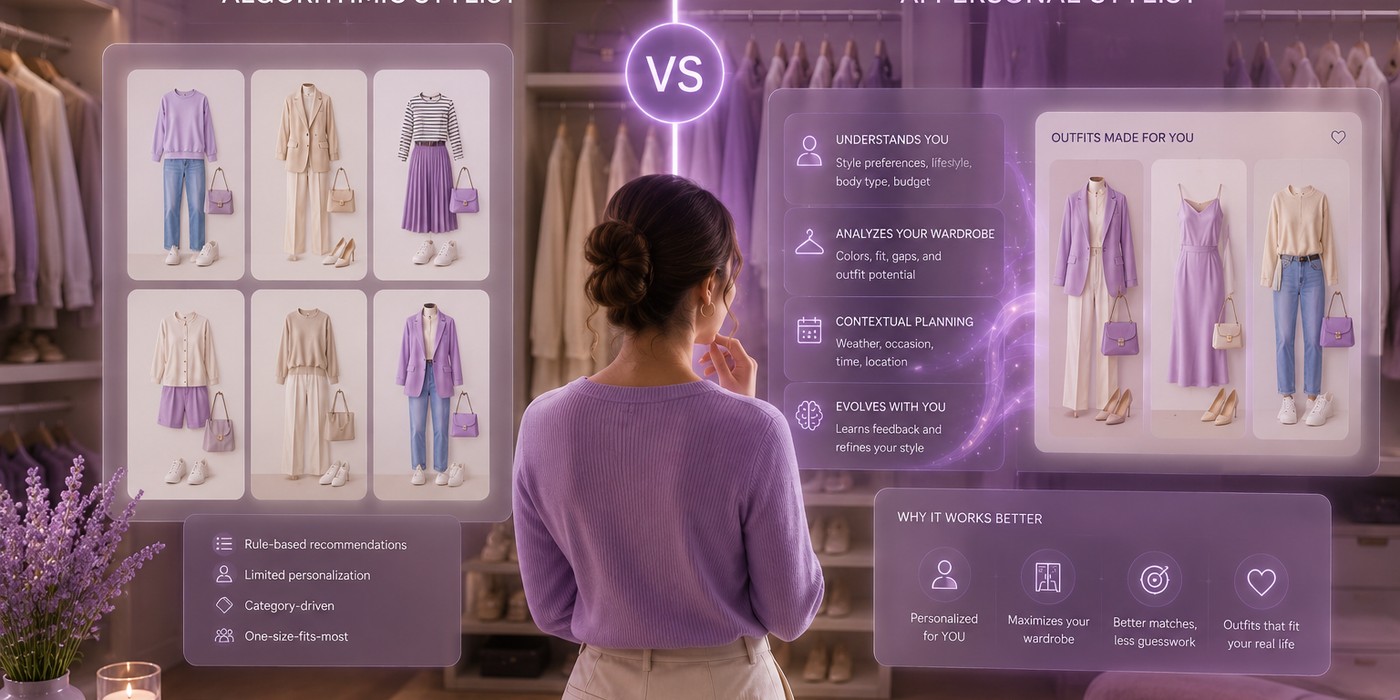
An algorithmic stylist begins with trend data and behavioral patterns — what people who browse like you eventually bought, what's gaining momentum in your demographic, what visual patterns correlate with conversion. It's a sophisticated system, but it's oriented outward: toward the market, toward the aggregate, toward what's moving. An AI personal stylist begins with your wardrobe — the specific garments you own, the occasions you actually dress for, the preferences you've expressed and refined over time.
Four dimensions separate them in practice:
- Starting point — Algorithmic stylist: trend database. AI personal stylist: your existing closet.
- Personalization depth — Algorithmic stylist: collaborative filtering ("people like you bought…"). AI personal stylist: your specific pieces, occasions, and style history.
- Output type — Algorithmic stylist: product recommendation carousels. AI personal stylist: wearable outfits assembled from what you already own, with targeted gap-filling where genuinely needed.
- Relationship to trends — Algorithmic stylist: is the trend machine. AI personal stylist: uses trend data as context, not as the core recommendation engine.
Elara operates on the second model. The interaction is conversational — you just talk or type ("what do I wear to a rooftop dinner tonight?"), and the AI responds with outfit curation drawn from your actual wardrobe, accounting for occasion, weather, and your stated preferences. There's no product carousel unless you've identified a genuine gap. The system learns your taste from your choices, not from the aggregate behavior of people who clicked on similar thumbnails.
Pearl Academy's framing of the shift from "fitting into the algorithm" to "standing out from it" is precisely what this model enables. When the AI's recommendations are grounded in your specific wardrobe rather than in trend-optimized content, the output is, by construction, not reproducible by anyone else's feed. The combinations are yours because the inventory is yours.
That's also where the decision fatigue argument lands. The question "what do I wear today?" is genuinely hard when you're sorting through a wardrobe mentally while simultaneously filtering out trend noise from six platforms. An AI personal stylist answers that question directly, without routing the answer through a trend engine first. It reduces cognitive load without outsourcing your taste.
Wardrobe Digitization: The Technical Layer That Makes It Personal
That ability to generate combinations only you could wear depends entirely on one thing: the AI actually knowing what you own. Wardrobe digitization means cataloging your existing garments into a structured digital inventory — uploading photos, letting AI-assisted categorization tag each piece by color, silhouette, formality, and fabric, and building a data layer the system can reason over. The difference in recommendation quality is immediate and significant. Instead of inferring your preferences from browsing behavior (which tells a system what you clicked, not what you wear), the AI has ground truth: these are the pieces you own, the fits you've committed to, the aesthetic choices you've already made.
The obvious objection is setup friction. Nobody wants to spend a Sunday afternoon photographing 80 garments. Modern approaches address this directly through conversational onboarding — starting with a handful of core pieces and building the inventory incrementally, adding items as occasions arise rather than front-loading the entire process. The system becomes useful faster, and the catalog deepens over time without a single overwhelming session.
The payoff extends beyond outfit suggestions. When the AI knows what you own, it can distinguish between a genuine wardrobe gap — you own nothing that works for a formal evening event — and an impulse temptation that would be the fourth navy blazer in your closet. That's not just better styling. It's a meaningful reduction in fashion waste and spending on pieces that never get worn.
FAQ
Q: How is an AI personal stylist different from just using Pinterest or Instagram for outfit ideas?
A: Pinterest and Instagram show you what exists across the internet — infinite possibilities from infinite people's closets. An AI personal stylist shows you what you can actually wear today from what you already own. It's the difference between inspiration and action. The AI also learns your taste over time, so recommendations get more accurate the more you interact with it, rather than showing the same generic ideas to everyone.
Q: Do I really need to upload my entire wardrobe to get started?
A: No. You can start with a handful of pieces — maybe 5-10 favorites — and build from there. Most systems, including Elara, use conversational onboarding to add items as you go. You add a new piece, mention it in conversation, or upload photos when you actually need styling help. The wardrobe grows naturally rather than requiring a single massive upload session.
Q: How does an AI personal stylist help me shop smarter?
A: Once the system knows what you own, it can show you exactly how a new item would work with your existing pieces before you buy it. That prevents the common problem of buying something that looked good on the model but doesn't match anything in your actual closet. It also identifies real gaps in your wardrobe — occasions you dress for but have nothing appropriate for — so you shop with purpose instead of impulse.
Conclusion: Use the Algorithm — Don't Let It Use You
The question was never whether to use AI in fashion. It's which kind — and whose interests it's optimizing for.
Algorithmic stylists optimize for trend visibility. AI personal stylists optimize for you. That distinction is the whole argument, and in 2026 it carries real stakes. Pearl Academy's research on Visual Friction makes the point precisely: the most stylish move available right now is resisting the pull of algorithmic homogeneity, and the right tool makes that resistance effortless rather than exhausting.
Rarity is the currency. As Istituto Marangoni and Maze35 put it, "Gen Z doesn't dress to look rich; they dress to look rare. And in 2026, rarity isn't defined by price; it's about personalisation." That insight applies well beyond any single generation. Personalization — grounded in your actual wardrobe, your specific occasions, your honest preferences — is what makes a look feel like yours rather than a trend cycle's output.
If that's the kind of styling you're after, explore what Elara can do with what you already own at joinelara.com. Your AI stylist that actually knows you.

Your AI Stylist is Here.
live on the App Store & Google Play
Available on iOS and Android for seamless access anytime, anywhere.