AI Personal Stylist vs Shopping Assistant: Which Wins?
AI personal stylists beat shopping assistants for styling decisions and return reduction. Learn the 68-point adoption gap, wardrobe-first architecture, and why fashion agents are converging.

AI Personal Stylist vs AI Shopping Assistant: Which One Do You Need?
Table of Contents
- Key Takeaways
- Introduction: The 68-Point Gap Nobody Is Talking About
- What Is an AI Shopping Assistant? (And What It's Actually Good At)
- What Is an AI Personal Stylist? (And Where It Outperforms)
- Head-to-Head: Choosing Based on Your Specific Problem
- The Convergence: Why "Fashion Agents" Are the Future (And What to Do Now)
- How to Decide: A Simple Framework for Consumers and Brands
- Frequently Asked Questions
- Conclusion: The Right Tool Solves the Right Problem
Key Takeaways
- AI shopping assistants focus on product discovery and price comparison; AI personal stylists start with your wardrobe and deliver outfit-first personalization that reduces returns.
- 76% of consumers want AI shopping help, but only 8% have completed a purchase through one — a 68-point adoption gap driven by missing wardrobe context.
- AI personal stylists cut returns by up to 40% through virtual try-ons and wardrobe-aware recommendations.
- By 2026, both categories are converging into "fashion agents" — making the choice of foundation architecture matter now.
Introduction: The 68-Point Gap Nobody Is Talking About
According to Capital One Shopping Research, 76% of consumers say they want AI-powered shopping assistants — yet only 8% of generative AI users have actually completed a purchase through one. That 68-point gap isn't a marketing problem. It's a tool-fit problem.
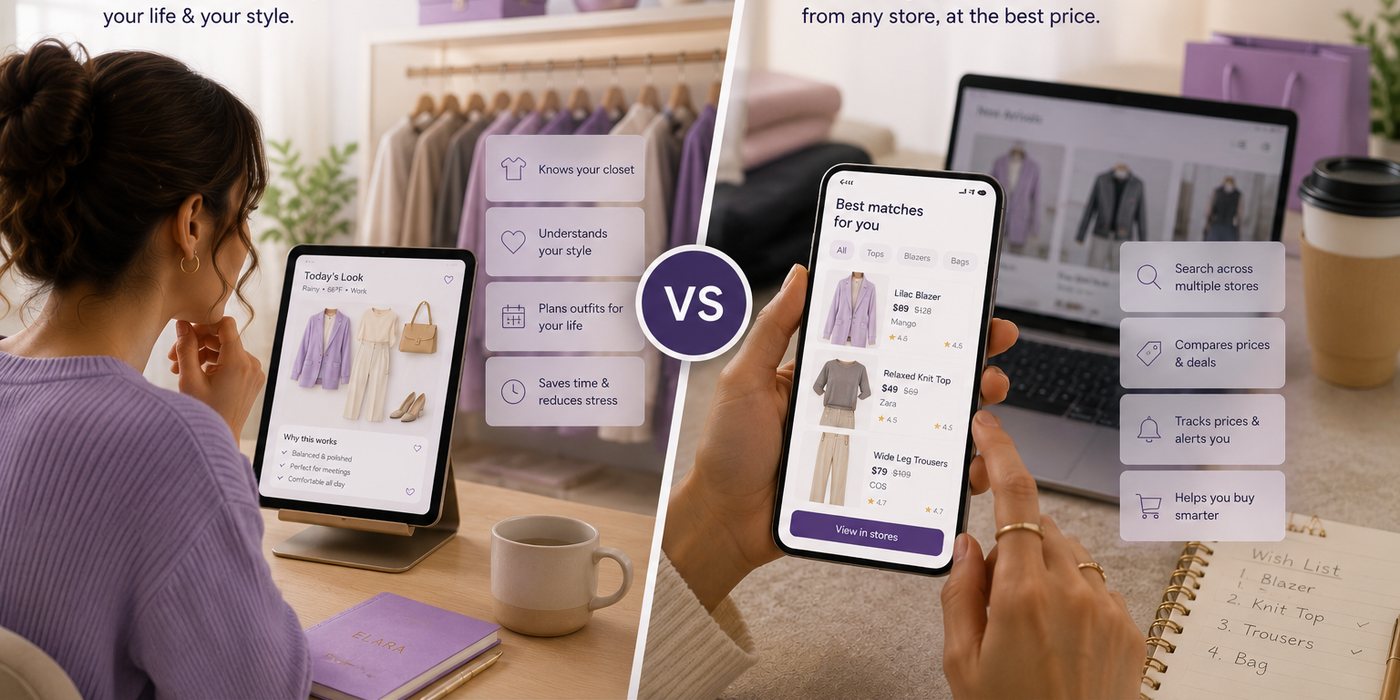
The most likely explanation isn't that consumers distrust AI. It's that most AI shopping tools are solving the wrong problem for the people using them. There are two meaningfully different categories here, and they're routinely conflated. AI shopping assistants are built to find products — they search catalogs, compare prices, surface deals, and move you toward a transaction. AI personal stylists are built to help you decide what to wear — they understand your wardrobe, learn your preferences, and evaluate whether any potential purchase actually fits your style and your life before you buy.
This article isn't a feature list comparison. It's an outcome-based framework: which tool solves which problem, and how to know which one you actually need. One forward-looking signal makes that choice more urgent than it sounds. According to Forbes, these two categories are already merging into what analysts call "fashion agents" — tools that can style an outfit from your closet and handle the missing purchase in a single conversation. The tools best positioned for that future are the ones already built around wardrobe intelligence first.
What Is an AI Shopping Assistant? (And What It's Actually Good At)
An AI shopping assistant is a conversational or agent-based tool designed to help users find and buy products. These tools search retail catalogs, compare prices across merchants, surface deals, and facilitate transactions — typically embedded inside browsers, retail apps, or third-party platforms. The category is substantial: according to Persistence Market Research, the AI shopping assistant market is projected to reach $22.1 billion by 2032, reflecting genuine consumer demand and serious investment from retailers.
The technology is also maturing fast. Data from shopthru.ai shows a 70% improvement in recommendation accuracy for AI shopping agents, meaning the gap between "surfacing random products" and "surfacing relevant ones" is closing meaningfully. For the right use case, these tools deliver real value.
That use case is specific. AI shopping assistants perform best when:
- You already know roughly what you want (a winter coat, white sneakers under $120, a specific brand).
- You want to compare multiple options quickly without opening 14 browser tabs.
- The purchase decision is largely price- and availability-driven.
The limitation is just as specific — and worth naming plainly. A shopping assistant knows what's in the catalog. It has no idea what's in your closet. Ask one for "a blazer for work" and it will surface 12 options ranked by relevance and price. What it cannot tell you is that you already own three navy blazers and your actual wardrobe gap is a warm-toned option that complements your existing pieces. Every recommendation it makes is product-first, context-blind. It can tell you what's available and what it costs. It cannot tell you whether you should buy it, or whether it will actually get worn.
That distinction — product-first vs. wardrobe-first — is the defining axis of the entire comparison.
What Is an AI Personal Stylist? (And Where It Outperforms)
That wardrobe-first distinction is exactly what defines an AI personal stylist as a category. Where shopping assistants start with a product catalog, AI personal stylists start with your closet — digitizing what you own, learning how you dress, and generating outfit recommendations from existing pieces before ever suggesting something new. Any purchase recommendation that follows is filtered through a real understanding of your style, your gaps, and your actual life.
The headline differentiator is measurable: according to fashioninsta.ai, AI personal stylists cut returns by up to 40% through virtual try-ons and wardrobe-aware recommendations. That single number captures the fundamental problem with product-first tools — they recommend without context, so buyers guess, and returns follow. A stylist that knows your wardrobe removes the guesswork before checkout, not after delivery.
The wardrobe-first model carries three compounding advantages. First, it maximizes what you already own — reducing the environmental and financial cost of unnecessary purchases. Second, it prevents duplicate buys and impulse decisions by answering "should I buy this?" against your real closet, not a generic style profile. Third, it builds genuine purchase confidence: when a recommendation comes from a tool that knows you have no warm-toned blazer and three navy ones, you trust it.
Ready to upgrade your wardrobe?
Get the Elara app for AI-powered styling and virtual try-ons.
Elara is built on this exact architecture. Through conversational AI and closet digitization, Elara learns your wardrobe, your preferences, and your context — occasions, weather, mood — and generates outfit suggestions from what you own first. Shopping recommendations surface only where genuine gaps exist, making every suggested purchase defensible rather than speculative. The tagline captures the model precisely: Your AI stylist that actually knows you.
Head-to-Head: Choosing Based on Your Specific Problem
The right tool depends entirely on the problem you're trying to solve. Here's how the two categories perform across five outcomes that actually matter to real users:
1. Finding the best deal on a specific item → AI Shopping Assistant wins. If you know you want white leather sneakers under $120, a shopping assistant is faster, broader, and purpose-built for this. It searches across retailers, compares prices, and surfaces options at scale — the $22.1B market projection from Persistence Market Research reflects exactly this kind of high-frequency, product-specific demand.
2. Figuring out what to wear today → AI Personal Stylist wins. No shopping assistant can answer "what should I wear to this dinner?" because it has no idea what you own. A wardrobe-integrated stylist can — and does it in seconds, drawing from your digitized closet rather than a product catalog.
3. Knowing whether a purchase fits your style before buying → AI Personal Stylist wins. This is the defining capability gap. A shopping assistant surfaces options; it cannot evaluate them against your existing wardrobe. A stylist can tell you that the dress you're considering duplicates three items you already own — or that it fills a genuine gap.
4. Reducing clothing returns → AI Personal Stylist wins. The 40% return reduction from wardrobe-aware recommendations (fashioninsta.ai) is a direct result of context-first buying. Shopping assistants have no equivalent mechanism.
5. Discovering new products across many retailers → AI Shopping Assistant wins. With a reported 70% improvement in recommendation accuracy according to shopthru.ai, AI shopping agents are optimized for product discovery at scale — a genuine strength when you're exploring, not deciding.
The deeper question is why the adoption numbers tell such a different story. According to Capital One Shopping Research, 85% of consumers expressed openness to completing a purchase through a generative AI agent after one use — yet only 8% of GenAI users have actually done it. That 68-point gap is not a UX problem. It's a trust problem. Consumers won't hand purchase decisions to a tool that doesn't know them. AI personal stylists solve this by building wardrobe understanding first, so that when a shopping recommendation arrives, it arrives with context. Trust follows knowledge — and shopping assistants, by design, skip the knowledge step.
The Convergence: Why "Fashion Agents" Are the Future (And What to Do Now)
The distinction between AI personal stylists and AI shopping assistants is already starting to blur. According to Forbes, the emergence of "fashion agents" — agentic tools that combine wardrobe intelligence with transactional shopping capability, handling both the styling decision and the purchase in a single conversation — is reshaping the category.
This convergence is directionally inevitable. Shopping assistants will add styling features. Stylists will add checkout flows. But the architecture underneath each tool determines how well those additions actually work — and wardrobe-first intelligence is significantly harder to retrofit than a payment integration.
Building a shopping assistant that "also styles" requires training on wardrobe context, preference learning, and outfit logic from scratch. Building a stylist that "also shops" requires adding an API connection to retailer catalogs. The asymmetry matters: tools that started with wardrobe understanding have a structural advantage in the fashion agent era, because their foundation is the harder half.
This is precisely why Elara's architecture positions it well for what's coming. Wardrobe digitization, conversational preference learning, and context-aware shopping recommendations are already integrated — not bolted on. That's the fashion agent model, built from the stylist side rather than the shopping side.
For readers making a tool choice now, the implication is practical: adopting a wardrobe-integrated AI today builds a personalization foundation that compounds in value as these tools mature. Every outfit logged, every preference learned, and every purchase evaluated against your closet makes future recommendations more accurate. Starting with a pure shopping assistant means starting over when styling intelligence becomes the baseline expectation — which, based on where the market is heading, is a matter of when, not if.
How to Decide: A Simple Framework for Consumers and Brands
That compounding value argument cuts both ways — it's an argument for choosing the right tool now, not later. The framework below maps specific situations to specific tools, so you don't have to guess.
For individual consumers, three scenarios cover most cases:
- Decision fatigue, closet underuse, or a pattern of returns → Start with an AI personal stylist. If you regularly stand in front of a full wardrobe feeling stuck, or if your return rate is high, the problem is styling context — not product discovery.
- Specific product need with a defined budget → An AI shopping assistant is the right call. You know what you want; you need comparison and price intelligence to get it efficiently.
- You want styling decisions and purchase guidance in one workflow → A wardrobe-first tool with shopping support, like Elara, handles the full cycle without forcing you to switch between tools.
For eCommerce and brand operators, the ROI case is concrete:
AI shopping assistants drive discovery and price-sensitive conversions. AI personal stylists reduce returns — according to fashioninsta.ai, wardrobe-aware AI cuts return rates by up to 40%, a number that merchandising directors and eCommerce managers can take directly to a business case. Wardrobe-integrated tools also enable outfit-driven cross-sell and higher average order value, because recommendations arrive with styling rationale rather than as isolated product pushes.
Not sure which fits your situation? Elara's free trial starts with wardrobe digitization — upload your closet, and see how styling intelligence changes the way you shop.
Frequently Asked Questions
What's the difference between an AI personal stylist and an AI shopping assistant? An AI personal stylist starts with your wardrobe — what you already own — and generates outfit recommendations and shopping advice based on that context. An AI shopping assistant starts with a product catalog and helps you find and compare items. The stylist knows you; the shopping assistant knows products. That knowledge gap explains why stylists cut returns by up to 40% while shopping assistants struggle with adoption.
Can an AI personal stylist replace a human stylist? No — but it solves a different problem. A human stylist offers aesthetic judgment, trend awareness, and emotional support. An AI personal stylist offers instant availability, wardrobe knowledge, and decision confidence based on what you actually own. Think of it as the stylist you can talk to at 6 a.m. when you have nothing to wear, not a replacement for the stylist who helps you rebuild your entire closet.
Do I really need to upload my entire wardrobe? Not all at once. Tools like Elara let you start with a few pieces and build from there. The AI gets smarter as you add more — but you'll see outfit suggestions and shopping guidance even with a partial closet. Many users find that the process itself is eye-opening: seeing what you actually own often reveals patterns you didn't notice.
Which tool should I use if I want both styling advice and shopping help? A wardrobe-integrated AI personal stylist with shopping recommendations, like Elara. These tools handle both — you get outfit suggestions from your closet first, and when a purchase makes sense, you get shopping guidance based on your actual gaps and preferences. This is the "fashion agent" model that's becoming the baseline expectation.
Conclusion: The Right Tool Solves the Right Problem
The distinction that opened this article holds at the end: AI shopping assistants help you find products; AI personal stylists help you decide what to wear — and whether a purchase actually belongs in your life. They solve different problems at different stages of the style journey, and conflating them is why so many AI shopping experiences feel hollow.
The 68-point adoption gap — 76% of consumers wanting AI shopping help versus just 8% completing a purchase through one, according to Capital One Shopping Research — exists because most tools skip the step that builds trust: knowing your wardrobe before recommending to it. Styling context is the missing foundation.
As analysts have noted, that foundation is exactly what the emerging fashion agent era rewards. The tools best positioned for that future are already wardrobe-first. Elara was built on that premise from day one — not as another shopping platform, but as the intelligent layer between you, your wardrobe, and every fashion decision you make. If that's the kind of stylist you've been looking for, joinelara.com is where to start.
Your AI Stylist is Here.
live on the App Store & Google Play
Available on iOS and Android for seamless access anytime, anywhere.