The no-code AI styling widget for Shopify and the dashboard that proves it worked

Most fashion teams don’t have an engineering budget for “nice-to-have” experiences.
They have:
- a merch calendar
- a content schedule
- ad performance pressure
- and a store that needs to convert today
That’s why the Elara for Commerce brief is structured around a practical promise:
Install quickly. Configure without code. Measure impact clearly.
What “installing an AI widget as a Shopify app” actually means
Shopify apps typically operate through permissioned access to store data and event-based syncing. Shopify’s own developer documentation explains that apps request specific API access scopes during authorization.
It also describes webhooks as a way to keep apps in sync with near-real-time events (new products, updates, inventory changes) without constant polling.
The Elara brief mirrors that standard model:
- the brand installs via the Shopify app marketplace
- the app requests read-only access to key objects
- it syncs catalog data and stays updated as inventory and merchandising change
The practical outcome for a marketing or eCommerce manager is simple:
You don’t need to schedule manual uploads or tagging projects.
How Elara turns a raw catalog into a styling catalog
Product catalogs weren’t built for styling. They were built for listing.
A listing might have:
- a title
- a few photos
- a short description
- variants (size/color)
That’s not enough to build outfits consistently.
So Elara’s flow (as described in your brief) starts before any shopper even interacts:
- computer vision extracts visual attributes from images
- natural language processing extracts signals from text (materials, occasion cues, seasonal context)
- products are enriched with many attributes so the system can reason about style compatibility
The idea is straightforward: If your store can understand “linen trouser” vs “structured wool blazer” as different styling building blocks, it can assemble outfits that feel intentional, not random.
What shoppers see and how it stays on-brand
The brief is explicit that Elara is meant to feel like the brand built it.
The brand configures:
- colors
Ready to upgrade your wardrobe?
Get the Elara app for AI-powered styling and virtual try-ons.
- logo
- fonts
- placement (floating button, embedded, or a dedicated Style Assistant page)
The shopper experience is plain-language:
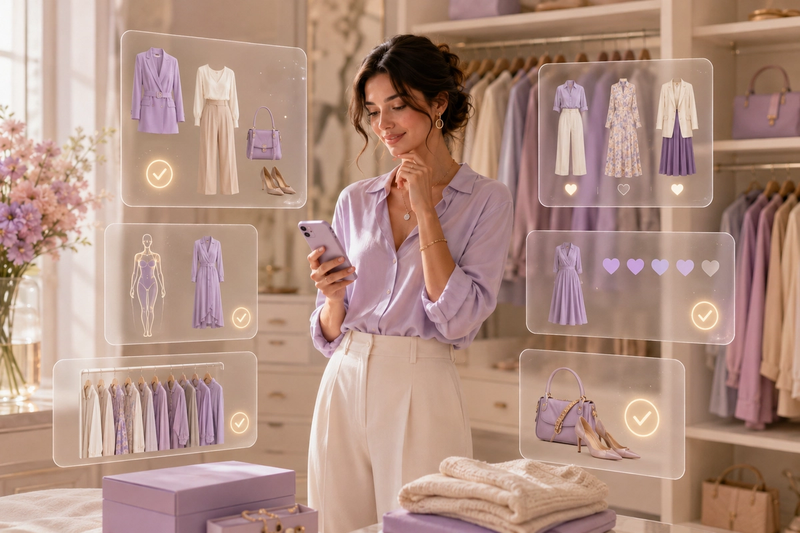
They type what they want, and get complete outfit recommendations, each item clickable to its product page, with multi-turn refinement over the session. This matters because it changes the interface from “find a product” to “get styled.”
The style quiz as a scaling mechanism
The quiz design choice is smart: It’s visual (aesthetics via images rather than long forms).
This reduces friction and increases the chance people actually complete it. And because profiles update based on behavior, the system doesn’t get stuck with a static “one-time quiz label.”
That matters because shoppers often think they like one style and then click another.
Behavior is truth.
The dashboard that keeps the conversation honest
Good merchandising tools don’t just “feel helpful.” They prove their value carefully. The Elara analytics dashboard is designed around:
- widget sessions
- query volume and breakdown (occasion, vibe, budget)
- outfit click-through rate
- outfit-to-cart conversion
- AOV comparison (Elara-assisted vs non-assisted)
- revenue attribution using a conservative session-based methodology (only counts a purchase if the shopper opened the widget, submitted a query, and purchased in that same session)
The conservative attribution choice is especially important in fashion, where shoppers bounce, return, and browse across devices. Overclaiming destroys trust. Undercounting keeps you credible.
Where this fits in the broader market
AI capabilities in fashion are growing quickly. A market research summary for “AI in fashion” estimates $2.47B in 2026 with a 39.8% CAGR through 2030.
But the opportunity isn’t just “AI exists.”
The opportunity is that small and mid-sized fashion brands can now adopt experiences that used to be complicated, expensive, or enterprise-only — without needing a dev roadmap.
The takeaway
If you’re an eCommerce or marketing lead, here’s the real question:
Can you add a genuine styling experience to your store without adding operational burden?
Elara’s brief says yes — by combining:
- a Shopify-native install model (permissions + syncing)
- catalog enrichment that removes manual tagging
- white-labeled styling surfaces across the store
- and analytics that attribute impact conservatively
That’s what makes it more than “another widget.” It’s a layer that turns your catalog into outfits — and turns browsing into buying.
Schedule a Demo now: https://calendar.app.google/BwDfg9owmrDSRgfj7
Your AI Stylist is Here.
live on the App Store & Google Play
Available on iOS and Android for seamless access anytime, anywhere.