

Navratri 2026 Outfit Guide: 9 Looks, 4 Pieces
Navratri 2026 outfit guide: nine nights, nine colors, nine looks. Skip the shopping spiral. Learn the jewelry-to-color rule and mix-and-match formula to create nine distinct outfits from just 3–4 base pieces.
 Mehul AgarwalFounder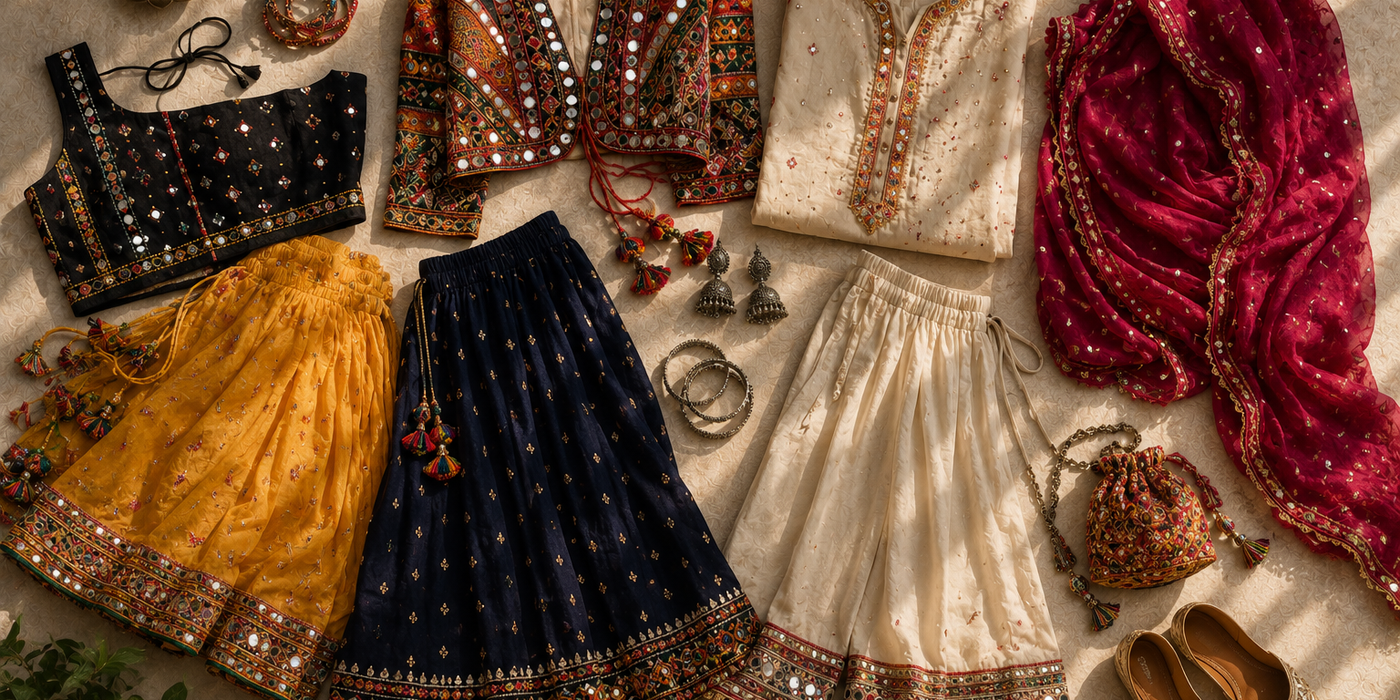
Navratri 2026 outfit guide: mix-and-match formula
Table of Contents
- Key Takeaways
- Introduction: Nine Nights, One Closet
- The 2026 Navratri Color Sequence, Decoded
- The Mix-and-Match Formula: Nine Looks from Four Pieces
- The Jewelry-to-Color Rule That Changes Everything
- Your 9-Night Style Map (Day-by-Day Plan)
- Beating Decision Fatigue: The Psychological Case for Pre-Planning
- FAQ: Your Navratri 2026 Outfit Questions Answered
- TL;DR: Your Navratri 2026 Action Plan
- Style Smart, Not More
Navratri 2026 Outfit Guide: Nine Nights, Nine Colors, Nine Looks (and How to Not Repeat Yourself)
Key Takeaways
- Chaitra Navratri 2026 runs March 19–27, with nine colors in sequence: Yellow, Green, Grey, Orange, White, Red, Royal Blue, Pink, Purple
- You need just 3–4 base pieces + 6 interchangeable accents to produce nine visually distinct looks — no nine new outfits required
- Match jewelry by color family: gold for warm tones, silver for cool tones, pearls for white/ivory
- The real problem this guide solves is decision fatigue, not a shortage of clothes
Introduction: Nine Nights, One Closet
Navratri is one of India's most joyful festivals — and one of its most quietly stressful, at least from a wardrobe perspective. Nine nights of celebration, each with its own prescribed color, creates a specific kind of pressure: the fear of showing up in the wrong shade, looking like you're repeating yourself, or quietly overspending on outfits you'll wear once. That tension is real, and it's more common than anyone admits.
Chaitra Navratri 2026 runs from March 19 to March 27, which means the planning window is now. The good news is that the solution is far simpler than most guides suggest. According to styling advice from OutfeVibe and Barkha Boutique, you don't need nine separate outfits — a capsule of just 3–4 solid base pieces, rotated with interchangeable accents, produces nine looks that feel genuinely distinct.
This guide solves two specific problems: first, which color belongs to which night; second, how to look different each night without treating Navratri like a nine-day shopping event. By the end, you'll have a complete, actionable style map built largely from pieces you already own.
The 2026 Navratri Color Sequence, Decoded
Each night of Navratri is associated with a specific color, traditionally linked to the nine forms of Goddess Durga worshipped across the festival. Wearing the day's color is a form of devotion as much as a style choice — which is why getting the sequence right matters.
The 2026 color order is confirmed across multiple credible sources, including the Times of India, India Today, and AnyTimeAstro. The sequence runs: Yellow on March 19, Green on March 20, Grey on March 21, Orange on March 22, White on March 23, Red on March 24, Royal Blue on March 25, Pink on March 26, and Purple on March 27.
Once you see all nine colors together, a useful pattern emerges. Group them into two families and the rest of your styling decisions — particularly around jewelry — become almost automatic. The warm family covers Yellow (Day 1), Orange (Day 4), Red (Day 6), and Pink (Day 8). The cool and neutral family covers Green (Day 2), Grey (Day 3), White (Day 5), Royal Blue (Day 7), and Purple (Day 9).
This grouping isn't arbitrary. Warm and cool colors respond differently to metal tones, fabric textures, and makeup choices — and understanding which family each night belongs to is the foundation of the mix-and-match formula that follows.
The Mix-and-Match Formula: Nine Looks from Four Pieces
That warm/cool grouping does more than organize a color wheel — it's the structural logic behind a capsule wardrobe strategy that eliminates the "I need nine new outfits" spiral entirely.
The formula, popularized by festive styling advisors at Barkha Boutique and OutfeVibe, works on three tiers: one statement outfit (held in reserve for a peak night), two neutral base pieces in white, grey, or beige, and six interchangeable accents — dupattas, earrings, bangles, bindi, belt, and hair accessories. According to OutfeVibe's 2025 capsule dressing guide, buying 3–4 solid base pieces and rotating them with different dupattas, blouses, and jewelry produces nine visually distinct looks without a single repeated combination.
The silhouettes that make this rotation easiest are chaniya choli separates, anarkalis, kurti-palazzo sets, and co-ord sets — all designed as mix-and-match systems, not fixed ensembles. A lehenga skirt worn with three different blouses and dupattas is technically three outfits. Most wardrobes already contain the raw material.
Here's a concrete example: on Day 3 (Grey night), style a white anarkali base with a charcoal grey dupatta, silver jhumkas, and a sleek low bun. On Day 5 (White night), wear the exact same anarkali with a white organza dupatta, pearl studs, and a floral braid. Same garment. Completely different look. No one in the crowd will register the repeat — because the visual story is told by the accessories, not the base.
This is the psychological shift that makes the whole system work. The anxiety of "repeating yourself" rests on the assumption that the garment is the outfit. It isn't. Accessories shape how an outfit reads — a fresh dupatta and earring set transforms a look entirely. Swapping these details doesn't just refresh a silhouette; it replaces the visual impact.
The Jewelry-to-Color Rule That Changes Everything
Most Navratri guides list what to wear. Almost none explain which metal to pair with which night — and that omission is where looks fall flat. The fix is a simple three-tier rule drawn from jewelry stylist Rashika Mittal's color-matching framework:
- Gold jewelry → warm color nights: Yellow (Day 1), Orange (Day 4), Red (Day 6), Pink (Day 8)
- Silver jewelry → cool color nights: Grey (Day 3), Royal Blue (Day 7)
- Pearls or minimalist accents → White (Day 5) and soft ivory tones
- Oxidized or mixed-metal statement pieces → Green (Day 2), Purple (Day 9) for an editorial, high-contrast finish
The visual logic is straightforward: warm metals amplify the warm undertones already present in yellow, orange, red, and pink fabrics, making the color read richer. Cool metals create contrast against grey and blue, making those cooler tones pop rather than flatten.
Practical fallback for gold-only jewelry owners:
- Lean into your four warm-color nights (Days 1, 4, 6, 8) for your boldest, most layered jewelry moments.
- On cool-color nights, go minimal — a single delicate chain or small stud reads as intentional restraint, not a mismatch.
- Avoid stacking gold on Grey or Royal Blue nights; the undertone conflict dulls both the metal and the fabric.
"Matching your metal to your color family isn't a fashion rule — it's a physics rule. Warm reflects warm; cool contrasts cool." — Rashika Mittal, jewelry and festive styling consultant
Your 9-Night Style Map (Day-by-Day Plan)
This is a planning tool, not a shopping list. The majority of pieces below can be sourced from what you already own — the goal is to arrange them intentionally before Day 1, not to replace them.
According to the color sequence confirmed across Times of India, India Today, and AnyTimeAstro for Chaitra Navratri 2026 (March 19–27), here is a complete night-by-night formula:
Day 1 — March 19 — Yellow. A kurti-palazzo set works beautifully here. Pair with gold jhumkas, a marigold dupatta, and a bold bindi to set the tone for the full nine nights.
Day 2 — March 20 — Green. An anarkali or chaniya choli in green, styled with oxidized silver jewelry and a floral hair accessory. The oxidized metal on green reads editorial — high contrast without being heavy.

Want this styled from your own closet?
Elara builds the look from what you own, then lets you try it on.
Day 3 — March 21 — Grey. This is a neutral base night. Use a white or grey base piece and carry the color entirely through a grey dupatta and silver earrings. A sleek bun completes it and keeps the look intentional rather than minimal-by-default.
Day 4 — March 22 — Orange. A co-ord set or lehenga, gold bangles stacked, and a bold contrast bindi. Orange is one of the warmest nights — let the metal do the work.
Day 5 — March 23 — White. White anarkali, pearl studs, a white organza dupatta, and minimal makeup. This night rewards restraint. Everything is the same color family — the interest comes from texture differences between the garments, not contrast.
Day 6 — March 24 — Red. This is your showstopper night. Red sits at the energy peak of the nine nights. Bring out your one statement chaniya choli, your most dramatic gold choker, and a classic red bindi. If you've been holding one piece in reserve, this is the night for it.
Day 7 — March 25 — Royal Blue. A lehenga skirt with a white base blouse, silver jhumkas, and a blue bindi. Keep neck jewelry minimal — the depth of royal blue doesn't need layering to make an impact.
Day 8 — March 26 — Pink. Return to a neutral base piece and carry the pink through a dupatta. Rose gold or gold earrings bridge the warm-metal logic, and a floral braid adds texture without adding more color.
Day 9 — March 27 — Purple. Close the nine nights with something deliberate: a co-ord set or a purple dupatta accent over a neutral base, oxidized or mixed-metal jewelry, a bold lip, and minimal accessories. Purple on the final night reads as intentional closure rather than a random color assignment — and the editorial jewelry choice makes it memorable.
Day 6 (Red) and Day 9 (Purple) are the two natural showstopper slots. Red is the mid-festival peak; Purple is the closing statement. If you have two statement pieces, assign one to each. If you have one, Red is the stronger choice for pure visual impact in a crowd.
Days 3 and 5 — Grey and White — are your neutral base nights and the foundation of the whole system. These are the two nights where the base-piece strategy does its heaviest lifting, and they're also the easiest to dress up or down depending on how much energy you have mid-festival.
An AI stylist like Elara can map this exact plan to the specific pieces already in your wardrobe, flagging which nights you're already covered for and where a single dupatta purchase would complete the set — without guesswork.
Beating Decision Fatigue: The Psychological Case for Pre-Planning
That day-by-day map only works if you actually use it — and the biggest threat to execution isn't a missing dupatta, it's the mental load of making nine consecutive style decisions under social pressure with no system in place.
This is worth naming plainly: decision fatigue during Navratri is not a personal failing. Nine nights of celebration, each with its own color requirement and an implicit audience judging whether you're "repeating yourself," is a genuinely exhausting cognitive load. The solution isn't more willpower — it's removing the decisions before Day 1 begins.
Here's the reassuring part: when you shift accessories, jewelry, hairstyle, and makeup, the overall look transforms even if the base garment stays the same. Barkha Boutique's nine-look formula makes the same point structurally — six interchangeable accents create six perceptually distinct outfits even when the underlying garment stays constant. What your guests see is the visual story, not the inventory tag.
Three habits make this work in practice:
- Lay out all nine accent pieces before Day 1. Arrange your dupattas, earring sets, bangles, and bindis together so you can see the full plan at a glance — and spot any gaps before the festival starts, not at 7 a.m. on Day 4.
- Photograph each night's look. A quick mirror photo gives you an instant reference log, eliminates the "did I wear these earrings already?" spiral, and doubles as content if you're sharing on social.
- Batch your hair and makeup decisions with your outfit plan now. Assign a hairstyle and a makeup emphasis (bold lip, smoky eye, minimal glow) to each night so no single element — not even a bun — repeats across nights.
This pre-planning logic is precisely how Elara approaches your wardrobe: mapping what you already own to every occasion so you never face a blank-closet moment at the worst possible time.
FAQ: Your Navratri 2026 Outfit Questions Answered
Q: What if I don't own all the base pieces listed in the day-by-day plan?
A: You don't need to. Start with one neutral base piece you already own — a white or grey anarkali, kurti, or lehenga skirt — and commit to rotating it across at least three nights. Swap the dupatta, jewelry, and hair styling between each wear. This single piece becomes three distinct looks. Add a second neutral base if you want to avoid back-to-back repeats. Most people find this covers six of the nine nights comfortably.
Q: Can I wear the same outfit twice if I change my jewelry and dupatta?
A: Yes. This is the entire principle behind the capsule formula. What matters visually is the final assembled look — the color story told by your dupatta, jewelry, bindi, and styling choices. Your guests see the complete picture, not individual pieces. Barkha Boutique's research confirms that swapping these accents creates a perceptually fresh outfit even when the base garment repeats.
Q: What if I only own silver jewelry, not gold?
A: Wear silver on the cool-color nights (Days 2, 3, 5, 7, 9) without hesitation — those are the nights silver shines. On warm-color nights (Days 1, 4, 6, 8), go minimal: a single delicate chain, small studs, or no neck jewelry at all. Minimize the number of pieces rather than trying to force a warm-metal look. Restraint reads as intentional, not as a shortage.
Q: When should I start shopping for Navratri pieces?
A: Now. Lay out your existing wardrobe against the nine-night plan and identify the gaps. Most people find they need one or two dupatta additions, not nine new outfits. Shopping for one or two specific pieces — a grey dupatta, a white organza dupatta, or a statement blouse for Day 6 — is far less overwhelming than open-ended Navratri shopping. Elara can scan your closet and tell you exactly which pieces would complete the plan with minimal new purchases.
Q: Is it okay to wear pants or Western clothing for Navratri?
A: Navratri is a celebration of tradition, and the color sequence is the core of that tradition. If you prefer Western silhouettes, honor the color requirement — wear a yellow outfit on Day 1, a green on Day 2, and so on. The color matters more than the garment type. That said, if you have the option to wear traditional silhouettes, they're designed for the exact mix-and-match logic this guide outlines, so you'll get more mileage from fewer pieces.
TL;DR: Your Navratri 2026 Action Plan
Before Day 1 (March 19):
- Confirm the color sequence: Yellow → Green → Grey → Orange → White → Red → Royal Blue → Pink → Purple
- Audit your closet for 3–4 neutral base pieces (white, grey, or beige anarkalis, lehengas, or kurti-palazzo sets)
- Gather 6 dupattas that match the color families (warm dupattas for Days 1, 4, 6, 8; cool dupattas for Days 2, 3, 5, 7, 9)
- Assign jewelry and hairstyles to each night using the gold/silver rule
- Identify the one gap piece that would complete your plan (usually a single dupatta) and buy it if needed
Days 1–9 (March 19–27):
- Follow the day-by-day map in the table above
- Use the same base piece across multiple nights — the accessories tell the story, not the garment
- Photograph each night's complete look so you have a reference log
After Navratri:
- You've just proven that you can create nine distinct looks from 3–4 base pieces. Apply this principle year-round using Elara, which maps your existing wardrobe to every occasion and tells you exactly which new pieces unlock the most outfit combinations.
Style Smart, Not More
Nine nights of Navratri don't require nine new outfits, nine shopping trips, or nine moments of panic. They require three things: a clear color sequence to follow (Yellow through Purple, March 19–27), a jewelry rule that does the heavy lifting on coordination (gold for warm tones, silver for cool, pearls for white), and a 9-night map built from three or four base pieces rotated through six interchangeable accents.
The goal was never a perfect haul. It was a confident outfit every single night, built from what you already own — and the knowledge that looking different doesn't mean owning more.
If you want to apply this logic to your actual wardrobe rather than a hypothetical one, Elara can map your existing pieces to the full nine-night plan — showing you what you're already covered for and where one smart addition completes the picture. Explore it at joinelara.com.
Your stylist, in your pocket
Stop reading about outfits. Start wearing them.
Elara knows your closet, shops every store and gets you dressed for any occasion.